Kafka, FranzBiblio.com

3.185 Ergebnisse
1997Best.-Nr. SBBIH-3SZSSW7GAXAPMartin Secker & Warburg Ltd 1997. paperback. Acceptable. Please see the condition note after this for details if this is missing please consider Acceptable to mean poor quality that could include major staining water damage writing missing dustjacket etc etc. Our books are dispatched from a Yorkshire former cotton mill. We list via barcode/ISBN so please note that the images are stock images and may not be the exact copy you receive furthermore the details about edition and year might not be accurate as many publishers reuse the same ISBN for multiple editions and as we simply scan a barcode or enter an ISBN we do not check the validity of the edition data when listing. If you're looking for an exact edition please don't order at least not without checking with us first although we don't always have time to check. We aim to dispatch prompty the service used will depend on order value and book size. We can ship to most countries see our shipping policies. Payment is via Abe only. Martin Secker & Warburg Ltd paperback
1948Best.-Nr. 14925Paris, Presses du livre français, 1948. Grand in-8 broché de 28-[4] pages, couvertures à rabats, illustré d'une composition de Wols imprimée en gris clair.
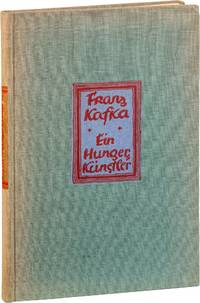
1924Best.-Nr. 1145Berlin: Verlag die Schmiede 1924. First Edition. in German The last collection of short stories to be finished before Kafka’s death though it was published posthumously. Original green cloth it was also published in paper boards spine and extremities faded front hinge starting but holding strong near fine. The title story was published 2 years earlier in Die Neue Rundschau magazine the other three appeared for the first time in this book. The four stories comprising Kafka's final collection "Ein Hungerkünstler" are a culmination of his literary preoccupations with artistic alienation and the futility of human endeavor. Reading these stories it is easy to see how they form a cohesive thematic quartet despite their disparate subjects each examining the relationship between the exceptional individual and an indifferent community. In "Josefine die Sängerin oder Das Volk der Mäuse" perhaps the most enigmatic of the four tales Kafka constructs a complex allegory of artistic exceptionalism through the figure of Josephine a mouse whose singing—which the narrator suggests may be nothing more than ordinary squeaking—commands unusual attention from her mouse community. The narrative's persistent ambiguity regarding the actual quality of Josephine's art creates a tension between the performer's self-perception and the community's response foregrounding questions about the social function of art. Unlike the hunger artist whose talent is measurable through his capacity to endure prolonged fasting Josephine's artistry remains fundamentally unverifiable existing primarily through collective acknowledgment rather than objective criteria. This unstable ontological status of the artistic performance destabilizes conventional hierarchies between artist and audience suggesting that artistic value emerges not from inherent qualities but from the complex social negotiations between performer and community. The story's final movement documenting Josephine's disappearance and rapid forgetting by her community offers Kafka's most poignant commentary on artistic legacy—the once-celebrated performer vanishes "like a legend dissolving into the ordinary" leaving no trace of her supposedly transformative art. Verlag die Schmiede unknown
1924Best.-Nr. 1145Berlin: Verlag die Schmiede 1924. First Edition. in German The last collection of short stories to be finished before Kafka’s death though it was published posthumously. Original green cloth it was also published in paper boards spine and extremities faded front hinge starting but holding strong near fine. The title story was published 2 years earlier in Die Neue Rundschau magazine the other three appeared for the first time in this book. The four stories comprising Kafka's final collection "Ein Hungerkünstler" are a culmination of his literary preoccupations with artistic alienation and the futility of human endeavor. Reading these stories it is easy to see how they form a cohesive thematic quartet despite their disparate subjects each examining the relationship between the exceptional individual and an indifferent community. In "Josefine die Sängerin oder Das Volk der Mäuse" perhaps the most enigmatic of the four tales Kafka constructs a complex allegory of artistic exceptionalism through the figure of Josephine a mouse whose singing—which the narrator suggests may be nothing more than ordinary squeaking—commands unusual attention from her mouse community. The narrative's persistent ambiguity regarding the actual quality of Josephine's art creates a tension between the performer's self-perception and the community's response foregrounding questions about the social function of art. Unlike the hunger artist whose talent is measurable through his capacity to endure prolonged fasting Josephine's artistry remains fundamentally unverifiable existing primarily through collective acknowledgment rather than objective criteria. This unstable ontological status of the artistic performance destabilizes conventional hierarchies between artist and audience suggesting that artistic value emerges not from inherent qualities but from the complex social negotiations between performer and community. The story's final movement documenting Josephine's disappearance and rapid forgetting by her community offers Kafka's most poignant commentary on artistic legacy—the once-celebrated performer vanishes "like a legend dissolving into the ordinary" leaving no trace of her supposedly transformative art. Verlag die Schmiede unknown books
1929Best.-Nr. 3537Prag 1929. In original portfolio pages loose. In original portfolio pages loose. Includes four short stories from Ein Landarzt translated from German by P. Pastor and Ludvík Vrána: Na galerii Auf der Galerie - In the Gallery Šakalové a Arabi Schakale und Araber - Jackals and Arabs Bratrovražda Ein Brudermord - A Fratricide Starý list Ein altes Blatt - An Old Page Illustrated with 6 plates outside the text on loose-leaf black pages. Archy Ark was a series edited by the Czech writer translator and publisher Josef Florian 1873–1941 published between 1926 and 1948. The present 12th issue includes writings from Louis Massignon 1883–1962 Miguel de Unamuno y Jugo 1864–1936 and W. B. Yeats 1865–1939 . unknown
Best.-Nr. 53753Del Mar California Ettan Press 1975. 4° 14 Bl. 5 Orig.-Radierungen. Lose Bogen Bütten in Umschlag in Kork-Mappe. Tadell. Nr. 84/93. Mit 5 handschriftlich nummerierten u. signierten Radierungen von Paul Eliasberg gedruckt von Eugene Schiller und Rod Ligren auf Rives Bütten. Der Text wurde in Garamond handgesetzt und bei H. Kätelhön in Möhnesee-Wamel gedruckt. Buchbinderarbeit von H. Halbach in Königstein i. T. - Mit einem Vorwort von Edouard Roditi. 010 Del Mar, California, Ettan Press, 1975 unknown
2009Best.-Nr. 232381993 - 2009. Edition Graphischer Zirkel, Wien. Mit Illustrationen. Original-Edel-Pappbände im IB-Format.
1933Best.-Nr. 91146Gallimard | Paris 1933 | 11.8 x 18.6 cm | Broché
1946Best.-Nr. 43412Paris Maeght Editeur 1946 In-4, en feuilles, couverture illustre. Chemise, tui.Edition originale de cette traduction, illustre par Atlan de 16 lithographies originales dont une sur la couverture, un frontispice, 7 hors-texte et 7 in-texte. Tirage limit 350 exemplaires numrots. Un des 300 exemplaires sur vlin.
1937Best.-Nr. 7389The Trial by Franz Kafka stated first American edition first printing hardcover Publisher: Alfred A. Knopf 1937 Condition: Good - scuff mark on the bottom of the spine wrinkle and some fading of the front cover owner's label and blind stamp on the front end paper tight binding no other writings Alfred A. Knopf hardcover
1946Best.-Nr. 311085Paris: Maeght 1946. Limited. paperback. fine. Atlan. Lithographies Originales par Atlan. Traduction de Clara Malraux et Rainer Dorland. Preface de Bernard Groethuysen. 8 full page lithographs plus head & tail pieces. Pictorial wrappers. Folio leaves in loose quires as issued within board folder & slipcase. Paris: Maeght Editeur 1946. Fine. Number XXVI of only 50 copies printed on Auvergne bottom & fore-edges uncut. Maeght unknown
Best.-Nr. 20278Limited Editions Club. Fine. Hardcover. Signed by the illustrator. Limited edition of 1500 copies this being copy #869. Quarter grey leather cover with taupe patterned boards is rubbed on both front corners and sunned on spine else fine. Boards and spine are straight. Binding is tight. Pages are clean and pristine. Slipcase is has light scuffing to bottom panel and in near fine condition.; Signed by Illustrator . 1984. Limited Editions Club hardcover
1937Best.-Nr. 140948199New York: Alfred A. Knopf 1937. First American Edition. Near Fine. First American edition stated first printing. ix 297 1 pp. illustrated throughout by Georg Salter. Bound in publisher's rust-colored cloth over flexible boards with pictorial stamping in blue and black blue topstain; lacking the dust jacket. Near Fine with lean to binding light wear and soiling to cloth soft crease to front board and foxing to upper edge of textblock. Offsetting to endpapers owner signature to front free endpaper. A much nicer copy than normally encountered. A nice copy of Kafka's darkest work a posthumously published novel about a man arrested on undefined charges with no hope of redemption or acquittal. Translated by Willa and Edwin Muir who introduced Kafka's works to the English-speaking world. Alfred A. Knopf unknown
1955Best.-Nr. 593122New York: Alfred A. Knopf 1955. Hardcover. Near Fine. Eleventh printing. Translated by Willa and Edwin Muir. Illustrated by George Salter. Near fine lacking the dust jacket. Inscribed by John Berryman to the wife of fellow poet Donald Justice Jean Ross Justice: "To Jean to read up! John / Wpk. 13 Oct 56. Alfred A. Knopf hardcover
1946Best.-Nr. 311085Paris: Maeght 1946. Limited. paperback. fine. Atlan. Lithographies Originales par Atlan. Traduction de Clara Malraux et Rainer Dorland. Preface de Bernard Groethuysen. 8 full page lithographs plus head & tail pieces. Pictorial wrappers. Folio leaves in loose quires as issued within board folder & slipcase. Paris: Maeght Editeur 1946. Fine. Number XXVI of only 50 copies printed on Auvergne bottom & fore-edges uncut. Maeght unknown books
1955Best.-Nr. 593122New York: Alfred A. Knopf 1955. Hardcover. Near Fine. Eleventh printing. Translated by Willa and Edwin Muir. Illustrated by George Salter. Near fine lacking the dust jacket. Inscribed by John Berryman to the wife of fellow poet Donald Justice Jean Ross Justice: "To Jean to read up! John / Wpk. 13 Oct 56. Alfred A. Knopf hardcover books
1937Best.-Nr. 140948199New York: Alfred A. Knopf 1937. First American Edition. Near Fine. First American edition stated first printing. ix 297 1 pp. illustrated throughout by Georg Salter. Bound in publisher's rust-colored cloth over flexible boards with pictorial stamping in blue and black blue topstain; lacking the dust jacket. Near Fine with lean to binding light wear and soiling to cloth soft crease to front board and foxing to upper edge of textblock. Offsetting to endpapers owner signature to front free endpaper. A much nicer copy than normally encountered. A nice copy of Kafka's darkest work a posthumously published novel about a man arrested on undefined charges with no hope of redemption or acquittal. Translated by Willa and Edwin Muir who introduced Kafka's works to the English-speaking world. Alfred A. Knopf unknown books
1946Best.-Nr. IATsc& A68Paris: Maeght 1946. 1946. 4to. pp. 80 1 1 leaf. with half-title. title in red & black. original lithographs by Atlan 8 full-page incl. frontis. loose quires as issued in original illus. wrs. attractive etched bookplate of Günther Lambers. First Edition of the French Translation. Limited to 350 numbered copies this one of 300 on 'papier vélin'. F. [Paris]: Maeght, [1946]. unknown
1933Best.-Nr. 91146Paris: Gallimard 1933. Fine. Gallimard Paris 1933 11.8 x 18.6 cm Broché First edition of the French translation prepared by Alexandre Vialatte one of the complimentary copies.A manuscript ex-dono erased in the upper right corner of the half-title page resulting in a small loss of paper.Signed autograph inscription by Alexandre Vialatte to Albert Thibaudet. Gallimard unknown
1981Best.-Nr. 43842Paris: Gallimard 1981. Fine. Gallimard Paris 1981 11 x 18 cm broché The first edition published only in paperback format of which there were no deluxe copies one of the Service de Presse advance copies. Moving and precious signed autograph inscription from Maurice Blanchot to his sister Marguerite on a card mounted on the first endpaper: ""Chère Marg ce livre qui n'est pas un livre mais qui te dit en ces jours si sombres ma fidèle ma profonde affection. Maurice."" ""Dear Marg this book which is not a book but which tells you in these dark days my faithful one my deep affection. Maurice."" Envelope bearing Marguerite Blanchot's address written by her brother Maurice mounted on the half-title page. Marguerite Blanchot renowned organist at the cathedral of Chalon remained all her life in the family home with her mother and aunt. ""She gradually became for the family like the memory of origins."" Very close to Maurice she corresponded regularly with the writer who showed her great gratitude for her devotion to their invalid mother. While Blanchot's intense affection for his mother and sister shows through in his dedications we know almost nothing of their relationship. In the only biographical essay on Blanchot Christophe Bident reveals however: ""Marguerite Blanchot venerated her brother Maurice. Very proud of him . she attached great importance to his political ideas . She read a great deal . They telephoned each other corresponded. At a distance they shared the same natural authority the same concern for discretion."" Blanchot indeed sent her numerous works from his library maintaining with her a continuous intellectual bond. A marginal crease at foot of first cover. Handsome copy. Gallimard paperback
1940Best.-Nr. 2698Norfolk: New Directions 1940. In original cloth. In fine condition. In original cloth. 299 p. From Robert Klopstock's collection. Robert Klopstock who was in the years 1920-1924 a friend Franz Kafka. Professor Klopstock was of Hungarian origin and he got acquainted with Franz Kafka at the end of the year 1920 in Tatranske Matliare The High Tatras. They were both patients treated for lung tuberculosis. They became close friends and their mutual correspondence shows their real friendship. Robert Klopstock was present at Franz Kafka's death-bed on June 3 1924 Klopstock was forced into emigration in 1938 and became a U.S. citizen in 1945. New Directions unknown
1948Best.-Nr. 2699New York: Schocken 1948. In original cloth with original dust-jacket. Jacket with small missings inside fine condition. In original cloth with original dust-jacket. 345 p. From Robert Klopstock's collection. Robert Klopstock who was in the years 1920-1924 a friend Franz Kafka. Professor Klopstock was of Hungarian origin and he got acquainted with Franz Kafka at the end of the year 1920 in Tatranske Matliare The High Tatras. They were both patients treated for lung tuberculosis. They became close friends and their mutual correspondence shows their real friendship. Robert Klopstock was present at Franz Kafka's death-bed on June 3 1924 Klopstock was forced into emigration in 1938 and became a U.S. citizen in 1945. Schocken unknown
1947Best.-Nr. 2696New York: Shocken 1947. In original cloth with the dust jacket. The jacket in very good conditon inside fine. In original cloth with the dust jacket. From Robert Klopstock's collection. Robert Klopstock who was in the years 1920-1924 a friend Franz Kafka. Professor Klopstock was of Hungarian origin and he got acquainted with Franz Kafka at the end of the year 1920 in Tatranske Matliare The High Tatras. They were both patients treated for lung tuberculosis. They became close friends and their mutual correspondence shows their real friendship. Robert Klopstock was present at Franz Kafka's death-bed on June 3 1924 Klopstock was forced into emigration in 1938 and became a U.S. citizen in 1945. Shocken unknown
1946Best.-Nr. 2697New York: Knopf 1946. In original cloth. In very good condition. In original cloth. 339 p. From Robert Klopstock's collection. Robert Klopstock who was in the years 1920-1924 a friend Franz Kafka. Professor Klopstock was of Hungarian origin and he got acquainted with Franz Kafka at the end of the year 1920 in Tatranske Matliare The High Tatras. They were both patients treated for lung tuberculosis. They became close friends and their mutual correspondence shows their real friendship. Robert Klopstock was present at Franz Kafka's death-bed on June 3 1924 Klopstock was forced into emigration in 1938 and became a U.S. citizen in 1945. Knopf unknown
1915Best.-Nr. 126202Leipzig, Verlag der Weißen Blätter 1915. * Mit Illustrationen von Rudolf Großmann, Ludwig Meidner, Max Oppenheimer, Richard Seewald, Ernst Stern, Ines Wetzel u. a. IV, IV, 1510 Seiten. 22 x 16 cm. Original-Halbpergamentbände (etwas fleckig) mit Rücken- und Deckeltiteln. [2 Warenabbildungen]