Kafka, FranzBiblio.com
3.228 resultados
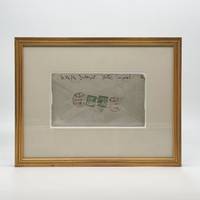
1917ref. 371699Budapest 1917. 1 vols. 4-1/8 x 7-1/8 inches. Matted in double glazed frame. Fine. 1 vols. 4-1/8 x 7-1/8 inches. Envelope sent Express from Budapest to Rudolf Fuchs by author Franz Kafka who was writing from the Hotel Imperial Budapest. Signed in the third person Dr. Kafka on the back flap. Rudolf Fuchs 1890-1942 poet and social critic was a member of Kafka's literary circle in Prague. He knew Kafka since 1912. In an article in Zeitschrift für Germanistik scholar Ilse Seehase discusses three wartime communications from Kafka to Fuchs. The second of these dated 14 July 1917 was "probably" written in Budapest and looked ahead to a meeting in Vienna Seehase p. 179. This autograph envelope postmarked 14 July confirms that Kafka was indeed in Budapest when he wrote Fuchs: he had just become engaged for the second time to Felice Bauer. On 16 July 1917 Kafka held a conversation with Otto Groß Anton Kuh and Rudolf Fuchs at a café in Vienna. In August of that year Kafka was diagnosed with the tuberculosis that would later kill him. Fuchs published an early obituary of Kafka on 4 June 1924. Fuchs described the effect of his writing: "He perceived as no other the romance of the quotidian and the poetry of familiar things. The effect of just one of his short observations is magical. As in a dream a dense realistic dream. All that he puts into words is so vital and yet an experience one hasn't seen before and even his simple phrasing has the grace of utter strangeness." Fuchs escaped the Nazis to London where he composed his Erinnerungen an Franz Kafka. A posthumous collection Ein wissender Soldat. Gedichte und Schriften aus dem Nachlass von Rudolf Fuchs was published there in 1943. Kafka autograph material is rare. Cf. Ilse Seehase Drei Mitteilungen Kafkas und ihr Umfeld pp. 178-83 in: Zeitschrift für Germanistik 8:2 1987 unknown
1917ref. 371699Budapest 1917. 1 vols. 4-1/8 x 7-1/8 inches. Matted in double glazed frame. Fine. 1 vols. 4-1/8 x 7-1/8 inches. Envelope sent Express from Budapest to Rudolf Fuchs by author Franz Kafka who was writing from the Hotel Imperial Budapest. Signed in the third person Dr. Kafka on the back flap. Rudolf Fuchs 1890-1942 poet and social critic was a member of Kafka's literary circle in Prague. He knew Kafka since 1912. In an article in Zeitschrift für Germanistik scholar Ilse Seehase discusses three wartime communications from Kafka to Fuchs. The second of these dated 14 July 1917 was "probably" written in Budapest and looked ahead to a meeting in Vienna Seehase p. 179. This autograph envelope postmarked 14 July confirms that Kafka was indeed in Budapest when he wrote Fuchs: he had just become engaged for the second time to Felice Bauer. On 16 July 1917 Kafka held a conversation with Otto Groß Anton Kuh and Rudolf Fuchs at a café in Vienna. In August of that year Kafka was diagnosed with the tuberculosis that would later kill him. Fuchs published an early obituary of Kafka on 4 June 1924. Fuchs described the effect of his writing: "He perceived as no other the romance of the quotidian and the poetry of familiar things. The effect of just one of his short observations is magical. As in a dream a dense realistic dream. All that he puts into words is so vital and yet an experience one hasn't seen before and even his simple phrasing has the grace of utter strangeness." Fuchs escaped the Nazis to London where he composed his Erinnerungen an Franz Kafka. A posthumous collection Ein wissender Soldat. Gedichte und Schriften aus dem Nachlass von Rudolf Fuchs was published there in 1943. Kafka autograph material is rare. Cf. Ilse Seehase Drei Mitteilungen Kafkas und ihr Umfeld pp. 178-83 in: Zeitschrift für Germanistik 8:2 1987 unknown books
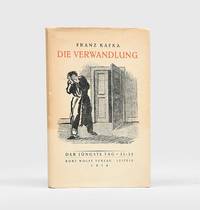
1915ref. 175616Leipzig: Kurt Wolff Verlag 1915. The insect itself must not be illustrated by a drawing. It cannot be shown at all not even from a distance First edition first printing first issue a superbly well-preserved copy of the case-bound issue complete with the original dust jacket which rarely survives. The first of Kafka's masterpieces Metamorphosis narrates the tale of a man who wakes up to find himself transformed into an "ungeheuren Ungeziefer" usually translated as a "monstrous insect". The Expressionist jacket illustration by Ottomar Starke 1886-1962 does not represent the insect; after learning that Starke would illustrate the dust jacket Kafka wrote to the publisher: "The insect itself must not be illustrated by a drawing. It cannot be shown at all not even from a distance" 25 October 1915. The novel met with unimpressive sales on publication and after a year or so the numerous unsold copies were stamped on the title pages with the official stamp of the German censors. This copy is a first issue without the censor stamp. It is one of two variant states with the spine and front cover lettered in serif type no established priority. There was also an issue in wrappers which repeats Starke's jacket illustration published simultaneously. Octavo. Original quarter japon spine and front lettered in black blue laid paper boards top edge blue. With dust jacket illustrated by Ottomar Stark. Housed in a black quarter morocco solander box by the Chelsea bindery. Boards slightly bowing minimal rubbing to extremities a couple of minute marginal tears to first few leaves; jacket just lightly toned tiny marks and nicks to top edge flaps without price as issued: notwithstanding a fine copy in like dust jacket. hardcover