JOYCE, JamesABAA

2.568 Ergebnisse
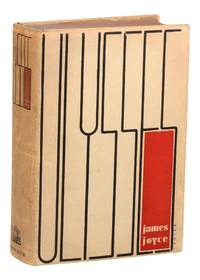
1927Best.-Nr. 577975Paris: Shakespeare & Company 1927. Softcover. Very Good. Ninth printing May 1927. Small quarto. 735pp. Spine shaken with some loss affecting the titling front cover with a vertical crease wrappers edgeworn with a small chip a couple of short tears and a small stain on the lower wrap an about very good copy of a rather fragile volume; the interior is bright. Housed in a modestly worn slipcase titled in gilt. Possibly the magnum opus of the 20th Century and certainly one of the most important modern novels. Beginning in 1918 episodes of this novel were published in the American Little Review until it was banned in 1920. On publication copies of the book had to be smuggled into the United States often with the aid of rebinding. Connolly 100. Shakespeare & Company unknown books
1926Best.-Nr. 1346821New York: Two Worlds Publishing 1926-1927. First US Edition. Softcover. Octavos Eleven parts. In Very Good minus condition. Light brown softcovers with spines age-toned white and black or red lettering. All issues save two in maroon slipcases with loose issues protected in mylar sleeves. Light plus shelf wear and soiling to all issues. CX Consignment. Shelved in Room A CX Oversized Ephemera Oversized order. Additional shipping and handling may be necessary for expedited/international orders. Economy international shipping unavailable due to size/weight restrictions. Contact seller if you have any questions. Two Worlds Monthly contains the first US edition of James Joyce's "Ulysses." The text was pirated and published by Samuel Roth. Wikipedia. 1346821. Special Collections. Two Worlds Publishing unknown books
1934Best.-Nr. ST15753eThe Hague: The Servire Press; New York: Gotham Book Mart 1934. FIRST EDITION. No. 631 OF 1000 COPIES on Old Antique Dutch and 29 special signed copies on Japon. 241 x 162 mm. 9 1/2 x 6 3/8". 4 p.l. first blank 77 3 pp. Plain paper wrappers in white dust jacket front cover with design by Lucia Joyce printed in blue and silver blue titling on front cover and spine ENTIRELY UNOPENED. With the very rare original glassine and housed in a slightly worn brown cardboard slipcase. With opening initial and tailpiece designed by Lucia Joyce. Slocum & Cahoon A-43. ◆Glassine a little wrinkled one corner just lightly bumped otherwise A PRISTINE COPY. This is a fragment from "Finnegans Wake" beautifully printed in Holland on thick paper using an unusually large round and vaguely Medieval typeface. Our copy could hardly be in better condition--as close to mint as one could hope to find and with all original components. Joyce's daughter Lucia 1907-82 was diagnosed with schizophrenia when in her early twenties and was permanently institutionalized by 1935. She had desperately tried and failed to become a dancer and Joyce was determined to find a new artistic outlet for her believing it would be therapeutic. He hit upon the design of ornamental capitals like this one and even went so far as to give publishers the money to pay her for her work. Gotham Book Mart unknown books
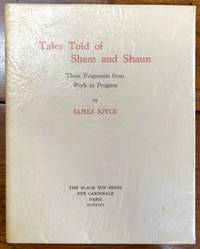
1929Best.-Nr. 2064Paris: Black Sun Press 1929. First edition. xvi 64 pp. Original printed wrappers in publisher's slipcase. One of 500 copies on Holland Van Gelder Zonen paper of a total edition of 650 copies. Frontispiece portrait of Joyce by Brancusi. A fine copy with supplied later acetate wrapper in the original slipcase which is rubbed with tape repair at the corners splitting at the top edge and lacking a three-inch piece of the lower edge. Brancusi's frontispiece portrait commissioned by the publishers Harry and Caresse Crosby was a "Symbol of Joyce" intended to convey the sense of "enigmatic involution." When the sketch was shown to Joyce's father in Dublin he remarked gravely "The boy seems to have changed a good deal." Ellmann p. 614. Slocum & Cahoon A36. Minkoff Black Sun A-21. Black Sun Press unknown books
1934Best.-Nr. 140946820New York: Random House 1934. First American Edition. Very Good/Very Good. First American edition first printing. Bound in publisher's original cream-colored cloth lettered in black and red. Very Good. CLoth with toning to spine and edges light wear to front joint. Former owner name to front free endpaper and contents tanned. In a Very Good unclipped dust jacket with designer's name Reichl to bottom corner of front panel with tanning and edge wear several small splits at the joints with a mending tissue repair made to the verso of the rear spine joint. A nice copy of the once banned novel. Random House unknown books
1944Best.-Nr. 55458New York: Harcourt Brace and Company 1944. First printing. Near fine in a very good plus jacket. Inscribed first edition association copy of this effort to unpuzzle Joyce's famously inscrutable masterpiece - signed to the famed Jungian analyst Erlo van Waveren. Erlo van Waveren practiced psychotherapy in New York with his wife Ann for more than four decades. Both studied with Carl Jung and were regular attendees at the Jung Institute. Campbell himself was famously influenced by Jung and edited an edition of his work an influence heavily reflected in this Campbell's first book which investigates Joyce's "monomyth" an idea deeply indebted to the renowned psychologist's idea of the "collective unconscious." The van Waverans were also instrumental in the establishment of the Bollingen Series which published Campbell's most important work THE HERO WITH A THOUSAND FACES. It was Elro and Ann who introduced Paul and Amy Mellon benefactors of the series to Jung after whose Bollingen Tower the series was named and whose work served as its driving influence. A warm and significant association. 8'' x 5.25''. Original green cloth boards. Original price-clipped yellow printed dust jacket. 2 xiv 366 2 pages. Inscribed by Campbell on the front endpaper: "For / Erlo van Waveren / unconscious and all / from / Joseph Campbell." Jacket with touches of sunning edgewear. Couple of faint spots of soll. Spine and front panel mildly sunned. Book has slight lean. Overall bright and sound. Harcourt, Brace and Company unknown books
1939Best.-Nr. 140937376New York: The Viking Press 1939. First Edition. Fine/Near Fine. First edition first printing. Publisher's black cloth binding lettered in gilt. Fine with fading to topstain near spine in a Near Fine unclipped dust jacket with several tiny edge-tears and very light soiling. A striking copy of a book and jacket typically found in much lesser condition. The Viking Press unknown books
1929Best.-Nr. 208857Paris: The Black Sun Press 1929. Softcover. VG-. Glassine has some thumbnail sized chips along the spine and is a little toned. Otherwise clean. Etched abstract Brancusi portrait of Joyce. #291 of 500 on Holland Van Gelder Zonen. Large Octavo. Softcover. Cream wraps with red and black titles with glassine jacket. 4 preliminary leaves XV 1 55 pages 2 unnumbered leaves 1 unnumbered leaf of plates : illustration ; 22 cm. The Black Sun Press paperback books
1916Best.-Nr. 268174New York: Laurence J. Gomme 1916. First edition first issue. viii 79 1 pp. 1 vols. 12mo. Publisher's half brown cloth and boards. Near fine in orange pictorial dust-jacket with clown holding flaming circus hoop jacket toned at spine panel with some chipping to extremities of jacket. With obituary and other contemporary notices and poem pasted in to preliminaries and final leaf and with manuscript poem "Joyce Kilmer" by George Steele Seymour on half-title. First edition first issue. viii 79 1 pp. 1 vols. 12mo. With a fine Autograph Letter signed "Joyce Kilmer" to Miss Olson written from the front. Headquarters Co. 165th Infantry A.E.F. France n.d. but after Nov. 1917. 1-1/2 pages tipped in after title-page. "It was kind of you to send me the book of tickets and I am honored by thus becoming the guest of the Chicago Woman's Club . I'm more homesick for Chicago than for any other city in America you see Larchmont Manor isn't a city . I think you will like my poem 'Rogue Bouquet.' I am a sergeant now and never expect to go any higher. For to get a commission I'd be obliged to go to school away from the Regiment for some months and when school was over I'd be sent - whether or not I had gained a commission - not back to this Regiment but to some strange outfit. And I'd rather be a sergeant in the 69th than an officer in any other Regiment ." Kilmer was proud of his position in the "Fighting Sixty-ninth" though by his time known as the 165th Infantry and had requested permission to join its ranks. Kilmer was killed in action 30 July 1918 while scouting German machine-gun positions near the Ourcq River. BAL 11108 Laurence J. Gomme unknown books
1924Best.-Nr. 15929London: Jonathan Cape Ltd 1924. First Edition Thus. Hardcover. Near Fine/Very Good. Near Fine in a Very Good dust jacket unclipped 7s. 6d. net generally rubbed and soiled some chips at the edges. Black cloth with gilt lettering on the spine. Square and firmly bound sparsely foxed at the edges toned at the endpapers clean otherwise. The first Cape edition of Joyce's classic novel of Stephen Dedalus. Jonathan Cape Ltd hardcover books
1989Best.-Nr. 290816New York: Whitney Museum 1989. Limited. hardcover. fine. Gober. 2 vols. bound in crushed white leather with diary-style gilt clasps and enclosed side by side in the publishers 4to lavender silk box. New York: Whitney Museum 1989. Limited Edition. This beautifully conceived artist's book of a short story concerning a pair of twins was designed by Robert Gober along with the hand-written text & lithographed end-papers. One of 140 copies signed by Oates and Gober. As new in a very lightly stained box. Whitney Museum unknown books
1934Best.-Nr. 140949980New York: Random House 1934. First American Edition. Near Fine/Very Good. First authorized American edition first printing. xvii 768pp. Bound in publisher's cream-colored cloth lettered in black an red over beveled boards top edge stained red. Near Fine with light wear and toning to cloth two bookplates to front paste down. In a Very Good unclipped dust jacket with designer's name Reichl to bottom corner of front panel spine darkened and extremities toned a few closed tears archival tape to verso reinforcing the ends of the spine and flap folds and the entire front flap fold. Slocum 21. A nice copy of the novel that was sued in the Southern District of New York in 1933 in the famous trial named United States vs. One Book Called Ulysses. Random House publisher Bennett Cerf and attorney Morris Ernst arranged a deliberate legal challenge. The U.S. government brought an in rem action a lawsuit against the physical object to seize a copy of Ulysses under tariff and obscenity laws. Federal Judge John M. Woolsey ruled that the book was not obscene effectively lifting the ban and permitting its publication in the United States. Random House unknown books
1934Best.-Nr. 333702New York: Random House 1934. First. hardcover. very good/good. Thick 8vo cream colored cloth lettered in red & black. d.w. N.Y.: Random House 1934. First Authorized American Edition. The first issue dust wrapper with "Reichl" on the front cover & the $3.50 price is lightly tanned & edge-chipped. Ownership name on end-paper. Laid in is the very rare folio sheet folded to pamphlet form entitled "How to Enjoy James Joyce's Ulysses" presented with the compliments of Random House to the original buyers of the book. Random House unknown books
1929Best.-Nr. 22621Paris: Black Sun Press 1929. First edition. Hardcover. Orig. printed stiff wrappers. Fine in original glassine nicked with some minor loss. Brancusi Constantin. 55 pages. 21 x 17 cm. Limited edition copy 325 of 500 on Holland Van Gelder Zonen. Preface by C.K. Ogden. Portrait of the author by C. Brancusi. Title printed in red and black: The three fragments are entitled; "The Mookse and the Gripes. The Muddest Thick That Was Ever Heard Dump. The Ondt and the Gracehoper." Binding by Andrea Kohler. The three fragments comprise pp. 152-159 282-304 and 414-419 respectively of "Finnegans Wake." The image by Brancusi is a graphic work. THE ARTIST & THE BOOK 1860-1960" notes: "A portrait as abstract as the author's text." This was one of the last books printed at the Black Sun Press. Crosby committed suicide in December 1929. Slocum and Cahoon A36. Kohler binding in fine red velvet and gold framed slipcase housed in fine black leather spine folding box lettered in red and black. Black Sun Press hardcover books
1934Best.-Nr. 72391New York: Random House 1934. First U.S. edition to be authorized. Preceded by a 1929 piracy printed in New York for Samuel and Max Roth Slocum & Cahoon A21. In first-issue dust jacket with designer's name on front panel. "Complete and unabridged" this U.S. edition adds a foreword by Morris Ernst the "historic decision by Judge John M. Woolsey" that removed the U.S. federal ban on the book and Joyce's letter to publisher Bennett Cerf expressing his hopes for an American publication. 8vo rough beige cloth boards lettered in black and red; top edge brown; 768 pages. Near fine with subtle soiling and touch of light foxing to upper boards; in very good to near fine dust jacket with light professional repair to edges and folds and spot of soiling affecting few words in publisher's ads on rear panel. Random House unknown books
1989Best.-Nr. 13275HEAT Whitney Musem 1989 first edition 2 volumes complete very fine in like cloth tray case. Bound in full leather and produced as clasp-locked hand-written diaries with illustrations by Robert Gober. Limited to 140 copies and SIGNED by both author and artist. A Fine Press item to be sure. Whitney Musem hardcover books
Best.-Nr. 3206631970. Silver print on medium paper stamped. 14 x 11 inches. Fine. Silver print on medium paper stamped. 14 x 11 inches. Photographed in Berenice Abbott's Paris studio the iconic image of Joyce wearing a hat. According to Abbott who relied on natural light for her Paris portraits of the 1920s Joyce wore the hat because of the extreme sensitivity of his eyesight. unknown books
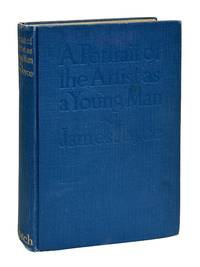
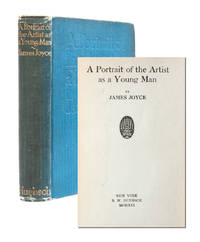
1916Best.-Nr. 2940New York: B. W. Huebsch 1916. First edition. Very Good. A Very Good copy with bright gilt on the spine. Shelfwear to extremities. Front inner hinge starting but holding. Some offsetting to front endpaper and early ownership signature to front pastedown. Page 16 with slight skinning affecting several lines of text. Joyce's first novel recounts the coming of age story of Stephen Dedalus the artistic alter-ego of Joyce himself. Stephen grows up ensconced in rigid institutions: the church school system family and national politics. Feeling trapped Stephen experiences a series of awakenings as he grows older and as a result of these awakenings Stephen rejects these traditional bulwarks of Irish culture. Instead he develops an aestheticism that will support his artistic vision. This rejection of existing communities and institutions alongside his embrace of a new aestheticism alienates Stephen from what he knows. Facing this alienation Stephen decides to leave Ireland and pursue his art abroad. A Portrait of the Artist as a Young Man is an important contribution to literary modernism. One innovation is Joyce's use of age-appropriate syntax and vocabulary. The beginning of the novel which starts in Stephen's infancy is mostly monosyllabic nonsense. As Stephen grows older and grasps more about the world and his place in it the novel's vocabulary and syntax become correspondingly complex. Of Joyce's first novel H.G. Wells writes that "It is a mosaic of jagged fragments that does altogether render with extreme completeness the growth of a rather secretive imaginative boy in Dublin. The technique is startling but on the whole it succeeds." Very Good. B. W. Huebsch unknown books
1939Best.-Nr. 6104London: Faber and Faber 1939. First trade edition. Near Fine/Very Good . A Near Fine copy of the book in Very Good dust jacket. Contemporary owner's name and bookplate on the front endpapers some foxing to the closed text-block and to the early and late leaves. Price-clipped dust jacket with the yellow titling faded minor chips and tears mostly a the extremities and some smudges to the jacket panels. Among the most influential and complex Modernist works Finnegans Wake "blends the reality of life with a dream world. The motive of the novel inspired by the 18th century Italian philosopher Giambattista Vico is that history is cyclical.the novel's plot is nearly as complex as the linguistic tactics deployed by Joyce who combined a number of languages and utilized complex sonic implications to create an atmosphere of wordplay and hidden meaning throughout the entirety of Finnegans Wake" Britannica. A natural progression from his earlier masterpiece Ulysses Finnegans Wake shows Joyce pressing his ability to weave together numerous languages cultural mythologies and national literatures to defy boundaries and binaries we so often lean on to understand the world. Near Fine in Very Good dust jacket. Faber and Faber unknown books
1925Best.-Nr. 140948862Paris: Shakespeare and Company 1925. Early Reprint. Near Fine. Seventh printing of the first edition. 736 pp. Bound in publisher's blue printed wraps lettered in white. Housed in a custom teal blue cloth clamshell case with green morocco spine label stamped in gilt. Near Fine with light toning and wear to the notoriously fragile wraps. Light creasing to spine light chipping to ends to ends small closed tear to rear joint at foot with tiny abrasion to rear cover. Light corner creases from prelims to 112 p. A nicer than usually found copy of Joyce's epic modern novel. Shakespeare and Company unknown books
1916Best.-Nr. JJ046New York: Huebsch 1916 First edition first printing. Publisher's blue cloth blind-stamped front cover and gilt spine. A very good copy with a slight lean to spine and wear to spine ends some light spotting to cloth and rubbing to board edge a slight mark to fore edge of pages 45-48 binding slightly cracked between pages 28 and 29 otherwise sturdy. Internally free of any writing or bookplates. Lacking the scarce original dust jacket. Overall a solid copy of the author's first novel. Slocum & Cahoon A11. A Portrait of the Artist as a Young Man is Joyce's second book and first novel. With the assistance of Ezra Pound the semi-autobiographical text was first published serially in twenty-one monthly installments in the British literary magazine The Egoist from February 1914-September 1915. Readers' critical reactions and fear of obscenity laws led many British publishers to initially reject publication and it was first published in book form in America in 1916. The book which is a virtual rewrite of his abandoned novel Stephen Hero tells the story of the young artist Stephen Daedalus Joyce's fictionalized alter ego. The name alludes to both the Christian martyr Saint Stephen and the Greek mythological inventor Daedalus. A Portrait of the Artist as a Young Man is a Künstlerroman a subset of the bildungsroman genre. The novel is written in Joyce's characteristic style of free indirect speech; Joyce's writing style matures along with Daedalus' own consciousness so that the sophistication of the narrator's voice mirrors the protagonist's level of awareness. First Edition. Hard Cover. Very Good. New York: Huebsch hardcover books
1916Best.-Nr. 3926New York: B. W. Huebsch 1916. First edition. Very Good . A Very Good copy with minor shelfwear to extremities. Spine toned. Rear inner hinge tender but holding. Previous owner's bookplate to the front free endpaper. Joyce's first novel recounts the coming of age story of Stephen Dedalus the artistic alter-ego of Joyce himself. Stephen grows up ensconced in rigid institutions: the church school system family and national politics. Feeling trapped Stephen experiences a series of awakenings as he grows older and as a result of these awakenings Stephen rejects these traditional bulwarks of Irish culture. Instead he develops an aestheticism that will support his artistic vision. This rejection of existing communities and institutions alongside his embrace of a new aestheticism alienates Stephen from what he knows. Facing this alienation Stephen decides to leave Ireland and pursue his art abroad. A Portrait of the Artist as a Young Man is an important contribution to literary modernism. One aspect of this innovativeness is Joyce's use of age-appropriate syntax and vocabulary. The beginning of the novel which starts in Stephen's infancy is mostly monosyllabic nonsense. As Stephen grows older and grasps more about the world and his place in it the novel's vocabulary and syntax become correspondingly complex. Of Joyce's first novel H.G. Wells writes that "It is a mosaic of jagged fragments that does altogether render with extreme completeness the growth of a rather secretive imaginative boy in Dublin. The technique is startling but on the whole it succeeds." Very Good . B. W. Huebsch unknown books
1929Best.-Nr. 299582Paris: Black Sun 1929. Limited. paperback. fine/fine. Three Fragments from a Work in Progress. With a "Portrait" by Brancusi. Sq. 8vo printed wrappers with original glassine. Paris: The Black Sun Press 1929. First Edition. Contains work that was later to appear in Finnegans Wake. Number 66 of 500 copies. Fine in the original gilt slipcase. Slocum & Cahoon A-36. Black Sun unknown books
1966Best.-Nr. 140604Los Angeles: Expanding Cinema 1966. Shooting final for the 1966 film. Copy belonging to actor Peter Haskell with his manuscript annotations throughout and his shooting schedule laid in. Mary Ellen Bute's final film and the first cinematic adaptation of James Joyce's masterfully complex work of fiction. Shot over a two year period Bute was tasked with transforming Joyce's impenetrable prose without losing any of the work's surreal lyrical essence. The subsequent film maintains the original novel's oneiric style. Bute and her husband Ted Nemeth were longtime collaborators and Nemeth worked as both cinematographer and producer of the film. In 1965 it was honored at the Cannes Film Festival as Best Debut and remains Bute's sole feature length film. Shot on location in New York City and Dublin. Brown untitled wrappers. Title page present dated March 4 1963 and December 3 1962 noted as Shooting Final with credits for screenwriters Mary Ellen Bute Romana Javitz and T. J. Nemeth Jr and editor A.I.M.S. Street. 148 leaves with last page of text numbered 139. Mimeograph duplication with onionskin revision pages throughout. Pages Very Good plus wrapper Very Good plus. Some pages detaching and wrapper slightly cracked. Bound internally with prong binding. Expanding Cinema unknown books
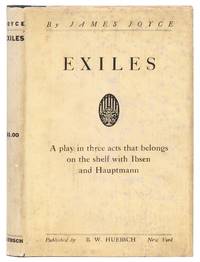
1918Best.-Nr. 7836New York: B.W. Huebsch 1918. First edition. Fine/Near Fine. Published simultaneously with the English edition on May 25 1918 see Slocum & Cahoon 14 and 15. A Fine copy of the book in Near Fine dust jacket. vi 154 pp. Publisher's green cloth over tan blindstamped boards. A touch of foxing to edges and top edge dusty otherwise clean throughout. Dust jacket rubbed and a bit foxed with just a few short tears to the rear panel. Overall a very appealing copy of Joyce's only play. Exiles captures the romantic dramas of Richard and Bertha a common-law couple recently returned to their home country of Ireland and the complex dynamics that play out between them Richard's cousin Robert and Robert's wife Beatrice. "The play was not especially popular at the time and is commonly regarded as one of Joyce's weaker works. However much of the initial criticism may have had to do with the play's provocative themes: unconventional relationships jealousy weakened national ties to Ireland and exile. All of these topics resonate with Joyce's personal life making Exiles a partly autobiographical work" James Joyce Foundation. After W.B. Yeats refused to stage the play Joyce unsuccessfully attempted to interest theatrical companies throughout England Ireland and the United States. Exiles eventually debuted in German translation in Munich in 1919. Of the premiere Joyce wrote: "Complete fiasco. Row in theatre. Play withdrawn. Author invited but not present.Thank God" Morgan Library. The play was not performed in English until a staging at New York's Neighborhood Playhouse in 1925. Slocum & Cahoon 15. Fine in Near Fine dust jacket. B.W. Huebsch unknown books