JOYCE, JamesBiblio.com
18,394 results
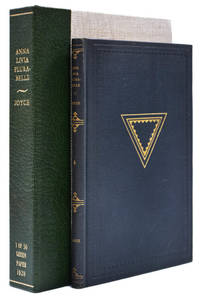
ref. 98347New York Crosby Gaige 1928. . FIRST EDITION no. 3 of six numbered copies of 50 COPIES ON PALE GREEN-TINTED PAPER from an overall limitation of 850; 8vo; title previously detached cleanly at gutter now with neat reversible tissue paper repair to verso chip from fore-edge of a preliminary blank leaf slight separation at upper hinge bookplate to front pastedown; publisher's black cloth lettered in gilt on the spine and with triangular gilt design on upper cover top edge gilt presented in morocco-backed cloth drop-back box. The first edition of Anna Livia Plurabelle by James Joyce the text that was to become chapter eight in Finnegans Wake and introduce Joyce readers to the character that fellow Irish author Edna O'Brien was to describe as 'the most accessible and indeed beloved character conceived by Joyce'. Slocum and Cahoon note that: 'Of these 50 copies on light green paper probably 6 were offered for sale by the publisher. These were numbered 1 to 6 with the following notice on p.iv in the handwriting of Crosby Gaige: This is one of 6 copies on green paper. Crosby Gaige.'; however this copy is simply numbered '3' and does not bear the publisher's statement on the limitation page. The remaining 44 copies were presumably disseminated by Crosby Gaige with the exception of a few which were passed on to the Chaucer Head Book Shop New York by Random House in 1938. Slocum & Cahoon A32. New York, Crosby Gaige, 1928. hardcover
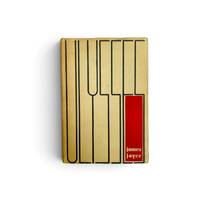
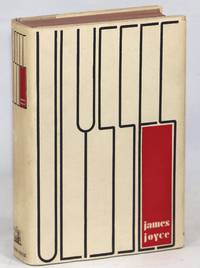
1934ref. 24133USA: Random House 1934. First authorised American edition first printing with "First American Edition" stated on the copyright page and no indication of a subsequent printing. Thick octavo measuring approximately 21 × 14 cm. xvii 2 5768 pp. Publisher's original beige cloth lettered in black and red with dark-brown top edge in the original typographical dust wrapper designed by Ernst Reichl. This copy retains the particularly desirable Reichl-signed variant of the dust wrapper with the designer's surname printed vertically at the lower-right corner of the front panel. Two variants of the wrapper are known one bearing Reichl's name and the other without it. Although no conclusive bibliographical priority has been established the signed variant is generally preferred by collectors and commands a premium. The first authorised edition of Joyce's modernist masterpiece to be published in the United States appearing twelve years after the Shakespeare and Company first edition of 1922. The novel had long been prohibited from importation into America on grounds of obscenity. Random House deliberately arranged for a copy to be seized by US Customs in order to test the ban in court culminating in Judge John M. Woolsey's landmark 1933 ruling that Ulysses was not obscene and could legally be admitted and published in the United States. This edition includes a foreword by Morris L. Ernst concerning the historic judgment together with Joyce's letter to Random House publisher Bennett Cerf expressing his desire for an authorised American edition. Ernst Reichl's striking typographical treatment of the binding wrapper and text has subsequently become recognised as a landmark of twentieth-century American book design. The price-clipped dust wrapper is slightly toned to the spine with a little chipping and areas of wear to the extremities. Some spotting to the cloth boards and minor toning internally. A very good copy in the very good original dust wrapper. Random House hardcover
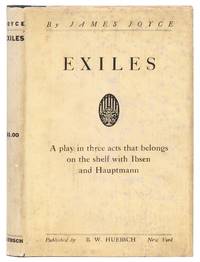
1918ref. 7836New York: B.W. Huebsch 1918. First edition. Fine/Near Fine. Published simultaneously with the English edition on May 25 1918 see Slocum & Cahoon 14 and 15. A Fine copy of the book in Near Fine dust jacket. vi 154 pp. Publisher's green cloth over tan blindstamped boards. A touch of foxing to edges and top edge dusty otherwise clean throughout. Dust jacket rubbed and a bit foxed with just a few short tears to the rear panel. Overall a very appealing copy of Joyce's only play. Exiles captures the romantic dramas of Richard and Bertha a common-law couple recently returned to their home country of Ireland and the complex dynamics that play out between them Richard's cousin Robert and Robert's wife Beatrice. "The play was not especially popular at the time and is commonly regarded as one of Joyce's weaker works. However much of the initial criticism may have had to do with the play's provocative themes: unconventional relationships jealousy weakened national ties to Ireland and exile. All of these topics resonate with Joyce's personal life making Exiles a partly autobiographical work" James Joyce Foundation. After W.B. Yeats refused to stage the play Joyce unsuccessfully attempted to interest theatrical companies throughout England Ireland and the United States. Exiles eventually debuted in German translation in Munich in 1919. Of the premiere Joyce wrote: "Complete fiasco. Row in theatre. Play withdrawn. Author invited but not present.Thank God" Morgan Library. The play was not performed in English until a staging at New York's Neighborhood Playhouse in 1925. Slocum & Cahoon 15. Fine in Near Fine dust jacket. B.W. Huebsch unknown
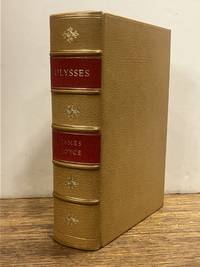
1934ref. 334890New York: Random House 1934. hardcover. fine. Thick 8vo handsomely rebound in full beige morocco red leather spine labels. New York: Random House 1934. First Authorized American Edition. Fine. Slocum & Cahoon 21. Random House unknown
1918ref. 7836New York: B.W. Huebsch 1918. First edition. Fine/Near Fine. Published simultaneously with the English edition on May 25 1918 see Slocum & Cahoon 14 and 15. A Fine copy of the book in Near Fine dust jacket. vi 154 pp. Publisher's green cloth over tan blindstamped boards. A touch of foxing to edges and top edge dusty otherwise clean throughout. Dust jacket rubbed and a bit foxed with just a few short tears to the rear panel. Overall a very appealing copy of Joyce's only play. Exiles captures the romantic dramas of Richard and Bertha a common-law couple recently returned to their home country of Ireland and the complex dynamics that play out between them Richard's cousin Robert and Robert's wife Beatrice. "The play was not especially popular at the time and is commonly regarded as one of Joyce's weaker works. However much of the initial criticism may have had to do with the play's provocative themes: unconventional relationships jealousy weakened national ties to Ireland and exile. All of these topics resonate with Joyce's personal life making Exiles a partly autobiographical work" James Joyce Foundation. After W.B. Yeats refused to stage the play Joyce unsuccessfully attempted to interest theatrical companies throughout England Ireland and the United States. Exiles eventually debuted in German translation in Munich in 1919. Of the premiere Joyce wrote: "Complete fiasco. Row in theatre. Play withdrawn. Author invited but not present.Thank God" Morgan Library. The play was not performed in English until a staging at New York's Neighborhood Playhouse in 1925. Slocum & Cahoon 15. Fine in Near Fine dust jacket. B.W. Huebsch unknown books
1934ref. 334890New York: Random House 1934. hardcover. fine. Thick 8vo handsomely rebound in full beige morocco red leather spine labels. New York: Random House 1934. First Authorized American Edition. Fine. Slocum & Cahoon 21. Random House unknown books
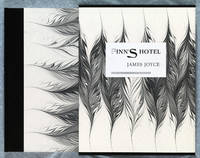
2013ref. FH.1.AOne of only 10 copies printed on Zerkall Litho for presentation in Artist's Bindings. Designed by the Spanish artist Antonio Veléz Celemín exclusively for the first edition these copies are beautifully handbound in quarter cloth with exquisite hand marbling on both the book and the slipcase joining two complementary patterns. To achieve this unique and specially commissioned design the artist has combined Suminagashi a Japanese technique dating back to 1055 using only black ink and the classic western pattern of 'wavy thorns'. These are our 'top copies': they marry the finest in printing art with a rare fine-binding. The First Edition of FINN'S HOTEL by James Joyce. Edited arranged and with a preface by Danis Rose introduced by Seamus Deane with eleven illustrations by Casey Sorrow. Designed and printed letterpress by Michael Caine for Ithys Press Dublin. The Preface and Joyce's text have been handset by Caine in Van Dijk Kis-Janson and various early 20th Century typefaces and the Introduction has been set by Phil Abel in Monotype Univers. The edition is limited to 180 copies : of 40 head copies on Zerkall mouldmade 10 signed deluxe copies I-X are housed in bespoke bindings featuring the handmarbling of Antonio Vélez Celemín of Madrid and 26 copies lettered A-Z and 4 copies Hors Commerce are issued in paper wrappers within clamshell boxes ; 140 numbered copies on Fedrigoni Vellum are presented in Elisabeth Hyder's printed paper over boards. The edition has been handbound by Tom Duffy in Dublin's 5 Lamps. Ithys Press hardcover
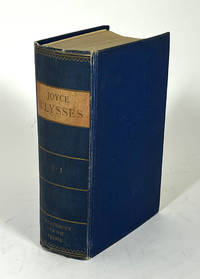
ref. 0296-25Basel Rhein-Vlg. 1927. Privatdruck. 3 Bll. 458; 2 Bll. 465; 2 Bll. 662 S. Blauer OLn.-Bd./Orig. blue cloth binding. m. Rückensch. Kanten sehr leicht berieb. Alter Namenszug am flieg.Vorsatz. Slocum-C. D.45.2 - Erste deutsche Ausgabe. Nummer LXXV von nur 100 numerierten Exemplaren als Sonderausgabe in einem Band für die Presse: "Privatdruck für die Presse". Weitere erschienen in einer Auflage von 1000 num. Exemplaren. - First edition in german. The first translation of Ulysses published by Joyce. Limited to 100 numbered copies for the press. (Basel, Rhein-Vlg.) 1927. hardcover
1934ref. 000016927New York: Random House 1934. First authorized American edition. Hardcover. Near Fine/Very Good or better. 8vo. 6 vii-xvii 5 5-767 7 pp. Pale buckram cloth over beveled-edge boards black and red lettering on the front board and spine; dark purple topstain. Price of 3.50 on the front flap of the dust jacket. The jacket does not state the jacket designer's name on the front panel. Slocum and Cahoon do not address the question of the designer's name credit though many consider the credit's presence on the jacket to be the preferred variant we have seen this point referred to as a state and as an issue. Slocum and Cahoon 21. A sharp copy of Joyce's modern epic an impressionistic comic tour de force using the epic narrative as a framework. A cultural blend of Irish wit and Greek literary devices and themes dense but beloved and extraordinarily influential. The spine's cloth very gently toned the free front endpaper with two faint wrinkles to its corner; jacket with about three tiny chips on its folds. Random House hardcover
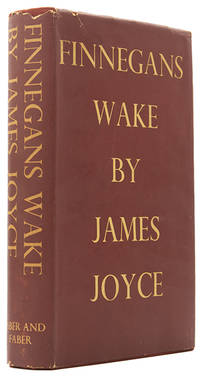
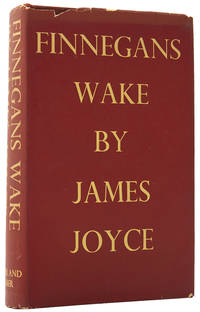
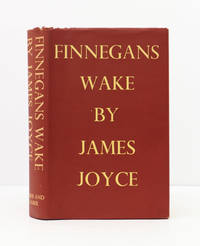
ref. 112465London Faber & Faber 1939. . First edition first impression trade issue; large 8vo; toning to the first and last leaves from the endpapers as always; publisher's burgundy cloth titles to spine gilt with the unclipped dust-jacket dust-jacket with some slight loss at head of spine slight rubbing to extremities spine a little toned else very good; housed in green morocco gilt solander box. One of 3400 sets of sheets for the trade edition of Finnegans Wake which were printed for Faber. Of these 2255 were bound and sold at 25 shillings 950 were destroyed by the publisher and the remaining were gratis copies. It is possible that the 950 discarded sets of sheets remained unsold because of the price which Joyce believed was too high. 'A way alone aloved alost along the ' If Finnegans Wake is a key book it is a key which needs a key' Connolly. 'His work is enriched by such large resources of invention and allusion that its total effect is infinite variety' Harry Levin. Slocum & Cahoon A47; Connolly The Modern Movement 87; Harry Levin James Joyce: A Critical Interpretation. London, Faber & Faber, 1939. hardcover
ref. 107461London Faber & Faber 1939. . First edition first impression trade issue; large 8vo; publisher's burgundy cloth titles to spine gilt spotting to the first and last leaves from the endpapers as always dust jacket with some very minor loss at the top edge otherwise a very good copy. One of 3400 sets of sheets for the trade edition of Finnegans Wake which were printed for Faber. Of these 2255 were bound and sold at 25 shillings 950 were destroyed by the publisher and the remaining were gratis copies. It is possible that the 950 discarded sets of sheets remained unsold because of the price which Joyce believed was too high. 'A way alone aloved alost along the ' If Finnegans Wake is a key book it is a key which needs a key' Connolly. 'His work is enriched by such large resources of invention and allusion that its total effect is infinite variety' Harry Levin. Slocum & Cahoon A47; Connolly The Modern Movement 87; Harry Levin James Joyce: A Critical Interpretation. London, Faber & Faber, 1939. hardcover
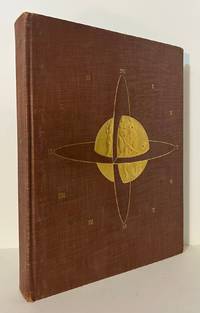
1935ref. 18427New York: Limited Editions Club 1935. Limited Edition First Edition Thus. Hardcover. Good bound in original full brown cloth with gilt decoration on front panel and spine. Webbing exposed at front hinge binding intact. Toning. Edge wear to exterior includind a few bumps some fading to gilt at a few locations. No markings to text. 4to 12"h x 9 1/4"w. Illustrated by Matisse limited edition also signed by Matisse on the Limitation Page. Limited Editions Club hardcover
1989ref. 586FISCHER 02-07/1989. 1. softcover. Tredana Deutsche Erstausgabe! 274827492753 FISCHER paperback
1966ref. 140604Los Angeles: Expanding Cinema 1966. Shooting final for the 1966 film. Copy belonging to actor Peter Haskell with his manuscript annotations throughout and his shooting schedule laid in. Mary Ellen Bute's final film and the first cinematic adaptation of James Joyce's masterfully complex work of fiction. Shot over a two year period Bute was tasked with transforming Joyce's impenetrable prose without losing any of the work's surreal lyrical essence. The subsequent film maintains the original novel's oneiric style. Bute and her husband Ted Nemeth were longtime collaborators and Nemeth worked as both cinematographer and producer of the film. In 1965 it was honored at the Cannes Film Festival as Best Debut and remains Bute's sole feature length film. Shot on location in New York City and Dublin. Brown untitled wrappers. Title page present dated March 4 1963 and December 3 1962 noted as Shooting Final with credits for screenwriters Mary Ellen Bute Romana Javitz and T. J. Nemeth Jr and editor A.I.M.S. Street. 148 leaves with last page of text numbered 139. Mimeograph duplication with onionskin revision pages throughout. Pages Very Good plus wrapper Very Good plus. Some pages detaching and wrapper slightly cracked. Bound internally with prong binding. Expanding Cinema unknown
1966ref. 140604Los Angeles: Expanding Cinema 1966. Shooting final for the 1966 film. Copy belonging to actor Peter Haskell with his manuscript annotations throughout and his shooting schedule laid in. Mary Ellen Bute's final film and the first cinematic adaptation of James Joyce's masterfully complex work of fiction. Shot over a two year period Bute was tasked with transforming Joyce's impenetrable prose without losing any of the work's surreal lyrical essence. The subsequent film maintains the original novel's oneiric style. Bute and her husband Ted Nemeth were longtime collaborators and Nemeth worked as both cinematographer and producer of the film. In 1965 it was honored at the Cannes Film Festival as Best Debut and remains Bute's sole feature length film. Shot on location in New York City and Dublin. Brown untitled wrappers. Title page present dated March 4 1963 and December 3 1962 noted as Shooting Final with credits for screenwriters Mary Ellen Bute Romana Javitz and T. J. Nemeth Jr and editor A.I.M.S. Street. 148 leaves with last page of text numbered 139. Mimeograph duplication with onionskin revision pages throughout. Pages Very Good plus wrapper Very Good plus. Some pages detaching and wrapper slightly cracked. Bound internally with prong binding. Expanding Cinema unknown books
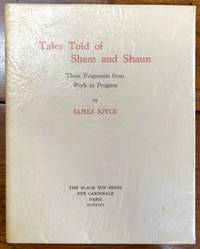
1929ref. 299582Paris: Black Sun 1929. Limited. paperback. fine/fine. Three Fragments from a Work in Progress. With a "Portrait" by Brancusi. Sq. 8vo printed wrappers with original glassine. Paris: The Black Sun Press 1929. First Edition. Contains work that was later to appear in Finnegans Wake. Number 66 of 500 copies. Fine in the original gilt slipcase. Slocum & Cahoon A-36. Black Sun unknown
1927ref. 000759Paris: Shakespeare & Co. The 9th printing printed from the wholly new and corrected setting of type prepared for the eighth edition. Original blue wrappers bound in 3/4 leather boards and green tan and gilt paper. Green and tan designed end pages. Gilt title on spine. Gilt topstain. . Very Good. Hardcover. 1st Edition. 5th or later Printing. 1927. Shakespeare & Co., hardcover
1936ref. 46625London:: John Lane The Bodley Head 1936. First edition printed in England; No. 847 of 900 copies on Japon vellum. . publisher's green buckram stamped with Homeric bow in gold; in dust jacket. Very slight browning to extremities of spine; else a fresh bright copy in a price-clipped jacket with some light wear to its extremities and some hand-soiling particularly to the spine. Uncommon in dust jacket. Small 4to. John Lane, The Bodley Head, hardcover
1929ref. 299582Paris: Black Sun 1929. Limited. paperback. fine/fine. Three Fragments from a Work in Progress. With a "Portrait" by Brancusi. Sq. 8vo printed wrappers with original glassine. Paris: The Black Sun Press 1929. First Edition. Contains work that was later to appear in Finnegans Wake. Number 66 of 500 copies. Fine in the original gilt slipcase. Slocum & Cahoon A-36. Black Sun unknown books
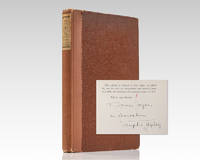
1925ref. 151568New York: Greenberg Publisher Inc 1925. First limited edition of this classic work inspired by King John. Octavo original half-cloth. One of 500 numbered copies this is number 8. Association copy inscribed by the author to fellow writer James Joyce on the limitations page "To James Joyce in admiration Joseph Shipley." The recipient James Joyce was an Irish modernist writer whose novel Ulysses 1922 is widely regarded as one of the most influential works of twentieth-century literature. In very good condition. Joseph T. Shipley 1893–1988 was an American author literary critic and lexicographer whose career spanned several decades of influential work in both theater criticism and the study of language. He served as drama critic for The Call later The New Leader from 1918 to 1962 and extended his critical reach through radio broadcasts on New York station WEVD where his program First Nights ran from 1940 to 1982. Shipley was an early and perceptive commentator on modern drama publishing one of the first critical studies of Eugene O’Neill in 1928 and he later held leadership roles in the New York Drama Critics’ Circle including serving as president from 1952 to 1954. Although widely respected as a theater critic he is perhaps best remembered for his contributions to etymology and literary reference particularly his Dictionary of World Literary Terms 1943 and his final work The Origins of English Words 1984. Over the course of his career he authored or edited 27 books and received honors such as the Townsend Harris Medal. Greenberg, Publisher, Inc hardcover
ref. 17744Saint-Gérand le Puy 2 avril 1940 181 x 138 mm. 1 feuillet écrit au recto, encre un peu passée mais bien lisible.
1939ref. 145126London: Faber and Faber Limited 1939 First UK edition. iv 628 pp. Tall octavo. Original burgundy cloth. Top edge trimmed. Gilt title and decoration on spine. Fore edge and bottom edges untrimmed. Original endpapers. Text block clean and crisp. Original printed dustwrapper. Touch of wear on the top edge. Price trimmed and a rubber stamp with a US dollar amount added. Really no fading to speak of. A fine copy of a scarce item in this condition. 3400 sets of sheets for the trade edition were printed for Faber. Of these 2255 were bound and sold at 25 shillings 950 were destroyed by the publisher and the remaining were complimentary copies. Joyce thought that the 950 discarded sets of sheets remained unsold because of the price which Joyce believed was too high. Slocum & Cahoon A47. Also included is a small group of ephemera that relates to the first sale of the book in 1939 by Philip C. Duschnes in New York 1939 Faber and Faber Limited hardcover
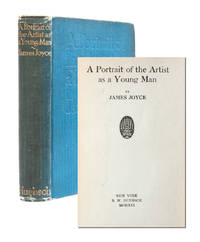
1916ref. 3926New York: B. W. Huebsch 1916. First edition. Very Good . A Very Good copy with minor shelfwear to extremities. Spine toned. Rear inner hinge tender but holding. Previous owner's bookplate to the front free endpaper. Joyce's first novel recounts the coming of age story of Stephen Dedalus the artistic alter-ego of Joyce himself. Stephen grows up ensconced in rigid institutions: the church school system family and national politics. Feeling trapped Stephen experiences a series of awakenings as he grows older and as a result of these awakenings Stephen rejects these traditional bulwarks of Irish culture. Instead he develops an aestheticism that will support his artistic vision. This rejection of existing communities and institutions alongside his embrace of a new aestheticism alienates Stephen from what he knows. Facing this alienation Stephen decides to leave Ireland and pursue his art abroad. A Portrait of the Artist as a Young Man is an important contribution to literary modernism. One aspect of this innovativeness is Joyce's use of age-appropriate syntax and vocabulary. The beginning of the novel which starts in Stephen's infancy is mostly monosyllabic nonsense. As Stephen grows older and grasps more about the world and his place in it the novel's vocabulary and syntax become correspondingly complex. Of Joyce's first novel H.G. Wells writes that "It is a mosaic of jagged fragments that does altogether render with extreme completeness the growth of a rather secretive imaginative boy in Dublin. The technique is startling but on the whole it succeeds." Very Good . B. W. Huebsch unknown
1916ref. 3926New York: B. W. Huebsch 1916. First edition. Very Good . A Very Good copy with minor shelfwear to extremities. Spine toned. Rear inner hinge tender but holding. Previous owner's bookplate to the front free endpaper. Joyce's first novel recounts the coming of age story of Stephen Dedalus the artistic alter-ego of Joyce himself. Stephen grows up ensconced in rigid institutions: the church school system family and national politics. Feeling trapped Stephen experiences a series of awakenings as he grows older and as a result of these awakenings Stephen rejects these traditional bulwarks of Irish culture. Instead he develops an aestheticism that will support his artistic vision. This rejection of existing communities and institutions alongside his embrace of a new aestheticism alienates Stephen from what he knows. Facing this alienation Stephen decides to leave Ireland and pursue his art abroad. A Portrait of the Artist as a Young Man is an important contribution to literary modernism. One aspect of this innovativeness is Joyce's use of age-appropriate syntax and vocabulary. The beginning of the novel which starts in Stephen's infancy is mostly monosyllabic nonsense. As Stephen grows older and grasps more about the world and his place in it the novel's vocabulary and syntax become correspondingly complex. Of Joyce's first novel H.G. Wells writes that "It is a mosaic of jagged fragments that does altogether render with extreme completeness the growth of a rather secretive imaginative boy in Dublin. The technique is startling but on the whole it succeeds." Very Good . B. W. Huebsch unknown books
ref. 145786New York: Walker and Company 1994. First edition of this riveting work on the legendary scientist James D. Watson. Octavo original boards. Boldly signed by James Watson and Francis Crick on the half-title page. Fine in a fine dust jacket. Jacket design by Ron Monteleone. Rare and desirable signed by Watson and Crick. In its drama Watson's life has rivaled the discovery of the structure of DNA. So intent on his research was this awkward bumbling scholar that he would climb a drainpipe to sneak into a lab at night. Watson had a knack for selecting problems that would yield important scientific results but did he pilfer Did Rosalind Franklin originate crucial material If so why was she not included in the Nobel Prize Baldwin who had exceptional access to Watson and his family conveys the elegance of science the ``structure of DNA was too pretty not to be true'' describes diverse influences birding Arrowsmith movies and even gives advice go to a college where others are brighter than you to test your mettle. Voluminous detail on what exactly provided a lifetime's worth of inspiration broaden an intriguing picture of this intrepid competitor. Walker and Company hardcover