6294 risultati
1888rif. 90183Reliure demi-maroquin bordeaux à coins à la bradel. Titre doré et date dorée en queue. Non rogné. Couvertures et dos conservés.
rif. 82384L.A.S., 1 p. in-8.
1879rif. 87597Charpentier | Paris 1879 | 14 x 23 cm | relié
1898rif. AMO-4388Paris, Bibliothèque-Charpentier, Eugène Fasquelle éditeur, 1898 1 volume in-18 (19 x 14 cm) de (4)-608 pages. Reliure strictement de l'époque plein maroquin rouge vermillon, dos à nerfs janséniste, auteur et titre doré, millésime doré en queue "Paris 1898", double-filet doré sur les coupes, doublure de maroquin en encadrement sertie de huit filets dorés concentriques, centre de la doublure et gardes de moire vermillon, tranches dorées sur témoins (reliure signée DAVID). Reliure très fraîche. A noter deux légères éraflures sombres au bas du premier plat. Légères ombres au maroquin. Intérieur très frais. Sans le premier plat de couverture imprimée. Edition originale. Un des 300 exemplaires sur papier de Hollande. Il a été tiré en outre 30 exemplaires sur papier du Japon (et 1 exemplaire sur papier rouge). Les Trois Villes est un cycle romanesque écrit par Émile Zola entre 1893 et 1898. Il suit directement le cycle précédent du romancier : Les Rougon-Macquart. Son héros, l'abbé Pierre Froment, sert de fil rouge aux trois romans, Lourdes, Rome et Paris, dans lesquels Zola s'interroge sur la place de la religion dans la société moderne, mais aussi sur la confrontation entre une bourgeoisie rayonnante face à un monde ouvrier misérable. Un voyage dans les Pyrénées conduit Zola à Lourdes en 1891, où il observe effaré « un monde de croyants hallucinés ». Il annonce son projet sur la ville miraculeuse en juillet 1892, dans le périodique Gil Blas, « sans intention malveillante ». Sous la conduite du baron Malet et sous celle de M. de Lacvivier, le 25 août 1892, Zola visita la Grotte, le magasin des cierges, le bureau des envois de l’eau de Lourdes, puis le rosaire, la Crypte et la Basilique. Ces deux notables inspirèrent le personnage du baron Suire dans Lourdes et sont directement nommés dans Mes voyages ; Lourdes, Rome. Puis repart pour le centre de pèlerinage, voyage à l'issue duquel il décide de scinder l'œuvre à venir en deux romans, avec Rome. À l'automne, il rajoute Paris, « la part du socialisme qui ouvre vers le XXe siècle » aux deux premiers, concevant finalement un nouveau cycle portant sur la place du religieux dans la société française de la fin du XIXe siècle. Il écrit : « Ma trilogie, qui contiendra le bilan religieux, philosophique et social du siècle, sera moins pessimiste que le reste de mon œuvre, et animée d'un souffle d'idéal et d'espoir ». Lourdes paraît le 25 juillet 1894, après avoir été publié en feuilleton dans Gil Blas. L'intrigue expose cinq journées d'un pèlerinage mettant en scène l'abbé Pierre Froment, personnage fil rouge du cycle. Le roman peint tout à la fois la souffrance des pèlerins dans leur foi et « le besoin de surnaturel persistant chez l'homme malgré les conquêtes de la science ». Il dénonce aussi les escroqueries à la guérison, les rivalités entre les différents courants du clergé, les Pères de la grotte assimilés à de nouveaux marchands du temple. Les réactions à la publication de Lourdes sont immédiates, la polémique lancée par Mgr Ricard est reprise et alimentée par la droite catholique. Elle aboutit à la mise à l'Index du roman et de toute l'œuvre d'Émile Zola. Cependant, le livre remporte un succès énorme, vendu à cent vingt mille exemplaires en un mois, troisième roman de Zola le plus vendu au 1er mars 18985. Le second volume des Trois Villes, Rome, place l'action dans la ville sainte, où Pierre Froment est venu défendre son livre, La Rome nouvelle contre une éventuelle mise à l'Index. Il s'y mêle une histoire d'amour sous une forme mélodramatique, puisque les deux amants Dario et Benedetta meurent victimes du poison des Borgias, des tableaux sans concessions du Pape et de son clergé, mais aussi de belles descriptions d'une Rome tridimensionnelle (antique, religieuse et moderne en pleine construction). C'est l'occasion pour Zola de dresser le bilan d'un « néochristianisme » qui tente d'assimiler la modernité d'une conscience universelle en évolution, au carrefour des XIXe et XXe siècles. Comme toujours, le romancier s'est très sérieusement documenté, voyageant pendant six semaines à Rome et en Italie fin 1894. Mais malgré sa demande, il ne fut pas reçu par le Pape Léon XIII. Rome est publié simultanément en feuilleton dans Le Journal à Paris et dans La Tribuna à Rome à partir de décembre 1895 jusqu'à mai 1896. Le volume est en librairie le 8 mai 1896. Les réactions sont partagées, avec une nouvelle polémique logiquement issue des milieux de la droite cléricale et conservatrice. Sa presse ne trouve aucun intérêt dans le roman, et dresse la liste des invraisemblances qui gâteraient l'ouvrage. Zola est même accusé de plagiat à l'occasion d'une campagne visant à lui barrer une fois de plus l'entrée de l'Académie française, et il se doit de répondre par un article très documenté en exposant toutes ses sources. Mais déjà, le romancier pense à clore sa trilogie. L'idée de Paris est venue à Zola en septembre 1892. Le contexte anarchiste des années 1892-1894 avec leurs attentats, mais aussi la révélation du Scandale de Panama, qui met en cause une part du monde politique républicain et la sphère financière, inspirent l'écrivain. Pierre Froment est donc toujours le personnage principal. Ayant perdu toute foi, il décide de se consacrer à la charité envers les plus pauvres, sans succès. Il s'oppose à son frère chimiste et anarchiste, concepteur d'un nouvel explosif surpuissant, qui veut changer le monde par l'usage de la terreur et de la violence. Le héros comprend alors la nécessité d'un renouvellement organisationnel de la société pour combattre la misère. Zola brosse aussi le tableau du Paris de l'argent, de la politique et du plaisir, en opposition à l'extrême pauvreté qui pousse à l'anarchie. Rédigé de janvier à août 1897, le roman est d'abord publié dans Le Journal d'octobre 1897 au 9 février 1898. La parution de l'ouvrage tombe en pleine affaire Dreyfus, au moment où Zola publie J'Accuse...!. Le romancier décide de décaler la parution de Paris au 1er mars 1898, à la demande de son éditeur, Charpentier. Comme il était possible de s'y attendre, la réaction de la presse de droite conservatrice est d'autant plus hostile que des personnalités d'extrême droite, comme Édouard Drumont se sont reconnus au fil des chapitres. La critique véhémente du livre se conjugue au lynchage médiatique consécutif à la condamnation de Zola. À gauche, Jaurès affirme que « Paris est une protestation hardie contre toutes les puissances de mensonge et de servitude ». Léon Blum quant à lui, écrit : « Jamais M. Zola n'a développé avec plus de lucidité et de force sa vision optimiste de l'humanité en marche ». Cette trilogie aujourd'hui éclipsée et délaissée au profit des Rougon-Macquart constitue selon Zola lui-même, un "bilan religieux, philosophique et social du siècle, [qui] sera moins pessimiste que le reste de mon œuvre, et animée d'un souffle d'idéal et d'espoir." Superbe exemplaire en maroquin de l'époque, condition rare et toujours désirable pour les éditions originales de Zola.
rif. 4785ZOLA DANS LES TRACAS DE LA PUBLICATION EN FEUILLETON DE SON ROMAN LE RVE DANS DIVERSES REVUESIl annonce que la revue La Vie populaire sera la premire publier Le Rve mais il consent ...trs volontiers vous autoriser le publier ensuite pour mille francs. Mais jignore si la Vie populaire consentira ce que la Lecture en commence la publication avant quelle-mme lait termine. Voyez donc Catulle Mends ce sujet. Pourquoi nattendriez-vous pas un mois de plus ? Je mengagerais formellement vous rserver la reproduction en second rang. Rien ne serait plus ais, si la date du 10 dcembre ne vous est pas impose par quelque raison grave. Enfin, voyez arranger cette affaire, je serai trs heureux quelle se fasse... Le roman dmile Zola intitul Le Rve, seizime volume du cycle Les Rougon-Macquart, a t publi en 1888. Zola y aborde le thme de la religion, mais de faon beaucoup moins violente et polmique quil ne lavait fait dans La Conqute de Plassans ou La Faute de l'abb Mouret. Cette fois il sintresse la foi populaire et au renouveau du mysticisme dans la socit franaise de la seconde moiti du XIXe sicle.
1618rif. 931618 L.A.S. adressée au directeur du Journal des Débats, Georges Patinot. Paris, 16 novembre 1889. 2 pages in-8, avec enveloppe.
1883rif. 727Paris, Charpentier, 1883 ; in-12 de [2] ff., 340 pp., [1] f., maroquin rouge janséniste, dos à nerfs, double filet doré sur les coupes, dentelle intérieure, tranches dorées (Marius Michel).
1890rif. 90280Reliure demi-chagrin rouge à coins. Dos à nerfs. Tête dorée. Couverture et dos conservés. Mors frottés. Longs témoins. Usures du cuir.
1871rif. 84964Reliure demi-maroquin brun à coins. Dos à nerfs. Titre et date dorés. Couverture et dos conservés (grande fraîcheur). Rarissimes larmes et rousseurs en marge. Dos très légèrement éclairci. Fine reliure signée Vermorel.
1892rif. 84801Charpentier | Paris 1892 | 12.50 x 19 cm | relié
rif. 85059L.A.S., 3 p. in-8. Un réhaut de crayon rouge.
1880rif. 84510Reliure postérieure bradel demi-maroquin vert. Dos lisse avec date au talon. Reliure signée BOICHOT. Sans les couvertures. Non rogné.
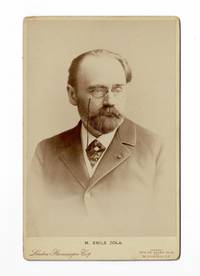
1900rif. 73358Londres London: London Stereoscopic Company 1900. Fine. London Stereoscopic Company Londres London 1900 10.70 x 16.60 cm une photographie au format carte cabinet Handsome original photographic portrait of Emile Zola in cabinet card format period print on albumen paper mounted on cardboard from the London Stereoscopic Company and taken by an unidentified photographer. The writer poses there rosette of the Legion of Honor at his buttonhole. Condemned for defamation after the publication of his famous ""J'Accuse!"" on the front page of L'Aurore and to escape prison Zola secretly fled to London on July 18 1898. On July 26 1898 the Legion of Honor was withdrawn from him. A snub to this France that did not understand him this ""rosette"" photograph was most likely taken after his removal from the order of the Legion of Honor. Exceptional state of conservation. London Stereoscopic Company unknown
1923rif. 346844Paris : Bibliotheque-Charpentier 1923. Various Edition. Hardcover. Finely and uniformly bound set in gilt blocked aniline calf over marble boards. Raised band gilt cross bands with gilt titles to the spines. A fine set. Includes previous owner's inscriptions. Physical description; 34 volumes. Contents; La Joie de Vivre: tome premier & tome second bound in one ; Les Soirées de Médan ; Germinal: tome premier & second bound in one ; Le Voeu D'Une Morte ; Contes a Ninon ; Pot-Bouille: tome premier & deuxieme bound in one ; Nouveaux Contes a Ninon ; Le Ventre de Paris ; Thérese Raquin ; Son Excellence Eugene Rougon: tome premier & deuxieme bound in one ; Nana: tome premier & deuxieme bound in one ; La Débacle: tome premier & deuxieme bound in one ; L'Argent: tome premier & deuxieme bound in one ; Les Mysteres de Marseille: tome premier & deuxieme bound in one ; Une Page D'Amour ; La Confession de Claude ; Le Docteur Pascal ; Vérité: tome premier & deuxieme bound in one ; La Faute de L'Abbé Mouret ; Madeleine Férat ; Paris: tome premier & deuxieme bound in one ; La Terre: tome premier & deuxieme bound in one ; Fécondité: tome premier & deuxieme bound in one ; La Fortune Des Rougon ; La Conquete De Plassans ; L'Assommour: tome premier & deuxieme bound in one ; Lourdes: tome premier & deuxieme bound in one ; Rome: tome premier & deuxieme bound in one ; La Bete Humaine ; Le Reve ; Le Capitaine Burle ; Travail: tome premier & deuxieme bound in one ; La Curée ; Les Personnages des Rougon-Macquart. Subjects; Zola Emile 1840-1902. French Literature. Paris : Bibliotheque-Charpentier hardcover
1909rif. 0008050LOS ANGELES CALIFORNIA. Good. 1909. On offer is an outstanding travel journal written by a young girl in California in the early years of the 20th century. This well-written journal measures 9.25 inches by 7.5 inches and contains 60 pages. It is 60% complete. The cover and pages are in good condition and the handwriting is legible and quite easy to read. Also included is a black and white photograph a map/itinerary and a number of newspaper clippings - all in very good condition. The author is Zola Grace Strawser a 14 year old school girl. Born in 1895 she grew up in Los Angeles where her father Bert was a successful businessman. She had 3 sisters - Nellie Merle and Bertie. Casual research has not discovered any additional biographical information. In July of 1909 she left on a long train trip from Los Angeles to the Worlds Fair in Seattle. Along the way she makes stops in Las Vegas and Salt Lake City amongst other places. She is a keen observer and her descriptions are detailed and well-written. "The train slowly pulled out of the Salt Lake City Station and our long hoped for journey began. Nellie Merle Bertie Papa and Daisy Clark were there to say "goodbye." Daisy Clark gave us our first box of candy and also a beautiful bunch of carnations. The ride to Pomona was not so interesting as we made so many trips to San Bernardino before. Our next stop was Ontario. From Ontario you have a very beautiful view of the mountains which is very interesting. We next passed through Riverside and Coulton and arrived in San Bernardino 12:12. Between Los Angeles and San Bernardino can be seen orange trees and mountains while from San Bernardino is a vast stretch of desert. We then went to lunch and from the window you could see right down between the mountains on which were some snow. I saw an automobile filled with men and for a long time had great fun waving back and forth. They at last got ahead of us. We had to go so slow up a high incline . the rest of the landscape was desert desert desert. ." July 8. In Salt Lake City she visited a number of sites: ". we saw all the important buildings the temple tabernacle the Lion House Bee Hive grave of Brigham Young and the "Eagle Gate" July 9. She goes out to visit Saltair - an amusement park and resort built at the south end of Great Salt Lake. At one time Saltair was the largest and most popular family resort west of New York. Today it is abandoned a victim of shrinking water and the ravages of a changing climate. Each day's entry is accompanied by a small pen and ink drawing representing some remark in the entry. She writes an excellent description of a wedding accompanied by a drawing of wedding bells and music notes and the inscription "No Wedding Bells For Me.: "THE WEDDING: Talk about your presents you ought to have seen Bessie's. Cut glass china silverware well it was enough to make anyone wish it was them getting married. She also received four chairs three tables bedding and linen. The few people assembled to see her married arrived about half past seven. Bessie who was naturally nervous broke right down and cried but as soon as the ceremony was over she was as happy as a lark and was receiving many congratulations. Well while we are waiting for the guests to arrive I will describe the appearance of the house. The rooms were all decorated in carnations roses ferns palms and small trees. On the electric lights were twined smilax and over the globes were different color flower shades. The long porch was made beautiful with small green palms and at the father end a Hawaiian orchestra played the whole evening. The yard which was very large was strung with lanterns of all manner and shapes. There was a wall of canvas all around so as to keep intruders out. The guests have now arrived and the air was sweet with lavender and violet perfume. Ladies with low neck chiffon dresses; with white satin evening coats; ladies with the tight fitting empire ladies in simple white ladies in red pink blue and every imaginable color. In the evening lunch was served and while the bride and groom were eating they threw handfuls of rice at them. Of course their dinner was spoilt and they had to get more dinner. About an hour after the bride and groom were missed and the whole party set out to look for them. The bride was found and the girls who were quite rough drew her across the bed and a hat pin stuck in her and hurt her. Mrs. Brook fought them and Bessie got free again and escaped in the crowd and hid in the cellar. She was so scared and sick that she could hardly stand. She then slipped in the back bedroom and changed her wedding dress for her brother's clothes. There she slipped in the automobile barn until the crowd had gone around the front and slipped over the fence and went in the house next door and mingled with the crowd who did not know her dressed as a boy. Cora the girl next door put on a long black coat and put something over her head. Her brother was waiting in a buggy outside. With one jump Cora was in the buggy and was driving away as fast as possible. The whole party thought it was Bessie and Vic and started after the buggy. Cora's brother had heart trouble and when they were about a block away he fainted and Cora had to drive home with her brother in her arms. When she reached home she fainted and they had an awful time. Of course the crowd found it was not the bride and groom. The bride and groom left for the canyon 20 min. to one. While all the excitement was going on the groom was next door asleep." July 14. After a number of adventures she continues her trip to Seattle and the World's Fair: "In the morning Irene mother and I went to the fairgrounds. I can't very describe how they look only by showing you postcards. They have an imitation geyser which goes up and down all the time. "The Cascades" are simply beautiful. You can stand at the top and look right over the falls and the geyser and see Mt. Rainier. The buildings are all white and the flowers are beautiful. In the evening we went to a show and saw the smallest woman in the world "Princess Checita" July 31. We again went to the fair and visited many buildings. Our feet were just covered with blisters from all the walking up the hills. Mama isn't feeling well. She is lonesome for papa. Aug 1 "As this was to be our last day at the fair we visited all the buildings we had not seen before. In the government building were articles from the "Dead Letter Office." Skulls snakes a pig's tail money jewelry a bustle the hair of a woman who had been scalped guns swords and all manners of weapons beads small funny statues locks of hair old books and dirty table covers pencils and everything imaginable. We had a nice time at the fair and had our pictures taken several times."Aug 6. Before they return to Los Angeles they travel up to Portland on August 8th and on the 9th take a boat trip up the Columbia River all the way to The Dalles. There are two brochures included from this trip and two pages of wonderful descriptions. On Aug 11th they board their train for their return trip. She arrived back in San Francisco on Aug 12th and met her father the next day: ". In the evening we took dinner at the Cafe Bismark a German-influenced restaurant in San Francisco in the 1900s. It was called "the largest and finest café in the city." and then went to the Orpheum a long-vanished vaudeville theatre. After the theatre we met papa on his way to Chicago. Aug 13. Her trip ends when she reaches home on Aug 17th. Following her account of the trip are 4 pages with some notes made in 1910 and 1911. "Nellie and I gave a masquerade party" Dec 3 1910 "Merle Bertie and Mother and I start for Catalina to spend the month."Aug 3 1911. A historian looking at the early history of California would find this journal simply rich in local detail. The descriptions are excellent and her keen eye misses nothing. There are interesting observations about the towns she visits and the people she encounters. It is clear that she comes from a well-to-do family and this would be an interesting contrast to the majority of people living in California at this time.; Manuscript; 4to - over 9¾" - 12" tall; KEYWORDS: HISTORY OF EARLY 20TH CENTURY 1900S PROGRESSIVE ERA UNITED STATES CALIFORNIA LOS ANGELES ZOLA GRACE STRAWSER; BERT STRAWSER; ACME LAUNDRY; SAN BERNARDINO; SEATTLE WORLD FAIR 1909 BISMARK CAFE; ORPHEUM THEATRE DEAD LETTER OFFICE DLO TRAVEL JOURNALS TRAVEL BY RAIL EXPOSITIONS FAIRS TRAIN JOURNEYS TRAIN TRIPS WEDDING CEREMONIES BLACK AND WHITE PHOTOS MAPS DRAWINGS SOCIAL HISTORY AMERICANA HANDWRITTEN MANUSCRIPT DOCUMENT LETTER AUTOGRAPH WRITER HAND WRITTEN DOCUMENTS SIGNED LETTERS MANUSCRIPTS DIARY DIARIES JOURNALS PERSONAL HISTORY SOCIAL HISTORY HISTORICAL HOLOGRAPH WRITERS AUTOGRAPHS PERSONAL MEMOIR MEMORIAL ANTIQUITÉ CONTRAT VÉLIN DOCUMENT MANUSCRIT PAPIER ANTIKE BRIEF PERGAMENT DOKUMENT MANUSKRIPT PAPIER OGGETTO D'ANTIQUARIATO ATTO VELINA DOCUMENTO MANOSCRITTO CARTA ANTIGÜEDAD HECHO VITELA DOCUMENTO MANUSCRITO PAPEL . hardcover
1890rif. 76845Reliure postérieure demi-maroquin lavallière avec coins. Dos à nerfs avec date dorée en queue. Tête dorée. Couverture conservée. Non rogné. Petites taches sur les angles des pages 244-245.
1892rif. 76911Reliure demi-maroquin marron à coins. Dos à nerfs orné de caissons dorés. Tête dorée. Couverture et dos conservés. Non rogné. Est ajouté in fine Retour de Voyage, réponse au capitaine Tanera. Un des 40 exemplaires sur Hollande. Coins frottés.
1888rif. 81650Reliure demi-maroquin corail à coins. Dos lisse orné de losanges et de pointillés dorés et pièce de titre de maroquin noire. Toutes tranches dorées. Couverture et dos conservés.
1879rif. 81825Reliure demi-maroquin rouge à coins. Dos à nerfs avec date dorée au talon et caissons bordés de multiples filets à froid. Tête dorée. Couverture conservée. Reliure signée DEVAUCHELLE.
1890rif. RFERPAG00twCirca 1890. Very Good. Ferris Jean Leon Gerome. Page of Love. 20 framed prints of watercolors by Jean Leon Gerome Ferris for Emile Zola's novel Une Page d'Amour. Zola Emile. NP: NP Circa 1890. 10x15 cm images in 29x34 cm frames. Framed illustration prints. Book condition: Very good. 20 delicate watercolors depicting scenes from Zola's novel. Beautifully reproduced and matted in buff and moss green in gold-painted wooden frames. Jean Leon Gerome Ferris 1863-1930 was an American painter. unknown books
1871rif. elala172Paris Brussels : Librairie Internationale A.Lacroix Verboeckhoven Et Cie. 1871. 1871. 18mo. pp. 360. A fine copy untrimmed in original printed wrs. preserved in slipcase with morocco-backed chemise. First Edition issue with publication date 1872 on front wrapper. There was no limited issue on large paper. Variously translated into English as The Rush for the Spoils The Hounds Fee and more recently The Kill La Curée is the scarce second novel from Zolas great twenty-volume Rougon-Macquart series the chief monument of the French Naturalist Movement which explores the scientific theme of the determing influence of heredity on character. The book was immediately censored upon publication. Vicaire VII 1202. 1st Edition. Soft cover. Fine. Paris, Brussels : Librairie Internationale, A.Lacroix, Verboeckhoven Et Cie., 1871. Paperback
1890rif. RFERPAG00twCirca 1890. Very Good. Ferris Jean Leon Gerome. Page of Love. 20 framed prints of watercolors by Jean Leon Gerome Ferris for Emile Zola's novel Une Page d'Amour. Zola Emile. NP: NP Circa 1890. 10x15 cm images in 29x34 cm frames. Framed illustration prints. Book condition: Very good. 20 delicate watercolors depicting scenes from Zola's novel. Beautifully reproduced and matted in buff and moss green in gold-painted wooden frames. Jean Leon Gerome Ferris 1863-1930 was an American painter. unknown
1869rif. 005298Paris: Librairie Internationale 1868 9 1869. SECOND EDITION PRESENTATION COPY. 1 vol. 7-1/4" x 4-7/8" inscribed by the author on half title "A M. Aug. Mar offert par s'auteur Emile Zola" 12mo. original green printed wrappers dated 1869 with a dedication to Edouard Manet housed in a green morocco backed slipcase raised bands gilt lettered spine. Uncut as issued chipping to front and rear wrappers slight slant to spine first 2 signatures loose completely unsophisticated. According to RBH only two inscribed copies of this title have ever appeared at auction. One of them being this copy which sold in 1974. The other copy was a later 1892 edition. Paris: Librairie Internationale, 1868 (9) hardcover
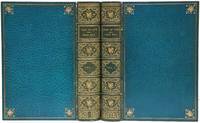
1897rif. 143835Philadelphia: George Barrie & Son 1897. Hardcover. Near fine. Edition Magnifique of Chefs-d'Oeuvre du Roman Contemporian Realists. Limited to five copies. viii 319; viii 361 pp. unpaginated plates. 2 Volumes. Octavo hardcover. Bound in full teal levant morocco leather boards designed with impressed gilt decorations double ruled in gilt. Spines with 5 raised bands each divided in six compartments decorated and lettered in gilt slightly darkened. All edges trimmed and gilt. Each volume with a vertical fore-edge painting. Inner side of the boards covered with terra cotta levant morocco doublures elaborately decorated impressed in gilt designed in green blue and white. Joints starting as usual to the fore-edge painting books. Pale blue moiré silked free endpapers; the majority of the blue silk has become detached and is laid-in in incomplete pieces. Free endpapers toned with light pencil notations. Small gallery labels to rear free endpapers recto. Illustrated with monochrome copper etchings each with a hand-coloured douplicate some guarded with tissue paper. Leaves bright and charming tight binding. Near fine condition. 2 volumes each with a fore-edge painting. vol. 1 depicting a couple standing together vol. 2 depicting a nude woman holding a child. Limited edition of five copies of which this is number one. Printed only for subscribers. Hammer Galleries typed letter signed on their stationary laid in dated March 1941 From the Estate of Randall J. Moskovitz MD Memphis Tennessee. 1897 George Barrie & Son hardcover
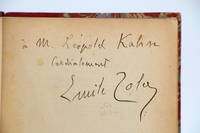
1892rif. 84801Paris: Charpentier 1892. Fine. Charpentier Paris 1892 12.50 x 19 cm relié First edition. Half red morocco binding spine with five raised bands date gilt at foot restoration to head of one joint marbled paper boards endpapers and pastedowns of combed paper bookplate mounted at head of one pastedown top edge gilt contemporary binding. Occasional light foxing. A handsomely bound copy. Autograph inscription signed by Emile Zola to Léopold Kahn who was Calmann-Lévy's principal collaborator. Charpentier hardcover