Emile ZOLABiblio.com
6848 risultati
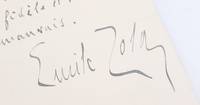
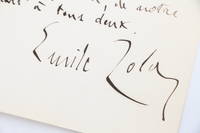
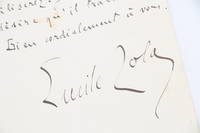
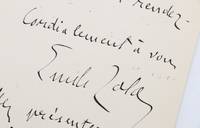
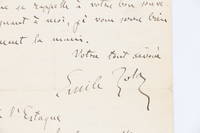
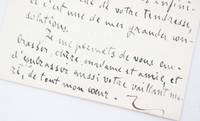
1898rif. 867501898. Fine. ""The nervous and passionate man that I am is not made for exile for resignation and silence"" 15 décembre 1898 13.50 x 20.50 cm quatre pages sur un bifeuillet Autograph letter initialed by Emile Zola dated in his hand April 10 1898. Four pages in black ink on a bifolium addressed to Octave Mirbeau's wife. Horizontal fold mark inherent to mailing very rare and discrete foxing on the first leaf. A particularity of this exile correspondence Zola chose to omit his signature in his letters - or as here to initial only protecting himself from censorship or police investigations. Published in his Complete Works vol. XXV ed. F. Bernouard 1927 p. 820. Heart-wrenching letter by Zola written in complete exile the most unknown retreat the most absolute silence. The justiciar writer is secluded in England forced to leave Paris after being condemned to the maximum penalty for having written ""J'accuse!"" during these cruel hours. After his historic cry from the heart in l'Aurore Zola was condemned a first time by the Seine jury on February 23 1898 to one year in prison and three thousand francs fine. The judgment was annulled on appeal and the case was referred to the Versailles assizes which retained only three lines out of the eight hundred that ""J'accuse!"" contains as the charge. To not accept such a stifling of the debates Zola's defense decided to default and the condemnation was confirmed. The very evening of his tumultuous exit from the Palace of Justice Clémenceau and his lawyer Labori advised him to leave the country before the judgment could become executable. The writer struggles to bear this voluntary exile so contrary to his character and opens his heart in this missive he addresses to Mirbeau's wife who was for him unconditional support alongside her husband. He does not hide the feeling of guilt that gnaws at him and exposes his strategy: ""Dear Madam and friend what a good and comforting letter you wrote to me! I confess that I needed this cordial somewhat for the nervous and passionate man that I am is not made for exile for resignation and silence. You perfectly guessed that my torture is to be sheltered in too much peace and security while others are fighting. And you know that my resolution was taken to say nothing to anyone and to return one fine morning. Now here you are writing to me and you are not the only one everyone writes to me that I must stay where I am under penalty of unleashing the worst catastrophes. I don't believe it I confess I remain convinced that my project was brave even useful and that we would have been victorious once more. But faced with unanimous opinion I must bow. As I write to Labori this is the greatest sacrifice I have yet made to the cause for one cannot imagine all that I suffer here morally intellectually in the powerlessness to act in which I find myself. And I do not speak of my poor heart torn from all that it loved. As for leaving this country I will not even attempt it. All my suffering would be renewed. I have reflected on it at length all good reasons are that I stay where I am even if the affair must last months more. It seems to me that this is better for it would only be lacking that I go amuse myself in the sun while others are fighting. You already guess the articles of the vile press France sold to Italy for the thirty pieces of silver of Judas. Tell your husband how much I love and admire him. There he is thrown into action too and he behaves superbly in it. Thanks also to both of you for the affection with which you surround my dear wife devoting yourselves to our interests ensuring that she is not alone in Paris in the midst of battle. I am infinitely touched by your tenderness and it is one of my great consolations. I take the liberty of embracing you dear madam and friend and of also embracing your valiant husband with all my heart."" While his own camp forces him into exile events unfold in Fran unknown
1898rif. 86837Weybridge 1898. Fine. In the midst of universal cowardice you wouldn't believe how moved I am to feel a few faithful people around me Weybridge 19 août 1898 13.50 x 20.50 cm quatre pages sur un bifeuillet Autograph letter signed by Emile Zola to Octave Mirbeau dated August 19 1898. Four pages in black ink on a bifolium written to Octave Mirbeau. Usual trace of horizontal fold. Published in Zola's uvres complètes t. XLIX ed. F. Bernouard 1927 p. 808. Exceptional testament of friendship and self-sacrifice from Emile Zola in exile after being sentenced to the maximum penalty for writing ""J'accuse!"" the most famous article proclaming Captain Dreyfus's innocence. After his historic article in L'Aurore Zola was sentenced a first time by a jury on February 23 1898 to one year's imprisonment and a fine of three thousand francs. The verdict was overturned and the case was referred back to the Versailles court of justice which upheld only three of the eight hundred lines in ""J'accuse!"" as a charge. Unwilling to accept such a stifling of the proceedings Zola's defense decided to default and the conviction was upheld. After his eventful exit from the courthouse Clémenceau and his lawyer Labori advised him to leave the country before the judgment could become enforceable. Zola left on the last train that evening with only a shirt hastily rolled up in newspaper as luggage. A month after his departure the writer writes this superb reply to a letter from his loyal supporter Octave Mirbeau who had written to him a few days earlier: ""We think only of you; there isn't a minute of our existence that you don't fill entirely"" August 14 1898. Settled in the London suburb of Weybridge he angrily receives the ""echoes of Paris"" and is enraged to see Esterhazy the true culprit of the Dreyfus Affair once again cleared - this time by civil courts. ""My dear friend Thank you for your kind letter . In the midst of universal cowardice you wouldn't believe how moved I am to feel a few faithful people around me. My existence here has become possible since I've been able to get back to work. Work has always comforted me saved me. But my poor hands are still trembling with a shiver that cannot end. You wouldn't believe the outrage I feel at the echoes from France that reach me. In the evening when daylight falls I think it's the end of the world. You think I should go back and make myself a prisoner without returning to Versailles. That would be too good to have the peace of prison and I don't think it's possible. I didn't set out to go back like that; our attitude would be neither logical nor beautiful. Rather I think I'm in indefinite exile unless I run the abominable risk of a new trial. Besides we won't be able to make up our minds until October. And by then who knows Although I'm counting on a miracle in which I have little faith. So let us be brave my friend and let our work be done! If I can keep working things won't be too bad yet. . I shake your hand my good friend the faithful and rare friend of bad days"". Poignant manuscript confession from Zola forced into exile. Death would strike him in the midst of his glory days without him ever knowing the outcome of the affair he had devoted so many years of struggle. unknown
1901rif. 87263Paris 1901. Fine. ""I have finished my crushing task and I am going to rest a little because I am exhausted"" Paris 4 Mars 1901 13.50 x 20.50 cm deux pages sur un bifeuillet Autograph letter signed by Emile Zola addressed to Octave Mirbeau dated in his hand March 4 1901. Two pages in black ink on a bifolium. Horizontal fold mark inherent to postal delivery. Published in his Correspondence vol. X p. 242. Precious letter from Zola to his great supporter Octave Mirbeau who had paid his fine at the end of his second trial for ""J'accuse!"". Now amnestied the writer attempts - in vain - to recover the sum to reimburse him. After his historic cry from the heart in l'Aurore Zola was first condemned by the Seine jury on February 23 1898 to one year in prison and a three thousand franc fine. The judgment was overturned on appeal and the case was referred to the Versailles assizes which retained only three lines out of the eight hundred that make up ""J'accuse!"" as grounds for accusation. To avoid accepting such a stifling of the debates Zola's defense decided to default and the conviction was confirmed on July 18 - Zola left that very evening for London to avoid prison. The tribunal also demanded 7555 francs from him which Mirbeau spontaneously decided to pay from his own funds. It was also Octave Mirbeau who prevented the seizure of Zola's furniture by obtaining from Joseph Reinach the 40000 francs in damages that Zola had been condemned to pay to the three pseudo-experts in handwriting that he had ""defamed"" in J'accuse!. Following the amnesty law that ended judicial proceedings for ""all criminal or delictual acts connected to the Dreyfus affair"" Zola was acquitted but was not reimbursed. This letter attests to the writer's desire to compensate Mirbeau for his act of generosity: ""Labori his lawyer will attempt an approach to try to recover the seven thousand and some francs that you paid on my behalf for the Versailles affair. He simply wishes to have a letter from you in order to show it and thus be authorized to speak in your name. You certainly do not have down there the receipt that was issued to you. Perhaps you remember its terms. In any case if we must wait we will wait for nothing is urgent after all. The important thing today is only to test the ground to see if they will return the money to us"". However the prosecutor's office refused his request. Furious Zola wrote two days later a letter to Labori asking him to give up claiming the slightest cent - he published it in L'Aurore under the title ""Let them keep the money"": ""they torture the text of the law and the State too keeps the money. If the prosecutor's office persists in this interpretation it will be yet another monstrosity in the unworthy way they have refused me all justice . I do not want to be complicit by accepting anything whatsoever from their amnesty ."". According to Pierre Michel these unsuccessful recovery attempts of which this letter bears witness ""incited Zola to adopt an attitude that emphasizes even more his disinterestedness and that of his 'friend' who is not named in the L'Aurore article probably at Mirbeau's request."" Dreyfus's pardon and the amnesty of his supporters did not satisfy the writer but nevertheless marked the end of long years of struggle: ""I have finished my crushing task and I am going to rest a little because I am exhausted"". Struck down in full glory the following year he would not be able to witness Captain Dreyfus's rehabilitation. Beautiful lines from Zola to Mirbeau who gave him the means to continue his fight for justice. unknown
1893rif. 84893Paris 1893. Fine. Paris 5 Avril 1893 13.50 x 20.50 cm une page et demie Autograph letter dated and signed by Emile Zola 23 lines in black ink on a page and a half addressed to press baron Arthur Meyer Folds inherent to postal delivery. Emile Zola intervenes with Arthur Meyer proprietor of the high-circulation newspaper ""Le Gaulois"" on behalf of his friend Louis de Robert: ""Vous sentirez comme moi que c'est un garçon d'avenir et je suis convaincu que vous l'utiliserez. Je le connais et je désire qu'il travaille."" ""You will feel as I do that he is a young man with a future and I am convinced that you will make use of him. I know him and I want him to work."" in whom he recognizes a talented writer: ""Me permettrez-vous de vous recommander un de mes jeunes confrères Louis de Robert dont j'ai lu les chroniques charmantes. Je crois que vous devriez l'encourager le mettre à l'essai car vous trouveriez en lui un excellent rédacteur pour ""Le Gaulois""."" ""May I recommend to you one of my young colleagues Louis de Robert whose charming chronicles I have read. I believe you should encourage him put him to the test for you would find in him an excellent editor for 'Le Gaulois'."" unknown
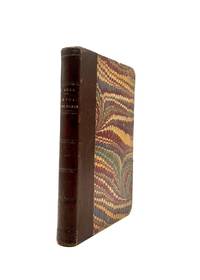
1866rif. 85365Paris: Achille Faure 1866. Fine. Achille Faure Paris 1866 11 x 18 cm relié The rare first edition of this early novel by the author overshadowed by the Rougon-Macquart series but which prefigures naturalism and whose story is based on a news item. The novel is followed by Esquisses parisiennes a collection of 4 short stories. The second edition would not appear until 1889 with Charpentier. Contemporary half-brown shagreen binding. Smooth spine decorated with black fillets. Signs of rubbing and corners slightly bumped. Achille Faure unknown
1893rif. 85495Paris: Charpentier 1893. Fine. Charpentier Paris 1893 12 x 19 cm relié First edition on ordinary paper. The genealogical table is lacking in our copy. Half-red shagreen binding spine with four raised bands decorated with triple gilt compartments gilt name at foot blind-ruled frame on red paper boards pebbled paper endpapers and pastedowns contemporary binding. Charpentier hardcover
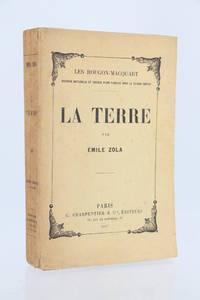
1887rif. 85323Paris: G. Charpentier & Cie 1887. Fine. G. Charpentier & Cie Paris 1887 12 x 19 cm broché First edition printed on ordinary paper. Heavy foxing primarily at the beginning and end of the volume. In original wrappers as issued. G. Charpentier & Cie unknown
1922rif. 85646Paris: Editions Mornay 1922. Fine. Editions Mornay Paris 1922 15.50 x 20.50 cm broché Edition illustrated with 1 frontispiece in colors 2 figures hors-texte 1 title vignette 50 head-pieces 50 initials and 50 tailpieces finely engraved on wood after drawings by Maurice Achener one of 946 numbered copies on deckle-edged paper. Endpapers very lightly and partially shadowed without any significance. Handsome copy of this work adapted for cinema by Georges Franju in 1970 with in the main roles Francis Huster Gillian Hills and Lucien Barjon. Editions Mornay unknown
1880rif. C216217Paris: G. Charpentier 1880. Hardcover Hardcover. Very Good. Early reprint 1880. Small octavo. 524pp. Bound in contemporary black cloth with gilt spine titles. Slight wear and rubbing to covers slight nicking to spine ends and splitting to upper spine hinge lacks front endpaper pages with tanning to edges and slight scattered foxing otherwise near very good. No jacket. G. Charpentier, hardcover
1894rif. 85696Paris: FlammarionHenri Floury 1894. Fine. Flammarion Henri Floury Paris 1894-1896 17.50 x 26 cm 2 volumes en reliures de l'éditeur First edition of each volume. Publishers full burgundy cloth bindings flat spines blue endpapers and pastedowns original wrappers preserved for the second volume front cover preserved for the first volume gilt top edges. Minor discoloration spots on the boards. The first volume includes 75 biographies of notable figures of the time each featuring a facsimile autograph and a wood-engraved portrait by Brauer including Paul Arène Léon Cladel Coquelin ainé Charles Gounod Frédéric Mistral Albert Robida Octave Uzanne. The second volume contains 76 biographies each with a facsimile autograph and a wood-engraved portrait by Brauer of figures such as Auguste Bartholdi Benjamin Constant Georges Courteline Alexandre Dumas Thomas Edison Judith Gautier Jules Massenet Catulle Mendès Henri Rochefort Georges Rochegrosse Emile Zola. Some light foxing. A handsome set. FlammarionHenri Floury hardcover
1969rif. 89111Éxito 1969. hardcover. Aceptable. Barcelona 1969. Éxito. Grandes Novelas de la Literatura Universal nº24. Guaflex con dorados. 518 pp. 20x14. Sello anterior propietario. Falta en cubierta delantera. Éxito hardcover
1992rif. 34826Translated and edited with a preface by Ernest Alfred Vizetelly 1992. unbound. Bueno. Translated and edited with a preface by Ernest Alfred Vizetelly. London 1900. Chatto and Windus. 412 pp. 19 x 13. Tela. En inglés. Translated and edited with a preface by Ernest Alfred Vizetelly unknown
1900rif. 79245La España Moderna 1900. hardcover. Bueno. Madrid s/f. 1900. La España Moderna. Cartoné lomo piel. Dos tomos en un volumen. 297303 pp. 17x11. La España Moderna hardcover
1921rif. 65387Eugéne Fasquelle Éditeur 1921. hardcover. Aceptable. París 1921. Eugéne Fasquelle Éditeur. Bibliothèque Charpentier. 2 volúmenes. 302296 pp. 19x12. Cartoné lomo piel. Cubiertas algo deslucidas. Cantos y lomo algo rozados. Texto en francés. Eugéne Fasquelle, Éditeur hardcover
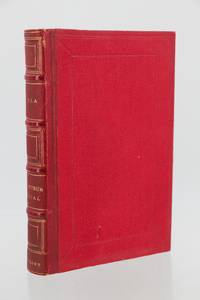
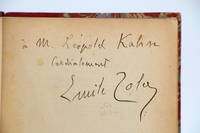
1892rif. 84801Paris: Charpentier 1892. Fine. Charpentier Paris 1892 12.50 x 19 cm relié First edition. Half red morocco binding spine with five raised bands date gilt at foot restoration to head of one joint marbled paper boards endpapers and pastedowns of combed paper bookplate mounted at head of one pastedown top edge gilt contemporary binding. Occasional light foxing. A handsomely bound copy. Autograph inscription signed by Emile Zola to Léopold Kahn who was Calmann-Lévy's principal collaborator. Charpentier hardcover
1875rif. 83515Paris: Charpentier & Cie 1875. Fine. Charpentier & Cie Paris 1875 11 x 17.50 cm relié First edition of which no copies were printed on deluxe paper. Half red shagreen binding smooth spine decorated with triple gilt fillets gilt roll at foot marbled paper boards marbled paper endpapers and pastedowns rubbed corners contemporary binding. Some light foxing. A fine and very rare copy. Charpentier & Cie hardcover
1882rif. 83518Paris: Charpentier & Cie 1882. Fine. Charpentier & Cie Paris 1882 11 x 17.50 cm broché First edition one of 250 numbered copies on Holland paper the only deluxe copies after a few rare copies on China paper. First cover skillfully restored printed library stamp with numbering on the half-title page. Copy as issued. Charpentier & Cie unknown
1890rif. 659AG1890. um Um 1890. Photographie Portrait. Format: 125 x 85 cm. aufgezogen auf Karton 233 x 148 cm. Mit kleiner Fehlstelle. unknown
1890rif. 84423Paris 1890. Fine. Paris 20 Février 1890 13.50 x 20.50 cm une page Autograph letter dated and signed by Emile Zola 12 lines in black ink addressed to librettist Louis Gallet concerning the operatic adaptation by Alfred Bruneau of the novel ""Le rêve"". Folds inherent to postal dispatch. Emile Zola was to meet jointly with Alfred Bruneau who had adapted the novel ""Le rêve"" for the opera and Louis Gallet the librettist of this adaptation. ""Je vous attends demain matin. pour causer des trois derniers tableaux. J'écris également à Bruneau pour lui donner rendez-vous"" ""I await you tomorrow morning. to discuss the last three tableaux. I am also writing to Bruneau to arrange a meeting with him"" and shows himself very satisfied with this prospect: ""Tout va bien."" ""All goes well."" unknown
1928rif. 849P36London: T. Werner Laurie LTD 1928. Vellum. Near Fine/Very Good Indeed. 9" by 6.5". Toulouse Lautrec. A lovely limited edition of one of Emile Zola's best known works looking at alcoholism. Signed by the translator Arthur Symons. A limited edition limited to one-thousand copies numbered and signed this copy numbered six-hundred and forty-seven.Signed by the translator Arthur Symons to the edition page. In the original publisher's unclipped dustwrapper. 'l'Assommoir' is one of Zola's novels in his Rougon-Macquart series. This novel is a study of alcoholism and poverty in the working class life in Paris. Emile Zola was an influential writer who is known for leading the literary school of naturalism. His novels show the prosperity and poverty in France during the nineteenth century. Translated from French by Arthur Symons. Symons was a poet editor and critic. His other works include 'A Book of Parodies' 'Tristan and Iseult: A Play in Four Acts' 'Love's Cruelty' 'Figures of Several Centuries' 'The Cafe Royal and Other Essays' and more. With a frontispiece after 'The Drinking Place' by Toulouse Lautrec. Additional spine label bound in to the rear. In the original publisher's quarter paper vellum binding with cloth to the boards in the original unclipped dustwrapper. Externally smart. Spine and joints are a little discoloured as is usual with paper vellum. A few spots to the spine label. Minor bumping to the head and tail of the spine and to the extremities. Prior owner's ink inscription to the recto of the front free endpaper and to the recto of the rear free endpaper. Dust wrapper is smart with minor edge wear. Spine is a little age-toned. A few minor marks to the wraps including a larger mark to the tail of the spine. Internally firmly bound. Pages are bright and clean. Near Fine T. Werner Laurie LTD hardcover
1884rif. 1533Light brown cloth with paper label which is chipped and scratched on spine. Boards pushed in at bottom corner. Rubbing to boards. Some creasing to spine. Front hinge cracked. Frontispiece detached and laid in. Translated from the 97th French edition. Illustrated with sixteen page engravings from designs by Bellenger Clairin Amdre Gill Leloir Rose and Vierge. Pages browned. Some brown spots to front illustrations. Previous owner's name label affixed to front pastedown. Decorative endpapers green floral pattern. Half title page has a tear and hole near top and hole near bottom. 16 pages of ads dated July 1884 at rear. Vizetelly & Co. hardcover
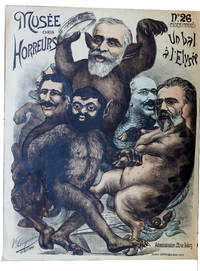
1900rif. 80343Paris: Imprimerie Lenepveu 1900. Fine. Imprimerie Lenepveu Paris s. d. mai 1900 49.80 x 65.20 cm une affiche Musée des horreurs Original colour lithographed poster n° 26 exceptionnel Un bal à l'Elysée Imprimerie Lenepveu Paris May 1900 498 x 652 cm one poster Original colour lithographed poster depicting Émile Loubet as a bear holding a tambourine marked Panama Émile Zola as a pig Dreyfus as a hydra Joseph Reinach as a monkey the rabbi Kadoc Kahn as a donkey and Georges Picquart as a dromedary. This imposing poster featuring several people already caricatured in the previous issues is a direct reference to the Panama Scandal. This large-scale corruption affair which saw the resignation of Émile Loubet then Minister of Finance is re-referred to here because of the Judaism of some of is protagonists. It is Drumont through his magazine La Libre Parole who revealed the Panama Scandal denouncing the alleged alliance between the secular Republic and the Jewish high bank and thus contributing to the strengthening of the stereotype of the Jew eager for money: The deputy Joseph Reinach cousin and son-in-law of the baron Jacques de Reinach compromised in the scandal focuses the hatred of the polemicist. A republican close to the business world a free thinker Reinach is undoubtedly with Alphonse de Rothschild the man most attacked by the anti-Semites of the time. His wealth the vast networks of influence available to him his early involvement with Gambetta the memory of his campaigns against Boulangism and his equivocal role in the Panama affair make him the man to slaughter in order to return France to the French. Grégoire Kauffmann Rothschild & Cie. La bourgeoisie juive vue par Édouard Drumont in Archives Juives 2009 As for Émile Zola his novel L'Argent published in 1891 denounces the misappropriation of this financial scandal but his support for Alfred Dreyfus earned him his place in this nightmarish animal circle. Circulated between October 1899 and December 1900 in a France set ablaze by the Dreyfus Affair these immense colour portraits are the work of Victor Lenepveu who announced the publication of 150 and then 200 drawings before finally producing only around fifty. Despite the 1881 law on the freedom of press allowing the dissemination of a politically subversive image the publication of this nightmarish pantheon was interrupted by order of the Ministry of the Interior. The fragility of the paper and the imposing size of these very violent posters as well as their almost immediate seizure by the police contributed to the disappearance of these caricatures which strongly left a mark on public opinion. These horreurs were widely promoted by anti-Semitic newspapers that announced a fantasised print of 300000 copies thus insinuating the success of anti-Semitic ideas in the population. On 1st October 1899 L'Intransigeant announced the publication of the Musée des horreurs in its columns: Un dessinateur de beaucoup d'esprit au coup de crayon d'un comique intense M. V. Lenepveu a eu l'heureuse idée d'inaugurer une série de portraits des vendus les plus célèbres de la tourbe dreyfusarde. Le titre de cette série « Musée des Horreurs » est suffisamment suggestif et indique bien ce qu'il promet. . C'est la maison Hayard qui mettra en vente à partir d'aujourd'hui le numéro 1 de cette désopilante série. An artist of great spirit with an intense comical pencil stroke M. V. Lenepveu had the happy idea of inaugurating a series of portraits of the most famous sellouts of the Dreyfusard rabble. The title of this series Musée des Horreurs is sufficiently suggestive and is a good indicator of what it promises. . It is Maison Hayard that will put up for sale from today issue number 1 of this hilarious series. First a peddler then a bookseller-publisher Napoléon Hayard known as Léon Hayard specialised in the marketing of anti-Dreyfusard and anti-Semitic ephemera and advertisem Imprimerie Lenepveu unknown
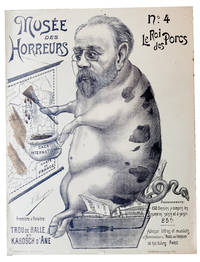
1899rif. 80330Paris: Imprimerie Lenepveu 1899. Fine. Imprimerie Lenepveu Paris s. d. novembre 1899 49.80 x 65.20 cm une affiche Musée des horreurs Original colour lithographed poster n° 4 Le Roi des Porcs Imprimerie Lenepveu Paris November 1898 498 x 652 cm one poster Original colour lithographed poster depicting Émile Zola in the shape of a pig sitting on a tub containing his fictional works and smearing international poop on the map of France. Transverse folds some tiny tears two small holes above Zola's head without affecting the image. The representation of Émile Zola as a pig does not date back to Lenepveu as Guillaume Doizy highlights in his article dedicated to pig caricatures Le porc dans la caricature politique 1870-1914: une polysémie contradictoire in Sociétés & Représentations n°27 2009: For the end of the 19th century we also think of the many caricatures of which Zola was the victim and which associate excrement symbols of naturalism with pigs. Dozens of images could be mentioned. In the 1880s Sapeck imagined the naturalist naked a vine leaf hiding his genitals a veiled reference to the supposed pornography of his writings sitting astride a pig feeding on his excrement a long-lasting symbol called to stigmatise the new literary school. In a caricature dated 1898 Alfred Le Petit shows a Zola-pig defecating on the tricolore flag. Barely a month after the publication of his famous J'accuse the writer defending the Dreyfusard cause is accused of defiling France and especially its Army by defending the traitor Dreyfus and Prussia considered the eternal enemy. The pig is dirty but above all it dirties defiles by the effect of its harmful will. The same year Caran d'Ache portrayed the weapons of the Dreyfusard press as a big pig sprawled in muck and covered with mud. . In his series Le Musée des horreurs the very right-handed Lenepveu violently attacks Zola. The writer is depicted as a piglet sitting on a box of waste containing his own works the fruit of his defecations prominently including La Terre and Nana. He soils a map of France with his international poop contained in a chamber pot that he spreads with a small brush. The artist is of course aiming at the Dreyfus defender through his famous J'accuse and Jewish cosmopolitanism smearing France with his support for treason. The soiling-pig association seems obvious and primordial. As for Napoleon III the pig's dirt reinforced here by the visible excrement stigmatises the target's political choices. Lenepveu defines Zola's ideas as works of unworthiness intestinal and dripping products. Although this is not the first porcine representation of Émile Zola the one that features prominently in Lenepveu's Musée is undeniably by its realism the most violent. Circulated between October 1899 and December 1900 in a France set ablaze by the Dreyfus Affair these immense colour portraits are the work of Victor Lenepveu who announced the publication of 150 and then 200 drawings before finally producing only around fifty. Despite the 1881 law on the freedom of press allowing the dissemination of a politically subversive image the publication of this nightmarish pantheon was interrupted by order of the Ministry of the Interior. The fragility of the paper and the imposing size of these very violent posters as well as their almost immediate seizure by the police contributed to the disappearance of these caricatures which strongly left a mark on public opinion. These horreurs were widely promoted by anti-Semitic newspapers that announced a fantasised print of 300000 copies thus insinuating the success of anti-Semitic ideas in the population. On 1st October 1899 L'Intransigeant announced the publication of the Musée des horreurs in its columns: Un dessinateur de beaucoup d'esprit au coup de crayon d'un comique intense M. V. Lenepveu a eu l'heureuse idée d'inaugurer une série de portraits des vendus les plus célèbres de la tourbe Imprimerie Lenepveu unknown
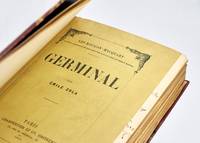
1885rif. 82388Paris: Charpentier 1885. Fine. Charpentier Paris 1885 11.50 x 18.50 cm relié Charpentier Paris 1885 115x185cm bound. First edition. One of 150 numbered copies on hollande the only deluxe issue after 10 on papier japon. Half red morocco binding gilt date on spine marbled paper covers and endpapers. Original wrappers including the spine preserved. Set in an early 20th century binding signed by Alfred Farez. Our copy includes a two-page autograph letter dated and signed by Émile Zola to Octave Mirbeau. The author thanks him for the benevolent article he recently wrote about Germinal while defending himself from being considered as the leader of Naturalism: But why do you say that I lead naturalism I don't lead anything at all. I work in my own corner letting the world go where it pleases. A beautiful and rare copy perfectly established with a superb autograph letter signed about Germinal and Émile Zola's position within the École Naturaliste. Charpentier unknown
1877rif. 79046L'Estaque - Marseille Marseille 1877. Fine. L'Estaque - Marseille Marseille 22 septembre 1877 13.30 x 20.80 cm 3 pages 1/2 sur un double feuillet Autograph letter signed by Emile Zola addressed to Louis-Edmond Duranty written in black ink on a double leaf. Some deletions and corrections; folds inherent to postal transmission. This letter has been transcribed in the complete correspondence of Emile Zola published by the CNRS and the Presses of the University of Montreal. Long letter evoking the heat wave at L'Estaque Une page d'amour and Edouard Manet. ""Il y a quatre mois que nous sommes ici et je vous avais promis de vous écrire. Mais j'ai tant travaillé et j'ai eu si chaud que vous m'excuserez de mon apparente paresse. Imaginez-vous que jusqu'au 15 août la température a été très agréable ; il faisait beaucoup moins chaud qu'à Paris et nous respirions chaque soir une brise de mer délicieuse. Puis voilà que brusquement lorsque je nous croyais hors de toutes mauvaises plaisanteries de la chaleur le thermomètre est monté à 40 degrés et s'y est maintenu nuit et jour. Nous avons ainsi passé deux semaines intolérables. Aujourd'hui la fraîcheur est revenue et nous allons rester jusqu'aux premiers jours de novembre pour jouir des charmes d'un bel automne."" ""We have been here for four months and I had promised to write to you. But I have worked so much and have been so hot that you will excuse my apparent laziness. Imagine that until August 15th the temperature was very pleasant; it was much less hot than in Paris and we breathed each evening a delicious sea breeze. Then suddenly when I thought we were safe from all the nasty tricks of the heat the thermometer rose to 40 degrees and stayed there night and day. We thus spent two unbearable weeks. Today the coolness has returned and we will stay until the first days of November to enjoy the charms of a beautiful autumn."" In this summer of 1877 Zola left the tumultuous capital for a five-month stay at L'Estaque ""banlieue de Marseille"" ""suburb of Marseille"" in the company of his wife Alexandrine and his mother Emilie Aubert. This long southern interlude reminded him of his youth in Aix: ""Je suis d'ailleurs enchanté de mon été. Les pays est splendide et me rappelle toute ma jeunesse."" ""I am moreover delighted with my summer. The country is splendid and reminds me of all my youth."" ""Pour finir avec moi j'ajouterai que j'ai travaillé vigoureusement à mon roman sans pourtant l'avancer autant que je l'aurais voulu. Ce roman doit paraître dans le Bien Public à partir du 14 novembre. J'en serai quitte pour donner encore un vigoureux coup de collier à Paris."" ""To finish with myself I will add that I have worked vigorously on my novel without however advancing it as much as I would have liked. This novel must appear in the Bien Public starting November 14th. I will have to give another vigorous push in Paris."" The new novel in question here is Une page d'amour whose plot and style contrast completely with the previous volume of the Rougon-Macquart: ""Je ne sais vraiment pas ce que vaut mon travail. J'ai voulu donner une note absolument opposée à celle de L'Assommoir ce qui me déroute parfois et me fait trouver mon roman bien gris. Mais je vais tout de même bravement mon chemin. Il faudra voir."" ""I really don't know what my work is worth. I wanted to give a note absolutely opposite to that of L'Assommoir which sometimes disconcerts me and makes me find my novel quite gray. But I am nonetheless bravely going my way. We will have to see."" But this ""page of love"" conceals another and during this stay in the Marseilles furnace Emile Zola was already thinking about the following volume: ""What is simmering in his southern pot is nothing less than a new bomb. Not Une page d'amour: 'it is a work too gentle to excite the public.' But Nana is already announced: 'I dream here of an extraordinary Nana. You will see that.' letter to Marguerite Charpentier of August 21 1877"" Henri Mitterrand Zola Even t unknown