C33; [Wilde, Oscar] C 3 3Biblio.com
8.587 Ergebnisse
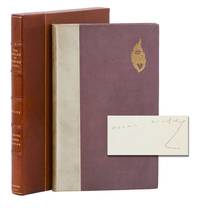
1898Best.-Nr. 140948944London: Leonard Smithers 1898. Signed Limited Issue. Near Fine. Third edition limited issue #69 of 99 copies signed by Oscar Wilde in black ink on the limitation page. 31 pp. printed on rectos only. Bound in publisher's purple cloth over and white spine cloth stamped in gilt; gilt floral ornament to front board after the famed British artist Charles Ricketts. Housed in a custom quarter morocco slipcase. Near Fine with slight lean to binding light soilingto boards. Bookplate of business man Chauncey Lawrence Williams at front pastedown along with an inscription from the former owner and giftee below dated March 8 1934. Williams was publishing partner of W. Irving Way of Way and Williams who published L. Frank Baum's first literary venture Mother Goose in Prose 1897 Additionally he commissioned a 28-year-old Frank Lloyd Wright to build his home in River Forest Illinois. Williams' funeral service program is laid-in at front offsetting from previously laid-in papers at front endsheets with remnants of former auction record at front free endpaper. Wilde's poignant poem a reflective narrative calling for prison reform and critique of Victorian-era justice systems. Written in exile and printed anonymously under his identification number "C. 3. 3." issued to him at Reading prison during his two year imprisonment for gross indecency with his lover Lord Alfred Douglas.The scarcest and most desirable edition of the author's widely lauded and instantly successful protest poem which serves as a deeply personal lament and a powerful testament to his time in prison. Mason 374. Leonard Smithers unknown
1893Best.-Nr. 2958London: Elkin Mathews & John Lane 1893. First edition. Near Fine. Original publisher's clothing binding with gilt to spine and boards. A Near Fine copy with the spine slightly toned. Bookplate of Governour Morris Esquire to front pastedown. Light scattered foxing throughout. Collates: 12 132 14 2: complete including the publisher's catalogue with pages uncut. Inscribed by Wilde on the first blank to the business manager of the St. James's Theater: "R. V. Shone with the author's compliments and sincere thanks. Nov. 93." Under the management of George Alexander and R. V. Shone The St. James's Theater staged Lady Windermere's Fan Wilde's first produced play in 1892 the year before the book was released. First editions signed by Wilde are scarce on the market with Lady Windermere being particularly rare as only 500 copies of the first edition were printed Mason. Auction records show that the six known association copies of this play were all signed trade editions as the run of 50 large paper copies came out after. The most recent presentation copy of Lady Windermere also presented to someone involved in the production sold in 2018 at Leslie Hindman for $40000. An exceptional example of Oscar Wilde presenting a first edition of his first produced play with "sincere thanks" to the theatre manager who throughout his career would assist Wilde in dodging scandal and bad publicity. Critics and scholars consider Lady Windermere's Fan to be Wilde's "first successful dramatic production" as well as an enduring masterpiece Mendelssohn. Its success not only relied on his update to French comic models and tropes including blackmail revenge attempts and the discovery of a lost child; success also came as a result of Wilde's own management of the premier. "What we want to do is to have all the real conditions of a success on our hands.Success is a science; if you have the right conditions you get the result" he informed one of the actors Mendelssohn. In addition to pulling on popular stars to perform Wilde had the young men of his entourage arrive at the premier wearing green carnations in their buttonholes -- something that scandalized attendees when in a metatheatrical moment one of the characters onstage appeared with one as well referencing its cost and symbolism for decadent immorality. Prim attendees were in fact surrounded by a generation of young men devoted to such aesthetic ideals and wearing the same flower. This very symbol born out of Lady Windermere would lead to a strong and important professional relationship between Wilde and this book's recipient R.V. Shone the business manager at the St. James. In 1894 an anonymously published novel The Green Carnation exposed the sexual relationship between Wilde and Bosie son to the Marquess of Queensbury -- a man who would become Wilde's nemesis to the end of his life. Though Wilde sought to dodge Queensbury socially the marquess was roiling for public confrontation. "There was one place and time where he could be sure of seeing Wilde -- the St. James' Theatre on the opening night of The Importance of Being Earnest when as was his custom he would take the stage after the performance to enjoy the acclaim of the audience. It was too good a chance to miss. Queensbury bought a ticket 'by fraud' Wilde suggested --as orders had been given not to sell him one -- and some vegetables.His intention was to greet Oscar's appearance with a shower of vegetation and then stand up and make a public announcement" Stratmann. Fortunately for Wilde supporters including Shone prevented this from happening. Rumor about Queensbury's plan spread notes were sent to Wilde and Wilde appealed to Shone for assistance. Reaching out to Queensbury with apologies Shone returned the marquess's money and explained that his seat had mistakenly been double-booked. Yet Shone and Wilde suspected this would not be the end and so Shone arranged not only to refuse the marquess admission at the door but to have police waiting at the entrance. It was this decision that prevented a disguised Queensbury and a paid prizefighter from sneaking in to pummel Wilde. Thwarted by Shone "he contented himself with having a bouquet of vegetables addressed to Wilde delivered to the stage door" Mikhail. Throughout his career staging work at St. James's Wilde would rely on Shone's business sense to make performances a success regardless what scandals they faced. An exceptional and rare association. Near Fine. Elkin Mathews & John Lane unknown books
1898Best.-Nr. 303630London Leonard Smithers 1898. 1898. Third edition so stated. 8vo. Half white over purple linen gilt stamped spine upper cover with gilt stamped floral design by Charles Ricketts uncut. Very good-fine. 31 pages. Enclosed in a 1/2 brown morocco slipcase with folding chemise. Number 69 of 99 copies printed March 4 1898 signed by Wilde in black ink on limitation page with characteristic paraph to the final "e." Mason #374. Bookplate of Chauncey Lawrence Williams on the front free endpaper and a signed pencil notation by Paul Lemperly noting he received the book from Williams. Williams 1872-1924 former member of Way and Williams publishers and the F.W. Dodge Corp. With his memorial booklet laid in loose. Lemperly 1858-1939 noted American book collector. Signed by Authors. 3rd Edition. Hardcover. Very Good/No Jacket. London, Leonard Smithers, 1898. hardcover books
1899Best.-Nr. 110755London: Leonard Smithers and Co 1899. Signed limited large-paper edition of the author's masterpiece number 68 of 100 copies signed by Oscar Wilde on the limitation page. Octavo original pale purple cloth gilt titles to the spine gilt floral motifs from designs by Charles Shannon on spine and covers edges untrimmed. Presentation copy with an autograph letter signed by the third and final wife of Nobel Prize-winning playwright Eugene O'Neill actress Carlotta Monterey O'Neill to stage actor Harrison K. Ford laid in which reads "To Harrison Ford Do hope you will enjoy this!- All good wishes Carlotta Monterey O'Neill Dec 6th 31 1095 Park Ave.-" From the library of Harrison K. Ford with his bookplate to the front pastedown. Housed in a custom half morocco clamshell box. In near fine condition. An exceptional example with noted provenance. First performed on 14 February 1895 at the St James's Theatre in London it is a farcical comedy in which the protagonists maintain fictitious personæ to escape burdensome social obligations. Working within the social conventions of late Victorian London the play's major themes are the triviality with which it treats institutions as serious as marriage and the resulting satire of Victorian ways. Contemporary reviews all praised the play's humour though some were cautious about its explicit lack of social messages while others foresaw the modern consensus that it was the culmination of Wilde's artistic career so far. Its high farce and witty dialogue have helped make The Importance of Being Earnest Wilde's most enduringly popular play. The successful opening night marked the climax of Wilde's career but also heralded his downfall. The Marquess of Queensberry whose son Lord Alfred Douglas was Wilde's lover planned to present the writer with a bouquet of rotten vegetables and disrupt the show. Wilde was tipped off and Queensberry was refused admission. Soon afterwards their feud came to a climax in court where Wilde's homosexual double life was revealed to the Victorian public and he was eventually sentenced to imprisonment. His notoriety caused the play despite its early success to be closed after 86 performances. After his release he published the play from exile in Paris but he wrote no further comic or dramatic work. Leonard Smithers and Co hardcover books
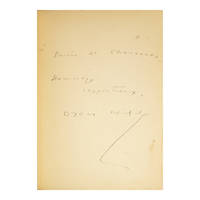
1893Best.-Nr. #16Oscar Wilde Salomé. Drame en un acte. Paris Librairie de l'Art indépendant; London Elkin Mathews and John Lane 1893. Square 12mo 196 × 145 mm. 2 blank leaves 84 numbered pages the first 8 unnumbered: half-title title dedication to Pierre Louÿs list of characters; text beginning on p. 9 and 2 unnumbered leaves 1 leaf with the colophon dated 6 February 1893 and 1 blank leaf. Modern binding. Half black morocco with small corner pieces bluish paper sides smooth spine title in gilt untrimmed top edge with matte gilt doublures and endleaves of the same paper. Original violet wrappers and spine the upper cover printed in silver lettering preserved. Excellent condition. A few small spots; upper edges of the boards slightly faded; wrappers somewhat sunned. First edition. This celebrated play was written directly in French by Wilde between 1891 and 1892; first performed in 1896 its text was revised at the author's request by Marcel Schwob Stuart Merrill and Pierre Louÿs. The first English edition appeared the following year. Limited edition of 600 copies with no special issue on large paper. The second blank leaf bears the following autograph inscription signed in black ink: "À Puvis de Chavannes / Hommage respectueux / Oscar Wilde" To Pierre Puvis de Chavannes respectful homage Oscar Wilde. The celebrated painter and muralist Pierre Puvis de Chavannes 1824–1898 like Oscar Wilde 1854–1900 lived in the cult of Beauty. Renowned for his compositions of noble and hieratic character influenced both by Greco-Roman classicism and by Symbolism his work exerted a profound fascination on late nineteenth-century painters and sculptors particularly Edgar Degas Paul Gauguin Aristide Maillol and Maurice Denis. The aesthetic connection between Oscar Wilde and Puvis de Chavannes is to be sought precisely around Salomé since the artist had painted in 1869 a Beheading of Saint John the Baptist that may well have inspired the author. Moreover it is known that when Aubrey Beardsley—who would illustrate the English version of the play in 1894—came to Paris in 1893 he was strongly encouraged by the French painter who introduced him as "a young English artist who produces astonishing things." The inscription in Salomé is therefore particularly significant and of greater import than a simple tribute. A very fine provenance for this celebrated drama written directly in French by Oscar Wilde. Librairie de l’Art indépendant
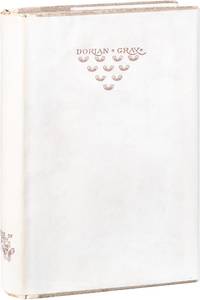
1891Best.-Nr. 260London: Ward Lock & Co 1891. First Edition. First printing without Bowden's name added to the title page imprint the Preface with Wilde's name at the end in larger bolder type and with "nd" for "and" beginning the eighth line from the bottom on page 208. The error was corrected for the second printing which included the 250 signed copies of the limited edition-copies that in addition to being the second issue are literally the second printing. This trade edition is not only earlier than the limited but when it has its dust jacket many times rarer. Original white vellum parchment-backed boards former owner's neat name to endpaper spine slightly faded from light not dust else near fine in the rare dust jacket with small tears and chips to the spine tips and corners neatly repaired a bit short an irregularity with nineteenth-century hand-trimmed jackets but a charismatic jacket still-integral clean and one to be owned with pride. An unequivocal Victorian classic as great a short novel as has ever been written and copies in dustjacket must have been dumped in the Bermuda Triangle because they never show up at auction or in the trade. Full morocco case. Wilde was from that atypical minority of great men those who do not remind us of anyone else. He wrote the best comedies since Shakespeare mastered paradox and was the reigning wit of the 1890s but he became a victim when society forgot that the mouse should never be a juror at the cat's trial. Dorian Gray was his only novel and why not When you write one like this one is sufficient. It's undeniably a modern Gothic and a self-evident Victorian classic unique in the delicacy of its grim and melancholy metaphor and it continues to maintain it's appeal even in our 21st century. Ward Lock & Co unknown
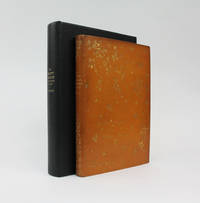
Best.-Nr. 18832London: David Nutt. 1888. First edition first printing. First edition first printing. Signed Limited Edition. Small 4to. Stunning contemporary orange morocco by Zaehnsdorf titles and ivy leaf tooling in gilt to the spine upper board with titles in gilt upper and lower boards decorated with acorns and oak ivy sycamore and willow leaves in gilt. The inner dentelles are decorated with ivy leaves in gilt the binder's name stamp in gilt at the front and exhibition stamp in gilt at the rear. Top edge gilt others untrimmed. Retaining the original upper wrapper. Illustrated title page in red with black vignette printed title page in red and black. Illustrated with a frontispiece and two further plates by Walter Crane each in two states and 12 head and tailpieces by Jacomb Hood. A beautiful near fine copy. Imperceptible repair to the upper joint minor toning to the leather. The contents with light offsetting to the endpapers and a faint mark to the margin of one page are otherwise clean and bright throughout. Housed in a recent full black morocco felt lined solander case titles in gilt to the spine and grey cloth slipcase. Limited to 75 large paper copies of which this is hand numbered 36 and signed by Oscar Wilde and the publisher David Nutt on the limitation page. A superb example of the rare first edition preceding the trade edition of 1000 copies issued later the same year in an exceptional contemporary exhibition quality autumnal foliate binding. The Happy Prince is Oscar Wilde's first and best known collection of children's stories including "The Selfish Giant" "The Nightingale and the Rose" "The Devoted Friend" and "The Remarkable Rocket". Wilde's "Reputation as an author dated from the publication of The Happy Prince and Other Tales in London in May 1888. The Athenaeum compared him to Hans Christian Andersen and Pater wrote to say that 'The Selfish Giant' was 'perfect in its kind' and the whole book written in 'pure English' - a wonderful compliment" Ellmann Richard: Oscar Wilde p. 282. Mason 314. Provenance: Charles Mills Lord Hillingdon 1830 - 1898; Sotheby's sale of 1932 lot 454; purchased by book dealer and co-founder of the Society for Theatre Research Ifan Kyrle Fletcher with his neat pencil note recording the sale on the front pastedown; Helen Hambro née Boyson 1936 - 2004. Further details and images for any of the items listed are available on request. All items are catalogued by humans. Lucius Books welcomes direct contact with our customers. London: David Nutt. 1888 hardcover
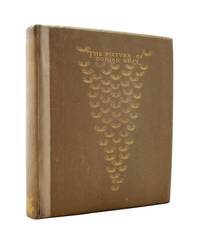
1891Best.-Nr. 69675London: Ward Lock and Co 1891. Full Description: WILDE Oscar. The Picture of Dorian Gray. London: Ward Lock and Co. 1891. First edition in book form this being the Edition de Luxe limited to 250 copies numbered by hand and signed by Oscar Wilde this being number 52. Royal octavo 8 1/2 x 7 inches; 215 x 180 mm. vii 1 334 pp. Printed on Dutch hand-made paper watermarked Van Gelder. Publisher's quarter parchment over rough grey bevelled boards possibly rebacked retaining the original spine. Front cover with gilt lettering atop a pattern of fifty-five gilt butterflies designed by Charles Ricketts spine lettered in gilt at base top edge gilt rest uncut. Newer endpapers. Previous owner's penciled poem in German to half-title. Some dust-soiling to deckle edges. Some rubbing to bevelled edges. A small slit at the bottom of the front hinge. Overall a very good copy in the publisher's binding. The Picture of Dorian Gray is Oscar Wilde's first novel and was first published in Lippincott's Monthly Magazine July 1890. Six new chapters are added to this first appearance in book form with many other additions and variations. On its first appearance this book was violently attacked by the critics and its publication did Wilde a great deal of harm. Mason 329. HBS 69675. $55000. Ward Lock and Co unknown
1899Best.-Nr. 140940300London: Leonard Smithers and Co 1899. Signed Limited First Edition. Near Fine. Signed limited first edition. xii 152 pp. Bound in publisher's original pale lavender cloth with gilt spine lettering and decorations by Charles Shannon. Copy number 82 of 100 large paper copies signed by Oscar Wilde with a flourish. Near Fine with subtle sunning several barely discernible spots to cloth short bubble to rear cloth. Typical offsetting to endpapers and a 5" tear to the rear endpaper. Contents bright and fresh. A beautiful copy. Wilde's masterpiece which opened to wide acclaim at the St. James's Theatre London on February 14 1895. It was withdrawn after 86 performances following his arrest and imprisonment on charges of gross indecency as a consequence of his failed libel suit against Lord Queensbury the father of Wilde's homosexual lover Lord Alfred Douglas. He was outed as gay a disgrace in Victorian society and the play was not published in any form until the present edition following his release from prison. It has been hailed as an exemplary farce called by poet W.H. Auden "a pure verbal opera. Leonard Smithers and Co unknown books
1899Best.-Nr. 140940300London: Leonard Smithers and Co 1899. Signed Limited First Edition. Near Fine. Signed limited first edition. xii 152 pp. Bound in publisher's original pale lavender cloth with gilt spine lettering and decorations by Charles Shannon. Copy number 82 of 100 large paper copies signed by Oscar Wilde with a flourish. Near Fine with subtle sunning several barely discernible spots to cloth short bubble to rear cloth. Typical offsetting to endpapers and a 5" tear to the rear endpaper. Contents bright and fresh. A beautiful copy. Wilde's masterpiece which opened to wide acclaim at the St. James's Theatre London on February 14 1895. It was withdrawn after 86 performances following his arrest and imprisonment on charges of gross indecency as a consequence of his failed libel suit against Lord Queensbury the father of Wilde's homosexual lover Lord Alfred Douglas. He was outed as gay a disgrace in Victorian society and the play was not published in any form until the present edition following his release from prison. It has been hailed as an exemplary farce called by poet W.H. Auden "a pure verbal opera. Leonard Smithers and Co unknown
1899Best.-Nr. 183655London: Leonard Smithers and Co. 1899. The truth is rarely pure and never simple First edition signed limited issue number 17 of 100 copies signed by the author and printed on large handmade paper. Wilde's last and greatest play opened to huge acclaim on Valentine's Day 1895 but was withdrawn after Wilde's failed libel suit against Lord Queensbury led to his arrest. The play was not published in book form until February 1899 after Wilde's release from prison. The total edition comprised 1000 unsigned copies 100 signed large paper copies and 12 signed copies on japon for presentation. Quarto. Original pink cloth spine lettered in gilt stylized leaf motifs by Charles Shannon in gilt to spine and covers edges untrimmed. Housed in a custom red quarter morocco folding box. Spine sunned and rubbed tiny spots of wear to extremities light browning to endpapers as usual. A very good copy. hardcover
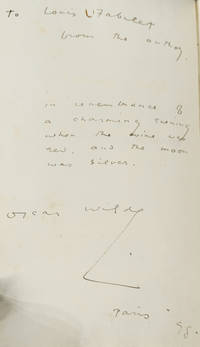
1898Best.-Nr. 6Oscar Wilde The Ballad of Reading Goal by C.3.3. Leonard Smithers Royal Arcade London W. 1898. Original white quarter cloth spine lettered in gilt yellow cloth sides. Inscribed in ink on the back of the half-title: To Louis Fabulet from the author in remembrance of a charming evening when the wine was red and the moon was silver Oscar Wilde Paris 98 Autograph note from Louis Fabulet: "This book: "The Ballad of Reading Jail" was given to me by Oscar Wilde in June 1898 a few days after the dinner that after his release from prison in England I persuaded my friend the poet Edouard Ducôté then director of the magazine "L'Ermitage" to offer in his honor. Hugues Rebell André Gide Henri Ghéon René Boylesve and I were the guests. Louis Fabulet. Attached is the business card bearing the name under which Oscar Wilde then lived in Paris. The address in pencil: "Hôtel d'Alsace rue des Beaux-Arts is in his handwriting. "Melmoth" is the man "who sold his soul for eternal youth." Louis Fabulet 1862-1933 was one of the main translators from English to French in his time notably of the works of Kipling and Thoreau. It is said that it was Oscar Wilde who introduced him to The Jungle Book. This inscription exceptionally long and colorful which is almost akin to a brief poem refers to the dinner that Louis Fabulet speaks of in his note. Wilde had arrived in Paris in March and the French literati were keen to pay him public homage with this banquet which he presided over. The inscription makes a nice reference to the event with perhaps a reminiscence of the Ballad itself where we read in the second verse: "For blood and wine are red" . Mounted in the copy is Wilde's rare card in the name of Sebastian Melmoth. The aged ruined writer abandoned by almost everyone hid himself under the name of the hero of Robert Mathurin's novel Melmoth the Wanderer. The card does not have an address. Wilde in fact lived at the Hôtel d'Alsace in Saint-Germain des Prés a shabby establishment at the time "it's so dirty so totally depressing and hopeless" he wrote. He wrote down the address of his hand in pencil. It was there that he died two years later. The hotel took the name "L'Hôtel" in 1963 and became a rather chic place. These combined elements: the poetic inscription which evokes a happy moment and the moving card which evokes his misery make this copy one of the most precious there is. Leonard Smithers