10,236 results
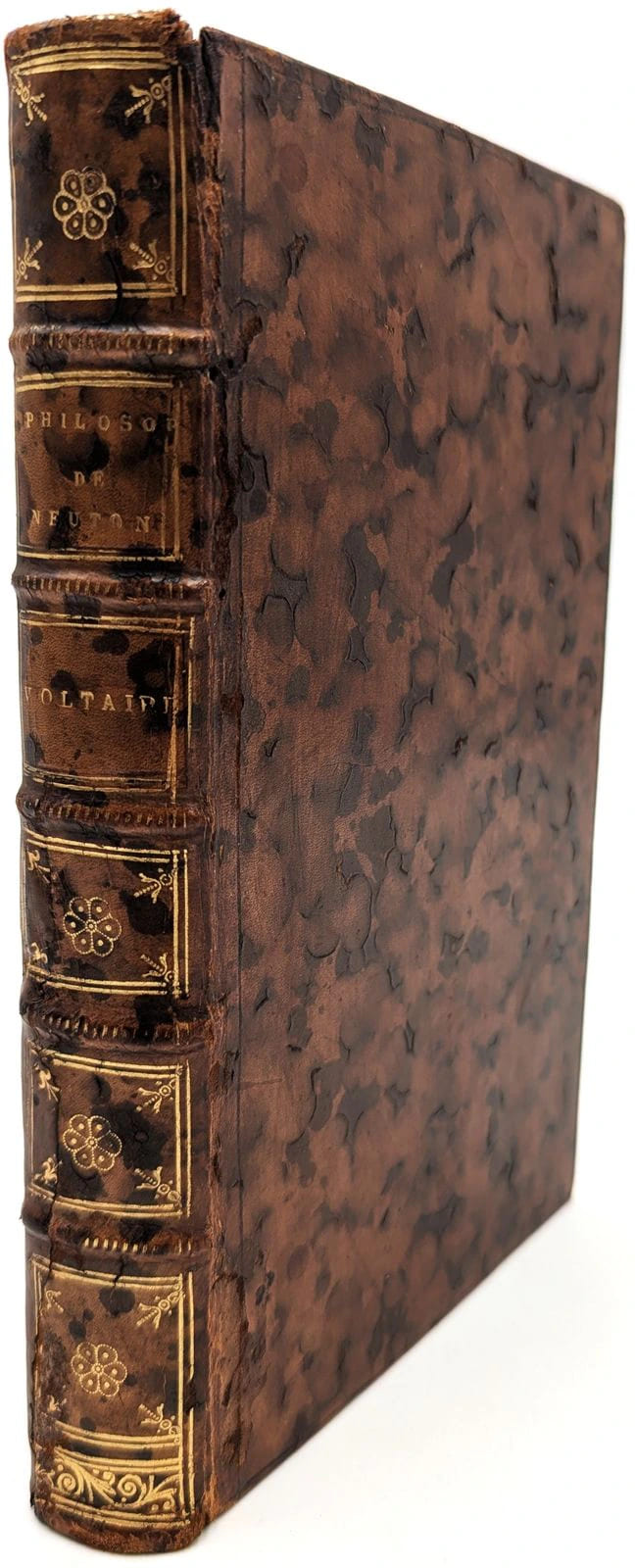
1744ref. 38273A Londres but Paris no printer 1744. Small 8vo. Contemp. full mottled calf raised bands richly gilt back. Previous owners stamp on tp. Engraved portrait Newton engraved titlevignette VIII5-121-232209-4714 pp. The text is complete and continous despite the odd pagination. Having 8 engraved plates 1 folding and many textengravings. A few leaves with contemporary marginal notes. Internally fine and clean. Second or third edition a contrefacon not printed in London but in Paris. "Voltaires's importence for the history of science lies particularly in his having composed a famous popularization of Newton Élemens de la philosophie de Nrwton 1738 while also collaborating with his companion and mistress Émilie marquise de Chatelet on her translation of the Principia into French and more generally in his having referred with the lightness of touch that made him a serious critic of the human condition his moral philosophy to what he took to be Newtonian and hence a correct account of physical reality." DSB XIV:p.83 The work has been called one of the most beautifull illustrated scientific works at all.- This edition not in Gray's Bibliography. hardcover
1785ref. 862N27Paris: De l'Impremerie de la Societe Litteraire Typographique 1785. Leather. Fair. 8" by 5". None. Forty three leather bound volumes from the Complete Works of Voltaire. 43 volumes from the complete works of Voltaire. Published in French. The present collection of the French philosopher's works includes volumes 2-10 12 14-17 20-23 25 27 32-35 37 45 51 60 63-69 70-77 and 89. With four plates to volumes two three and six. With three plates to volume four. With seven plates to volumes five and nine. With nine plates to volume eight. With ten plates to volume nine. With five plates to volume ten. The present collection opens with the theatrical works of Voltaire which is followed by his poetry including his epic poem the Henriade. In his Essay on the Universal History Manners and Spirit of Nations Voltaire discusses the history of Europe before Charlemagne until the age of Louis XIV. This is followed by his History of the Russian Empire Under Peter the Great his writings on politics and legislation some miscellaneous literary criticism and his commentary on the dramatic works of Pierre Corneille. The latter volumes are comprised of Voltaire's letter exchanges. Voltaire was a French Enlightenment writer philosopher and historian famed for his wit his criticism of Christianity and slavery and advocation of the separation of the church and state. The versatile and prolific writer produced works in many literary forms including plays novels essays but also scientific expositions. In a full contemporary calf binding. Externally sound. The rear board of volume 64 id disbound but present. The remaining volumes are lightly rubbed to the boards with some cracking to the leather along the spine. Volume 27 is missing some calf to the front extremity. Generally lightly rubbed to the head and tail of the spine although some volumes including 14 27 32-34 and the majority of the volumes in the 70s are missing a slither of calf to the head or tail of the spine or both. The front joints of volumes 10 16 20 33 and 45 are rather tender. Although the hinges are better to the latter volumes they are starting but firm to the majority of the earlier volumes.The front hinges are particularly tender to volumes 9 15 16 20 45 60 and 89 and the rear hinges are loose in volumes 10 and15. Internally firmly bound. Pages are generally bright and clean with some patches of light foxing. Fair De l'Impremerie de la Societe Litteraire Typographique hardcover

1819ref. 2003020120Paris: Renouard 1819-1822 1819. Hardcover. Very Good. 64 volume set of 66. Uniformly bound in later 1/4 leather over yellow marbled boards. Gilt stamped spines. Good bindings and covers. Minor scattered foxing. 164 engraved portraits and plates including folding and facsimiles. Refs: Brunet V.1355 Bengesco IV 2149. Carteret III 16. Querard X 379. Vicaire VII 1137 T. 1-7. Theatre 1819 7 v. . T. 8. La Henriade 1819 434 p. T. 9. La Pucelle d'Oleans 1819 371 p. T. 10. Poemes 1819 479 p. T. 11. Epitres et stances 1819 352 p. T. 12. Contes en vers. Satires et poesies melees 1819 408 p. T. 13-16. Essai sur les moeurs et l'esprit des nations 1819 4 v. . T. 17-18. Le siecle de Louis XIV 1819 2 v. . T. 19. Precis du siecle de Louis XV 1819 456 p. T. 20. Histoire de Charles IX 1819 338 p. T. 21. Histoire de l'empire de Russie 1819 404 p. T. 22. Annales de l'Empire 1819 636 p. T. 23. Histoire du Parlement de Paris 1819 514 p. T. 24-25. Melanges historiques 1819 2 v. . T. 26-27. Politique et legislation 1819 2v. T. 28. Physique 1819 611 p. T. 29-31. Philosophie 1819 3 v. . T. 32. Dialogues et entretiens philosophiques 1819 559 p. T. 33-38. Dictionnaire philosophique 1819 6 v. . T. 39-40. Romans 1819 2 v. . T. 41. Faceties 1821 432 p. T. 42-43. Melanges litteraires 1821 2 v. . T. 44-45. Commentaires sur Corneille 1821 2 v. . T. 46-57. Correspondance 1821 12 v. . T. 58. Correspondance avec l'imperatrice de Russie ; Lettres de plusieurs souverains a M. de Voltaire ; Lettres des princes de Prusse etc. et de M. de Voltaire. 1821 323 104 p. T. 59-61. Correspondance avec le roi de Prusse 91821 3 v. . T. 62. Correspondance avec d'Alembert 1821 756 p. T. 63. Lettres inedites de Voltaire a Mademoiselle Quinault a M. d'Argental au president Henault a M. Damilaville a Madame d'Epinay et autres personnages remarquables 1822 388 p. T. 64. Vie de Voltaire / par Condorcet. Memoires pour servir a la vie de M. de Voltaire ecrits par lui-meme. Commentaire historique sur les oeuvres de l'auteur de "La Henriade" 1822 495 p. This is an oversized or heavy book which requires additional postage for international delivery outside the US. Paris: Renouard [1819-1822] hardcover
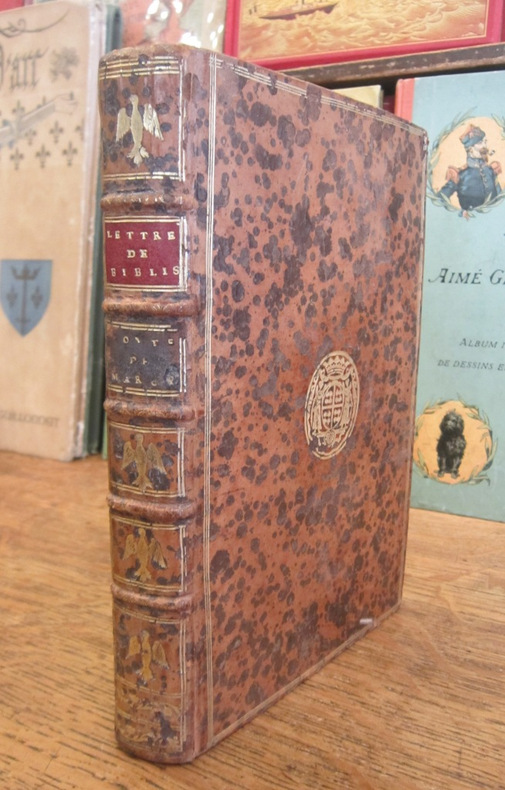
1777ref. 85781777 Londres [Amsterdam], s. n. e [Marc-Michel Rey], 1777. In-8° (195 x 125 mm) de [2, titre et errata au verso]-188 pp. Seconde édition, parue lannée même de loriginale. Reliure en plein veau marbré, dos à nerfs orné, pièce de titre olive (reliure dépoque); coiffes manquantes, charnières frottées et coins émoussés, mais reliure tout à fait solide.«Un chrétien contre six juifs» est une réponse de Voltaire aux « Lettres des quelques juifs portugais et allemands à M. de Voltaire », publiées par labbé Antoine Guénée (1717 1803) pour la première fois en 1769. Cette édition forme en faitle tome XIV deLEvangile du jour. On trouve aux pp. 172 188 quelques poésies (dont toutes ne sont pas de Voltaire), une lettre à M. de la Harpe, signée le maquis de C***, la lettre de Voltaire à labbé de la Chau, du 21 mars 1776, enfin les Remontrances du pays de Gex, rédigées par M. de Voltaire» ( Bengesco II, 1860). Ex-libris héraldique rectangulaire imprimé en rouge: Brisset.
1928ref. 059808New York: Random House 1928. 1st Edition Thus 1st Printing. Hardcover. Near Fine/Fair. 111 Pp. #423 Of 1450 Copies The First Book Published By Random House Illustrated Throughout By Rockwell Kent And Signed By Him On The Limitation Page. Tan Cloth Beveled Edges Gilt. Binding With Only Slight Wear To Gilt Contents Fine. With The Original Plain Opaque Dust Jacket Browned Small Losses 3/4" Water Spot On Front Panel. Random House hardcover
ref. 38465Paris,Leclere en 1865. 2 vols.in-8 en demi-maroquin à coins de Raparlier. 200 exemplaires.Tome I: portrait de Voltaire par Loizelet,gravure de bacchantes et de satyres par Bornet, portrait de la Pucelle en médaillon en page de titre. Double état d'une scène dans une auberge.Gravures, (Chant I à XI), légendées, précédant 11 planches de Monsiau ,et reprises dans les vignettes en têtes de chapitres.Figures par Duplessis-Berthault. Tome II: portrait de Voltaire à son bureau,en 2 états; portrait en médaillon en page de titre. 20 planches avant chaque chant, signées Marillier,précédées d'une vignette avec citation,vignette figurant en tête des chapitres. 215 et 175 pages avec Tables. Belle reliure aux dos à 5 nerfs,décorés de caissons dorés avec pièces de titre et de tomaison en maroquin rouge.Têtes dorées.TBE.
1738ref. 103385Amsterdam, Étienne Ledet & compagnie, 1738, in-8, [4]-XII-[2]-410-[6] pp.8 pl, Veau marbré havane, filet à froid en encadrement sur les plats, dos à nerfs orné de caissons dorés, tranches rouges, Édition originale de ce traité. Il est illustré de 8 planches hors-texte (dont un tableau des couleurs et des tons de la musique) et de nombreuses vignettes dans le texte ainsi que de jolis bandeaux et culs-de-lampe. Dans ses Élémens dédiés à la Marquise du Châtelet, qui partage avec Voltaire la gloire d'avoir introduit, en France, les idées scientifiques et philosophiques de Newton et à qui l'on doit la première édition française des Principia, Voltaire présente Newton comme le découvreur du vrai système du monde et le destructeur des erreurs du cartésianisme. Il s'engage personnellement pour la propagation de newtonisme, dont il fit la découverte pendant son exil en Angleterre entre 1725-1728 : pour Voltaire, l'empirisme de Newton, sa méthode expérimentale et son refus de tout dogme symbolise la victoire des Lumières sur la métaphysique chrétienne (Voir Norman). Complet du chapitre additionnel Du flux et reflux, l'Avertissement des libraires et des Éclaircissemens nécéssaires donnés par l'auteur pour servir de préface. Déchirure avec atteinte au f. R2 (sans dommage pour la lecture), petits manques et épidermures, restaurations à la reliure, dos gauchi, sans le portrait de Voltaire. Bel état intérieur. Norman, 2165 ; DSB XIV, pages 82-85; Babson, 120 Couverture rigide
1764ref. elala166Geneva: Cramer 1764. 1764. 8vo. pp. xvi 386 2. complete with half-title. woodcut title vignette. A fine copy in contemporary mottled calf gilt back. First Edition. Bengesco I 660. Cioranescu 63982. 1st Edition. Hardcover. [Geneva: Cramer], 1764. Hardcover
1768ref. 1591281768. First Edition. paperback. 182pp. half-title; woodcut title page vignette. sewn; unlettered buff wrappers. N.p. Geneva 1768. One of Voltaire's best known prose works it came out in many editions the same year. This is presumably the first and conforms to the copy in the Bibliotheque Imperiale. unknown
1768ref. 1591281768. First Edition. paperback. 182pp. half-title; woodcut title page vignette. sewn; unlettered buff wrappers. N.p. Geneva 1768. One of Voltaire's best known prose works it came out in many editions the same year. This is presumably the first and conforms to the copy in the Bibliotheque Imperiale. unknown books
1774ref. 49131disguised addresses 1774. Hardcover. Nearly Fine. Three works in sammelband published between 1774 and 1777 octavo. I. A-V8 = 160 leaves; xlvii 1 blank 261 p. 160 blank 1 avertissement 9 table 1 erratapp. Half title separate title precedes the two letters each letter with caption title; II. pi A-L8 M6 = 94 leaves; 2 188pp. p. 28 misnumbered 82 errata at verso title; III. A-C8 = 24 leaves; 48pp. Eighteenth-century cat’s paw calf spine with raised bands compartments tooled in gilt morocco lettering piece. Marbled endleaves edges tinted red green silk ribbon marker. Mild wear at extremities occasional light marginal foxing in early leaves a nearly fine set in a handsome contemporary binding. I. J. Toland Le Nazareen Londres n.p. MDCCLXXVII 1777. First French edition of Nazarenus originally published at London in 1718 here translated by Paul Henri Theri Baron d’Holbach 1723-89. The Irish freethinker and philosopher John Toland 1670-1722 here proposes “. that the ancient Celtic beliefs revealed in an Irish manuscript of the four gospels captured the true spirit of Christianity Judaism and Islam” Stephen H. Daniel ODNB. A false imprint possibly printed at Amsterdam. ESTC T104300. Weller E. O. Falschen Druckorte II 1864 p. 203 noting Amsterdam. Jonathan Israel ranks Nazarenus among Toland’s more significant writings: “. His astounding quasi-theological project. in which he seeks to dechristianize Christianity and remodel it as a republican civic religion designed only to teach the common people morality demonstrate his original creative side and some depth” Radical Enlightenment 613. II. Voltaire Un Chrétien contre six Juifs Londres n.p.: MDCCLXXVII 1777 - Bengesco 1860 with nearly 4 pages of notes. Published in 1778 our copy is chap. XIV of L’Evangile du jour 1769-80 an 18-part collection of works by or published by Voltaire; see Bengesco 1904. N.B.: On page 28 a single 3-1/2 line sentence treating the Chinese has been struck out. The printed text which immediately follows reprints the sentence with an abridged ending. III. Voltaire Le Taureau blanc traduit du Syriac A Memphis n.p: MDCCLXXIV 1774 - Also from L’Evangile du jour - Cf. Bengesco 1509. Our edition is complete. Bengesco notes that this printing of Le Taureau is often found separate. hardcover
1774ref. 49131disguised addresses 1774. Hardcover. Nearly Fine. Three works in sammelband published between 1774 and 1777 octavo. I. A-V8 = 160 leaves; xlvii 1 blank 261 p. 160 blank 1 avertissement 9 table 1 erratapp. Half title separate title precedes the two letters each letter with caption title; II. pi A-L8 M6 = 94 leaves; 2 188pp. p. 28 misnumbered 82 errata at verso title; III. A-C8 = 24 leaves; 48pp. Eighteenth-century cat’s paw calf spine with raised bands compartments tooled in gilt morocco lettering piece. Marbled endleaves edges tinted red green silk ribbon marker. Mild wear at extremities occasional light marginal foxing in early leaves a nearly fine set in a handsome contemporary binding. I. J. Toland Le Nazareen Londres n.p. MDCCLXXVII 1777. First French edition of Nazarenus originally published at London in 1718 here translated by Paul Henri Theri Baron d’Holbach 1723-89. The Irish freethinker and philosopher John Toland 1670-1722 here proposes “. that the ancient Celtic beliefs revealed in an Irish manuscript of the four gospels captured the true spirit of Christianity Judaism and Islam” Stephen H. Daniel ODNB. A false imprint possibly printed at Amsterdam. ESTC T104300. Weller E. O. Falschen Druckorte II 1864 p. 203 noting Amsterdam. Jonathan Israel ranks Nazarenus among Toland’s more significant writings: “. His astounding quasi-theological project. in which he seeks to dechristianize Christianity and remodel it as a republican civic religion designed only to teach the common people morality demonstrate his original creative side and some depth” Radical Enlightenment 613. II. Voltaire Un Chrétien contre six Juifs Londres n.p.: MDCCLXXVII 1777 - Bengesco 1860 with nearly 4 pages of notes. Published in 1778 our copy is chap. XIV of L’Evangile du jour 1769-80 an 18-part collection of works by or published by Voltaire; see Bengesco 1904. N.B.: On page 28 a single 3-1/2 line sentence treating the Chinese has been struck out. The printed text which immediately follows reprints the sentence with an abridged ending. III. Voltaire Le Taureau blanc traduit du Syriac A Memphis n.p: MDCCLXXIV 1774 - Also from L’Evangile du jour - Cf. Bengesco 1509. Our edition is complete. Bengesco notes that this printing of Le Taureau is often found separate. hardcover books
ref. 1905Geneva: Cramer 1765-1768. Five volumes. A GORGEOUS COPY OF THE FIRST EDITION with ALL HALF-TITLES PRESENT of one of Voltaire's most important and fascinating works a haphazard collection of philosophical and literary pieces which clearly demonstrate the depth and scope of his genius. The original intention was to publish only three volumes and for that reason many bibliographers consider the first three volumes a complete work in itself although Voltaire continued until the 19th volume appeared in 1776. I offer here the first three volumes along with the next two. In his introduction to the third part Voltaire points out that some of the works which appear here had been published before but only incorrectly and incompletely. He goes on to assert that many of the other works originally printed alongside them and attached to his name were not in fact by him. His reason for publishing this collection therefore was to present a definitive and complete text of many of his most important works many of which are printed here for the first time. Included are his commentary on Beccaria his Traite sur la tolerance with documentation that had not previously been published and dozens of other pieces. Volume 3 is complete with the supplement which is often missing. Due to their subversive nature they all ended up on the Catholic Church's Index of Prohibited Books these books were published without the name of the author the name of the publisher or the place of publication. Due to their popularity they were reprinted by Cramer and mercilessly pirated by other publishers. Most sets are mixed with different printings by different publishers. The volumes I offer here however are first printings throughout. Nicely printed on fine laid paper with numerous head- and tailpieces. 8vo. Bound in very attractive contemporary half French calf and decorated boards spines in six compartments leather spine labels. Minimal traces of wear to corners else fine and bright with large margins and no defects inside or out. Bengesco 2212; B.N. vol. 214 part I columns 82-86; Barbier III 531-532. A very rare and important set in contemporary bindings and in excellent condition. Geneva: Cramer, 1765-1768 hardcover
1817ref. 55477à Paris: Chez Antoine-Augustin Renouard 1817. Fine. Chez Antoine-Augustin Renouard à Paris 1817 13.50 x 23 cm 12 volumes reliés Later edition of the works of Pierre Corneille with a commentary by Voltaire. Contemporary half green Russia over paper boards a little rubbed spine with gilt Restoration typographic motifs. A little foxing. The set is illustrated with a frontispiece portrait of the author drawn and engraved by Auguste de Saint-Aubin and 25 hors texte figures by Jean-Michel Moreau. A very good complete set of the works of Pierre Corneille in contemporary half Russia. Chez Antoine-Augustin Renouard hardcover
1776ref. AMO-3296Voltaire] Lettres Chinoises, Indiennes et Tartares. A Monsieur Paw. Par un Bénédictin. Avec plusieurs autres Pièces intéressantes. Londres, s.n., 1776 (4)-182-(2) pages Relié à la suite : [Anonyme] Essai contre l'abus du pouvoir des souverains, et juste idée du gouvernement d'un bon Prince. Suivi du Tocsin contre le despotisme du souverain. Par M **, Avocat. Opuscules politiques et Moraux. A Londres, s.n., 1776 (4)-214 pages 2 ouvrages reliés en 1 volume in-8 (21 x 12,5 cm). Reliure de l'époque plein veau marbré, dos lisse richement orné aux "soleils dorés", tranches mouchetées de rouge, doublures et gardes de papier à la colle bleu. Quelques légères marques à la reliure restée très fraîche. Intérieur très frais.
ref. 3057A Bouillon, aux dépens de la Société Typographique, M. DCC. LXXVIII (1778). Trois volumes reliés in-8 (13,5 x 21,5 cm) de VI-304, VIII-320, VI-236-102 pages. Reliures plein veau caramel moucheté, dos à nerfs, caissons ornés, pièce de titre rouge, double roulette dorée en encadrement des plats, roulette dorée aux coupes, toutes tranches dorées. Dos passés, coiffes légèrement abîmés, coiffe inférieure du tome 3 absente, quelques rousseurs, sinon bons exemplaires.Joliment illustré d'un portrait de Voltaire gravé par Cathelin d'après La Tour, de 13 vignettes par Monnet et enfin 57 figures hors-texte numérotées (dont 2 en frontispices) par Monnet, Marillier, Martini et Moreau. Agréable exemplaire de la première grande édition des Romans et Contes qui est aussi l'oeuvre majeur de Monnet pour laquelle il réalisa 52 dessins. Bien complet de l'Avis au Relieur sur papier bleu. Malgré cet avis quelques planches ne se trouvent pas exactement à leur place, en particulier la planche xxiii qui se trouve dans le tome I alors qu'elle devrait être dans le tome II. Mais malgré cela notre exemplaire est bien complet de ces 58 gravures.
1799ref. ST17632cParis: de l'Imprimerie de Crapelet an VII 1799. 228 x 150 mm. 9 x 6". Two volumes. Very attractive 19th century red morocco by Capé stamp-signed in gilt on front turn-in French fillet border raised bands compartments with central quatrefoil surrounded by lacy gilt tooling gilt lettering gilt dentelles all edges gilt. Housed in a later marbled slipcase. WITH engraved frontispiece by Gaucher and 21 ENGRAVED PLATES after Marillier Monsiau and Ponce as called for AND EXTRA-ILLUSTRATED WITH 46 PLATES comprised of a suite of 20 small plates a suite of 21 large plates and five portraits. Verso of front free endpaper with the bookplate of Jacques Bastenet. Cohen-de Ricci 1035; Graesse VI 393. See also: Cohen-de Ricci 1047-48 for the plates by Moreau. ◆Two three-inch abrasions on one cover and a hint of wear to joints both very well disguised by refurbishment leather faintly soiled but the decorative bindings still lustrous and quite pleasing without any significant condition issues. Occasional mostly light foxing never serious and most of the plates clean but noticeable enough to be regrettable some of the smaller extra-illustrations slightly browned due to paper stock but still a book with considerable appeal inside and out with the engravings richly impressed. This printing of Voltaire's mock-heroic "Pucelle" a licentious burlesque based on the Joan of Arc story features the same beautiful engravings found in the Didot edition of 1795 but without the frames plus two additional suites of plates taken from other editions. The set of 20 small plates seem to be close copies of Gravelot's illustrations from the 1762 Geneva edition of "La Pucelle"; the set of 21 larger images are by Moreau all but two being before letters. The latter set probably comes from the suite of images for Voltaire's "Oeuvres" published by Renouard in 1802 of which there were just 40 copies before letters according to Cohen-de-Ricci. Capé was one of the most distinguished binders in France in the middle years of the 19th century being especially well known for the delicacy of his work as evidenced by our spines. He was the binder to the Empress Eugénie and Béraldi calls him "the Bozérian of the second Empire.". de l'Imprimerie de Crapelet unknown
1799ref. ST17632cParis: de l'Imprimerie de Crapelet an VII 1799. 228 x 150 mm. 9 x 6". Two volumes. Very attractive 19th century red morocco by Capé stamp-signed in gilt on front turn-in French fillet border raised bands compartments with central quatrefoil surrounded by lacy gilt tooling gilt lettering gilt dentelles all edges gilt. Housed in a later marbled slipcase. WITH engraved frontispiece by Gaucher and 21 ENGRAVED PLATES after Marillier Monsiau and Ponce as called for AND EXTRA-ILLUSTRATED WITH 46 PLATES comprised of a suite of 20 small plates a suite of 21 large plates and five portraits. Verso of front free endpaper with the bookplate of Jacques Bastenet. Cohen-de Ricci 1035; Graesse VI 393. See also: Cohen-de Ricci 1047-48 for the plates by Moreau. ◆Two three-inch abrasions on one cover and a hint of wear to joints both very well disguised by refurbishment leather faintly soiled but the decorative bindings still lustrous and quite pleasing without any significant condition issues. Occasional mostly light foxing never serious and most of the plates clean but noticeable enough to be regrettable some of the smaller extra-illustrations slightly browned due to paper stock but still a book with considerable appeal inside and out with the engravings richly impressed. This printing of Voltaire's mock-heroic "Pucelle" a licentious burlesque based on the Joan of Arc story features the same beautiful engravings found in the Didot edition of 1795 but without the frames plus two additional suites of plates taken from other editions. The set of 20 small plates seem to be close copies of Gravelot's illustrations from the 1762 Geneva edition of "La Pucelle"; the set of 21 larger images are by Moreau all but two being before letters. The latter set probably comes from the suite of images for Voltaire's "Oeuvres" published by Renouard in 1802 of which there were just 40 copies before letters according to Cohen-de-Ricci. Capé was one of the most distinguished binders in France in the middle years of the 19th century being especially well known for the delicacy of his work as evidenced by our spines. He was the binder to the Empress Eugénie and Béraldi calls him "the Bozérian of the second Empire.". de l'Imprimerie de Crapelet unknown books
1764ref. 1322Londres 1764. 8vo. 190 x 120 mm. 7 ½ x 4 ½ inches. viii 344 1 pp. Bound with half-title in contemporary Dutch decorated paper boards vellum spine and corner tips. Frontispiece portrait of Hugo Grotius dated 1790 probably added when bound. Some contemporary manuscript notes in the text and on the rear free endpaper. Very nice copy. First edition. Voltaire’s Philosophical Dictionary organized alphabetically and containing his thoughts on European society beginning with a short essay on Abraham and a critique of the stories of the Bible. Voltaire’s Dictionnaire ends with the topic of Virtue where referring to theologians in the Catholic Church his final words are a petition to God. In his most sarcastic way he completes his book with the sentence “Mon Dieu donnez nous souvent de pareils fripons!” My God give us often such rogues as these!. Voltaire had this work published in Geneva by Gabriel Grasset who to keep the authors identity secret created a false imprint stating London as the place of printing. Included are 73 essays on subjects ranging from Baptism to Character Equality Fables History Liberty Religion Solomon and Tyranny to name a few. “Voltaire sought to create a text which would fit in one's pocket and be affordable because "revolutionary material must be small enough for people to carry with them". What he created is a text which educated and amused at the same time.” As you can see by the subjects of Voltaire’s essays the Catholic Church was the target of much of his rhetoric. He wanted to expose the hypocrisy of the Church and at the same time advocate for a more rational God one who allowed for free will and self-examination as a major tenant of his philosophy. There are numerous edition of Voltaire’s Dictionnaire Philosophique but the first is scarce in the market. This is a nice copy in a sound and not unattractive copy. Roger Pearson Voltaire Almighty 2005. . unknown
1764ref. 1322Londres 1764. 8vo. 190 x 120 mm. 7 ½ x 4 ½ inches. viii 344 1 pp. Bound with half-title in contemporary Dutch decorated paper boards vellum spine and corner tips. Frontispiece portrait of Hugo Grotius dated 1790 probably added when bound. Some contemporary manuscript notes in the text and on the rear free endpaper. Very nice copy. First edition. Voltaire’s Philosophical Dictionary organized alphabetically and containing his thoughts on European society beginning with a short essay on Abraham and a critique of the stories of the Bible. Voltaire’s Dictionnaire ends with the topic of Virtue where referring to theologians in the Catholic Church his final words are a petition to God. In his most sarcastic way he completes his book with the sentence “Mon Dieu donnez nous souvent de pareils fripons!” My God give us often such rogues as these!. Voltaire had this work published in Geneva by Gabriel Grasset who to keep the authors identity secret created a false imprint stating London as the place of printing. Included are 73 essays on subjects ranging from Baptism to Character Equality Fables History Liberty Religion Solomon and Tyranny to name a few. “Voltaire sought to create a text which would fit in one's pocket and be affordable because "revolutionary material must be small enough for people to carry with them". What he created is a text which educated and amused at the same time.” As you can see by the subjects of Voltaire’s essays the Catholic Church was the target of much of his rhetoric. He wanted to expose the hypocrisy of the Church and at the same time advocate for a more rational God one who allowed for free will and self-examination as a major tenant of his philosophy. There are numerous edition of Voltaire’s Dictionnaire Philosophique but the first is scarce in the market. This is a nice copy in a sound and not unattractive copy. Roger Pearson Voltaire Almighty 2005. . unknown books
2019ref. __072941213XLUP – Voltaire Foundation 2019. Hardcover. New. French language. 0.00x0.00x0.00 inches. LUP – Voltaire Foundation hardcover
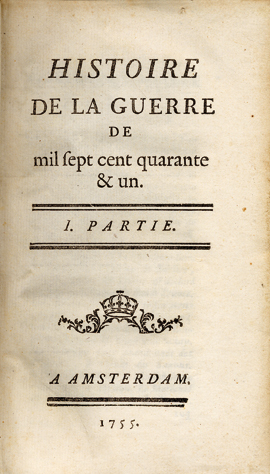
1755ref. 14498Amsterdam (Paris), s.n., 1755 ; 2 parties reliées en un volume in-12 ; plein veau havane marbré, dos lisse décoré et doré, pièce de titre grenat, tranches marbrées (reliure de l'époque) ; (4), 278 pp. ; (4), 208 pp.
Dieci tomi in belle legature bazzana marmoreggiata coeva, triplice filetto dorato ai piatti, dorsi con titoli e fregi in oro, in ottime condizioni; pp (4), viij, (2), 3-520, (2) per il primo tomo; quattro tavole f. t. incise in rame; pp (6), 3-380, (2) per il secondo, tre tavole; pp (6), 3-380, (2) per il terzo, tre tavole; integrazione alle pp 65-66 all'angolo inferiore destro; pp (6), ooj, (2), 3-504, (2) per il quarto; tre tavole; pp (6), (1), (3), 3-472, (2) per il quinto; quattro tavole; pp (6), iij, (2), 3-488, (2) per il sesto; quattro tavole; pp (6), ij, (2), 3-376 per il settimo; tre tavole; manca l'ultima bianca; pp (6), ij, (2), 3-396, (2) per l'ottavo; quattro tavole; (8), 3-436, (2) per il nono; quattro tavole; (8), 3-420, (2) per il decimo; tre tavole. Le trentaquattro tavole più antiporta, sono nitidamente inchiostrate (l'antiporta da Watelet, le altre da Gravelot). Tutte le pagine sono incorniciate da fregi silografici. Esemplare in buone condizioni, sguardie e tagli marmoreggiati, rarissime macchiette. Tragedie contenute: "t.1. Médée. Le Cid. Cinna. Jules César; t.2. Horace. Polyeucte. Le Menteur; t.3. La suite du Menteur. Pompée. Théodore; t.4. Rodogune. Andromède. La comédie fameuse. Héraclius; t.5. Dom Sanche d'Aragon. Nicomède. Pertharite. Oedipe; t.6. La toison d'or. Sertorius. Sophonisbe. Othon; t.7. Agésilas. Attila. Bérénice, tragédie de Racine. Bérénice, comédie de Corneille; t.8. Pulchérie. Suréna. Ariane. Le comte d'Essex; t.9. Mélite. Clitandre. La veuve. La galerie du palais; t.10. La suivante. La place royale. L'illusion. Trois discours". Due anni prima della morte del Patriarca di Ferney, esce questa seconda edizione dell'"opera omnia" di Corneille, edita, completata, preceduta da "avertissements", lettere, commenti di Voltaire. La prima edizione è del 1764. In questa edizione V. accentua la critica verso alcune opere del tragediografo (si veda, ad es., l'introduzione a "Dom Sanchez d'Aragon"), indispettito dalle critiche suscitate dai suoi "commentaires". Bengesco II, 1700; Cohen 85, descrive edizione in 8 voll., precisando: "M. Cohen signalait dans sa deuxième édition un tirage en dix volumes in-8, sous la même date, avec les mêmes figures retournées. Nous n'avons pu comparer cette édition qui aurait échappé à M. Picot, si tant est qu'elle existe". Esemplari censiti in COPAC, che precisa: "A pirated edition of that published in Geneva, 1764, with the plates reversed".