VOLTAIRE, François-Marie Arouet dit.Livre Rare Book

8 092 résultats
réf. LCS-186414L’un des exemplaires imprimés sur grand papier fin. De l’imprimerie de la Société Littéraire typographique 1784-1789. 70 volumes. Grand in-8, maroquin vert, encadrement doré sur les plats, roulette intérieure et coupes finement ornées, dos lisses ornés de motifs dorés (certains légèrement passés), pièces de titre et de tomaison de maroquin rouge, tranches dorées. Quelques rousseurs inhérentes au papier. Reliure de l’époque. 245 x 150 mm.
1751réf. 2605210193Chez Briasson David Le Breton Durand A Paris; Amsterdam 1751 - 1777 1751. First Edition. Hardcover. Very Good. 0x0x0. The Organization of Enlightenment Thought: The Revolution in Ideas. A first edition of this foundational encyclopedia of 18th century knowledge. A massive thirty-five volume set. Large folios volumes 39.5 x 25 cm. Bound in 18th-century French calf. Spines gilt with raised bands. One volume non-uniformly bound in light calf. The set includes: Encyclopedie Paris: 1751-57 & Neuchatel 1765. 17 volumes; Recueil de planches. Paris: 1762-72. 11 volumes 1 2 part I 2 Part II 3 5 6 7 8 9 10 11; Supplement a l'Encyclopedie. Paris & Amsterdam: 1776-77. 5 volumes including the Suite de recueil de planches; Table Analytique. Paris: 1780. Profusely illustrated with engraved plates. Diderot's famous Encyclopedie was initially a modest translation of Chambers's Cyclopaedia. It grew as a project into a massive project which attempted to collect human knowledge from a rationalistic perspective instead of by nature or theology. In organizing knowledge from a position where human reason was paramount the supremacy of the Church was imperiled. As a result the Encyclopedie was widely controversial and placed on the Index Librorum Prohibitorum by the Catholic Church. In discussing fundamental philosophical issues such as on political authority and natural rights articles in the Encyclopedie shifted the basis of governmental authority from the divine right of Kings to radical concepts popular consent was the basis of legitimacy and the ideals of a social contract. The work was banned by the King of France. It spread the foundational ideas of the French Revolution and enlightenment thinkers. "No encyclopaedia perhaps has been of such political importance or has occupied so conspicuous a place in the civil and literary history of its century. It sought not only to give information but to guide opinion." "It was a war machine; as it progressed its attacks on both the church and still more on despotic government as well as Christianity itself became bolder and more undistinguished and it was met with persecution and opposition unparalleled in the the history of encyclopedias." - Encyclopedia Britannica 11th ed p. 1483. "A monument in the history of European thought; the acme of the age of reason; a prime motive force in undermining the ancien regime and in heralding the French Revolution" Printing in the Mind of Man 200. Refs: Grolier/Horblit 25b; Norman 637; PMM 200. Includes: 17 v. : ill. ; 41 cm. supplement 4 volumes plates 11 volumes plates supplement 1 volume. Table Analytique 1 volume. This is an oversized or heavy book which requires additional postage for international delivery outside the US. Chez Briasson, David, Le Breton, Durand, A Paris; Amsterdam (1751 - 1777) hardcover
réf. 2038A Londres Fictitious imprint. BN gives place of publication as Amsterdam. Bengesco gives place of publication as Paris.: Pour la compagnie 1747. Hardcover. Very Good. Octavo. iv 172pp. 2 A8-K8 L6. With the half-title. Title-page in red-and-black. Engraved title vignette. Paper boards. Bengesco 1420; BN CCXIV 2973; Cioranescu 64349. From the library of the Fideicommis Bodenstein with their stamp on the title-page. The first published edition of a work by Voltaire which later appeared under the title Zadig ou La destinée. A Londres [Fictitious imprint. BN gives place of publication as Amsterdam. Bengesco gives place of publication as Paris.]: Pour hardcover
réf. LCS-18032« “Candide” se détache comme le chef-d’œuvre voltairien : bref, attractif, expression accomplie d’une pensée et d’un art, par quoi Voltaire, auteur de dizaines de volumes aujourd’hui peu fréquentés, assure sa présence auprès de la postérité » (René Pomeau). S.l. [Genève, Cramer], 1759. [Amsterdam, Marc Michel Rey]. In-12 de 299 pages. Quelques taches, demi-basane brune, dos lisse orné, pièce de titre en maroquin rouge, tranches jaunes. Reliure de l’époque. 163 x 97 mm.
réf. LCS-18034Cette édition originale de Candide est très rare. S.l. [Genève, Cramer], 1759. [Reliés à la suite] : II- [Maubert de Gouvest, Jean-Henri]. Ephraïm justifié. Mémoire historique et raisonné sur l’état passé, présent et futur des finances de Saxe... adressé par le Juif Ephraïm à son cousin Manasses d’Amsterdam. Nouvelle édition. Erlangen, 1758. III- [Du même]. Lettre du Prince de Prusse mourant, au Roi son frère. Erlangen, 1758. IV- [Rémond de Saint-Sauveur]. Remerciement d’un Particulier à Messieurs les Philosophes du Jour. V-[Coyer, Gabriel-François]. Lettre au R.P. Berthier sur le matérialisme. Genève (Paris), 1759. Soit 5 ouvrages reliés en 1 volumes in-12 de : I/ (1) f.bl., 299 pp. (signatures A-Nh), (1) f.bl. ; II/ viii pp., 103 ; III/ 23 pp. ; IV/ 8 pp. ; V/ 77 pp. L’encre noire a légèrement déchargé en transparence lors de l’impression de Candide. Reliure de l’époque en veau marbré, dos lisse orné de motifs dorés, pièce de titre de maroquin rouge, tranches rouges. Reliure de l’époque. 161 x 93 mm.
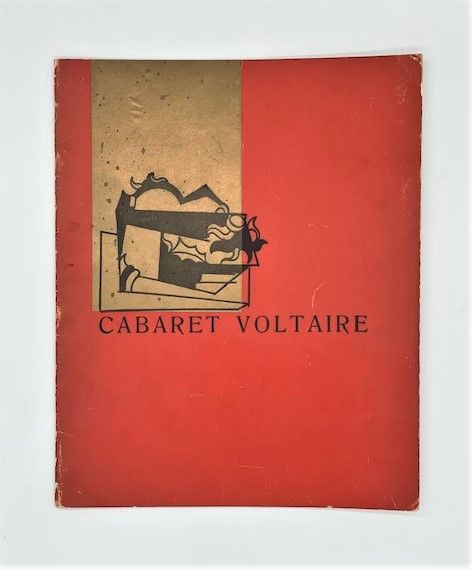
Die erste Publikation der Zürcher Dadaisten, zugleich ein bedeutendes Dokument der Dada-Bewegung. In dieser Veröffentlichung ist erstmals der Name "DADA" dokumentarisch belegt. Mit Beiträgen von Guillaume Apollinaire, Hans Arp, Hugo Ball, Francesco Cangiullo, Blaise Cendrars, Emmy Henning, Jacob van Hoddis, Richard Huelsenbeck, Marcel Janco, Wassilij Kandinsky, F.T. Marinetti, L. Modigliani, M. Oppenheimer, Pablo Picasso, O. van Rees, M. Slodki und Tristan Tzara. Eines der wenigen Exemplare mit dem deutschen Titelblatt und Einleitung von Hugo Ball. In 500 Exemplaren erschienen. Sehr schönes Exemplar. - Raabe, Zeitschriften 28.
1829réf. 34978Paris Antoine-Auguste Reno 1829 66 volumes in-8, demi-maroquin noir, plats de papier marbr, dos quatre larges nerfs finement orns de roulettes et filets pousss or ou froid; doublures et gardes de papier marbr, non rogns (Thouvenin).Un portrait-frontispice dessin et grav l'eau-forte par Aug. de Saint Aubin d'aprs le buste de Houdon, 113 figures de Moreau graves par Simonet et 48 portraits. Un des trs rares exemplaires sur grand papier. Bel exemplaire reli l'poque par Thouvenin.
1916réf. 65214Zürich, (Buchdruckerei Jul. Heuberger für) Meierei, Spiegelgasse 1, (1916). 4°. Mit einem mitpag. Orig.-Holzschnitt von M. Slodki u. 12 (7 ganzs.) Textabbildungen. 31 (1) S., Roter OKart.-Bd. m. Goldfolien-Collage von Hans Arp am Vorderdeckel.
réf. LCS-18355La Henriade de Voltaire conservé dans son maroquin de l’époque mosaïqué et armorié, condition d’exception pour un livre imprimé au cours de la Révolution française. Paris, P. Didot, fils aîné de F.A. Didot l’aîné, 1790. Grand in-4 de 1 portrait, 1 pl. hors-texte, xl pp., 222 pp., (1) f., 12 planches hors-texte. Plein maroquin rouge à grain long, plats richement ornés de filets, grecque et roulette dorées, dos à faux-nerfs mosaïqué avec incrustation de bandeaux de maroquin vert, pièces de titre et de tomaison en maroquin vert, chiffre doré du prince Albert de Saxe-Teschen répété cinq fois dans les entre-nerfs, coupes décorées, roulette intérieure, tranches dorées. Reliure armoriée et mosaïquée de l’époque. 308 x 228 mm.
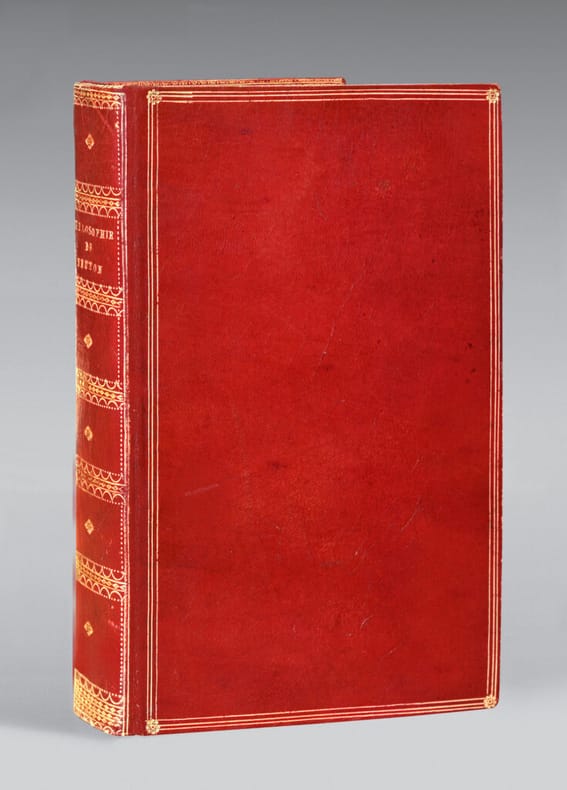
réf. LCS-A4L’introduction des idées de Newton en France et la victoire de l’empirisme sur le cartésianisme. Amsterdam, chez Jacques Desbordes, 1738. In-8 de (1) f. de titre, 399 pp. et (1) p. d’errata; 1 portrait de l’auteur, 1 frontispice, 7 planches hors texte dont une dépliante, 50 culs-de-lampe et vignettes, 60 figures géométriques dans le texte, titre imprimé en rouge et noir, 4 numéros de page grattés. Plein maroquin rouge, triple filet doré encadrant les plats avec fleurons d'angles, dos lisse orné, coupes ornées, roulette intérieure dorée, tranches dorées. Relié par Derome le jeune avec son étiquette. 212 x 132 mm.
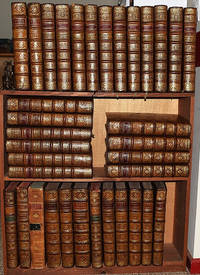
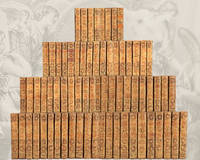
1784réf. 191724Kehl: De L'imprimerie de la Société Littéraire-Typographique 1784-89. Canonizing Voltaire an enterprise on the eve of Revolution The first complete collection known as the "Kehl" edition for the small German town in which it was printed to avoid French censorship. After his death the Société Littéraire Typographique was founded there dedicated to the monumental effort of disseminating Voltaire's work through a definitive and typographically magnificent edition. The group of Enlightenment intellectuals ready to champion the author were led by Pierre-Augustin Caron de Beaumarchais who financed the operation and the Marquis de Condorcet who acted as chief editor. For the first time Voltaire's correspondence was published and commentary and a biography by Cordorcet was added. For the type Beaumarchais bought John Baskerville's apparatus from his widow. This coupled with the unprecedented price he paid for the rights the paper mills he purchased and the cost of setting up in Kehl bankrupted Beaumarchais. Nevertheless he concluded "Europe will be satisfied". Octavo 70 vols 213 x 134 mm. Portrait frontispiece engraved plates. Contemporary mottled calf signed by François Gaudreau at foot of spines red morocco labels double gilt fillet to compartments and boards marbled endpapers varicolour bookmarkers. Superficial splits and worming to joints still very firm occasional wear contents largely clean. A very good set. hardcover
1759réf. 08228Geneva: Gabriel Cramer 1759. First Edition. Full Leather. Fine. The third of the first four editions according to Bengesco 1436 and the fourth edition according to Wade see Voltaire and Candide 1959 p. 201 dated 1759 with 299 pages clandestinely printed and published by Cramer in Geneva and preceeding the other 16 different editions published throughout Europe in 1759. The present copy conforms to Bengesco 1436 in every respect which is "page by page line for line like the first edition" except for the "que ce ce fut" error on page 103 an error which was introduced by Cramer into the early printings then doubtless not "fixed" as it was correct in the first place. Note that the fleurons agree exactly with Bengesco 1436 as follows: p. 134 is a basket of fruits; p. 228 shows two horns 'a plenty; the fleuron at p. 115 is repeated on pages 179 and 193; fleuron on page 213 is signed N. C. and is repeated on page 279; page 277 is paginated 177. The present copy also agrees with Wade see Voltaire and Candide 1959 p. 201 in every respect including that page 17 is numbered 15. Both the above references to Bengesco and Wade show signatures A-N3 meaning they are bound without the Table of Chapters; the present copy like 7 of the 10 known copies of the first edition shows signatures A-N6 without the final leaves N7 a blank and without N8 instructions to the binder concerning the cancellation of two pairs of leaves B4 B9 and D6 D7. In addition to the above let us state the textual points in the present copy: page 31 B4 an unnecessary paragraph break was eliminated. The words "mais il y a une raison." do NOT start a new paragraph; page 41 B9 several short sentences about the Lisbon earthquake were rewritten as "car dit-il tout ceci est."; page 84 D6 D7 reads "Nos filles se trouverent."; page 103 reads "que ce fut." as explained above was correct to begin with then discovered by Cramer and was not "fixed"; page 125 reads "mais ils se leverent precisement."; page 242 the paragraph beginning "Candide etait afflige."; has been removed by Voltaire while the book was being printed as it was critical of German poets. Pages 121 - 168 signatures F and G are a larger type than the rest of the book. In summation the present copy agrees with the first edition except that the "que ce ce fut." error was discovered and not inserted and the fleurons differ but are by Cramer who printed the first four editions. This a wide margined copy is larger than other copies we have seen at 165 mm x 95 mm; beautifully bound in late 19th Century full tan leather with raised bands and gilt decoration on spine with a brown leather lettering piece marbled end papers all edges gilt; printed on laid paper. The text is remarkably clean and bright; a fine copy. PMM204. Gabriel Cramer hardcover books
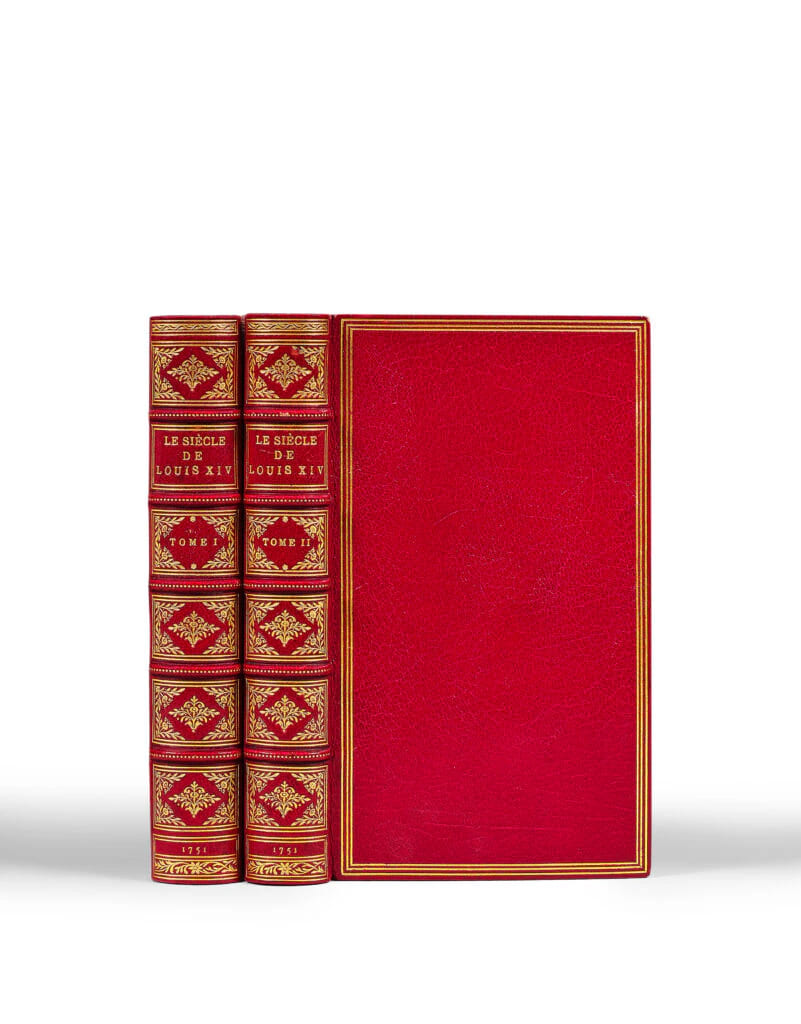
réf. LCS-A47Des bibliothèques Genard et Léon Rattier, avec ex-libris. Berlin, C.F. Henning, 1751. 2 tomes en 2 volumes in-12 de: I/ (7) ff., 488 pp., (1) f. d’errata,pte. déch. restaurée ss. manque p. 191; II/ (2) ff., 466 pp., (1) f. d’errata. Maroquin rouge, triple filet doré encadrant les plats, dos à nerfs ornés de filets et fleurons dorés, double filet or sur les coupes, roulette intérieure dorée, tranches dorées sur marbrures. Reliure signée de Chambolle-Duru. 143 x 85 mm.
1785réf. ABC_50750Kehl: Société Littéraire Typographique 1785. Contemporary uniform marbled calf with gold-tooled ornamental borders on boards gold-tooled spines with green morocco volume numbers and two red morroco title labels. Edges gilt. 12mo. With an engraved frontispiece and a portrait of the author in volume 1. Further with 18 portraits including 4 repeats on different paper 106 plates including 17 repeats on different paper 14 folding mathematical plates in volume 31 on Newtons physics 1 engraved map and 10 woodcuts in the text. 92 volumes. Attractive set of the first issue of the famous Kehl edition of the complete works by Voltaire pseudonym of François Marie Arouet 1694-1778 and with introductions and notes by Nicolas Marquis de Condorcet 1743-1794. The name of this "Kehl edition" derives from the small German town in which it was printed to avoid French censorship. Following the death of Voltaire the Société Littéraire Typographique was founded there and dedicated themselves to the Herculean task of disseminating Voltaires work through a definitive and typographically magnificent edition. This group of Enlightenment intellectuals was led by Pierre-Augustin Caron de Beaumarchais 1732-1799 who financed the operation as well as the Marquis de Condorcet who acted as the chief editor. De Beaumarchais is perhaps best known for his very successful Figaro plays Le Barbier de Séville Le Mariage de Figaro and La Mère coupable. Two of these plays made incredibly successful transitions to opera: The Barber of Seville was adapted by Paisiello and The Marriage of Figaro was adapted by Mozart and Da Ponte. A complete list of contents available upon request.With the bookplate of George Powney Esq. pasted on the front pastedown and a later annotation in pencil on p. 130 of volume 14. Some loose volume and title labels.Corners of the bindings occassionally showing and worn. Some volumes have loose hinges.The majority of the volumes show the following: slight marginal water staining to the first and last few leaves and occasional slight staining foxing and browning. In volume 12 the head margin of pp. 201-218 is somewhat damaged pp. 251-54 in volume 31 show a tear along the fore edge a large tear in p. 223 of volume 39. Otherwise in good condition.l Bengesco G. Voltaire. Bibliographie de ses oeuvres 1882-1885; Bibliotheque Nationale Voltaire 1979; Muir P.H. The Kehl Edition of Voltaire 1948. Société Littéraire Typographique, hardcover
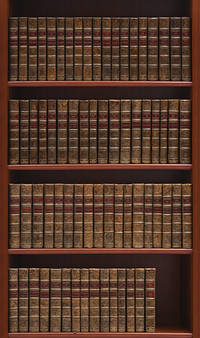
1784réf. 88246s. l. Kehl: Imprimerie de la Société Littéraire-Typographique 1784. Fine. « Divine Voltaire ora pro nobis ! » Exceptional copy on large paper and contemporary binding Imprimerie de la Société Littéraire-Typographique s. l. Kehl 1784-1789 14 x 21.7 cm 70 vol. reliés The Kehl edition the most renowned edition of Voltaire's works illustrated and published on deluxe paper. It was printed on five different types of paper and only the deluxe editions such as ours on laid paper feature engravings. These are naturally the most sought-after and rarest copies. Binding in full painted sheep decorated with a honeycomb motif smooth spine tooled with gilt fleurons fillets and compartments light beige calf lettering and volume pieces gilt chain-roll border on covers marbled endpapers gilt roll on edges all edges marbled contemporary binding. Two volumes nos. 50 and 70 with slight variations in gilt tools on the spines and with orange morocco lettering pieces edges and covers treated somewhat differently. General condition of the 70 volumes: bindings with light rubbing to corners gilt a little dulled occasional foxing a few wormholes and old restorations not affecting the text. 28 volumes vols. 4 5 8 10 11 13 16 17 19 20 24 27 28 33 34 35 36 37 43 48 61 62 63 65 66 67 68 70 with cracked joints at the ends and 20 volumes vols. 8 11 12 14 16 18 33 34 37 42 46 49 53 56 57 60 65 66 68 70 with damaged caps. Two editions were published at the same time. Our copy belongs to the prestigious in-8 edition on large paper published in 70 volumes the other edition being in-12 format in 92 volumes. It is richly illustrated with 125 etched plates: - There are 17 portraits including 3 of Voltaire: a frontispiece portrait by N. de Largillière engraved by P. Alex. Tardieu; one drawn from Houdon's bust by Moreau le Jeune and engraved by P. Alex. Tardieu; and one allegorical portrait by Louis Croutelle after Moreau le Jeune belonging to the second series of illustrations of Voltaire's works executed by Moreau for the publisher Renouard. The 14 other portraits include an allegorical frontispiece of Frédéric-Guillaume Prince of Prussia depicted in profile in a medallion by Dambrun after Moreau le Jeune; a portrait of Henry IV by Pourbus engraved by Tardieu; one of Charles VII engraved after the original in the King's Cabinet by Mavieri; another of Agnès Sorel drawn by Moreau the Younger after the original in the King's Cabinet and engraved by Mavieri; one of Joan of Arc engraved by Beisson; followed by the Count of Dunois engraved after the original in the King's Cabinet by J. B. Fosseyeux; one of Louis XIV drawn by Moreau Le Jeune after C. Le Brun engraved by J. B. Fosseyeux; one of Charles XII engraved by P. Alex. Tardieu after the original in the King's Cabinet; one of Pierre I engraved by P. G. Langlois after a painting by L. Caravaque; one of Madame du Châtelet after Marie Anne Loir and engraved by P. G. Langlois; one of the Count of Argental after J. Defraine and engraved by J. B. Fosseyeux; one of Frédéric II of Prussia painted from life by Van Loo and engraved by P. G. Langlois; one of Catherine II of Russia engraved by J. B. Fosseyeux; and one of d'Alembert after De La Tour engraved by N. F. Maviez. - 93 engravings by Moreau le Jeune including 44 figures for le Théâtre engraved by Lingée Simonet de Launay Trière Halbou Duclos Romanet Dambrun de Longueil Delignon Le Mire Le Veau 10 for la Henriade engraved by Masquelier Delignon Dambrun Patas Gutemberg Helman Simonet Duclos Romanet 21 for la Pucelle engraved by Simonet Dambrun Halbou Baquoy Trière Delignon de Longueil Croutelle and Duclos 4 for the Contes in verse engraved by Langlois Duclos Delignon and Le Veau and 14 for the Romans engraved by Trière Duclos de Longueil Dambrun Baquoy Delignon Simonet Langlois and Halbou. - 14 scientific plates in volume 31 illustrating the experiments of Newton Descartes and Leibniz. - 1 battle Imprimerie de la Société Littéraire-Typographique unknown
1785réf. 88781785 [Kehl], de limprimerie de la Société Typographique, 1785 1789. 70 volumes grand in-8° (175 x 270 mm). Exemplaire dexception sur très grand papier vélin de la fameuse édition de Voltaire financée par Beaumarchais, comportant dune part lillustration destinée aux tirages de luxe de cette édition (soit 93 planches de Jean-Michel Moreau le jeune, 12 portraits, 14 planches de physique, 1 plan, 1tableau des oeuvres de Voltaire), plus un large supplément dillustrations destinées à lédition Renouard des Oeuvres de Voltaire en 66 volumes in-8° publiée entre 1819 et 1825. Louvrage contient ainsi un total de 196 planches hors texte, soit : 113 figures de Moreau le jeune (44 pour le Théâtre, volumes 1 9; 10 pour la Henriade, volume 10; 21 pour la Pucelle dOrléans, volume 11; 6 pour les Contes en vers, volume 14; 2 pour le Siècle de Louis XIV, volumes 20 et 21; 1 pour le Siècle de Louis XV, volume 22; 1 pour lHistoire de Charles XII, volume 23; 1 pour lHistoire de Russie, volume 24; 27 pour les Romans et Contes, volumes 44 et 45); 67 portraits (33 gravés par Augustin de Saint-Aubin et 34 de graveurs divers dont Renouard possédait les cuivres); 14 planches de physique (volume 31) ; 1 plan («Camp des Tartares», volume 24 ); 1 tableau dépliant des oeuvres de Voltaire, volume 70). Impressionnantes reliures en demi-basane maroquinée bordeaux à coins, plats de papier rouge, dos lisse ornés, tranches ébarbées. Datant des environs de 1825 1830, elles sont signées (au dos du volume I): «Rel[ié] p[ar] les Dl[l]es Cotty». On ignore tout de ces personnes, dont on peut seulement supposer quelles étaient apparentées à Jean-Etienne Cotty, relieur actif à Paris de 1776 à 1820, que «Lesné [...] place parmi les bons relieurs de second ordre de son temps» (Thoinan, Les Relieurs français, page 234). Bas de la charnière inférieure du volume 11 fendu sur la moitié de sa longueur, quelques coiffes frottées, coins çà et là un peu émoussés, mais dans lensemble la collection est dans un état absolument désirable. Etiquettes collées aux premiers contreplats: «Louvard, libraire, rue du Bac, no 78»; ex-libris illustré: «André Gutzwiller» (1922 2014), banquier et bibliophile bâlois.
1784réf. 88246Imprimerie de la Société Littéraire-Typographique | s. l. [Kehl] 1784-1789 | 14 x 21.7 cm | 70 vol. reliés
réf. 8753Hambourg, 1753, un volume in 8 relié en plein veau marbré, dos orné de fers dorés, tranches rouges (reliure de l'époque), (un coin légèrement émoussé), 1 feuillet non chiffré blanc, 1 feuillet non chiffré (titre : MAUPERTUISIANA - verso blanc), 2 feuillets non chiffrés (avertissement - Pièces conenues dans ce recueil, pp. 7 à 48pp., 26pp., 192pp., (1), 65pp., 56pp., 40pp., (1), 41pp., 74pp., 32pp., 16pp., 8pp., 8pp., 8pp., (4), 88pp., 16pp., 19pp.. – Soit 16 parties reliées en un volume
réf. LCS-11978Edition de luxe et première édition illustrée de La Henriade. L’un des rares exemplaires imprimés sur papier fort de Hollande, à très grandes marges. A Londres, 1728. In-4 de (3) ff., 202 pp. et 12 planches. Collation conforme à l’exemplaire conservé à la B.n.F. Relié en plein maroquin bleu, triple filet doré autour des plats, dos à nerfs richement orné, double filet sur les coupes, roulette intérieure dorée, tranches dorées sur marbrures. Reliure du XIXe siècle signée Chambolle-Duru. 300 x 235 mm.
réf. LCS-A23Précieux exemplaire relié en maroquin rouge de l’époque aux armes de François VIII de La Rochefoucauld (1663-1728), Chevalier des Ordres du roi. Paris, Pierre Ribou; au Palais, Pierre Huet, Jean Mazuel et Antoine-Urbain Coustelier, 1719. In-8 de (4) ff. et 131 pp. Plein maroquin rouge, triple filet doré autour des plats, armoiries au centre, dos à nerfs finement orné, coupes décorées, roulette intérieure, tranches dorées sur marbrures. Reliure en maroquin armorié de l’époque. 183 x 108 mm.
1759réf. CLL-742Londres, Jean Nourse, 1759 In-12 de 299 pp., maroquin vert, triple filet doré en encadrement, dos à nerfs orné de caissons de fleurons dorés, double filet doré sur les coupes, dentelle intérieure dorée, tranches dorées sur marbrure (Thibaron).
1751réf. 65145à Berlin: Chez C. F. Henning 1751. Fine. Chez C. F. Henning à Berlin 1751 8.50 x 14.50 cm 2 volumes reliés First edition displaying all the distinctive features of its publication: it presents no capital letters except at the beginning of paragraphs and it is the very first work to have been printed with Voltaire's spelling. Our copy is complete with its errata leaf which is often missing. Later bindings 19th century in full red morocco Jansenist spines with five raised bands dates and places gilt at foot boards struck at center with large gilt typographical fleurons double gilt fillets on leading edges and headcaps pastedowns lined with blue morocco presenting a wide gilt decorative border monogrammed bookplates mounted on the pastedowns of each volume following endpapers of combed paper all edges gilt bindings signed Chambolle-Duru. Superb copy perfectly established in a binding signed by a master of French bookbinding. Chez C. F. Henning hardcover
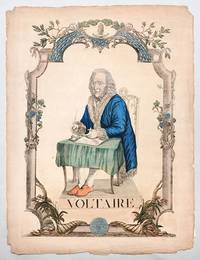
1790réf. 138601Paris: Basset c. 1790s. Voltaire as revolutionary icon A full-length portrait of the philosopher towards the end of his life in a fetching electric blue coat. The print is by the Parisian firm of Basset which was a leading source of popular prints during the Revolution. Voltaire was claimed as a foundational influence by many revolutionary leaders and in 1791 they arranged for his remains to be transferred to the Panthéon in Paris. Hand-coloured copperplate engraving. Image size: 70 x 52 cm. Framed size: 85 x 66.5 cm. Presented in a handmade gilt frame with conservation acrylic glazing. Light toning and chipping to extremities not touching impression several small tape repairs to extremities on verso not visible on recto: in very good condition. unknown
réf. LCS-18572Précieux exemplaire à marges immenses (hauteur 175 mm) des bibliothèques Lurde et Ruble. Louvain (Francfort?), 1755. Petit in-8 de (2) ff., 161 pp. Plein maroquin citron, chiffre doré dans les angles des plats, dos à nerfs orné du même chiffre doré et répété, double filet or sur les coupes, roulette dorée intérieure, tranches dorées. Motte. 175 x 105 mm.
1785réf. 618023 vol. in-8 reliure plein maroquin rouge, dos à 5 nerfs dorés richement ornés, plats richements orné, double filet doré en coupes, chasses ornées, gardes doublées de maroquin bleu orné d'une belle guirlande dorée d'encadrement ornementée, toutes tranches dorées, reliure signée de Chambolle-Duru, De l'Imprimerie de la Société Littéraire Typographique, [Kehl ], 1785, 2 ff., 439 pp. et 11 figures ; 2 ff., 470 pp. et 3 figures ; 2 ff. 416 pp. et 4 figures