12 797 résultats
1922réf. 340896Berlin: Julius Springer 1922. Softcover. Very Good. First edition. Very good ex-library book with minimal markings in wrappers with some soiling edgewear pages uncut. Text is in German. 258 pages. Julius Springer unknown books
1892réf. 37492Zwickau, Förster & Borries, 1892. 4°. Mit wenigen Textabbildungen u. zahlr. meist farb. Abbildungen auf 31 Tafeln. 115 (1) S., 2 Bll., OLwd. bzw. OLwd.-Mappe m. goldgepr. Deckeltiteln.
réf. 134618aafBerlin, Julius Springer, 1922, gr. in-8°, V + 258 S., mit 104 Illustrationen und 2 Tabellen, Original-Broschüre. Umschlag stockfleckig.
réf. 47419Leipzig, A. Förstner 1857, 225x140mm, 583Seiten, Chagrin-Halbledereinband. Goldgeprägtem Rückentitel. Platten marmoriertes Papier. Bibliothekstempel Titel Blatt. Guter Zustand.
réf. 35386Zürich, 1939, 225x155mm, 155Seiten, broschiert.
1993réf. 37680Berlin: Aufbau-Verlag 1993. First edition. Paperback. g to vg. Quarto. 214pp. Original photo-illustrated wrappers. Striking study on the 1936 "Nazi Olympics" as deciphered through the images of Leni Riefenstahl's "Olympia." For two weeks in August 1936 Adolf Hitler's Nazi dictatorship camouflaged its racist militaristic character while hosting the Summer Olympics. Softpedaling its antisemitic agenda and plans for territorial expansion the regime exploited the Games to bedazzle many foreign spectators and journalists with an image of a peaceful tolerant Germany. Having rejected a proposed boycott of the 1936 Olympics the United States and other western democracies missed the opportunity to take a stand that - some observers at the time claimed - might have given Hitler pause and bolstered international resistance to Nazi tyranny. With the conclusion of the Games Germany's expansionist policies and the persecution of Jews and other "enemies of the state" accelerated culminating in World War II and the Holocaust. Leni Riefenstahl's "Olympia" was divided into two parts: Olympia Part I: Festival of the Nations and Part II: Festival of Beauty both released in 1938. The movies represent a tremendous aesthetic and technical cinematic achievement. Through a compilation of sporting images "Olympia" subtly underlined a tenet of all authoritarian regimes: that individuals must be turned into machines that act as required but do not think. At no point do the sportsmen and women in Olympia speak. After the war Riefenstahl - who hoped her films would continue to be shown - claimed that the Nazi government had no influence on "Olympia." This was untrue. The Nazi government commissioned and financed the films. Propaganda minister Joseph Goebbels' diaries indicate that he was in contact with Riefenstahl about their progress though not always positively. "It is impossible to work with this wild woman" he wrote on one occasion. Wild though she may have been the films are utterly compliant. The fact that "Olympia" depicts such moments as the field hockey final in which India defeated Germany is sometimes mistaken by Riefenstahl's defenders as evidence of her editorial independence. It is the opposite. Riefenstahl's inclusion of the occasional German defeat fits squarely with Goebbels' instructions to the German press during the Games which were to create an impression of Nazi fairmindedness by reporting foreign as well as German victories. The Nazi obsession with race is constantly restated. "Two black runners against the strongest of the white race" muses "Olympia"'s commentator as he surveys the field for the men's 800m. On that occasion the black runners the US's John Woodruff and Canada's Phil Edwards took gold and bronze respectively. The most exhilarating section of the first "Olympia" film is the long-jump final in which black American athlete Jesse Owens faces the white German champion Luz Long. In the last of three jumps Long hits 7.87m: a new European record. The crowd is ecstatic as is Hitler himself who is shown applauding his champion. Then it is Owens's last jump. He composes himself. Sprints. Flies. Lands lightly in the sand. It's 8.06m a new Olympic record Owens already held the world record having jumped 8.13m in 1935. Tactfully Riefenstahl does not show Hitler's reaction to Owens's spectacular achievement. According to Albert Speer the Führer was "highly annoyed" but rationalised Owens's success within the terms of his pseudoscientific race theories. "People whose antecedents came from the jungle were primitive Hitler said with a shrug; their physiques were stronger than civilized whites." Moderate shelf wear along edges of wrappers. Text in German. Wrappers in overall good interior in very good condition. Aufbau-Verlag paperback books
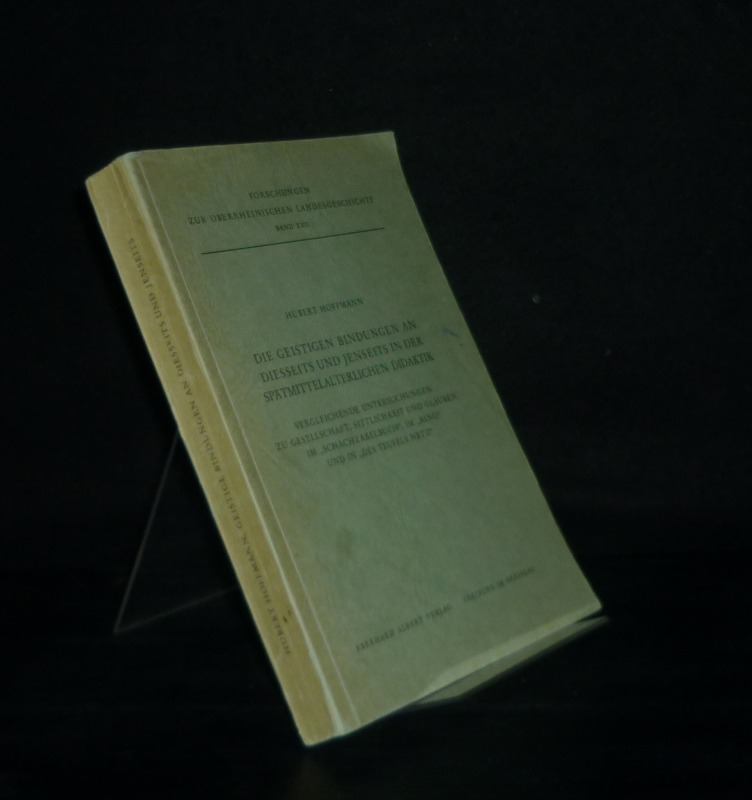
1969réf. 105373Freiburg: Eberhard Albert 1969. 290 Seiten. Gr. 8° (22,5-25 cm). Orig.-Broschur. [Softcover / Paperback].
2004réf. 1390768New York: World Security Network Foundation 2004. Limited First Edition 1/2000 Copies. Hardcover. Quarto 204 pages. In Very Good condition. Bound in publisher's gray cloth with silver lettering and a decorative monocle to front board. Mild bumping to corners of boards. Minor scuffing to cloth. Inscribed by contributor Edward L. Rowny on second free endpaper: "Dear Bill / Please accept this book as a token of my appreciation for our friendship. Fritz shared your values and was also one of your great admirers. / Best wishes to my favorite non-stovepiper! / Warm regards Ed Rowny." With a pocket to rear pastedown containing papers and prints from the publisher. Fritz Kraemer worked as the Senior Legal Advisor to the League of Nations in the 1930s. After serving in World War II he acted as Senior Civilian Advisor to the US Army Chief of Staff in the Pentagon until 1978. Kraemer is often credited with discovering Henry Kissinger and influencing the Department of Defense during the Cold War. Contributor and signer Edward L Rowny served as the US Representative to Strategic Arms Limitation Talks under Presidents Nixon Ford and Carter. He also served as an advisor on arms control for Presidents Reagan and George H.W. Bush. Other contributors include Alexander M. Haig Henry A. Kissinger Madeleine Kraemer Bryant Sven Kraemer Wilhelm-Karl Prinz von Preussen and Donald Rumsfeld. 1390768. Special Collections - Downstairs. World Security Network Foundation hardcover books
2004réf. 1412005New York: A World Security Network Foundation Publication 2004. Limited edition 2000 copies. Hardcover. Quarto 204 pages. In Fair condition. Spine is grey without print. Boards in grey cloth with embedded portrait medallion; stains to top portion of panels. Illustrated: b&w photographs. Laid in: Program for publication celebration various ephemera in rear pocket. Oversized books. Additional postage necessary for expedited/international orders. Economy International shipping unavailable due to size/weight restrictions. For international/expedited customers please inquire for rates. NOTE: Shelved in Locked Annex in quarto column. 1412005. FP New Rockville Stock. A World Security Network Foundation Publication hardcover books
1950réf. 103681950 Paris Editions de la toison d'or, vers 1950,, 2 volumes in8 brochés, illustrations en couleurs de René Mar coppélius, coppelia, le philosophe angora,la fille couleuvre, klein zach, mon ami peregrinus,,
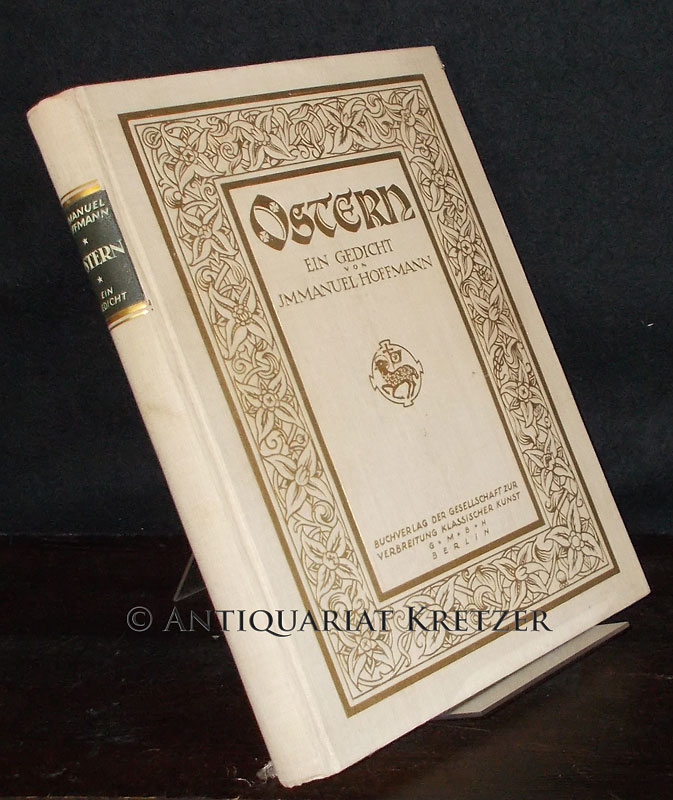
1924réf. 101923Berlin: Buchverlag der Gesellschaft zur Verbreitung klassischer Kunst 1924. 318 Seiten. Mit Frontispiz. 4° (25-35 cm). Orig.-Leinenband mit reicher Goldprägung. [Hardcover / fest gebunden].
1940réf. 59652Boston: Houghton Mifflin 1940. 8vo pp. 251. Little soiled brown clotha good copy. Houghton Mifflin unknown books
1940réf. 209628Boston: Houghton Mifflin Company / The Riverside Press 1940. Hardcover. Very Good/Very Good. First edition. 251pp. Text block edges slightly soiled covers rubbed and faded very good in a price-clipped about very good dust jacket with small tears and chipping mostly along the top edge and modest wear to the extremities. An alphabetical list of culinary herbs and hundreds of recipes of how to use them in different types of food. Houghton Mifflin Company / The Riverside Press hardcover books
1937réf. NF0443KUNST UND KUNSTHANDWERK AM BAU J. Hoffmann 1937 first edition near fine in worn and chipped but still most pleasing dust-wrapper with 233 photos of both contemporary German and Nazi architectural structures and buildings many of which today no longer exist. Text in German of course. J. Hoffmann unknown books
1996réf. 102094ABMünchen, Herbig, 1996. 3. durchges. u. erg. Neuaufl. Gr.-8°. 336 S. OLwd. m. OU. - OU. u. OLwd. minimal verblasst, gutes Ex. 3
réf. EO371341950 / 1966 Two papers. 46, 55 p., 27, 55 figures, printed wrappers. Published in: Institut Grand-Ducal de Luxembourg. Archives.
1960réf. EO374591960 88 p., 142 figures, paperbound. Published in: Archives. Institut Grand-Ducal de Luxembourg. Section des Sciences naturelles. Library stamp, else good copy.
1960réf. EX374441960 20 p., printed wrappers. Published in: Histoire Naturelle du Pays de Luxembourg. Faune. Library stamps.
1983réf. 204423BBBrschwg., Westermann, (1983). 4°. Mit zahlr. farb. Abb. 208 S. Ill. OPbd. - Gutes Expl.
1983réf. 227409BBBrschwg., Westermann, (1983). 4°. Mit zahlr. farb. Abb. 208 S. Ill. OPbd. - Gutes Expl.
réf. 7616Lausanne, Le Semeur Vaudois sans date, vers 1944, 183x115mm, 45pages, broché.
1842réf. 57626Kopenhagen, Reitzel, 1842. Clothbacked stiff blank wrappers. Stamp on title-page. Lower right corner of title-page defective, but no loss of letters. 22 pp., 1 galvanographic plate.
réf. 9781784727246Mitchell Beazley
réf. 9781784724290Mitchell Beazley
réf. 9781784729868Mitchell Beazley