Shelley, Percy ByssheBiblio.com
9.509 Ergebnisse
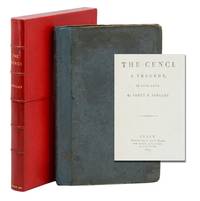
1819Best.-Nr. 140948806Livorno Italy: C. and J. Ollier 1819. First Edition. Very Good. First edition first printing one of 250 copies without initial blank. xiv 104 pp. Bound in the scarce original blue boards. Housed in a custom crimson red solander polished morocco case ruled in blind and lettered in gilt with matching chemise dust wrapper. Very Good with expertly rebacked spine soiling and light wear to boards and strengthened inner and rear hinges. Former owner's name in pencil at front pastedown light offsetting from chemise wrapper at endhseets title page has likely been washed ownership notations at verso dedication page and rear endpaper and light foxing to contents. A bit of light rubbing and soiling to case and chemise otherwise quite presentable. Penned while living in Rome at Villa Valsovano and based on a true story of a sixteenth-century Roman noble family Shelley recounts the violence accrued by Count Francesco Cenci in this controversial drama. Themes of incest tyranny patricide and near-blasphemous depictions of the Church made it too contentious to be staged publicly during Shelley's career. The play was staged privately by the Shelley Society on May 7 1886 at the Grand Theatre in Islington London to bypass censorship. It had had been denied a license for public performance by the sitting Lord Chamberlain with the first public performance occurring just over a century after publication in 1922. It later inspired influenced playwrights like Antonin Artaud who used it as a basis for his Theater of Cruelty in the 1930's.The Cenci is considered one of Shelley's masterpieces notable for its evocative language and dramatic force and the only work of his to reach a second edition during his tragically shortened lifetime; rather uncommon in the original boards. Ashley V 69. C. and J. Ollier unknown
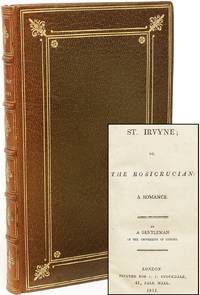
1811Best.-Nr. 005310London: for J. J. Stockdale 1811 1811. FIRST EDITION FIRST ISSUE. 1 vol. 7" x 4-1/2" ii236pp. with the original half-title bound in full olive green morocco ribbed gilt decorated spine covers double ruled and paneled in gilt gilt corner pieces gilt dentelles marbled pastedowns and endpapers all edges gilt. Internally clean and bright extreme foredge of page 19/20 as well as the extreme lower corner of page 21/22 expertly renewed both not affecting text short closed tear expertly repaired to page 25/26 not affecting text minor paper fault to pages 90/91 inner and outer hinges fine head and foot of spine fine back corners square spine sunned no previous ownership marking inscriptions or bookplate overall A VERY GOOD copy of an exceedingly scare title. According to RBH only 7 copies have appeared at auction in the last 75 years. The last in 2016. Stockdale later reissued the remaining copies with a new title page and imprint dated 1822. The original bill for the publication was meant to be borne by Shelley. Finding the young poet unable to pay Stockdale applied to Shelley's father who responded that since his son was not of age he wouldn't pay a farthing on the account. This was Shelley's second gothic romance actually written before he went to Oxford. He apparently thought that this sort of fiction would make money and tried financed the printing of the book himself assuming that it was "a thing which almost mechanically sells to circulating libraries." In fact he was wrong and St. Irvyne was little noticed. London: for J. J. Stockdale, 1811
1840Best.-Nr. 324477London: Edward Moxon 1840. First edition. 2 vols. 8vo. Recent half morocco and cloth. Formerly in the Exeter City Library with stamps. With a number of early neat pencil annotations in an unidentified hand 1:164 1:167; 1:234-239 three pages with lines shaved at the bindery. Very good. First edition. 2 vols. 8vo. Contains the first printing of Shelley's "The Defence of Poetry" and also his translations from the classics including Plato's "Symposium" "Ion" and fragments from "The Republic" and 67 letters. "The Defence of Poetry" was edited by John Hunt for inclusion in "The Liberal" but the magazine folded before it could be published. This first appearance used John Hunt's edited version. Inscribed in each volume "Julia Robinson from her affectionate friend Mary Shelley Putney 22 Dec. 1839". This inscription documents Mary Shelley's close connection with the Robinson family who figure for many years in her journals as well as in the Journals of William Godwin her father. From February 1827 Mary became close to Julia and Isabel or Isabella Robinson daughters of Joshua Robinson an Oxford graduate and a successful builder with a large family and a large residence Park Cottage in Paddington. After Isabella bore an illegitimate child she and Mary Shelley shared lodgings in the south of England in the summer of 1827. The inscription also points to a long-secret chapter in Mary's life documented by Betty T. Bennett in Mary Diana Dods A Gentleman and a Scholar 1991. Mary Shelley's friend Mary Diana Dods was the illegitimate daughter of a Scottish earl and wrote numerous works for Blackwood's Magazine under the name David Lyndsay including a story collection Tales of the Wild and the Wonderful 1825. Beginning in 1827 Mary Dods assumed the name and persona of Mr. Walter Sholto Douglas and with Isabella Robinson determined to live on the Continent where it was cheaper and where the legitimacy of Isabella's child would not be questioned. Mary Shelley secured the passports for the couple to travel to France as Mr. and Mrs. Walter Sholto Douglas. In April 1828 Mary Shelley travelled to Paris with Mr. Robinson and Julia "who has become Mary Shelley's new young companion" Bennett 38 to visit the Douglases. During much of that stay Mary was ill with smallpox and "her great regret is that she endangered Julia Robinson" Bennett 136. Mr. Sholto Douglas was later imprisoned for debt and died in France. Isabella was estranged from Mary Shelley when she returned to England in 1830 but Mary and her son lived with Julia Robinson for part of 1833 and clearly preserved friendly ties thereafter. An important book with an evocative association. Forman 77; Graniss 82. For Isabella Robinson and David Lyndsay see Betty T. Bennett. Mary Diana Dods A Gentleman and a Scholar 1991 Edward Moxon unknown books
1840Best.-Nr. 324477London: Edward Moxon 1840. First edition. 2 vols. 8vo. Recent half morocco and cloth. Formerly in the Exeter City Library with stamps. With a number of early neat pencil annotations in an unidentified hand 1:164 1:167; 1:234-239 three pages with lines shaved at the bindery. Very good. First edition. 2 vols. 8vo. Contains the first printing of Shelley's "The Defence of Poetry" and also his translations from the classics including Plato's "Symposium" "Ion" and fragments from "The Republic" and 67 letters. "The Defence of Poetry" was edited by John Hunt for inclusion in "The Liberal" but the magazine folded before it could be published. This first appearance used John Hunt's edited version. Inscribed in each volume "Julia Robinson from her affectionate friend Mary Shelley Putney 22 Dec. 1839". This inscription documents Mary Shelley's close connection with the Robinson family who figure for many years in her journals as well as in the Journals of William Godwin her father. From February 1827 Mary became close to Julia and Isabel or Isabella Robinson daughters of Joshua Robinson an Oxford graduate and a successful builder with a large family and a large residence Park Cottage in Paddington. After Isabella bore an illegitimate child she and Mary Shelley shared lodgings in the south of England in the summer of 1827. The inscription also points to a long-secret chapter in Mary's life documented by Betty T. Bennett in Mary Diana Dods A Gentleman and a Scholar 1991. Mary Shelley's friend Mary Diana Dods was the illegitimate daughter of a Scottish earl and wrote numerous works for Blackwood's Magazine under the name David Lyndsay including a story collection Tales of the Wild and the Wonderful 1825. Beginning in 1827 Mary Dods assumed the name and persona of Mr. Walter Sholto Douglas and with Isabella Robinson determined to live on the Continent where it was cheaper and where the legitimacy of Isabella's child would not be questioned. Mary Shelley secured the passports for the couple to travel to France as Mr. and Mrs. Walter Sholto Douglas. In April 1828 Mary Shelley travelled to Paris with Mr. Robinson and Julia "who has become Mary Shelley's new young companion" Bennett 38 to visit the Douglases. During much of that stay Mary was ill with smallpox and "her great regret is that she endangered Julia Robinson" Bennett 136. Mr. Sholto Douglas was later imprisoned for debt and died in France. Isabella was estranged from Mary Shelley when she returned to England in 1830 but Mary and her son lived with Julia Robinson for part of 1833 and clearly preserved friendly ties thereafter. An important book with an evocative association. Forman 77; Graniss 82. For Isabella Robinson and David Lyndsay see Betty T. Bennett. Mary Diana Dods A Gentleman and a Scholar 1991 Edward Moxon unknown
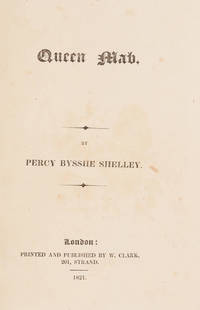
1813Best.-Nr. 1124London: P.B. Shelley 23 Chapel Street Grosvenor Square 1813. First Edition. 8vo 200 x 124mm pp. 6 240 2. Shelley’s first major poem. Original boards joints cracked but holding the interior is intact many copies have Shelley’s name and the printer’s imprint cut out as the book was being hunted by moralists and royalists. A virgin and unmutilated copy with the title page dedication and final leaf intact. One of only 250 copies printed for private distribution rare unrepaired and in anything approaching this condition. Morocco case. The poem is written in the form of a fairy tale that presents a future vision of a utopia on earth consisting of nine cantos and seventeen notes. Queen Mab a fairy the name from one referred to in Shakespeare’s play Romeo and Juliet descends in a chariot to a dwelling where Ianthe is sleeping on a couch. Queen Mab detaches Ianthe’s spirit or soul from her sleeping body and transports it on a celestial tour to Queen Mab’s palace at the edge of the universe. Queen Mab interprets analyses and explains Ianthe’s dreams. She shows her visions of the past present and the future. The past and present are characterized by oppression injustice misery and suffering caused by monarchies commerce and religion. In the future however the condition of man will be improved and a utopia will emerge. Two key points are emphasized: 1 death is not to be feared; and 2 the future offers the possibility of perfectibility of man by moral means. Humanity and nature can be reconciled and work in unison and harmony not against each other. While Ianthe is asleep on the couch Henry waits to kiss her. He never does. Queen Mab returns Ianthe’s spirit or soul to her body. Ianthe then awakens with a “gentle start.” Of the seventeen notes six deal with the issues of atheism vegetarianism free love the role of necessity in the physical and spiritual realm and the relationship of Christ and the precepts of Christianity. From a critical standpoint in this early poem Shelley forced together his youthful opinions into a scheme of dogmatic materialism. His objective was to show that reform and improvement in the lot of mankind were possible. In her notes to the work Mary Shelley explained the author’s goals: He was animated to greater zeal by compassion for his fellow-creatures. His sympathy was excited by the misery with which the world is bursting. He witnessed the sufferings of the poor and was aware of the evils of ignorance. He desired to induce every rich man to despoil himself of superfluity and to create a brotherhood of property and service and was ready to be the first to lay down the advantages of his birth. He was of too uncompromising a disposition to join any party. He did not in his youth look forward to gradual improvement: nay in those days of intolerance now almost forgotten it seemed as easy to look forward to the sort of millennium of freedom and brotherhood which he thought the proper state of mankind as to the present reign of moderation and improvement. Ill health made him believe that his race would soon be run; that a year or two was all he had of life. He desired that these years should be useful and illustrious. He saw in a fervent call on his fellow-creatures to share alike the blessings of the creation to love and serve each other the noblest work that life and time permitted him. In this spirit he composed Queen Mab. P.B. Shelley, 23, Chapel Street, Grosvenor Square unknown books
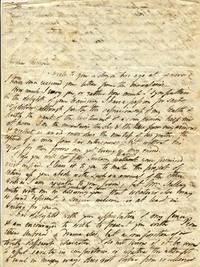
1820Best.-Nr. 42SHELLEY PERCY BYSSHE Autograph letter signed with his initials P. B. S. three pages 4to Pisa 20th July 1820 to his cousin Thomas Medwin ´My dear Medwin´. Shelley writes an interesting letter including references to two of his masterpieces stating that he has received Medwin´s letter from the mountains and remarking ´How much I envy you or rather how much I sympathise in the delights of your wandering. I have a passion for such expeditions although partly the capriciousness of my health & partly the want of the incitement of a companion keep me at home. I see the mountains the sky & the trees from my windows & recollect as an old man does the mistresses of his youth the raptures of a more familiar intercourse; but without his regrets for their forms are yet living in my mind´ adding that he hopes his cousin will not pass by Tuscany without paying a visit ´Mrs. Shelley unites with me in assuring.that whatever else may be found deficient a sincere welcome is at least in waiting for you´. Shelley proceeds to write at length regarding two of his verse dramas ´I am delighted with your approbation of my 'Cenci' & am encouraged to wish to present you with my 'Prometheus Unbound' a drama also but a composition of a totally different character. I do not know if it be wise to affect variety in compositions or whether the attempt to excel in many ways does not deter from excellence in one particular kind. 'Prometheus Unbound' is in the merest spirit of ideal poetry & not as the name would indicate a mere imitation of the Greek drama or indeed if I have been successful is it an imitation of anything. But you will judge - I hear it is just printed & I probably shall receive copies from England before I see you. Your objection to the 'Cenci' as to the introduction of the name of God is good in as much as the play is addressed to a Protestant people; but we Catholics speak eternally & familiarly of the 1st person of the Trinity; and amongst us religion is more interwoven with and is less extraneous to the system of ordinary life. As to Cenci´s curse I know not whether I can defend it or no. I wish I may be able since as it often happens respecting the worst point of an author´s work it is a particular favourite with me. I prided myself as since your approbation I hope that I had just cause to do upon the two concluding lines of the play. I confess I cannot approve of the squeamishness which excludes the exhibition of such subjects from the scene´ at this point of the letter two-and-a-half lines of text have been struck through seemingly by Shelley himself. The poet asks ´What think you of my boldness´ and reflects on a future project a drama which would remain unfinished at his death ´I mean to write a play in the spirit of human nature without prejudice or passion entitled 'Charles the 1st'. So vanity intoxicates people; but let those few who praise my verses & in whose approbation I take so much delight answer for this sin´ further making reference to contemporary events involving the British monarchy ´I wonder what in the world the Queen has done. I should not wonder after the whispers I have heard to find that the Green Bag contained evidence that she had imitated Pasiphae & that the Committee should recommend to Parliament a bill to exclude all minotaurs from the succession. What silly stuff is this to employ a great nation about. I wish the King & the Queen like Punch & his wife would fight out their disputes in person´ before closing his letter with the lines ´This warm weather agrees excellently with me; I only wish it would last all the year. many things both to say & to hear be referred until we meet´. With integral address panel in Shelley´s hand a couple of thin neat strips of the remains of the guard to the edges and centre. Autograph letters of Shelley are extremely rare as a result of his tragic death at the young age of 29 and the present example is particularly rich in its literary content. Some very light extremely minor age wear VG Thomas Medwin 1788-1869 English writer poet and translator remembered for his biography of Shelley and for published recollections of his friend Lord Byron. The Cenci. A Tragedy in Five Acts 1820 was written by Shelley in the summer of 1819 and inspired by the House of Cenci a real Roman family. The play was not considered stageable in its day owing to the themes of incest and parricide as well as the negative depiction of the Roman Catholic Church all subjects Shelley reflects on in the present letter and was not performed in public in England until over a century later in 1922. Prometheus Unbound 1820 is a four-act lyrical drama which is concerned with the torments of the Greek mythological figure Prometheus who defies the gods and gives fire to humanity for which he is subjected to eternal punishment and suffering at the hands of Zeus. The play is a closet drama not intended for stage production. In the tradition of Romantic poetry Shelley wrote for the imagination intending his play's stage to reside in the imaginations of his readers. Filled with suspense mystery and other dramatic effects W. B. Yeats famously described the work as being ´among the sacred books of the world´. The deleted passage of the present letter according to the published version in Volume IV of The Prose Works of Percy Bysshe Shelley originally read ´a squeamishness the produce as I firmly believe of a lower tone of the public mind and foreign to the majestic and confident wisdom of the golden age of our country´. One of the final parts of Shelley´s letter makes reference to the events of 1820 whereby King George IV who had recently succeeded to the throne attempted to divorce his long-estranged wife. Caroline of Brunswick. In order to secure his divorce the King had a special bill moved in the House of Lords and the evidence of the Queen´s adultery was presented to parliament in two green bags. Ultimately the measure was withdrawn by the government and Caroline remained married to the King until her death a year later.
1813Best.-Nr. 1124London: P.B. Shelley 23 Chapel Street Grosvenor Square 1813. First Edition. 8vo 200 x 124mm pp. 6 240 2. Shelley’s first major poem. Original boards joints cracked but holding the interior is intact many copies have Shelley’s name and the printer’s imprint cut out as the book was being hunted by moralists and royalists. A virgin and unmutilated copy with the title page dedication and final leaf intact. One of only 250 copies printed for private distribution rare unrepaired and in anything approaching this condition. Morocco case. The poem is written in the form of a fairy tale that presents a future vision of a utopia on earth consisting of nine cantos and seventeen notes. Queen Mab a fairy the name from one referred to in Shakespeare’s play Romeo and Juliet descends in a chariot to a dwelling where Ianthe is sleeping on a couch. Queen Mab detaches Ianthe’s spirit or soul from her sleeping body and transports it on a celestial tour to Queen Mab’s palace at the edge of the universe. Queen Mab interprets analyses and explains Ianthe’s dreams. She shows her visions of the past present and the future. The past and present are characterized by oppression injustice misery and suffering caused by monarchies commerce and religion. In the future however the condition of man will be improved and a utopia will emerge. Two key points are emphasized: 1 death is not to be feared; and 2 the future offers the possibility of perfectibility of man by moral means. Humanity and nature can be reconciled and work in unison and harmony not against each other. While Ianthe is asleep on the couch Henry waits to kiss her. He never does. Queen Mab returns Ianthe’s spirit or soul to her body. Ianthe then awakens with a “gentle start.” Of the seventeen notes six deal with the issues of atheism vegetarianism free love the role of necessity in the physical and spiritual realm and the relationship of Christ and the precepts of Christianity. From a critical standpoint in this early poem Shelley forced together his youthful opinions into a scheme of dogmatic materialism. His objective was to show that reform and improvement in the lot of mankind were possible. In her notes to the work Mary Shelley explained the author’s goals: He was animated to greater zeal by compassion for his fellow-creatures. His sympathy was excited by the misery with which the world is bursting. He witnessed the sufferings of the poor and was aware of the evils of ignorance. He desired to induce every rich man to despoil himself of superfluity and to create a brotherhood of property and service and was ready to be the first to lay down the advantages of his birth. He was of too uncompromising a disposition to join any party. He did not in his youth look forward to gradual improvement: nay in those days of intolerance now almost forgotten it seemed as easy to look forward to the sort of millennium of freedom and brotherhood which he thought the proper state of mankind as to the present reign of moderation and improvement. Ill health made him believe that his race would soon be run; that a year or two was all he had of life. He desired that these years should be useful and illustrious. He saw in a fervent call on his fellow-creatures to share alike the blessings of the creation to love and serve each other the noblest work that life and time permitted him. In this spirit he composed Queen Mab. P.B. Shelley, 23, Chapel Street, Grosvenor Square unknown
1813Best.-Nr. 20In-8. 2 leaves. title dedication to Harriet 240 pp. Copy with full margins. Original publisher's cardboard brown paper small rubbing on the spine and hinges. Contemporary bottle green silk undershirt with silk ribbon. Case spine titled in long-grain red morocco. Extremely scarce original and private edition with an estimated print run of 250 copies. Complete copy with the dedication page and printing notices. In the copies that he distributed around him Shelley deleted the page dedicating to Harriet name of a young cousin for whom he felt a romantic feeling but also of his first wife married in 1811 from whom he had separated and who committed suicide in 1816. He also cut out from these copies the printing instructions bearing his name on the title page and on the last leaf. In 1816 he revised and reprinted some extracts from his poem under the title The Daemon of the World. The few remaining complete copies of the 1813 edition were recovered by the London bookseller William Clark who ensured its distribution despite prosecution by the Society for the Suppression of Vice. In 1821 another publisher Richard Carlile produced a pirate edition in London which Shelley tried in vain to ban. Composed between June 1812 and February 1813 the poem Queen Mab named after a well-known figure in Irish legends and popularized by Shakespeare reflects all the utopian passion of a young eighteen-year-old poet having faith in a world full of love and castigating religion and all tyrannical institutions. Extremely rare first printing edition in strictly period cardboard of one of the very first works of the great English poet who died at the age of 31. Printed by P. B. Shelley hardcover
Best.-Nr. AME_97800778623122013: Principles Of Taxation For Business And Investment Planning Mcgraw-Hill. New. 17Th/_. New Principles Of Taxation For Business And Investment Planning unknown