1 540 résultats
1967(Buddismo - Orientalismo - Buddha - Vinaya - Gandhara - Testi in sanscrito) In 8°, legatura editoriale in piena tela grigia con titolo in bianco al dorso e disegno al piatto anteriore, sovrac. ill. a colori, pp. 310,(2), con numerose illustrazioni in b/n nel testo tratte da fotografie di Francesca Bonardi su sculture Gandhara. Collana ''All'insegna dell'orizzonte'' (29). Volume ben conservato.
2004réf. 22718Maisonneuve & Larose 2004 In-8 broché, couv. illustrée en coul., 177 pp. Très bon état. Poids : 600 gr avec emballage d’expédition
2005New English Paperback. Pbo. 4to. (27 x 24 cm). In English. 311 p., color ills. Museum, and showed how the Ottoman-European relationships and political events has reflected in Arts, a theme common with the previously held exhibition entitled From the Medicis to the Savoias, Ottoman Splendour in Florentine Collections. Along with being a rich art collection for the museums, the large number of portraits where the foreigners pose in Turkish costumes in their homeland after fighting with the Turks, showing how "Fear from the Turks" converted into a fascination, and the goods from the Ottomans that are either gained from wars, received as presents or bought, and the important role that they played in the European social life have always been interesting subjects for historians and other social researchers. In the exhibition, 92 oil paintings, landscapes and engravings, coming from different Museums in Central Europe (especially Slovenia) and private collections from England and Turkey, were displayed. The exhibition was made possible with the contributions of Credit Suisse. Contents: Vasko Simoniti, On the 'Turqueries'; Ales Arih, Foreword; Nazan Ölçer, Foreword; Hans-Ulrich Doering, Foreword; Christoph K. Neumann - Petr Stepanek, Ottoman-Habsburg relations in the 17th century; Stefan Yerasimos, Styrian dragomans in Istanbul; Gunsel Renda, The Ottoman Empire and Europe in the 17th century: Changing images; EdvilijoGardina, Alla Turca': The Tarsia Family of Koper in service for la Serenissima; Maximilian Grothaus "At the crossing of Orient and Occident: The Turquerie of Ptuj"; Polana Vidmar, Courage, power, beauty and luxury: The Vurberk gallery of 17th century paintings; Catalogue; Bibliography.
réf. 138179aafFribourg : Acad. Press / Göttingen : Vandenhoeck & Ruprecht, 2006, gr. in-8vo, 383 p. + ill. tafeln, hellblauer Original-Pappband, / orig. hardcover.
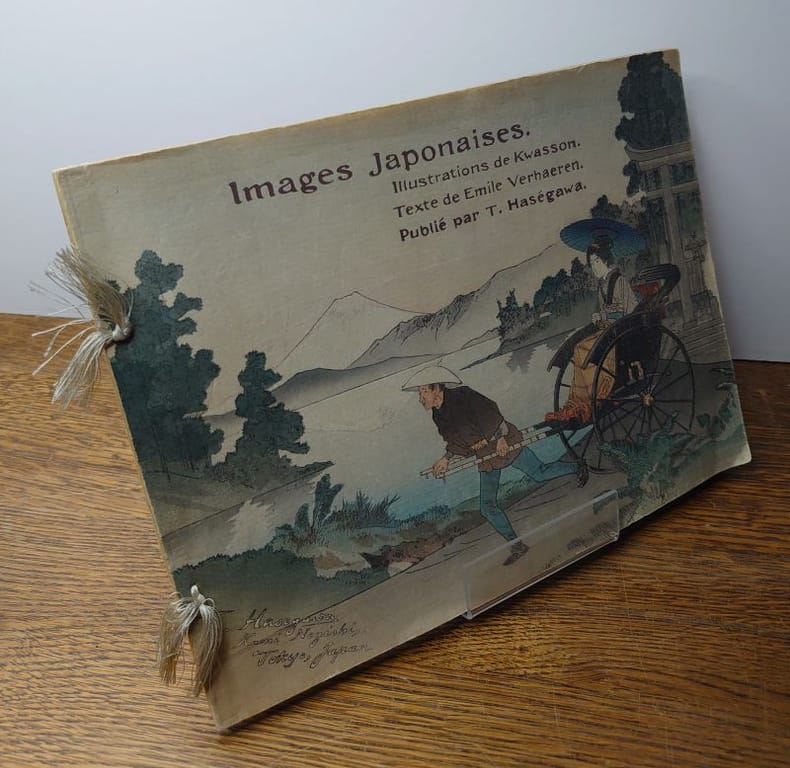
réf. 8186Tokyo, Japan, T[akejiro] Haségawa. [l'éditeur Hasegawa a déménagé à l'adresse de Tokyo indiquée sur la couverture (Kami Negishi) vers 1911. Cette impression date donc d'après 1911 (même si le colophon japonais indique la date de 1896 et l'ancienne adresse de Tokyo, 10 Hiyoshicho). Hasegawa a probablement réutilisé les blocs de bois du colophon pour faire des économies.]. Réf : Frédéric A. Sharf, Takejiro Hasegawa Meiji Japan's Preeminent Publisher of Wood-block-illustrated Crepe-paper Books, 1974, voir page 77. 27,5 x 20,5 cm. In-8° oblong. Broché, couture japonaise. Réédition de 6 poèmes de Verhaeren (l'originale est de 1896). Bel ouvrage japonisant dont les poèmes sont imprimés sur fond d'estampes dues à Kwasson, pseudonyme de Munetaro [ou Sôtaro] Suzuki. Au nombre de 14, elles couvrent chacune 2 ff. pliés à la japonaise doublés d'un f. de papier vergé, en plus des deux estampes illustrant les plats de couverture. Les exemplaires présentent de légères variantes de couleurs ou technique (quelques-uns sont parfois partiellement gaufrés comme le notre), résultat du procédé artisanal employé. Petites déchirures à la pliure du premier et dernier feuillet.
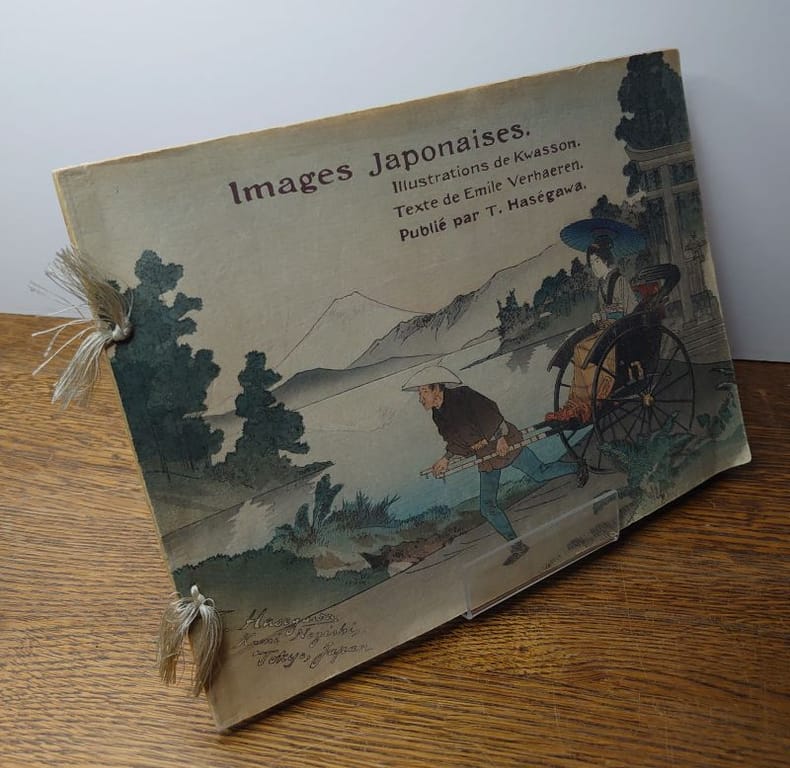
réf. 8590Tokyo, Japan, T[akejiro] Haségawa. [l'éditeur Hasegawa a déménagé à l'adresse de Tokyo indiquée sur la couverture (Kami Negishi) vers 1911. Cette impression date donc d'après 1911 (même si le colophon japonais indique la date de 1896 et l'ancienne adresse de Tokyo, 10 Hiyoshicho). Hasegawa a probablement réutilisé les blocs de bois du colophon pour faire des économies.]. Réf : Frédéric A. Sharf, Takejiro Hasegawa Meiji Japan's Preeminent Publisher of Wood-block-illustrated Crepe-paper Books, 1974, voir page 77. 27,5 x 20,5 cm. In-8° oblong. Broché, couture japonaise. Réédition de 6 poèmes de Verhaeren (l'originale est de 1896). Bel ouvrage japonisant dont les poèmes sont imprimés sur fond d'estampes dues à Kwasson, pseudonyme de Munetaro [ou Sôtaro] Suzuki. Au nombre de 14, elles couvrent chacune 2 ff. pliés à la japonaise doublés d'un f. de papier vergé, en plus des deux estampes illustrant les plats de couverture. Les exemplaires présentent de légères variantes de couleurs ou technique (quelques-uns sont parfois partiellement gaufrés comme le notre), résultat du procédé artisanal employé. Petites déchirures à la pliure du premier et dernier feuillet.
1993New English Original cloth bdg. by Legatoria Rigoldi SNC. Oblong folio. (36 x 47 cm). In English. 16, [1] p. text,1 full paged b/w map in text (Byzantivm nunc Constantinopolis), 8 folding color plts. of panoramic views made by Zacharias Wehme in 1582 from an album in the Sachsische Landesbibliothek Dresden (Mscr. J 2a). 1100 copies were printed in Italy. Numbered copy. 357/1100. Printed on handmade paper by Cartiere Enrico Magnani S.p.A. Preface.; Historical setting.; Images of Istanbul, I: A wedding procession. II: Entertainment in a Harem (women dancing and playing dance music). III: Ladies going to a bathhouse. IV: An imperial residence. V: Arrival of the Crimean Embassy. VI: Sultan embarking on a hunt. VII: Sultan going to Friday prayer. VIII: Procession of the Queen Mother. Images of imperial Istanbul. Facsimile Edition of eight panoramic views made by Zacharias Wehme in 1582 from an album in the Sachsische Landesbibliothek Dresden (Mscr. J 2a). Published by Ahmet Ertug. Photographic reproduction of originals by C. Hüttel. Translation of captions from German by Ali Özdamar.
2015New English Paperback. Pbo. Roy. 8vo. (24 x 17 cm). In English and Turkish. 254 p., b/w and color ills. Images of Üsküdar from the past. The five star book.= Geçmisten Üsküdar suretleri. Besibiryerde. Compiling the visual odyssey of our beloved borough of Üsküdar, spanning 500 years from the 1420s up until the 1950s, "The golden city" album aims at presenting the pertinent documents of the historical heritage that Üsküdar possesses. The paintings, etchings, photographs, postcards, and maps incorporated into the book all function to adequately and efficiently reflect and convety a semblance of the likeness of the past times pertaining to the "Eternal city" Üsküdar (Scutari) the our present day, and carry them forward to to posterity. Each page of this book-album ensures the remembrance of an exalted glory and an enduring magnificence of the bygone epochs, and, in a sense, successfully attempts to recreate the memory of a living metropolis. Each visual element and image featuring in the album attests to a diverse and rich accumulation, amassed over hundreds of years, as this impressive and exhilarating pictoral feast defines the magical and enchanted atmosphere of Üsküdar, standing out prominently as a "Dreamland" or the "City of fairy-tales and fantasies. (From introduction).
1961In 16°, brossura editoriale, pp. VI, 171, (5); esemplare molto buono. (XB4/B) (XB4/B)
réf. HuchetLivre sous emboitage, composé de 28 pages libres (30cm/45cm) sur vélin d’arches, contenant 8 lithographies numérotées et signées à la main par l’auteur ; le reste est composé de reproductions de ses notes manuscrites, avec petit croquis; tiré à 100 exemplaires seulement au total - tirage de 1983 (10 passages en présence de l'auteur) . Notre ex : N°79/100 ; L’intérieur est en état neuf mais accompagné d’une légère odeur d’ancien ; malheureusement l’emboitage, sur sa partie arrière connaît un léger enfoncement (on a posé quelque chose de trop lourd dessus) ; cela se traduit également par de légères marques à l’intérieur ; c’est la raison pour laquelle ce coffret « comme neuf » est désormais noté « bon état »
1979réf. ISLA0065Antelias, Selbstverlag, 1979. gr.-8°, XLV, 510 S., OKLdr. m. Goldpräg., leicht schiefgelesen, gutes Exemplar. In Englisch.
1986réf. 111954Michèle Trinckvel Paris 1986 In-4 relié 32 cm sur 25,7. 303 pages. Jaquette en bon état. Très bon état d’occasion.
1930(Tibet - Lamaismo - Orientalismo- Louise Eugène Alexandrine Marie David) In 8° (cm 20x13,5), legatura in mezza pergamena chiara con al dorso filetti in oro e tassello in pelle marrone con titolo dorato, carta marmorizzata ai piatti, pp. 244,(4), con 36 illustrazioni fotografiche in b/n su tavole fuori testo. Volume solido e ben conservato.
2014New English Paperback. Pbo. 4to. (28 x 24 cm). In English. 181 p., color and b/w ills. Since its earlier periods, The Ottoman Empire has established intense relations with European states. Urged by curiosity and a certain degree of fear at times, the West's efforts, on the other hand, to be acquainted with and understand this government of immense military power and source of political authority, emerged as a political exigency. Undoubtedly, the encounter of markedly different cultures bore the most enduring fruit within the realm of arts. Wars, the increase of trade as a means for mutual prosperity, and conflicts of status were the most significant factors behind the intense traffic of diplomacy. Sprawled across a vast geography, the Ottoman Empire welcomed more ambassadors than it sent to other countries, and particularly until the 19th century; these ambassadors were embraced, per Ottoman tradition. In turn, western ambassadors were prompted by the need to document the cities, particularly Istanbul, social structure, customs, administrative and military organization of the Ottoman Empire; apart from the reports they drafted upon their return, they also took advantage of the gifts and paintings they carried along. Often presumed to be true-to-life visual documents, such paintings thus became the most evident expressions of respectability and social status, and attained a special place and meaning, partly due to their potential to address the masses. The works that ambassadors commissioned to artists they added to their retinue en route to the East or to their local counterparts they encountered during service, evolved into books with engravings or collections decorating the walls of European chateaus, and served as source material for works by other artists, thus generating a large visual repertoire on the Ottoman world. Ottoman ambassadors sent to European countries were subjects of monumental portraits painted by leading European artists of the period, immortalizing these historic visits. This selection from the Suna and Inan Kiraç Foundation Orientalist Painting Collection, not only allows us to travel across the meandering paths of diplomatic history under the guidance of art, but it also introduces us to intriguing personalities. Ambassadors and painters continue to communicate with us through a silent yet equally rich and colourful language of expression, presented in their reports and letters, and share with us their respective periods, worldviews, travels and experiences, as well as the ceremonies they joined. Listening to their extraordinary tales, it is impossible not to be enraptured by the splendor and elegance of a lost age. Often used as one of the clearest indications of status and identity in western art since Antiquity, portraits also served a similar purpose for ambassadors. Furthermore, documenting the physiognomy of ambassadors through portraiture was also regarded as a precautionary measure against espionage. Portraits were painted of European ambassadors sent to the Ottoman Empire as high-level officials that have attained great respectability; artists to which these portraits were commissioned strived to reflect not only the physiognomy of the ambassadors, but the power and authority of the state and the ruler they represented. The Ottoman State's political, military, commercial, and cultural relations with European states gained momentum from the 18th century onwards. In turn, the visits Ottoman ambassadors paid to western countries accelerated the spread of the Turquerie fashion of the period. While portraits of Ottoman ambassadors painted by renowned artists of the countries to which they were assigned served to honor the Ottoman Sultan and his representative, they also nurtured the West's penchant for exoticism. There is no doubt that the ever-changing trends, fashions, as well as the purpose of diplomatic visits and political relations were reflected in the portraits. For example, while Kozbekçi M
As New English Paperback. Pbo. Mint. Cr. 8vo. (21 x 10 cm). In English. Color and b/w ills. [40] p. Intersecting worlds: Ambassadors and painters. Ambassadors portraits and art patronage of ambassadors from the 17th to the 19th century with works selected drom Suna and Inan Kiraç Foundation Collection. [Exhibition booklet].
1914réf. 99231914 Paris . Ernest Leroux, 1914, un volume in8, , relié en demi basane fauve, pièce de titre cuir rouge, titre doré, couverture conservée, 292 pp Bibliothèque historique des religions
1975In 4°, brossura editoriale, pp. 495, (3), con 20 tavole illustrate f.t. b/n; buon esemplare, lievissima mancanza alla prima bianca. (ZD5/B) (ZD5/B)
1938réf. 1209431938 Union des Imprimeries S.A., Collection "Les Trois lotus" - 1938 - In-8, broché - 38 p.
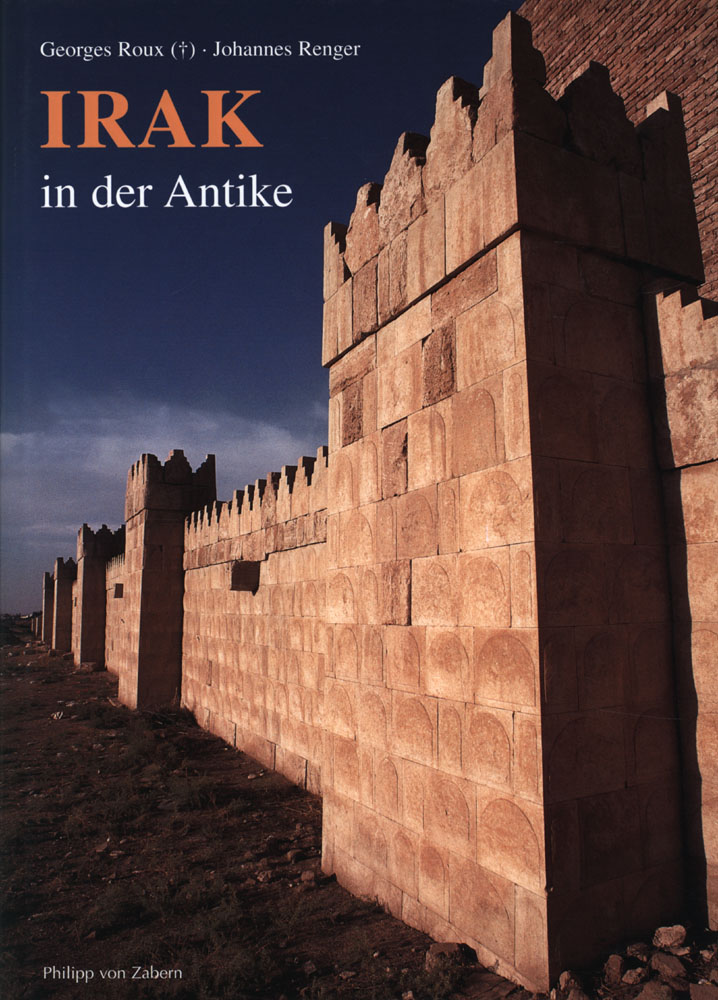
2005réf. 57012CBMainz am Rhein, Verlag Philipp von Zabern, 2005. 4°. 31 cm. 292 Seiten. Original-Pappband. Original-Schutzumschlag. (Zaberns Bildbände zur Archäologie; Sonderbände der Antiken Welt).
réf. ORD-8577L'Art à l'Epoque Préislamique. Albin Michel. (1962). Gd in-8 cartonné sous emboîtage illustré couleurs de l'éditeur, 265pp. Nombreuses illustrations in et h.-t. noir ou couleurs.
1995Fine English Paperback. Cr. 8vo. (20 x 13 cm). In Turkish. 216 p. Islâm maneviyati ve bati. [= L'Islam et la fonction de René Guénon.]. Translated by Isik Ergüden.
1973(Filosofie islamiche esoteriche - Islam sciita - Ismailismo - Nizariti - Dinastia dei Fatimidi - Il Vecchio della Montagna - Storia delle religioni - Orientalismo) In 8°, brossura editoriale verde oliva con titoli in nero al dorso ed al piatto anteriore, pp. (10),352,(4), con due cartine nel testo. Volume stampato nella Tipografia Poggi di Milano. Prima edizione. Ottimo stato di conservazione.
réf. 138140aafFreiburg, Universitätsverlag / Göttingen, Vandenhoeck & Ruprecht, 1999,, gr. in-8vo, XI + 359 S., hellblauer Original-Pappband, / orig. hardcover