1 565 résultats
2006pp.243 à 490, 28cm., brochure originale, non coupé, très bon état, X98842
1979236pp., 28cm., brochure originale, non coupé, très bon état, X98837
1979pp.237 à 409, 28cm., brochure originale, non coupé, très bon état, X98838
1984186pp., 28cm., brochure originale, bon état, X103210
1971298pp., 28cm., brochure originale, bon état, X98836
1995New French Paperback. Pbo. 4to. (29 x 24 cm). In French and Turkish. 103, [3] p., color and b/w ills. Le palais de France a Istanbul: Un demi-millenaire d'alliance entre la Turquie et la France.= Istanbul'da bir Fransiz Sarayi: Fransa ile Türkiye arasinda 500 yillik ittifak. Preface: François Dopffer. Traduction: Yigit Bener.
1995New English Paperback. Pbo. 4to. (29 x 24 cm). In French and Turkish. 103, [3] p., color and b/w ills. Le palais de France a Istanbul: Un demi-millenaire d'alliance entre la Turquie et la France.= Istanbul'da bir Fransiz Sarayi: Fransa ile Türkiye arasinda 500 yillik ittifak. Preface: François Dopffer. Traduction: Yigit Bener. Signed and inscribed by Casa to Nicole and Hugh Pope.
in-12, 369 pages, relie demi-toile bleue à coins, pièce de titre, couv. conservEe. Bel exemplaire. [CL-8]
1912(Tibet - Viaggi in Asia - Orientalismo - Tibetologia) In 8°, brossura editoriale, sovraccoperta in camicia con titoli in rosso e nero su fondo avorio e piccolo disegno al piatto anteriore, pp. (4),364,(4), con 60 illustrazioni fotografiche su 31 tavole fuori testo, 7 carte topografiche a colori fuori testo di cui sei a doppia pagina ed una più volte ripiegata. Edizione originale. Volume ben conservato.
in-8°, 243 pp., broche, couverture illustree Bel exemplaire. [PH-4] Conferences (Londres, Amsterdam, Paris) et Dialogues a Saanen.
iIn-12, 155 pages, broche, couverture. Bon etat. [CL-6]
in-8, 331 pages, broché. Pli au 1er plat sinon bel exemplaire. [LAFF]
1992In 8°, brossura editoriale illustrata con alette, pp. 242; coll. "L'espace interieur 43", testo in francese, ottimo esemplare. (stu IK02/04) . (spedizione standard SEMPRE tracciata con raccomandata - piego di libri, eventuale FATTURA da richiedere all'ordine) 9782213029139 (stu IK02/04)(18457)
2020New English Paperback. Demy 8vo. (22 x 14 cm). In English. [vii], [1], 107 p., b/w ills. According to the "Great Man Theory", leaders are born with a set of specific skills and traits that makes an individual destined for a leadership position. Also known as a trait perspective to leadership, it suggests that certain individuals have special innate or inborn characteristics or qualities that differentiates them from non-leaders. Specifically, these characteristics were believed to include height, weight, appearance, intelligence, disposition and others. Furthermore, charismatic and inspirational leaders instil faith in a better future for the followers in terms of their self-expression, self-evaluation, and self-consistency. The history of Ottomans is complicated and complex in terms of its emperors from the beginning to the end, in addition to severe relations with Europe and Asia. In this sense, especially the ascension period constitutes great importance; because of the fact that the six emperors of the period turned the Ottoman State into an "Empire" with their individual traits and acts. Therefore, it is worth to consider them as "great men" and evaluate them in this frame in order to construe the claim. It is expected that this book sheds light to the future researches in terms of evaluating both the emperors of Ottoman Empire and the other World emperors in terms of great man theory.
réf. 89909aafChampollion, Editions du Rocher / Jean-Paul Bertrand, 1998, gr. in-8vo, 361 p., richement illustré, cachet de l’ancien propriétaire sur p. de garde, brochure originale ill. en couleurs. / Softcover.
2005New English Paperback. Pbo. 4to. (29 x 21 cm). In English and Turkish. 208 p., color ills. "An Orientalist painter who lived almost half a century in Istanbul up to his death, Leonardo de Mango is described by the art commentator Thalasso as, a painter through whom the East spoke. De Mango was born on 19 February 1843, the eldest child of a large family in the town of Bisceglie near Bari in Italy, where he honed his native talent for drawing up to the age of nineteen. In 1862, under the patronage of an aristocratic family of Bari, he entered the Academy of Fine Arts of Naples and studied there for eight years under Filippo Palizzi and of Domenico Morelli. Morelli was also a painter who treated exotic orientalist themes. During this period de Mango also worked with Saverio Altamura, Bernardo Celentano, Raffaele d'Auria, Federico Maldarelli, Raffaele Postiglione and Giuseppe Mancinelli. In 1883 De Mango settled in Istanbul during the reign of Sultan Abdul Hamid II, where he is known to have set up, and taught for some time at, the oil painting department of the School of Fine Arts. Forced to leave Istanbul briefly in 1911 during the Tripolitanian War, the artist returned to the city following the Treaty of Ouchy on 15 October 1912. De Mango was among the artists who, at the initiative of Alexander Vallaury, a teacher in the architecture department of the School of Fine Arts, and Regis Delbeuf, manager of the Istanbul daily Le Stamboul, organized the first painting and sculpture exhibition at Beyoglu in 1901, dubbed the 'Pera Exhibitions in the Passage Oriental', an arcade owned by the French merchant Bourdon. With 27 works, De Mango was the most well represented artist in the exhibition, as he was again in the 1920 exhibition when he was one of 36 artists, participating with 33 of his own paintings. De Mango also had 16 paintings in the last of the Pera exhibitions, which was held in 1903. He painted in the open air and in his workshop at Beyoglu, reflecting the daily life of the different districts of Istanbul until his death in 1930.". Contents: Erol Makzume "The 75th anniversary of the death of an orientalist painter from Pera, Leonardo de Mango"; Roberta Ferrazza "Leonardo de Mango and the Italian community in Istanbul"; Bianca Consiglio "Portrait Painter Leonardo de Mango"; Piero Consiglio - Giacinto La Notte "Leonardo de Mango stages in a life divided between East and West"; Catalogue.
réf. 17569Paris, Ambroise Dupont et Cie, 1823-1827. 6 vol. in-8, XXVI-479 pp. + 487 pp. + 504 pp. + 526 pp. + 463 pp. + 502 pp., demi-veau glacé vert de l'époque, dos orné de filets et arabesques dorés, tranches marbrées (dos insolé, épidermures, quelques petites taches, rousseurs).
réf. c2127Paris, Bibliothèque de l'Honnête Homme,1955 ; fort volume in-8°, pleine percaline de l'éditeur bordeaux à décor de soleils stylisés dorés,titre doré au dos; 702pp.
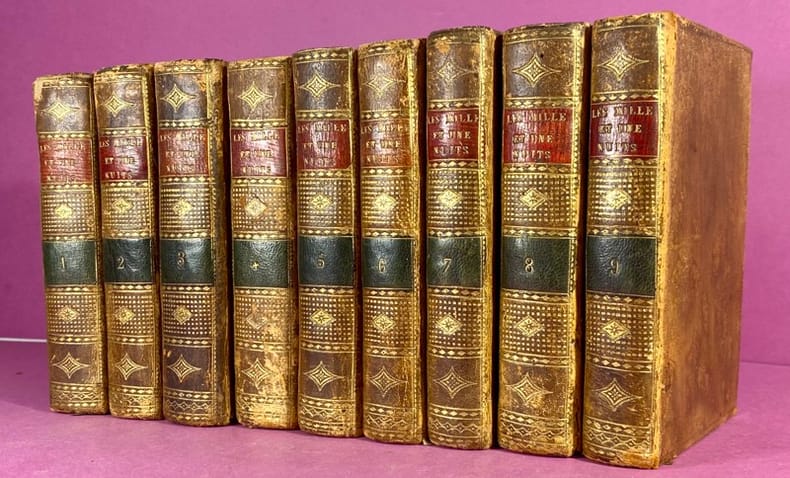
1806réf. 18911806 Couverture rigide A Paris, Chez le Normant, Imprimeur Libraire, 1806. 9 volumes in-16 (14 x 9 cm), reliure pleine basane racinée de l'époque, dos lisse orné de motifs dorés, pièce de titre en maroquin rouge, pièce de tomaison en maroquin vert, roulette dorée sur les coupes, quelques coiffes supérieures arasées, coins émoussés, petit manque de cuir au tome 1, charnières frottées, charnières du tome 7 légèrement fendillées, quelques épidermures. Tome 1 : xxxij, 479 pages, petit manque au coin supérieur de 3 feuillets (sans atteinte au texte) ; tome 2 : vj, 516 pages, manque au coin inférieur de la page 43 (sans atteinte au texte) ; tome 3 : faux-titre, titre, 548 pages ; tome 4 : vi, 520 pages ; tome 5 : vj 466 (2) pages ; tome 6 : faux-titre, titre, 432 (2) pages ; tome 7 : faux-titre, titre, 397 (3) pages, marques brunes sur les premiers feuillets, déchirure à la page 67 ; tome 8 : xlvj, 460 pages ; tome 9 : faux-titre, titre, 447 (1) pages. Concernant l'ensemble des volumes : intérieur légèrement jauni, quelques rousseurs et marques marginales. Si Antoine Galland fut le premier à révéler les Mille et Une Nuits à l’Europe en 1704, sa traduction était avant tout littéraire : il adaptait les contes au goût de la cour de Versailles, en gommant les passages trop crus ou les répétitions poétiques pour en faire un objet de divertissement galant. Jean-Jacques Caussin de Perceval, professeur de langue arabe au Collège de France, intervient un siècle plus tard avec une ambition différente. Il ne se contente pas de rééditer Galland ; il complète la série. À l'époque, on savait que la version de Galland était incomplète par rapport aux manuscrits originaux. Caussin de Perceval a donc puisé dans les manuscrits de la Bibliothèque impériale pour traduire des contes inédits et donner à l'oeuvre une envergure nouvelle, plus fidèle à la structure foisonnante du recueil oriental. Edition originale de la traduction revue par Caussin de Perceval. "Edition la meilleure et la plus complète", Brunet (2, 361). Bon exemplaire, en assez bon état, dans une reliure typique 1er empire.
réf. 19215Paris, La librairie des bibliophiles, 1881. 10 vol in-12, demi-maroquin à coins rouge, doubles filets dorés sur les plats, dos à nerfs orné de caissons dorés, tête dorée, couverture conservée (minuscules épidermures).
1949réf. _202000824Paris, Payot, 1949 ; in-8, (139 x 219 mm), 826 + 6, broché. Traduction intégrale par Charles MAURON.
réf. 54818P., Sfelt, Malfère (Collection "Les Grands Evènements Littéraires"), 1935, in 12 broché, 250 pages ; non coupé ; cachets.
1991réf. LIQ-4005Paris. ACR Edition 1991. In_4° pleine toile, jaquette illustrée en couleurs, 336 pp.
réf. 27143P., garnier, 1883, in 12 broché, VIII-419pp. ; à toutes marges ; rares annotations marginales au crayon ; des piqûres ; qq. marges pousiéreuses ; couverture légèrement fanée, dos fendu.
1987réf. 27814Paris ACR Edition 1987 in-4° les orientalistes volume 10, 288 pp,