NERUDA, PabloBiblio.com
1110 risultati
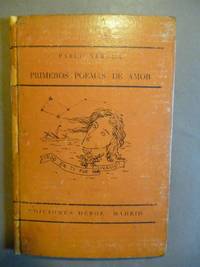
1936rif. 50.85Madrid: Eds. Heroe por Concha Méndez y Manuel Altolaguirre 6 de marzo de 1936. 1ª ed. Cartoné naranja editorial en una caja de tela. 11.7x18.6. Eds. Heroe, (por Concha Méndez y Manuel Altolaguirre) hardcover
1966rif. 3116340Santiago: Ediciones Sociedad De Amigos Del Arte Contemporianeo. Very Good with no dust jacket. 1966. First Edition; First Printing. Softcover. Limited edition. Copy #194 of 200 SIGNED ny pablo Neruda in his preferred green ink and by 3 ofthe features artists: Mario Carreno Hector Herrera & mario Toral. Very good in oversize paper wrappers. 105pp. 15 1/4" X 13 1/2" Features 17 full-color tipped-in paintings that accompany Neruda's poems. Near fine but for some tears along the top and bottom seam at spine. A few short edge tears. Scarce in the limited issue. ; 15 1/4" X 13 1/2"; 105 pages . Ediciones Sociedad De Amigos Del Arte Contemporianeo paperback
1954rif. 169457Santiago: Nascimento 1954. Amor hasta la noche abrupta Signed limited edition number 24 of 1000 copies signed by the author; there were also 10 hors commerce copies lettered A to J. The collection was originally published in 1948 and was translated into English in 1966. This limited edition illustrated with 11 images by Peruvian photographer Martín Chambi 1891-1973 was printed on the occasion of Neruda's 50th birthday. Folio. With 11 photographs by Chambi; 4-page bibliography by Jorge Sanhueza loosely inserted as issued. Original wrappers lettered in blue and yellow sepia photograph by Martín Chambi to front wrapper publisher's device to rear wrapper in yellow. With original glassine. Housed in a dark blue cloth flat-back box by the Chelsea Bindery. Wrappers slightly marked glassine creased and torn at extremities a near-fine copy. hardcover
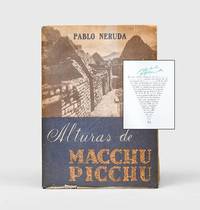
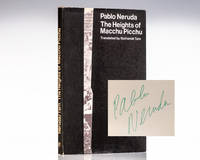
1966rif. 150452London: Jonathan Cape 1966. First edition in English of Neruda's masterpiece. Octavo original cloth. Boldly signed by Pablo Neruda on the half-title page. Translated by Nathaniel Tarn. Preface by Robert Pring-Mill. Fine in a near fine dust jacket. Housed in a custom half morocco clamshell box. A very sharp example rare and desirable signed. "The Heights of Machu Picchu" has been called Pablo Neruda's greatest contribution to poetry—a search for the "indestructible imperishable life" in all things. Inspired by his journey to the ancient ruins Neruda calls the lost Incan civilization to "rise up and be born" and also empowers the people of his time. Jonathan Cape hardcover
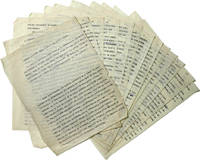
1962rif. 324526N.p. Santiago 1962. Published: Discursos Editorial Nascimiento 1962. Carbon typescript corrected in blue ink and typing. 24 pp. numbered 1-14 14a 15-23. 4to 8-1/2 x 11. Some marginal wear to first leaf; last leaf is tipped to another sheet toned. Very good. Published: Discursos Editorial Nascimiento 1962. Carbon typescript corrected in blue ink and typing. 24 pp. numbered 1-14 14a 15-23. 4to 8-1/2 x 11. Yo llegaba de la lluvia sureña y de la monosilábica relación de las tierras frías. I come from the southern rains and the monosyllabic exchanges of the cold lands. Typescript of the address of poet Pablo Neruda's 1904-1973 to the Facultad de Filosophia y Educacion at the Universidad de Chile upon his appointment to the university in March 1962. This is a discursive and wide-ranging contemplation of Chilean authors Mariano Latorre and Pedro Prado the question of influence and the history of Latin America and its place in the world. In resonant cadences Neruda singles out the clarity of Latorre and "his great wish to turn us towards the ancient essence of our land" while noting that for the taciturn adolescent it was the directness and "conversación" of Prado "the joyous maturity of his understanding of nature his perennial philosophical rambling made me comprehend the possibilities of association or society the expressive ccommunication of intelligence". Neruda quotes an extended passage from La Joie Rousse of Appolinaire and mentions the wandering nature of the poet's profession and the powerful emotion he felt when saying his poems in remote mining camps slums and before the longshoreman's union to see the audience of workers listen attentively. Many poets and writers are mentioned Garcia Lorca during a discussion of the creative process as well as Rimbaud and Baudelaire. He talks of seeing the first car and the first airplane in his youth and notes that the world has changed and so his poetry has changed. "Yo soy un patriota poético un nacionalista de las gredas de Chile" I am a patriotic poet a nationalist of the clay of Chile. Neruda turns to world affairs: "En America latina temblaron los tiranos. Cuba proclamó su inalienable derecheo a escoger su sistema social" In Latin America tyrants tremble. Cuba proclaimed its inalienable right to change its social system. A substantial and powerful essay. Pablo Neruda was awarded the Nobel Prize in literature in 1971. unknown
1962rif. 324526N.p. Santiago 1962. Published: Discursos Editorial Nascimiento 1962. Carbon typescript corrected in blue ink and typing. 24 pp. numbered 1-14 14a 15-23. 4to 8-1/2 x 11. Some marginal wear to first leaf; last leaf is tipped to another sheet toned. Very good. Published: Discursos Editorial Nascimiento 1962. Carbon typescript corrected in blue ink and typing. 24 pp. numbered 1-14 14a 15-23. 4to 8-1/2 x 11. Yo llegaba de la lluvia sureña y de la monosilábica relación de las tierras frías. I come from the southern rains and the monosyllabic exchanges of the cold lands. Typescript of the address of poet Pablo Neruda's 1904-1973 to the Facultad de Filosophia y Educacion at the Universidad de Chile upon his appointment to the university in March 1962. This is a discursive and wide-ranging contemplation of Chilean authors Mariano Latorre and Pedro Prado the question of influence and the history of Latin America and its place in the world. In resonant cadences Neruda singles out the clarity of Latorre and "his great wish to turn us towards the ancient essence of our land" while noting that for the taciturn adolescent it was the directness and "conversación" of Prado "the joyous maturity of his understanding of nature his perennial philosophical rambling made me comprehend the possibilities of association or society the expressive ccommunication of intelligence". Neruda quotes an extended passage from La Joie Rousse of Appolinaire and mentions the wandering nature of the poet's profession and the powerful emotion he felt when saying his poems in remote mining camps slums and before the longshoreman's union to see the audience of workers listen attentively. Many poets and writers are mentioned Garcia Lorca during a discussion of the creative process as well as Rimbaud and Baudelaire. He talks of seeing the first car and the first airplane in his youth and notes that the world has changed and so his poetry has changed. "Yo soy un patriota poético un nacionalista de las gredas de Chile" I am a patriotic poet a nationalist of the clay of Chile. Neruda turns to world affairs: "En America latina temblaron los tiranos. Cuba proclamó su inalienable derecheo a escoger su sistema social" In Latin America tyrants tremble. Cuba proclaimed its inalienable right to change its social system. A substantial and powerful essay. Pablo Neruda was awarded the Nobel Prize in literature in 1971. unknown books
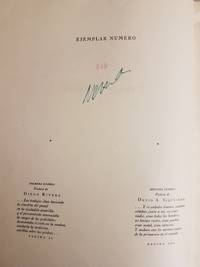
1950rif. 023048Mexico: Talleres Graficos De La Nacion. Good. 1950. Limited Edition. Hardcover. Limited edition of 600 copies this is number 489. Double signed by Neruda; once with just his last name in green pen on the limitation page and then again on the verso of the half-title page in red pen with a large doodle of a kite and an inscription to Chilean author Juan Agustin Palazuelos dated 1963. Published in Mexico City in March of 1950 this copy was printed on "Malinche" paper colophon. Folio measuring approximately 14 x 10 inches; 568 pages plus subscriber list subscribers include Frida Kahlo and Pablo Picasso. Publisher's red cloth boards with gilt fish imprint on cover and gilt lettering on spine. Gilt is quite faded and the cloth is somewhat soiled and faded as well. Rubbing to edges exposing boards at the corners. Cloth on spine is wrinkled. Binding is in a delicate condition with cracking gutters and a downward slant to the text block. Interior is clean except for a stain to the top edge of about the first 200 pages that does not impact content. Text block has a very faded purple top stain and uneven trim on the fore-edge. Features stunningly colorful endpapers decorated with an illustration by Diego Rivera in the front and another by David A. Siqueiros in the rear. Red cloth ribbon bookmark is faded. Overall good condition. Content is entirely in Spanish. This is a highly collectable copy of an epic book of poetry by Nobel Prize winning Chilean poet and diplomat Pablo Neruda. Canto General which translates to General Song consists of hundreds of poems separated into 15 sections and is widely considered to be one of Neruda's essential works. Together the poems present a history of Latin America with a focus on depicting struggles against oppression. ; Folio - over 12" - 15" tall; 568 pp; Signed by Author . Talleres Graficos De La Nacion hardcover
1960rif. 345639Third Programme: Future 1960. 16 typescript sheets title and 15 numbered pages of poems printed recto only. Small folio. Held by metal tab in upper left first sheet loose one letter corrected in black ink on p.2 some spotting to first and last sheet; signed on upper right of first sheet "Sylvia Plath Court Green North Tawton Devonshire. 16 typescript sheets title and 15 numbered pages of poems printed recto only. Small folio. In early 1960 they had met the poet W.S. Merwin and his wife Dido who became close to the couple and helped Plath and Hughes find a London Flat. In the spring of 1961 Merwin gave Plath the use of his studio and she began work on the novel that was to become the Bell Jar "working seven days a week from eight to one" and finishing the novel just before moving to Court Green the house in Devon that Plath and Hughes had recently purchased where she wrote the majority of her book Ariel and where Hughes lived in for the rest of his life. The transmission of Merwin's translations of Neruda's poems all from his Residence on Earth 1934-1945 was not aired on the Third Programme until 19 April 1962. Merwin's lively imagistic translations of Neruda would not be published until 1969 in Twenty Love Poems and his version of Neruda's Selected Poems in 1970 both published by Jonathan Cape. Provenance: Frieda Hughes; Clark Heather Red Comet: The Short Life and Blazing Art of Sylvia Plath New York: Knopf 2020 [Third Programme: Future] unknown books
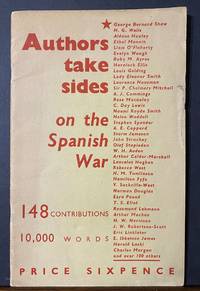
1937rif. 33174London: Left Review by Furnell and Sons Ltd 1937. First Edition. First Edition. RARE pamphlet AUTHORS TAKE SIDES ON THE SPANISH WAR 6 1/4" x 9 3/4" pp.28 plus cover printed on cream colour paper inside with black ink and red ink recto verso on the thicker cover stock. Slight wear on the outside right cover as per photos otherwise in fine shape. The editors of AUTHORS TAKE SIDES ON THE SPANISH WAR which was published in London by the Left Review in 1937 posed two questions to a list of influential poets and writers of the 1930's: "Are you for or against the legal Government and the People of Republican Spain Are you for or against Franco and Fascism" This historical and important document consists of 148 contributors and 10000 words on their stand on fascism and democracy. Among the contributors were: Leonard Woolf Vita Sackville-West Aliester Crowley with his name misspelled T S Eliot Ezra Pound W H Auden T.S. Eliot C. Day Lewis Rebecca West Sylvia Townsend Warner Evelyn Waugh George Bernard Shaw to name but a few influencers! Some responses were long and some such as with Samuel Beckett were quite short! '¡UPTHEREPUBLIC!' This significant pamphlet is very rare and a handful can only be found in library archives Left Review by Furnell and Sons Ltd unknown
1959rif. 194140Santiago: privately printed 1959. Te amo como se aman ciertas cosas oscuras / secretamente entre la sombra y el alma First edition presentation copy inscribed by the poet on the first blank "a Matilde Ladrón de Guevara gran capitana de sonetos su amigo Pablo Neruda 1960". This is number 12 of 250 copies signed by Neruda with a signed lithograph by the Chilean artist Nemesio Antúnez. Neruda wrote the sonnet sequence over a period of three years for his wife Matilde Urrutia and dedicated it to her; it is widely regarded as one of his greatest works. A fellow Chilean poet Matilde Ladrón de Guevara 1910-2009 has annotated around 40 of the sonnets in ink. Folio. With a lithographic centrefold by Nemesio Antunez signed by him in pencil. Original white wrappers spine and front wrapper lettered in black and red. Wrappers rubbed with a couple of faint stains extremities creased with small spots of wear small tears and creases to outer margins of first three leaves occasional toning to contents. A very good copy. unknown