19 risultati
1963rif. AH1486Oxford:: Clarendon Press 1963. 1963. Series: Scriptorum classicorum bibliotheca Oxoniensis. Small 8vo. pagination variable. Original navy blue gilt-stamped cloth. Fine. Second edition 1902; reprinted with revised index nominum. Also published: Tomus posterior. Libri V-VIII - not available here. Jones was a classical scholar and lexicographer. His main work was in classical studies in all branches of which including Greek music he had a wide knowledge. He was editor-in-chief of the new edition of Liddell and Scott's Greek - English Lexicon 1925-40. His numerous publications bibliography in Journal Rom. Stud. xxvii 3-11 included an edition of Thucydides Oxford Classical Texts 1898 The Roman Empire 1908 and A Companion to Roman History 1912. Clarendon Press, 1963. hardcover books
1951rif. 423765New York: The Modern Library 1951. Softcover. Very Good. The unabridged Crawley translation with an introduction by Finley. Octavo wrappers. 516pp. Fellow poet Daniel Hoffman's copy with his name penned on half-title and his penned underlining on a few pages rear wrapper creased lightly soiling about very good. "Modern Library College Editions T51. The Modern Library unknown books
2019rif. 94206Princeton:: Princeton University Press. Fine in Fine dust jacket. 2019. Hardcover. 9780691190150 . Speeches from The History of the Peloponnesian War. Selected translated from the Greek and introduced by Johanna Hanink. First printing thus. Fine in a fine dust jacket. . Princeton University Press, hardcover books
1854rif. 141547Leipzig: Wilhelm Engelmann 1854. later quarter leather over marbled paper-covered boards. small 8vo. later quarter leather over marbled paper-covered boards. 231176174198; 162 176 160 217 1 pages. Two volumes. Acht Bücher. Griechisch und deutsch mit kritischen und erklärenden Anmerkungen. In zwei Theilen. First edition. Exlibrary copy with markings. Rubbing to spine and covers. Foxing throughout. A good set. Index at the rear of volume two. Wilhelm Engelmann unknown books
1831rif. 287921Oxonii; Londini; Cantabrigiae: Excudebat S. Collingwood Academiae Typographus Impensis J. Parker; Whittaker Treacher et Arnott; C. J. G. et F. Rivington; J. et J. J. Deighton 1831. Full Leather. Good binding. 19th century edition of Thucidides’s work on the Peloponnesian War. Library plates on the front endpaper; library stamps on the front flyleaf and rear endpaper. Annotations throughout in the same hand underlining difficult vocabulary and providing translations in the margins. Hinges reinforced with green cloth. Fully rebacked in leather with the remnants of the original spine laid down. Full green morocco with gilt lettering borders and decorations. All edges gilt. Good binding. Excudebat S. Collingwood, Academiae Typographus, Impensis J. Parker; Whittaker, Treacher, et Arnott; C. J. G. et F. Rivington; J unknown books
1980rif. 100783Franklin Center:: Franklin Library. Near Fine with no dust jacket. Hardcover. Translated from the Greek by Richard Crawley. Revised by R. Feetham. With maps specially prepared for an English edition of 1629. Limited edition "The 100 Greatest Books of All Time". Octavo fully bound in black leather with gilt lettering and design raised bands along the spine all edges gilt silk moire endpapers sewn-in ribbon bookmark. About fine.; 732 pages . 1980. Franklin Library, hardcover books
1948rif. D14607London: The Dropmore Press 1948. Hardcover. Very Good. Translated by E.H. Blakeney. 12 24 4 pp. With an illustrated frontispiece. 4to. bound in publisher's half vellum and red cloth with nice example of the pictorial dust-wrapper and uncommon thus. Vellum discolored at the top of spine else an excellent copy. #130 of 300 copies printed. The Dropmore Press hardcover books
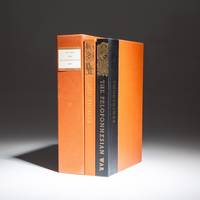
1974rif. 19025Avon Connecticut: The Limited Editions Club 1974. Limited Edition. Cloth. Fine. From The Limited Editions Club The History of the Peloponnesian War by Thucydides published in 1974. Tall octavo two volumes xviii 248pp; 249- 461pp 3. Bound in orange and black cloth titles on front cover and spine of each volume. Solid text blocks fine condition. In the matching slipcase light wear to edges. With detailed woodcut illustrations throughout the text. Includes the Limited Editions Club paperwork laid-in at front of each volume. One of 2000 copies this one numbered 85. Signed by the illustrator Tassos Anastasios Alevizos on the limitation page. The Limited Editions Club unknown books
1974rif. 47525Avon CT: Limited Editions Club 1974. Near Fine. Avon CT: Limited Editions Club 1974. First Edition Thus Limited to 2000 copies of which this is no. 1944. Two tall octavos 27cm; publisher's two-toned gilt-lettered cloth housed in original paper-covered slipcase; xiii12471; 2461pp.; frontispieces eight double-paged plates text illus. throughout. Two small specks to Vol. II spine cloth light wear to slipcase margins else a Near Fine example. Signed by the illustrator on colophon in rear of Vol. II. Limited Editions Club unknown books
1948rif. 14215London: Dropmore Press 1948. Frontispiece and initials by John O’Connor. Set by hand in Baskerville and printed by hand on an Albion press. Bound in publishers half vellum covers slightly sunned else a fine copy. One of 300 copies this being number 155. Dropmore Press unknown books
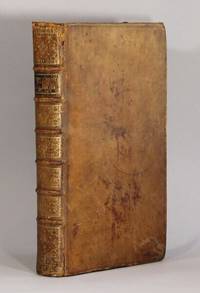
1746rif. 25224Oxford: Pheatrou en Oxonia 1746. First edition edited by Edward Bentham of Thucydides' De bello peloponnesiaco in ancient Greek; 8vo 4 163 1 14 index 48 Latin translation and index; engraved vignette on title engraved headpiece; bound with: M. T. Ciceronis sententeæ duæ de iis honore augendis qui periculum vitæ adierunt repub. causa . Oxonii 1746 pp. 16; contemporary full speckled calf gilt decorated spine; label wanting spine darkened joints cracked but cords holding; internally fine. Also with selections from the works of Plato and Lysias. Pheatrou en Oxonia unknown books
1920rif. 314255Frankfurt am Main: Kleukens Presse 1920. Number 34 of 250 copies. Unpaginated 12 ff. First and last leaves are blanks. 1 vols. 4to. Full brown morocco stamped in blind spine titled in gilt patterned paper endsheets t.e.g. Number 34 of 250 copies. Unpaginated 12 ff. First and last leaves are blanks. 1 vols. 4to. Pericles' Funeral oration from the second book of Thucydides History of the Peleponnesian War. The German text is by Rudolf G. Binding. This is the fifth book of the Kleukens Presse; most copies were issued in boards the present copy is in a full brown morocco binding with elaborate decorative strapwork borders in blind. Rodenberg I104; Schauer II67 Kleukens Presse unknown books
1550rif. 322912Venice 1550. hardcover. very good. Very thick short 8vo. one gathering loose. Full vellum with title in gold all edges rubricated. Printer's woodcut device to title-page and last page. 12 440 1. Venice 1550. Very good. A fine Venetian edition of Thucydides' famous history of the wars between Athens and the Peloponesians. unknown books
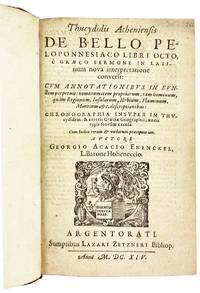
1614rif. 31123Argentorati Strassburg: Sumptibus Lazari Zetzneri Bibliop. Lazarus Zetzner 1614. Very Good. Argentorati Strassburg: Sumptibus Lazari Zetzneri Bibliop. 1614. First Zetzner Edition. Octavo 17cm.; 19th-century roan over papier-peint boards marbled endpapers; 3266448pp. collated complete; folding map plate woodcut printer's device to title page initials throughout. Leather chipped and dried with smallish loss at spine crown and biopredation along rear joint and upper cover fore-edge very faint evidence of gilt spine titling only else a Very Good internally clean and sound example. Sumptibus Lazari Zetzneri Bibliop. [Lazarus Zetzner] unknown books
1731rif. 73515Amstelaedami: apud R. & J. Wetstenios & Gul. Smith 1731. First edition large folio leaf 40.4 cm pp. 36 34 728 48 123 1; Greek and Latin text in parallel columns; engraved vignette title page printed in red and black engraved frontispiece engraved headpiece 2 engraved folding maps woodcut headpieces tailpieces initials and ornaments; contemporary full calf gilt-decorated spine in 7 compartments red morocco label in 1 a.e.g.; spine and label rubbed without loss of lettering joints cracked or starting internally crisp and clean. Dibdin II 4th ed. p. 509. "This edition was undertaken by Karl Andreas Duker at the express wish and entreaty of the publishers R. and J. Wetsten and Wm. Smith on account of the scarcity and high price of Hudson's at that time. The famous Joseph Wasse had prepared a variety of materials for this work by a careful revision of all the preceding editions: but he dying Duker was prevailed upon to complete it. The preface is by Duker; and although it is one of the most sumptuous and erudite productions which we have ever received from the continent and has long borne the distinguished title of " Editio optima;" yet says Harles "critici multa desiderant in hâc alias venustâ et præstanti editione" i.e. critics find much to be desired in this otherwise charming and excellent edition. apud R. & J. Wetstenios & Gul. Smith unknown books
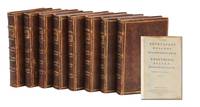
1759rif. 140946021Glasguae Glasgow: Robertus et Andreas Foulis 1759. Near Fine. Foulis Press edition. Each volume has the Greek text followed by the Latin translation which was taken from Duker's 1731 edition by Valla rev. Estienne Portus & Duker. Bound in contemporary speckled calf with double gilt ruling; six compartment spines tooled in gilt with five raised bands and the original morocco spine labels. All edges stained red 6.25" x 4" 18mo. Near Fine with chip to spine label on volume one minor rubbing to joints. Minor dust soiling to top edges; slight offset to title pages in each volume else bright. A handsome set of Thucydides' primary historical account The Peloponnesian War printed by famed scholars and publishers Robert and Andrew Foulis. A pioneering work of history. Robertus et Andreas Foulis unknown books
1540rif. 4885Basel: Ex Officina Hervagiana 1540. THIRD EDITION IN GREEK 1st ed. 1502. Hardcover. Fine. Bound in contemporary blind-tooled pigskin lightly soiled some surface abrasions discreet repairs to hinges. The binding is stamped with the date 1542 and the initial M. The boards are ruled in compartments with blind-stamped figurative rolls featuring female personifications of Prudence holding a mirror and Justice with her scales as well as Christ Moses and Lucretia plunging her a sword into hear breast. Further tools include interlocking sheaves of wheat and small pomegranates. A nice copy with broad margins. There is a little light dust-soiling to the margins of the first few leaves the final leaf and scattered instances in the upper margin elsewhere; a persistent light dampstain to the upper inner corner of the leaves; a wormhole to the outer blank margin occasionally developing into a short trail only entering the text in gatherings Z A and B. With minute contemporary annotations in the first three books. Printed in Greek with attractive woodcut Greek initials and Herwagen’s printer’s device on final leaf. This is the third printed edition of the Greek text of Thucydides edited by the renowned humanist Joachim Camerarius to whom Henri Estienne would dedicate in 1564 his own edition of Thucydides. In his introduction Camerarius tells us that he used a manuscript -brought to Italy from Constantinople over one-hundred years earlier- that had only recently come to Basel thanks to Herwagen. The text is followed by the scholia. “The standards and methods of Thucydides as a contemporary historian have never been bettered. Thucydides has been valued as he hoped; statesmen as well as historians men of affairs as well as scholars have read and profited by him. He began work at the very start of the events he records and the penetration and concentration which he devoted to his account of the ‘Peloponnesian War’ the war between Athens and Sparta from 431 to 404 B.C. were based on the conviction that it would prove the most important event in Greek history.”PMM 102. Ex Officina Hervagiana hardcover books
1588rif. 1936Geneva: Excudebat Henricus Stephanus 1588. SECOND ESTIENNE EDITION corrected by Estienne and with numerous additions. Printed in two sizes of the ‘grecs du roi’ types of Claude Garamond. There are numerous historiated initials and decorative head- and tail-pieces. The Estienne "Noli altum sapere" device appears on the title page. Hardcover. Fine. Bound in contemporary calf rebacked. The boards are framed by a single gold fillet. Central wreath-like cartouches also gilt are stamped at the centers of both boards. The text is in very good condition with good margins. There is however a bit of worming affecting the text in the first part. Second Estienne edition generally considered the best sixteenth century edition of Thucydides’ history of the Peloponnesian War. The war was fought from 431–404 BC “between the two leading city-states in ancient Greece Athens and Sparta. Each stood at the head of alliances that between them included nearly every Greek city-state. The fighting engulfed virtually the entire Greek world and it was properly regarded by Thucydides as the most momentous war up to that time. With Athens’ defeat . . . the most culturally advanced Greek state was brought into final eclipse.” Britannica "For this new edition Estienne has corrected the Greek text and scholia as well as further revised Lorenzo Valla's Latin translation which is now printed on the same page with the Greek text in parallel columns while the Greek scholia are printed at the foot of the page. Estienne has also added marginal concordances to his first edition. Among the other important additions are Estienne's ‘Proparasceue’ Preparation to the reading of the Greek scholia which is to this day a most valuable exposition of the special vocabulary and technical terminology used by the Greek scholiasts; his annotations on the text and scholia of the first two books Renouard as well as Carter and Muir in PMM wrongly attribute these annotations to Isaac Casaubon; the Thucydidean Chronology of David Chytraeus and the Greek Life of Thucydides by Marcellinus with a Latin translation by Casaubon." Quoted from Schreiber's "The Estiennes" "The standards and methods of Thucydides as a contemporary historian have never been bettered. Thucydides has been valued as he hoped; statesmen as well as historians men of affairs as well as scholars have read and profited by him"PMM 102. “Thucydides kept rigidly to his theme: the history of a war—that is a story of battles and sieges of alliances hastily made and soon broken and most important of the behaviour of peoples as the war dragged on and on of the inevitable “corrosion of the human spirit.” He vividly narrates exciting episodes and carefully describes tactics on land and sea. He gives a picture direct in speeches indirect in the narrative of the ambitious imperialism of Athens—controlled ambition in Pericles reckless in Alcibiades debased in Cleon—ever confident that nothing was impossible for them resilient after the worst disaster. He shows also the opposing picture of the slow steadiness of Sparta sometimes so successful at other times so accommodating to the enemy. “His record of Pericles’ speech on those killed in the first year of the war is the most glowing account of Athens and Athenian democracy that any leading citizen could hope to hear. It is followed in of course due chronological order by a minutely accurate account of the symptoms of the pestilence “so that it may be recognized by medical men if it recurs” and a moving description of the demoralizing despair that overtook men after so much suffering and such heavy losses—probably more than a quarter of the population most of it crowded within the walls of the city died. “Equally moving is the account of the last battles in the great harbour of Syracuse and of the Athenian retreat. In one of his best-known passages he analyzes by a most careful choice of words almost creating the language as he writes the moral and political effects of civil strife within a state in time of war. By a different method in speeches he portrays the hard fate of the town of Plataea due to the long-embittered envy and cruelty of Thebes and the faithlessness of Sparta and the harsh brutality of Cleon when he proposed to execute all the men of the Aegean island city of Mytilene. Occasionally he is forced into personal comment as on the pathetic fate of the virtuous and much-liked Athenian Nicias. “He had strong feelings both as a man and as a citizen of Athens. He was filled with a passion for the truth as he saw it which not only kept him free from vulgar partiality against the enemy but served him as a historian in the accurate narrative of events—accurate in their detail and order and also in their relative importance. He does not for example exaggerate the significance of the campaign he himself commanded nor does he offer a self-defense for his failure. Characteristically he mentions his exile not as an event of the war but in his “second preface”—after the peace of 421—to explain his opportunities for wider contacts. By the end of the 4th c. BC “the philosopher Theophrastus coupled Thucydides with Herodotus as a founder of the writing of history. Little is known of what the scholars of Alexandria and Pergamum did for his book; but copies of it were being made in considerable numbers in Egypt and so doubtless elsewhere from the 1st to the 5th century AD. By the 1st century BC as is clear from the writings of Cicero and Dionysius who vainly disputed his preeminence Thucydides was established as the great historian and since that time his fame has been secure.” Britannica. Excudebat Henricus Stephanus hardcover books
1588rif. 4174Geneva: Excudebat Henricus Stephanus 1588. SECOND ESTIENNE EDITION corrected by Estienne and with numerous additions. Printed in two sizes of the ‘grecs du roi’ types of Claude Garamond. There are numerous historiated initials and decorative head- and tail-pieces. The Estienne "Noli altum sapere" device appears on the title page. Hardcover. Fine. A fine tall copy in contemporary blind-ruled vellum edges of the text block sprinkled red and blue. The text is in very nice condition lightly toned with minor blemishes A FEW small ink stains sm. burn hole in margin of one leaf ss2 small rust spot g3-5 v. light dampstain at corner light damp to lower outer margin of final few signatures title and verso of final leaf lightly soiled. Provenance: 1. Ownership inscription dated 1595 of the German jurist political philosopher and seven-time rector of the University of Tübingen Christoph Besold 1577-1638. Besold was a close friend of Johannes Kepler whom he met while studying at Tübingen at which time he purchased this book. Besold championed Kepler's theories while at Tübingen and in 1626 he participated in the trial of Kepler's mother who was accused of witchcraft and ultimately acquitted. As a political philosopher Besold proposed a form of mixed constitution in which the ‘rights of majesty’ are divided between the prince and the assembly of estates. For his evolving views see his “De consilio politico axiomata”1622 “De statu reipublicae mixtu”revised ed. 1625 and “Principium et finis politicae”1626. For his views on Democracy in particular see his 1623 “Discursus politici” esp. Chapter III “De Democratia”. 2. Small stamp of the Donaueschingen Hofbibliothek library sold 1999-2001 on verso of the title. Second Estienne edition generally considered the best sixteenth century edition of Thucydides’ history of the Peloponnesian War. The war was fought from 431–404 BC “between the two leading city-states in ancient Greece Athens and Sparta. Each stood at the head of alliances that between them included nearly every Greek city-state. The fighting engulfed virtually the entire Greek world and it was properly regarded by Thucydides as the most momentous war up to that time. With Athens’ defeat . . . the most culturally advanced Greek state was brought into final eclipse.” Britannica "For this new edition Estienne has corrected the Greek text and scholia as well as further revised Lorenzo Valla's Latin translation which is now printed on the same page with the Greek text in parallel columns while the Greek scholia are printed at the foot of the page. Estienne has also added marginal concordances to his first edition. Among the other important additions are Estienne's ‘Proparasceue’ Preparation to the reading of the Greek scholia which is to this day a most valuable exposition of the special vocabulary and technical terminology used by the Greek scholiasts; his annotations on the text and scholia of the first two books Renouard as well as Carter and Muir in PMM wrongly attribute these annotations to Isaac Casaubon; the Thucydidean Chronology of David Chytraeus and the Greek Life of Thucydides by Marcellinus with a Latin translation by Casaubon." Quoted from Schreiber's "The Estiennes" "The standards and methods of Thucydides as a contemporary historian have never been bettered. Thucydides has been valued as he hoped; statesmen as well as historians men of affairs as well as scholars have read and profited by him"PMM 102. “Thucydides kept rigidly to his theme: the history of a war—that is a story of battles and sieges of alliances hastily made and soon broken and most important of the behaviour of peoples as the war dragged on and on of the inevitable “corrosion of the human spirit.” He vividly narrates exciting episodes and carefully describes tactics on land and sea. He gives a picture direct in speeches indirect in the narrative of the ambitious imperialism of Athens—controlled ambition in Pericles reckless in Alcibiades debased in Cleon—ever confident that nothing was impossible for them resilient after the worst disaster. He shows also the opposing picture of the slow steadiness of Sparta sometimes so successful at other times so accommodating to the enemy. “His record of Pericles’ speech on those killed in the first year of the war is the most glowing account of Athens and Athenian democracy that any leading citizen could hope to hear. It is followed in of course due chronological order by a minutely accurate account of the symptoms of the pestilence “so that it may be recognized by medical men if it recurs” and a moving description of the demoralizing despair that overtook men after so much suffering and such heavy losses—probably more than a quarter of the population most of it crowded within the walls of the city died. “Equally moving is the account of the last battles in the great harbour of Syracuse and of the Athenian retreat. In one of his best-known passages he analyzes by a most careful choice of words almost creating the language as he writes the moral and political effects of civil strife within a state in time of war. By a different method in speeches he portrays the hard fate of the town of Plataea due to the long-embittered envy and cruelty of Thebes and the faithlessness of Sparta and the harsh brutality of Cleon when he proposed to execute all the men of the Aegean island city of Mytilene. Occasionally he is forced into personal comment as on the pathetic fate of the virtuous and much-liked Athenian Nicias. “He had strong feelings both as a man and as a citizen of Athens. He was filled with a passion for the truth as he saw it which not only kept him free from vulgar partiality against the enemy but served him as a historian in the accurate narrative of events—accurate in their detail and order and also in their relative importance. He does not for example exaggerate the significance of the campaign he himself commanded nor does he offer a self-defense for his failure. Characteristically he mentions his exile not as an event of the war but in his “second preface”—after the peace of 421—to explain his opportunities for wider contacts. By the end of the 4th c. BC “the philosopher Theophrastus coupled Thucydides with Herodotus as a founder of the writing of history. Little is known of what the scholars of Alexandria and Pergamum did for his book; but copies of it were being made in considerable numbers in Egypt and so doubtless elsewhere from the 1st to the 5th century AD. By the 1st century BC as is clear from the writings of Cicero and Dionysius who vainly disputed his preeminence Thucydides was established as the great historian and since that time his fame has been secure.” Britannica. Excudebat Henricus Stephanus hardcover books