Thucydides E -A BetantBiblio.com

1 076 résultats
2015réf. BN238335ANDESITE PR 2015. 2015. Hardcover. Histoire de la Guerre du Péloponèse de Thucydide Histoire de la Guerre du Péloponèse de Thucydide Thucydides E. -A Bétant ANDESITE PR hardcover
réf. 45080275-nnew. unknown
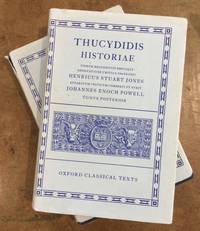
1970réf. 7045Oxford: Oxford University Press 1970. Hardcover. Very Good. 12mo - over 6¾" - 7¾" tall. Oxford Classical Texts series. The revised and reprinted second edition of 1902. Henry Stuart Jones editor. Dust jackets have small tears but generally very good. Bindings are tight. Pencilled annotations throughout. In the original Greek. 12mo 1970 Oxford University Press hardcover
1974réf. 47525Avon CT: Limited Editions Club 1974. Near Fine. Avon CT: Limited Editions Club 1974. First Edition Thus Limited to 2000 copies of which this is no. 1944. Two tall octavos 27cm; publisher's two-toned gilt-lettered cloth housed in original paper-covered slipcase; xiii12471; 2461pp.; frontispieces eight double-paged plates text illus. throughout. Two small specks to Vol. II spine cloth light wear to slipcase margins else a Near Fine example. Signed by the illustrator on colophon in rear of Vol. II. Limited Editions Club unknown
réf. 78087like new. unknown
réf. 1833896-nnew. unknown
1994réf. FB4480 /25In a fitted box. Maroon cloth spine with gilt title. Warrior image on the mauve boards. This is a very rare book and one of the best produced by the Folio Society The History of the Peloponnesian War by Thucydides: A plague so devastating it destroyed belief in the gods; prisoners of war worked to death in quarries; statesmen debating military action with chilling pragmatism… The horrors dilemmas and costs of war have never been examined more urgently or more rigorously than by the Athenian general Thucydides who recorded the seismic conflict between democratic Athens and authoritarian Sparta that engulfed the Greek world for a generation from 431 BC. In language of unorthodox beauty Thucydides reveals how the same patriotic pride and self-belief that had repulsed the Persians years before brought Athens to the brink of annihilation. The History of the Peloponnesian War – one of the 'most heart-rending and yet coldly analytical accounts of calamity ever written' – speaks with stark immediacy to future generations of their most fundamental challenges and concerns. Translated by Benjamin Jowett edited and annotated by Chris Scarre and Maps by Denys Baker and index by Ailsa Heritage. The Peloponnesian War 431–404 BC was an ancient Greek war fought between Athens and Sparta and their respective allies for the hegemony of the Greek world. The war remained undecided for a long time until the decisive intervention of the Persian Empire in support of Sparta. Led by Lysander the Spartan fleet built with Persian subsidies finally defeated Athens and started a period of Spartan hegemony over Greece. Historians have traditionally divided the war into three phases. The first phase 431–421 BC was named the Ten Years War or the Archidamian War after the Spartan king Archidamus II who launched several invasions of Attica with the full hoplite army of the Peloponnesian League the alliance network dominated by Sparta. However the Long Walls of Athens rendered this strategy ineffective while the superior navy of the Delian League Athens' alliance raided the Peloponnesian coast to trigger rebellions within Sparta. The precarious Peace of Nicias was signed in 421 BC and lasted until 413 BC. Several proxy battles took place during this period notably the battle of Mantinea in 418 BC won by Sparta against an ad-hoc alliance of Elis Mantinea both former Spartan allies Argos and Athens. The main event was nevertheless the Sicilian Expedition between 415 and 413 BC during which Athens lost almost all its navy in the attempted capture of Syracuse an ally of Sparta. The Sicilian disaster prompted the third phase of the war 413–404 BC named the Decelean War or the Ionian War when the Persian Empire supported Sparta in order to recover the suzerainty of the Greek cities of Asia Minor incorporated into the Delian League at the end of the Persian Wars. With Persian money Sparta built a massive fleet under the leadership of Lysander who won a streak of decisive victories in the Aegean Sea notably at Aegospotamos in 405 BC. Athens capitulated the following year and lost all its empire; Lysander imposed puppet oligarchies on the former members of the Delian League including Athens where the regime was known as the Thirty Tyrants. The Peloponnesian War was followed ten years later by the Corinthian War 394–386 BC which although it ended inconclusively helped Athens regain its independence from Sparta. The Peloponnesian War reshaped the ancient Greek world. On the level of international relations Athens the strongest city-state in Greece prior to the war's beginning was reduced to a state of near-complete subjection while Sparta became established as the leading power of Greece. The economic costs of the war were felt all across Greece; poverty became widespread in the Peloponnese while Athens was completely devastated and never regained its pre-war prosperity. The war also wrought subtler changes to Greek society; the conflict between democratic Athens and oligarchic Sparta each of which supported friendly political factions within other states made war a common occurrence in the Greek world. Ancient Greek warfare meanwhile originally a limited and formalized form of conflict was transformed into an all-out struggle between city-states complete with atrocities on a large scale. Shattering religious and cultural taboos devastating vast swathes of countryside and destroying whole cities the Peloponnesian War marked the dramatic end to the fifth century BC and the golden age of Greece. Thucydides c. 460 – c. 400 BC was an Athenian historian and general. His History of the Peloponnesian War recounts the fifth-century BC war between Sparta and Athens until the year 411 BC. Thucydides has been dubbed the father of "scientific history" by those who accept his claims to have applied strict standards of impartiality and evidence-gathering and analysis of cause and effect without reference to intervention by the gods as outlined in his introduction to his work. He also has been called the father of the school of political realism which views the political behaviour of individuals and the subsequent outcomes of relations between states as ultimately mediated by and constructed upon fear and self-interest. His text is still studied at universities and military colleges worldwide. The Melian dialogue is regarded as a seminal work of international relations theory while his version of Pericles' Funeral Oration is widely studied by political theorists historians and students of the classics. More generally Thucydides developed an understanding of human nature to explain behaviour in such crises as plagues massacres and civil war. The Folio Society. hardcover
réf. DADAX0521612586New unknown
1998réf. Q-0684827905Free Press 1998-09-10. Paperback. New. In shrink wrap. Looks like an interesting title! Free Press paperback
réf. DADAX0226734005New unknown
réf. 50026089-nnew. unknown
réf. 50195039-nnew. unknown
réf. ria9780521847742_inpHardcover. New. New Book; Fast Shipping from UK; Not signed; Not First Edition; Thucydides' classic work is a foundational text in the history of Western political thought. This new translation includes extensive reference material for non-specialists including maps glossaries biographies chronological charts hardcover
réf. 18525900like new. unknown
réf. ria9780521339292_inpPaperback. New. New Book; Fast Shipping from UK; Not signed; Not First Edition; This volume of Thucydides' history includes an account of Pericles' Funeral Speech and the plague in Athens between 431 and 429 BC. Professor Rusten comments on Thucydides' conception of these events with a thorough exegesis of passages paperback
réf. DADAX0199206198New unknown
réf. DADAX0199275858New unknown
réf. DADAX0199298289New unknown
réf. DADAX0198141262New unknown