224 résultats
1845réf. 8613Paris 1845. Pen ink and watercolour. Very good condition apart from some overall light soiling minor foxing and a 1 7/8" tear at the extreme right edge. A rare example of an original watercolour design for porcelain by the Samson factory of Paris. This finished design was intended as a reference source from which the porcelain painters could work using the design as a guide for the colours and image to be transformed from paper into fine porcelain. The French porcelain manufactory of Samson & Cie. was established by "Edmé Samson b. Paris 1810; d. Paris 1891 at 7 Rue Vendôme later Rue Béranger in Paris. The intention of the firm was to reproduce ceramics from museums and private collections and it claimed that all such reproductions would be distinctly marked to avoid confusion with the originals. In 1864 the factory was moved to Montreuil by Samson's son Emile Samson 1837-1913. The range of wares included copies of 18th-century porcelain from such factories as Sèvres Chelsea Meissen and Derby Chinese export-wares especially armorial wares decorated with famille rose colours and mugs decorated with the Fitzhugh pattern Delftware Iznikware maiolica and faience." Grove Dictionary of Art. unknown books
1845réf. 15378Paris 1845. Pen ink and watercolour. Very good condition apart from some overall light soiling and mild creasing. A rare example of an original watercolour design for porcelain by the Samson factory of Paris. This finished design was intended as a reference source from which the porcelain painters could work using the design as a guide for the colours and image to be transformed from paper into fine porcelain. The French porcelain manufactory of Samson & Cie. was established by "Edmé Samson b. Paris 1810; d. Paris 1891 at 7 Rue Vendôme later Rue Béranger in Paris. The intention of the firm was to reproduce ceramics from museums and private collections and it claimed that all such reproductions would be distinctly marked to avoid confusion with the originals. In 1864 the factory was moved to Montreuil by Samson's son Emile Samson 1837-1913. The range of wares included copies of 18th-century porcelain from such factories as Sèvres Chelsea Meissen and Derby Chinese export-wares especially armorial wares decorated with famille rose colours and mugs decorated with the Fitzhugh pattern Delftware Iznikware maiolica and faience." Grove Dictionary of Art. unknown books
1845réf. 14127Paris 1845. Pen ink and watercolour. Very good condition apart from some overall light soiling and a few skillfully repaired tears in the bottom left and top right of the image. Top right corner of sheet trimmed diagonally. The design is based on a piece from the Musée des Arts Déocratifs and a notation on the bottom of the print reads: "Panette Rouen XVIII siècle" A rare example of an original watercolour design for porcelain by the Samson factory of Paris. This finished design was intended as a reference source from which the porcelain painters could work using the design as a guide for the colours and image to be transformed from paper into fine porcelain. The French porcelain manufactory of Samson & Cie. was established by "Edmé Samson b. Paris 1810; d. Paris 1891 at 7 Rue Vendôme later Rue Béranger in Paris. The intention of the firm was to reproduce ceramics from museums and private collections and it claimed that all such reproductions would be distinctly marked to avoid confusion with the originals. In 1864 the factory was moved to Montreuil by Samson's son Emile Samson 1837-1913. The range of wares included copies of 18th-century porcelain from such factories as Sèvres Chelsea Meissen and Derby Chinese export-wares especially armorial wares decorated with famille rose colours and mugs decorated with the Fitzhugh pattern Delftware Iznikware maiolica and faience." Grove Dictionary of Art. unknown books
1845réf. 14117Paris 1845. Pen ink and watercolour. Very good condition apart from some light soiling and a few small barely visible foxing marks. A rare example of an original watercolour design for porcelain by the Samson factory of Paris. This finished design was intended as a reference source from which the porcelain painters could work using the design as a guide for the colours and image to be transformed from paper into fine porcelain. The French porcelain manufactory of Samson & Cie. was established by "Edmé Samson b. Paris 1810; d. Paris 1891 at 7 Rue Vendôme later Rue Béranger in Paris. The intention of the firm was to reproduce ceramics from museums and private collections and it claimed that all such reproductions would be distinctly marked to avoid confusion with the originals. In 1864 the factory was moved to Montreuil by Samson's son Emile Samson 1837-1913. The range of wares included copies of 18th-century porcelain from such factories as Sèvres Chelsea Meissen and Derby Chinese export-wares especially armorial wares decorated with famille rose colours and mugs decorated with the Fitzhugh pattern Delftware Iznikware maiolica and faience." Grove Dictionary of Art. unknown books
1845réf. 13927Paris 1845. Pen ink and watercolour. Good condition apart from some overall light soiling and minor foxing mild creasing and a few brownish stains in the top margin and right side of the image. A rare example of an original watercolour design for porcelain by the Samson factory of Paris. This finished design was intended as a reference source from which the porcelain painters could work using the design as a guide for the colours and image to be transformed from paper into fine porcelain. The French porcelain manufactory of Samson & Cie. was established by "Edmé Samson b. Paris 1810; d. Paris 1891 at 7 Rue Vendôme later Rue Béranger in Paris. The intention of the firm was to reproduce ceramics from museums and private collections and it claimed that all such reproductions would be distinctly marked to avoid confusion with the originals. In 1864 the factory was moved to Montreuil by Samson's son Emile Samson 1837-1913. The range of wares included copies of 18th-century porcelain from such factories as Sèvres Chelsea Meissen and Derby Chinese export-wares especially armorial wares decorated with famille rose colours and mugs decorated with the Fitzhugh pattern Delftware Iznikware maiolica and faience." Grove Dictionary of Art. unknown books
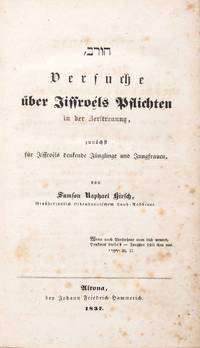
1837réf. 48406Altona Hamburg: Johann Friedrich Hammerich 1837. First edition. Hardcover. g to g. Octavo. xvi 800pp. Bound in brown pebbled half cloth over black pebbled boards. Treatise of Jewish law and observances by Samson Raphael Hirsch the German Orthodox Rabbi who founded the school of contemporary Orthodox Judaism Today's modern Orthodoxy and a vocal opponent of Reform Judaism. The work is organized in six sections according to Hirsch's classification of the commandments: Thaurauß Laws derived from the Five Books of Moses Edauß Jewish Holidays Mischpotim Laws Between Man and Man Chukim Laws Regarding Daily Life and Animals Mizwauß Laws about Devotion and Awaudoh Service and Prayer. The book was written in a literary German to explain Jewish customs ceremonies and doctrines with the special emphasis on German-Jewish youth. List of abbreviations and symbols in German and Hebrew at front and registers in German and Hebrew an addendum of explanation and abbreviations in Hebrew and errata at rear. Publisher's advertisement for the German Bible for Israelites a new translation from the Masoretic text and edited by Gotthold Salomon on last page. Text in German Gothic script titles subtitles and abbreviations in Hebrew. Binding with some wear along edges small chips and some scuffing along leather spine. Light foxing of block diminishing towards end of block. Binding in overall good interior in good to goo condition. Johann Friedrich Hammerich hardcover books
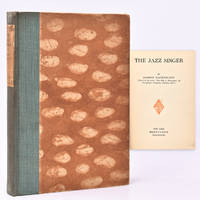
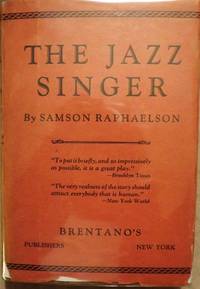
1925réf. 23656New York: Brentano's 1925. First edition. Hardcover. Fine/Near fine. 8vo. 153pp. blue cloth spine printed paper label decorated paper over boards. A fine copy. The dustwrapper is present. It is not clipped; there is a short closed marginal tear on the front cover and some roughness along the bottom edge of the rear cover but it is essentially near fine. The first book edition of the Jazz SInger after its short story appearance in the January 1922 Everybody's Magazine. The author expanded and dramatized the story. A special acknowledgment of the first stage production in 1925 at the Fulton Theatre starring George Jessel as Jack Robin. Basis for the Warner Brothers production starring Al Jolson billed as the first talking motion picture. . Brentano's hardcover books
1845réf. 14074Paris 1845. Pen ink and watercolour. Very good condition apart from a 7/8" tear along the right edge of the bottom crease some overall light soiling and minor foxing and a few skillfully repaired small tears in the right margin one of which slightly extends into the right part of the image. A rare example of an original watercolour design for porcelain by the Samson factory of Paris. This finished design was intended as a reference source from which the porcelain painters could work using the design as a guide for the colours and image to be transformed from paper into fine porcelain. The French porcelain manufactory of Samson & Cie. was established by "Edmé Samson b. Paris 1810; d. Paris 1891 at 7 Rue Vendôme later Rue Béranger in Paris. The intention of the firm was to reproduce ceramics from museums and private collections and it claimed that all such reproductions would be distinctly marked to avoid confusion with the originals. In 1864 the factory was moved to Montreuil by Samson's son Emile Samson 1837-1913. The range of wares included copies of 18th-century porcelain from such factories as Sèvres Chelsea Meissen and Derby Chinese export-wares especially armorial wares decorated with famille rose colours and mugs decorated with the Fitzhugh pattern Delftware Iznikware maiolica and faience." Grove Dictionary of Art. unknown books
1845réf. 13983Paris 1845. Pen ink and watercolour. Very good condition apart from some light soiling and a few small tears at the edge of the bottom margin. A rare example of an original watercolour design for porcelain by the Samson factory of Paris. This finished design was intended as a reference source from which the porcelain painters could work using the design as a guide for the colours and image to be transformed from paper into fine porcelain. The French porcelain manufactory of Samson & Cie. was established by "Edmé Samson b. Paris 1810; d. Paris 1891 at 7 Rue Vendôme later Rue Béranger in Paris. The intention of the firm was to reproduce ceramics from museums and private collections and it claimed that all such reproductions would be distinctly marked to avoid confusion with the originals. In 1864 the factory was moved to Montreuil by Samson's son Emile Samson 1837-1913. The range of wares included copies of 18th-century porcelain from such factories as Sèvres Chelsea Meissen and Derby Chinese export-wares especially armorial wares decorated with famille rose colours and mugs decorated with the Fitzhugh pattern Delftware Iznikware maiolica and faience." Grove Dictionary of Art. unknown books
1845réf. 18737Paris 1845. Watercolor. Very good condition apart from very mild soiling and a vertical crease where the sheet was once folded. This finished design was intended as a reference source from which the porcelain painters could work using the design as a guide for the colours and image to be transformed from paper into fine porcelain. The French porcelain manufactory of Samson & Cie. was established by "Edmé Samson b. Paris 1810; d. Paris 1891 at 7 Rue Vendôme later Rue Béranger in Paris. The intention of the firm was to reproduce ceramics from museums and private collections and it claimed that all such reproductions would be distinctly marked to avoid confusion with the originals. In 1864 the factory was moved to Montreuil by Samson's son Emile Samson 1837-1913. The range of wares included copies of 18th-century porcelain from such factories as Sèvres Chelsea Meissen and Derby Chinese export-wares especially armorial wares decorated with famille rose colours and mugs decorated with the Fitzhugh pattern Delftware Iznikware maiolica and faience." Grove Dictionary of Art. unknown books
1845réf. 15379Paris 1845. Pen ink and watercolour. Very good condition apart from some overall light soiling and foxing overall light creasing and a vertical crease in the center. A rare example of an original watercolour design for porcelain by the Samson factory of Paris. This drawing shows a full-height outline of a covered pot with high waisted body and spreading foot drawn in ink and completed in delicate washes of red green and soft blue. The main surfaces are filled with loose asymmetrical floral sprays centred on a large bouquet of roses and other garden flowers repeated on the shoulder foot and domed cover. The spout and opposing handle take the form of sinuous dragon- or serpent-like creatures their heads heightened in red and their scaly bodies mottled in green adding a whimsical zoomorphic note to the otherwise floral scheme. The French porcelain manufactory Samson & Co. was founded in 1845 by Edmé Samson 1810-1891 a Paris-born painter on ceramics who began by making replacement pieces for damaged services before turning to high-quality reproductions of historic wares. Working first at 7 rue Vendôme later rue Béranger in Paris and later from a factory at Montreuil run by his son Emile Samson 1837-1913 the firm drew on a large study collection of original pieces to copy or adapt designs from Sèvres Meissen Chelsea Derby and Worcester as well as Chinese export porcelain Japanese Islamic Delft faience and maiolica. Samson always maintained that its reproductions were distinctly marked to avoid confusion with the originals though later removal or alteration of marks has often led the firms work to be mistaken for earlier pieces. Production continued into the twentieth century finally ceasing in 1969 and the manufactory is now recognised as one of the most inventive nineteenth-century interpreters of historic ceramic styles. Surviving design drawings such as the present work offer rare insight into the way the Samson workshop translated museum models and historic patterns into working colour copies for its painters and modellers. unknown books
réf. 04086London: S.W. Fores 1801. Three of George Moutard Woodward's Hand-Colored Prints from "Symptoms of the Shop" WOODWARD George Moutard artist SANSON Francis printmaker. Symptoms of the Shop. London: S.W. Fores 1801. First edition. Quarto 10 1/8 x 8 1/16 inches; 257 x 265 mm. Three of twelve hand colored 'Satirical' stipple engravings on wove paper drawn by Woodward and etched by Sanson numbers 7 8 and 10. Each with the plate number at the top right margin and with lithographed text at the top of the image. On each of the lower margins is "Pub. June 1st 1801 by S.W. Fores No.50 Piccadilly Prints and Drawings lent on the plan of a Library Folio's of Caricature lent out for the Evening." / Symptoms of the Shop" / "Drawn by G. Woodward Etchd by F. Sansom". Some light marginal soiling otherwise near fine. Plate #7. "After all there is nothing like the true old orthodox principles." Plate #8. "I have brought your Honor home your new suit." Plate #10. "Madam - I was once a Minister and used to negotiations." Very rare. According to OCLC there are only two complete set in libraries and institutions worldwide The Lewis Walpole Library CT. has a complete colored set Princeton NJ also has a complete set but does not mention 'colored'. Yale university has nine of the twelve colored plates missing numbers 1 7 & 8. Harvard MA has one plate. These two artists previously collaborated on Every Body in Town BC-28 Every Body Out of Town BC-29 and Pigmy Revels: All Alive in Lilliput BC-62 all published by Fores. Each plate depicts two persons engaged in humorous wordplay relating to the characteristics of a trade or calling. William Gordon. A catalogue of the Books Drawings Prints and Periodicals forming the William A. Gordon Library of British Caricature. The three images present here include: Plate 7. A man sitting in a wooden chair lifts his hand for emphasis and declares: "After all there is nothing like the true old orthodox principles." An obese clergyman in a padded armchair on the right responds: "Orthodox principles - ah my dear friend you put me in mind of old times - when I was but a simple vicar. How I used to charm my congregation - slim as a Bedles wand - & delicate as a new wash'd surplice - but since I have been raised to higher dignities I do nothing but remain in my chair; bulky & unweildy as a Folio Church Service. - oh how elegantly I used to manage my discourses - fifteen minutes to a point by the clock under the gallery - never exceeded - short praye - text - and devision - one - two - three & away - that was my method." Plate 8. A man with a parcel under his arm bows slightly and says: "I have brought your Honor home your new suit." A stout bespectacled lawyer replies: "Suit - ah - Mr. Buckram you did not know me when I practiced in the Courts - I could have shewn you suits that would have puzzled Judge Blackstone himself - none of your simple matters - brim full of Law as a brief bag - intricate as the Temple avenues -& long as Westminster Hall - Shy Clients sometimes - but it would not do with Paul Parchment - sure to have them on way or other. - Once in never out that was my motto." Plate 10. A former Minister holding his hat wearing a bag-wig and with his pocket filled with scrolls addresses a woman: "Madam - I was once a Minister and used to Negotiations I shall therefore be happy to treat with you on Matrimonial Speculation - I have ample credentials ready to ratify my powers and if you please will enter into preliminaries immediately - but let me have a sight glance at your project and be assured I will deliver to you my contre projet as soon as the definitive treaty is concluded and duly guaranteed." The woman who is short and plump looks aghast at the proposition. London: S.W. Fores, 1801 unknown books
1696réf. 16269Paris: Alexis Hubert Jaillot 1696. Copper-engraved map with full original colour and gold embellishment in excellent condition. A stunning map of Normandy by Alexis Jaillot an exceptional example with gilt embellishments. One of the most important figures in French cartography Nicolas Sanson initiated the great school of French geographers. Born in Abbeville in 1600 Sanson established his first printing house in Paris in 1638. He soon became geographer to the king establishing himself as one of the most influential cartographers on the Continent. He was succeeded by his sons Adrien and Guillaume and by his son-in-law Pierre Duval who continued to publish a wealth of maps using Sanson's name. At the close of the seventeenth century Sanson's plates were purchased by the influential cartographer Alexis Hubert Jaillot who continued to publish his maps and atlases under Sanson's title. This stunning map of Normandy is based on Sanson's map published in 1650 but was redrawn and enlarged by Jaillot. It shows the provinces of Normandy as well as the northern tip of Brittany and part of the English Channel. Both Jersey and Guernsey are included as is Mont St. Michel off the coast of St. Malo. In keeping with all of Sanson's and Jaillot's superb maps forests rivers and towns are meticulously identified and named. The map includes an ornate cartouche in the upper section as well as a scale and key. Tooley Maps & Map-Makers pp. 40-41. Alexis Hubert Jaillot unknown books
1845réf. 8619Paris 1845. Pen ink and watercolour. Very good condition apart from some overall light soiling. A rare example of an original watercolour design for porcelain by the Samson factory of Paris. This finished design was intended as a reference source from which the porcelain painters could work using the design as a guide for the colours and image to be transformed from paper into fine porcelain. The French porcelain manufactory of Samson & Cie. was established by "Edmé Samson b. Paris 1810; d. Paris 1891 at 7 Rue Vendôme later Rue Béranger in Paris. The intention of the firm was to reproduce ceramics from museums and private collections and it claimed that all such reproductions would be distinctly marked to avoid confusion with the originals. In 1864 the factory was moved to Montreuil by Samson's son Emile Samson 1837-1913. The range of wares included copies of 18th-century porcelain from such factories as Sèvres Chelsea Meissen and Derby Chinese export-wares especially armorial wares decorated with famille rose colours and mugs decorated with the Fitzhugh pattern Delftware Iznikware maiolica and faience." Grove Dictionary of Art. unknown books
1925réf. 326925New York: Brentano's 1925. 153pp. 8vo. Blue cloth paper label & patterned boards. Very Good. 153pp. 8vo. Signed by the author on the ffep. This movie is considered the first talkie. Brentano's unknown books
1845réf. 8623Paris 1845. Pen ink and watercolour. Very good condition apart from some overall light soiling. A rare example of an original watercolour design for porcelain by the Samson factory of Paris. This finished design was intended as a reference source from which the porcelain painters could work using the design as a guide for the colours and image to be transformed from paper into fine porcelain. The French porcelain manufactory of Samson & Cie. was established by "Edmé Samson b. Paris 1810; d. Paris 1891 at 7 Rue Vendôme later Rue Béranger in Paris. The intention of the firm was to reproduce ceramics from museums and private collections and it claimed that all such reproductions would be distinctly marked to avoid confusion with the originals. In 1864 the factory was moved to Montreuil by Samson's son Emile Samson 1837-1913. The range of wares included copies of 18th-century porcelain from such factories as Sèvres Chelsea Meissen and Derby Chinese export-wares especially armorial wares decorated with famille rose colours and mugs decorated with the Fitzhugh pattern Delftware Iznikware maiolica and faience." Grove Dictionary of Art. unknown books
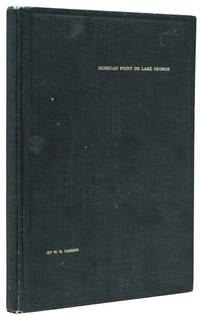
1913réf. 238650New York: Privately printed 1913. First edition no. 96 of 200 copies initialed and numbered on the half-title. With frontispiece 19 plates including 2 group portraits double map of Lake George around Bolton Landing at back. 65 pp. 1 vols. 8vo. Original green cloth titled in gilt on upper board. Bixby bookplate of Mohican Point house on front pastedown. Fine. First edition no. 96 of 200 copies initialed and numbered on the half-title. With frontispiece 19 plates including 2 group portraits double map of Lake George around Bolton Landing at back. 65 pp. 1 vols. 8vo. Inscribed on flyleaf "Mr. & Mrs. A. B. P- names partly effaced with sincere regards of Mr. & Mrs. W.K. Bixby St. L. 5/18/14" "Includes 12 pages of text on fishing for smallmouth bass lake trout and land-locked salmon. one of the few early books to contain as much material on fishing in Lake George" Heller. An important and rare book. Plum Adirondack Bibliography 568; Bruns S27; Heller 1:716 Privately printed unknown books
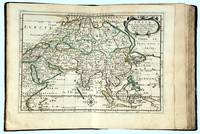
1662réf. 16493Paris: chez l’Autheur 1662. SECOND EDITION. Complete with 17 double-page engraved maps hand-colored in outline. Contemporary mottled calf corner edges neatly repaired interior has some minor dampstaining mainly on text and on blank verso of maps last blank leaf torn on lower fore-edge. A contemporary signature on first blank leaf. Similar to L’Amerique this atlas of the continent of Asia was first printed in 1652 and reprinted here with a new title page. The maps are all dated 1652 with only one dated 1653 and do not include the address of Mariette. The atlas features maps of India Persia China Japan the Maldives Arabia and the Philippines among others. Just prior to publication of this series of works which also included atlases of Europe and Africa Sanson formed a partnership with Pierre Mariette an engraver and printseller. Pursuant to their contract Sanson drew the maps and Mariette engraved and printed them. Each maintained possession of half of the plates and they were allowed to exchange and/or buy from one another. Some bore the address of Sanson others Mariette. But Sanson allowed Mariette to store his plates and Mariette without prior agreement started placing his address on Sanson’s plates. In time a lawsuit which had been prosecuted was settled when both died and their respective sons took over the business. This atlas is a fine examples of French mapping by the foremost French cartographer of the seventeenth century. Sanson 1600-1667 “Geographe Ordinaire du Roi” to Louis XIII is considered the founder of French cartography and is generally acknowledged as the originator of the great age of French cartography. chez l’Autheur unknown books
réf. 30548Brentano's. RAPHAELSON Samson. THE JAZZ SINGER. NY: Brentano's 1925. Small 8vo. cloth & patterned boards in dust jacket. First Edition. Signed by Raphaelson on the front endpaper and dated Christmas 1925. Basis for the hit play starring George Jessel and Sam Jaffe. The play was later adapted to the famous film starring Al Jolson and Warner Oland. The film generally considered the first "talkie" is certainly one of the milestones in cinematic history. Very Good; some edgewear & shallow chipping number of tears with professional interior repairs d/j. Enclosed in a custom-designed leather and cloth clam-shell box with Al Jolson in black face depicted on the spine and front cover. $4000.00. Brentano's unknown books
1656réf. 006682Paris: Chez l'Autheur 1656. First Edition. Full Calf. Very Good. 4to. 23.5 by 17.5 cm. Unpaginated 100 pages of text plus 2 pp. of ads. With 18 copper engraved maps all two page plates each with hand-colored of boundaries. Maps include one of the entire continent then of its various regions as then known plus the islands off the continent. Also a map of Malta. Bound in contemporary calf. Condition: calf dry and rubbed on spine and joints and edges rubbed. Light to moderate soiling in the margins of the pages. Two bookplates -- one of the Marquis of Lothian the other the Newbattle Abbey Library. Chez l'Autheur unknown books
1652réf. 006683Paris: Chez l'Autheur 1652. First Edition. Full Calf. Very Good. 4to. 23.5 by 17.5 cm. Unpaginated 102 pages of text plus 2 pp. of ads 1 Royal privilege page. With 17 copper engraved maps all two page plates each with hand-colored of boundaries. Maps include one of the entire continent then of its various regions as then known plus island groups. Separate maps for China and Japan. Bound in contemporary calf. Condition: Rebacked with joints making this obvious. The original spine was re-mounted with some losses. Its blindstamped decoration of fans is discernible but somewhat vague. We think it is possible this decoration had some gilding or color originally but none survives. Still an interesting and unusual feature in our view. Calf dry and rubbed on spine and joints and edges rubbed. Light to moderate soiling in the margins of many pages and on a few pages the soiling invades inward beyond the margins and also in a few instances the marginal soiling is on the heavier side. There are a few archival tape repairs of small chips three on the title leaf one on the following leaf and after that wormhole edge damage was left untouched. That said the defect and repair isn't as glaring as it might sound. The edges elsewhere can have short spans of a chewed appearance. As a book generally we would consider this copy at best Good. As far as the maps go independent of the book we would regard them as Very Good. A few of the maps might individually fall short of such grading; on the other hand all the maps of this copy one can easily imagine someone enthusiastically framing even without an attempt to clean them up. Two bookplates -- one of the Marquis of Lothian the other the Newbattle Abbey Library. Chez l'Autheur unknown books
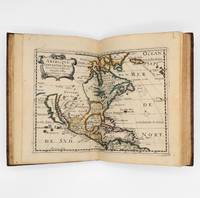
1657réf. 375003Paris: Chez L'Autheur 1657. 15 engraved double-page maps hand colored in outline. 4 40 of 42 unpaginated text leaves lacks final two leaves of text. 4to. Contemporary mottled calf gilt raised spine bands repairs at joints. Lacks final two leaves of text after the map of Brazil. 15 engraved double-page maps hand colored in outline. 4 40 of 42 unpaginated text leaves lacks final two leaves of text. 4to. First edition of important and quite handsome 17th-century French atlas of the Americas. This atlas was first published in 1657 and stands as a beautiful cartographic record of America for the 17th century. Sanson was official cartographer to the King. The maps include detailed charts of North South and Central America the West Indies Canada Mexico Florida and the southeast and a map of New Mexico showing most of the Spanish southwest territory with California depicted as an island. An impressive and detailed atlas for the time. The maps are titled as follows: 1 Americque Septentriole 2 Le Canada ou Nouvelle France &c. 3 La Floride 4 Audience de Mexico 5 Audience de Guadalajara Nouveau Mexique Californie &c. 6 Audience de Guatimala 7 Les Isles Antilles &c. 8 Amerique Meridionale 9 Terre Ferme Nouveau royme de Grenade &c. 10 Guiane divisee en Guiane et Caribane 11 Le Perou et le cours de la rivre Amazone 12 Le Chili 13 Le Brasil 14 Le Paraguay subdivise en ses principales parties suivant les dernieres relaons 15 Destroit de Magellan Terre et Isles Magellanicques &c. Sabin 76708; Phillips Atlases 1151; Streeter sale 68 undated edition; Leighley California as an Island plate 9 Chez L'Autheur unknown books
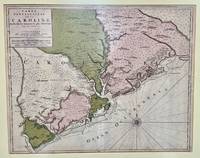
1696réf. 48399Amsterdam: Pierre Mortier 1696. Engraved broadside map 19 x 23 5/8 inches plate mark dimensions with extensive pink and green wash. Some light browning but an attractive copy. Matted glazed and framed. One of two issues of this map this one being a bit larger based on the Thornton-Morden map of circa 1685. Pictures the colony from the Santee River to the South Edisto River and well inland up the Cooper River. Physical features and names of plantation and land owners are given in English "Nouveau Londre" on the Edistow sic River being exceptions; soundings are given at river mouths in Charleston Harbor and in the ocean along some beaches. Cumming Southeast in Early Maps 121. Kendall Early Maps of Carolina 17c: "This map has a wealth of names of owners of land in Carolina. Pierre Mortier unknown books
réf. 05696London: S. W. Fores 1800. The Rarest Woodward of All London Is No Place To Be In The Summer WOODWARD George Moutard designer. SANSON Francis engraver. Every Body Out Of Town exemplified in six characteristic prints and illustrative labels with Every Body In Town exemplified in six characteristic prints and illustrative labels. London: S.W. Fores 1800. Second editions originally published by Woodward himself in 1794/1796. Quarto 10 1/8 x 8 3/8 in; 259 x 213 mm. Twelve hand-colored engraved plates 9 x 7 1/2 in; 297 x 192 mm two hand-colored engraved title-pages each imprinted Feb. 14 1800 and mounted on fourteen quarto sheets 133/4 x 18 1/4 in; 349 x 470 mm of various colors. Four blank leaves at rear folded blank quarto sheet inserted in rear pocket. Bound in contemporary full maroon morocco with double gilt fillets enclosing extravagantly blindstamped covers with an outer frame of floral and foliate motifs volutes curls with bacchants along lower edge an inner rolled frame and a central panel with center lozenge within an elaborately blocked medallion. Pocket to rear cover. Astonishingly bright clean and very fine. Housed in a felt-lined half maroon morocco over gray cloth clamshell case spine with five raised bands ruled and lettered in gilt in compartments. OCLC records one copy of the 1800 edition of Every Body Out of Town and only two copies of the 1800 edition of Every Body In Town in institutional holdings worldwide. Not found in the British Museum's collection of satirical prints. According to the ABPC Index the last time either title came to auction was in 1942 Every Body Out of Town 1800 and 1923 Every Body In Town 1800. These 1800 reprints are rarer than the original issues. They are also larger than the 1794-1796 first issues which measured only 7 7/8 x 6 5/8 inches 200 x 170 mm. Of George Murgatroyd Woodward 1760-1809 caricaturist and author the DNB notes that he "later known as Mustard George grew up in a Derbyshire town living with his father and to judge by the evidence of his later writings received a sound education. He took early to caricature ridiculing his neighbours in Derbyshire; a folio of these drawings dated 1781 is in the Derby Local Studies Library among a sizable collection of his prints drawings and book illustrations. His caricatures having caused something of a local stir he persuaded his father to let him seek his fortune in London. "Apart from two caricature prints dated 1785 designed by Woodward and published by him from 28 Cary Street Lincoln's Inn London it was not until 1790 that he made an impact on the London scene. Thereafter his output was copious. The British Museum catalogues list 525 examples of his work from the next twenty years published by Holland Fores Ackermann and latterly Tegg all leading printsellers. These prints designed by Woodward are etched by others-Rowlandson who was his friend and drinking companion Isaac Cruikshank Roberts and Williams. Woodward's original drawings are vigorous. and his value lay in his humorous ideas. "Woodward.might have rivalled Hogarth. Certainly his collaboration with Rowlandson constituted a lively if frivolous commentary on the social scene. Dorothy George described him as 'original prolific varied humorous and good-humoured' and few students of the subject would dispute her conclusion that his death was 'a loss to caricature' George English Political Caricature 1.174" Simon Heneage 'Woodward George Murgatroyd 1760-1809 Oxford Dictionary of National Biography Oxford University Press 2004. Etcher and engraver Francis Sanson was active 1784-1799. Bobins IV 1365; Gordon Library BC28 BC29; Not in Abbey or Tooley. London: S. W. Fores, 1800 unknown books