AnonBiblio.com
7.465 resultados
1947ref. 4-708Indianapolis: Hollenbeck Press 1946 1947. 1st. ed. First Edition. 203p. photos. Roster. Blue cloth. Oversize. Fine copy. 1st. Hardcover. Fine. Book. Hollenbeck Press, 1946 hardcover
1946ref. 5-1166Tokyo: Toppan Printing 1953 1946. 1st ed. 284p. Photos. CV 33. Korean War . Embossed cloth. Oversize. Slightly soiled. Corner bumped. Very Good Copy. 1st. Hardcover. Very Good. Toppan Printing, 1953 Hardcover
1994ref. 4451483Dun & Bradstreet Ltd 1994. Volume 1 2 3 & 4. Volume 2. This is an ex-library book and may have the usual library/used-book markings inside. . .This book has hardback covers. In fair condition suitable as a study copy. Please note the Image in this listing is a stock photo and may not match the covers of the actual item8250grams ISBN:0901491829 Dun & Bradstreet Ltd hardcover
1696ref. 26366AB1696. Paris J. Boudot 1696. 12°. 2 Kupfertaf. 1 Textholzschn. 14 Bl. 255 S. Lederband der Zeit mit Rückenschild und ornamentaler Rückenvergoldung Leder etwas brüchig Ecken und oberes Kapital restauriert unteres Kapital mit kleiner Fehlstelle. Umlaufend roter Sprenkelschnitt. Rot-schwarz gedruckter Titel. Innenspiegel mit vierzeiligem Eintrag in brauner Tinte. Titel mit altem Namenszug. Stellenweise geringfügig braun- oder schmutzfleckig. Sonst in schöner Erhaltung. Zweite Ausgabe der seltenen Schrift über die Wünschelrute als okkultes Hilfsmittel zum Aufspüren von Erdstrahlen Wasser und Bodenschätzen. - Barbier II 1287; Rosenthal 1820 EA; Caillet 6223 zur EA 1693: 'Sur la decouverté des voleurs et de vols. - Découverte des eaux et des métaux. - Anges et démons. - Divination par des baguettes qui se remuaient sans qu'on y touchat. - Pratiques superstitieuses etc.' - Die erste Tafel zeigt wie Wünschelruten gehalten werden die zweite mit Darstellung von Wünschelrutengängern. - Unter Anwendung seriöser wissenschaftlicher Methoden kann das umstrittene Phänomen der Wünschelrute heute als geklärt angesehen werden. Die Ursache des Wünschelrutenausschlages liegt nachweislich in der 'idiomotorischen Triggerung eines instabilen Kohnstammeffektes'. unknown
1886ref. BTETM0001866N/A 1886. Hardcover. Very Good/No Jacket. Octavo Standard 8vo 6 נ9 in 152 נ229 mm . Anon. Please email for Photographs or further information.188619TH CENTUARY SKETCH BOOK 42 SKETCHES ENGLISH COUNTRYSIDEBy AnonKEY DETAILSCondition: Very GoodFormat: Hardcover Octavo Standard 8vo 6 נ9 in 152 נ229 mm Note: Binding/size selection follows standard bibliographic conventions and is approximate; exact measurements may vary.Published By: N/A 1886Language: EnglishIllustrated By: AnonCollation: pp. SKU: BTETM0001866Shipping Info: Approximate Package Dimensions H: 12.5 L: 30 W: 25 Units: cm W: 2KgTracked Shipping Insurance Coverage as per Customer RequestCONDITION COLLATION & COPY NOTESManuscriptPlease see Photos as part of condition report.SYNOPSIS1886Sketch Book42 Sketches of the English CountrysideArtist UnknownSt Leonards Church South Stoke SussexDevonshire LaneHampshire LaneToddington House LittlehamptonHampsteadWallingford OxfordshireShipton Lee BuckinghamshireMapledurham OxfordshireSt Thomas of Canterbury Church Goring OxfordshireBirhamWoltingGomshall Mill SurreyPulboro Pulborough West SussexSopham Bridge Pulboro West SussexArundel Castle SussexThames Nr WindsorHoughton Cliffs Arundel ParkThe First Sluich near Houghton Bridge ArundelBury 6th from the CarputaleAmberley CliffsCunninghamsCunninghams Looking EastCottages HoughtonThatched Cottages SussexOld Water Mill ThamesStreatly Old MillClieve Old MillIffley MillPangbourne MillNunehamWallingford BridgeKemands Gate AmberleyCastle Hill AmberleyBury Church SussexBlack Rabbit ArundelTintern AbbeyWepham Sussex N/A hardcover
1749ref. 692L33London: Nutt 1749. Paperback. Near Fine. 7" by 4.5". None. An early account of this scarce work purporting to be written by a knight stationed in Paris during the mid eighteenth century. With details from the Jacobite rising Battle of Culloden and the War of the Austrian Succession. The letter gives details from 1745-1748 and explains various messages passed between him and the French King 'and my other curious and interesting particulars'. This work was published earlier the same year under a similar title 'Authentic account.' The second edition. ESTC reference no: T164224. A scarce work. An interesting treatise regarding European affairs during the eighteenth century. Disbound. Externally smart with a few light marks to the wraps. Internally firmly bound. Pages are bright with just the odd spot. Near Fine Nutt paperback
1926ref. LTH3-B-14London: Dunning 1926. Leather. Very Good. 7" by 5". None. A collection of the periodical Casual Letters from 1926 on social political and economical issues involving amongst others the UK USA Germany China and Russia. Bound by Hatchards with a bookbinder ink stamp to the front pastedown. With several fold-out diagrams often financial. The Casual Letters included: Rubber Russia; Foreign Policy; Ambassadors et Als; A Review of British Trade; The Lesson of the Strike; What Price the British Empire; American Prosperity; An Empire Worth Knowing; Germany in the League; Disarmament; The Message From Mars; and From a Merchant of Foo-Chien. In a half crushed morocco binding. Externally rubbed. The joints are just starting. Internally firmly bound and clean. Very Good Dunning hardcover
ref. 19151subscribed but not signed to "Your Eminence" apparently from a servant of "poor L'ascasas" who "is no more his illness was most extraordinary he could not control it" in spite of taking "the waters at Valdagno North West of Vicenza and rode out here and there for several days" her husband sent the packet to him at Tressino Trissino "by a mounted orderly. His will states that all the trinkets are to go to his wife" and details the provision for his heir aged 9 for a natural son in Italy and "in England for the education of a lad who is not his son up to the age of 24. 14 Prussian florins a month. I have not yet bought the two books as they promised me them 'in Italian in sheets not bound'. I will take care of everything when the nobility come back from their Willagiature sic country houses. Vallis' baggage came through here to go to the Army of the Rhine by way of the Tyrol. He. will go through Linz. to see his wife" and perhaps to Vienna "The new Commanding Officer is already established at Padua. No one believes any more that there will be war" 3 sides 8vo. no place. probably Vicenza 9th November n.y. c. From the Bibliotheca Lindesiana no. 2378. Vicenza is at the great crossroads South of the Alps. unknown
1648ref. 6419159Unknwn 1648. Volume 10. This is an ex-library book and may have the usual library/used-book markings inside.This book has hardback covers. In poor condition suitable as a reading copy. No dust jacket. Full leather covers. Boards covered with marbled paper. Boards rubbed. Backstrip edges worn. Gilt bands on backstrip. Gilt lettering on backstrip. Backstrip torn.Top page edges dusty. Binding split slightly.Marbled end papers. Traces of foxing throughout. Pencil markings. Internally clean. Please note the Image in this listing is a stock photo and may not match the covers of the actual item4050grams ISBN: Unknwn hardcover
1824ref. 753L10Edinburgh: Bell & Bradfute 1824. First edition. Cloth. Very Good Indeed. 8.5" by 5.5". None. A very scarce agricultural work on Salmon fisheries in Scotland. The first edition of this work.An anonymously printed work which looks at the Salmon Fishery of Scotland. There is reference to the stake-net mode fo fishing and the regulation of the close-time. Prior owner's inscription to the top of title page. Rebound in a very smart binding comprising paper covered boards. In paper covered boards. Externally excellent with minor shelfwear. Internally firmly bound. Prior owner's inscription to the head of title page. Pages are bright and clean. Very Good Indeed Bell & Bradfute hardcover
1885ref. 769R35Paris: Gauthier-Villars 1885. Leather. Very Good Indeed. 11.5" by 9". None. A fascinating geological work based on the findings of the expedition to observe the transit of Venus in the late nineteenth century complete with marvellous colour plates. Lacking the original half title title page and table of contents.The geological volume.Written by Henri Filhol 1843-1902 a French scientist who served as naturalist and expedition doctor on the Transit of Venus Expedition of 1874 to Campbell Island six-hundred kilometres south of New Zealand. The expedition sought to observe the transit of Venus a rare astronomical occurrence. This expedition was one of six French expeditions dispatched.Illustrated with thirteen plates including a number of magnificent colour plates depicting geological discoveries.A scarce example of this work. In a modern full calf binding. Externally lovely. Ownership bookplate to the front pastedown. Contemporary inscription to the first page. Internally firmly bound. Pages are a little spotted but otherwise clean. Very Good Indeed Gauthier-Villars hardcover
1904ref. LTH18-E-13Oxford: Oxford University Press 1904-12. Leather. Very Good. 8.5" by 5.5". None. Various reports of the Oxford University Natural History Museum. Including the Sixteenth Annual Report of the Delegates of the University Museum for 1903 and the Seventeenth Annual Report of the Delegates of the University Museum for 1904 in volume I. Report of the Hope Professor of Zoology 1910 Report of the Hope Professor of Zoology 1911 and Report of the Hope Professor of Zoology 1912. Two volumes containing complete reports. Details of research laboratory work and acquisitions. The Oxford University Museum of Natural History sometimes known simply as the Oxford University Museum is a museum displaying many of the University of Oxford's natural history specimens. The Hope Entomological Collections are held by the Oxford University Museum of Natural History. The Hope Department was founded by Frederick William Hope. George Alexander James Rothney 1849-1922 formed an extensive collection of Oriental Hymenoptera during his travels in India. His library and collection was donated to the Hope Entomological Collections Oxford. In half morocco bindings. Externally very sound although rubbed. Internally firmly bound. Bright and clean throughout just the very odd spot. Some small red crayon marks in the second volume. Slight evidence of past worming to volume I from the rear board to a few pages at the end but this is very slight. Very Good Oxford University Press hardcover
1750ref. 807R39London: Henry Lintot 1750. Leather. Very Good. 7" by 4.5". None. A smart fifteenth edition work on tenants and landlords bound in contemporary leather. The fifteenth edition. This work was an early work on tenancy laws covering rent waste crops growing frauds trespassing and fire prevention.An interesting work on British law in the eighteenth century bound in a smart contemporary leather binding. In a full calf binding. Externally generally smart; a little bumped to the extremities. Joints are a little cracked at the head and boards are a touch rubbed. Internally firmly bound. Pages are generally bright and clean. Very Good Henry Lintot hardcover
1815ref. LTH8-B-21London: The Clarendon Press 1815. Leather. Very Good. 8.5" by 5". None. A handsome volume of The Book of Common Prayer. Stereotype edition. With eminently readable text. A sought after edition rather uncommon and in the original binding. Pointed as they are to be sung or said in Churches. In a full red morocco leather binding. Externally sound with slight rubbing. Internally firmly bound. Pages are generally bright and clean with some scattered light foxing. Very Good The Clarendon Press hardcover
1773ref. 57123Published at Winton. Very Good with no dust jacket. Hardcover. 2 volumes. Xi 237pp 299pp 2 frontises and 11 other plates 6.5"x4.5" nice and clean internally. Bound in full leather sl rubbed pagination omits pps 265 tp 268 obviously just a printers error as text complete. Scarce set of this early book; 12mo 7" - 7½" tall . 1773. Published at Winton hardcover
1843ref. 017777London: J. Hatchard 1843 Full vellum gilt stamped binding 224pp. Early photograph frontis. Very Scarce. First Edition. Hard Cover. Very Good. 8vo - over 7¾" - 9¾" tall. J. Hatchard hardcover
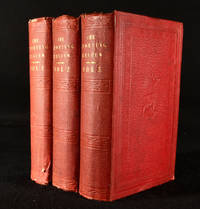
1851ref. 706L14London: Rogerson and Co 1851. Cloth. Very Good. 9.5" by 6". Not Stated. An uncommon three volume set of 'The Sporting Review'. This periodical looks at fox hunting and horse racing with both fictional serials and real accounts. Illustrated with twelve plates to volume I twelve plates to volume II and twelve plates to volume III. Collated complete. In the publisher's original cloth bindings. With articles such as 'Fashions connected with Fox hunting' 'Friends to Fox-hunting' 'Hunting in Australia' and ' The literature across these volumes include 'Memoir of James Chapple the Celebrated Jockey' 'Lameness in Horses' ' In the publisher's original cloth bindings. Externally sound with small loss to the head and tail of spines. Front hinge to volume II is strained but firm. Gatherings A-B1 of volume I are loosening. Bookplate to the front endpaper Sidney Hacker. Internally firmly bound. Pages are bright. Scattered spots to the first and last few pages. Very Good Rogerson and Co hardcover
1819ref. NY105London: A . K. Newman and Co. Leadenhall Street 1819. Hardcover. Near Fine. 16mo - over 5¾ - 6¾" tall. viii184pp. No date c 1819 111mm x 73mm. Engraved frontis. depicting a father and a wise son under a tree. Pub. original quarter red calf binding with marble boards. Gilt titles to the spine. All original in sound condition. Some minor rubbing to the extremities. Printed by J.Darling Leadenhall Street London. A RARE ITEM. One copy traced in Copac.University of Oxford Libraries. Printed by J. Darling. nb several editions were pub. by other presses PLEASE EMAIL FOR PHOTOS. J. Darling was associated with the Minerva Press on Leadenhall Street London A . K. Newman and Co. [Leadenhall Street] hardcover
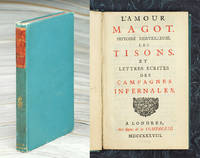
1738ref. 1106401738. Londres i.e. Amsterdam : Aux dépens de la Compagnie 1738. 12mo 4 179pp. Title- printed in red and black. Ink signature "Carteret Harvey" on A1. 19th-century blue cloth red label red edges very good. § OCLC: 12073708: "Miscellany comprising a grotesque fairy tale a philosophical epistle and a series of letters addressed from hell to the world above. The whole is redolent of political and philosophical overtones intended as a criticism of the Regency and the morality of the age. L'amour magot is a fable about the dangers of romantic love in an inexperienced young heroine. The 'lettres infernales' are written by inhabitants of hell. One letter is written from a bookseller addressed to his colleagues on earth in which he discusses hell's booktrade." OCLC locates in all about 18 copies but doubtless there are more. No one hazards a guess at the authorship. A pencil note in the book states: "Anon see Bulletin du bibliophile 16 série p. 372. Comte d'I.". unknown
1738ref. 1106401738. Londres i.e. Amsterdam : Aux dépens de la Compagnie 1738. 12mo 4 179pp. Title- printed in red and black. Ink signature "Carteret Harvey" on A1. 19th-century blue cloth red label red edges very good. § OCLC: 12073708: "Miscellany comprising a grotesque fairy tale a philosophical epistle and a series of letters addressed from hell to the world above. The whole is redolent of political and philosophical overtones intended as a criticism of the Regency and the morality of the age. L'amour magot is a fable about the dangers of romantic love in an inexperienced young heroine. The 'lettres infernales' are written by inhabitants of hell. One letter is written from a bookseller addressed to his colleagues on earth in which he discusses hell's booktrade." OCLC locates in all about 18 copies but doubtless there are more. No one hazards a guess at the authorship. A pencil note in the book states: "Anon see Bulletin du bibliophile 16 série p. 372. Comte d'I.". unknown books
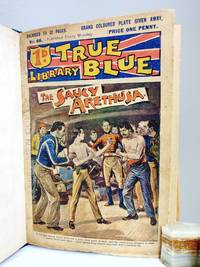
1901ref. 33815London: Aldine Publishing Co 1901. 1st Edition. 1st Edition. TRUE BLUE LIBRARY. Published Every Saturday. 32 pages per issue. THE HUG OF THE BEAR plus 11 other titles. A Story Of Russian Despots. London: Aldine Publishing Co. c. 1903. 4to. blue cloth backed untitled plain beige boards. Original coloured wrappers bound-in. Illustrated throughout in black & white. A run of 12 issues: Nos 222 223 230 231 232 243 245 247 249 259 260 261 262. In very good antiquarian condition. TRUE BLUE weekly magazine was published for boys just prior to the turn of the 19th century & featured one complete & patriotic adventure story per issue set. Intended to celebrate Britain 's glorious national past in a creative range of historical periods each issue had a full colour illustrated themed wrapper with black & white drawings inside. Each issue generally ran 32 pages. Extremely popular in their day these junior magazines had a lengthy run waning only as alternative forms of entertainments gradually took over their audience's attention. Penny Dreadful Dime Novels were the American version was a term applied to nineteenth century British fiction publications usually lurid serial stories appearing in parts over a number of weeks each part costing a penny. The term however soon came to encompass a variety of publications that featured cheap sensational fiction such as story papers and booklet "libraries." The Penny Dreadfuls were printed on cheap pulp paper and were aimed primarily at teenage boys from the working class though there is some evidence that many girls read them as well. Penny Parts The penny part stories got underway in the 1830s originally as a cheaper alternative for the working class adults but by the 1850s the serial stories were aimed exclusively at teenagers. The stories themselves were reprints or sometimes rewrites of Gothic thrillers such as The Monk or The Castle of Otranto as well as new stories about famous criminals. Some of the most famous of these penny part stories were The String of Pearls which ostensibly introduced Sweeney Todd The Mysteries of London inspired by the French serial The Mysteries of Paris and Varney the Vampire. Highwaymen were popular heroes. Black Bess or the Knight of the Road outlining the largely imaginary exploits of real-life highwayman Dick Turpin continued for 254 episodes. Working class boys who could not afford a penny a week often formed clubs that would share the cost passing the flimsy booklets from reader to reader. Other enterprising youngsters would collect a number of consecutive parts then rent the volume out to friends. Penny Dreadfuls In 1866 Boys of England was introduced as a new type of publication an eight page magazine that featured serial stories as well as articles and shorts of interests. It was printed on the same cheap paper though sporting a larger format than the penny parts. Numerous competitors quickly followed with such titles as Boys Leisure Hour Boys Standard Young Men of Great Britain etc. As the price and quality of fiction was the same these storypapers also fell under the general definition of Penny Dreadfuls also known as Penny Bloods or Blood and Thunders in their early days. American dime novels were edited and rewritten for a British audience. These appeared in booklet form such as the Boys First Rate Pocket Library. Frank Reade Buffalo Bill and Deadwood Dick were all popular with the Penny Dreadful audience. Half-penny Dreadful In the mid-1890s a publisher Alfred Harmsworth decided to do something about what was widely perceived as the corrupting influence of the Penny Dreadfuls. He issued new story papers The Half-penny Marvel The Union Jack and Pluck all priced at one half-penny. At first the stories were high-minded moral tales reportedly based on true experiences but it was not long before these papers started using the same kind of material as the publications they competed against. A.A. Milne once said 'Harmsworth killed the penny dreadful by the simple process of producing the ha'penny dreadfuller. '. 1st Edition. TRUE BLUE LIBRARY. Published Weekly. 4to. 32 pages per issue. THE SAUCY ARETHUSA plus 11 other titles. London : Aldine Publishing Co. 1901. 4to. tan cloth backed untitled plain beige boards. Original coloured wrappers bound-in. Illustrated throughout in black & white. A run of 12 issues: Nos 66 85 130 141 152 159 160 171 172 190 191 and 193. In very good antiquarian condition. TRUE BLUE weekly magazine was published for boys just prior to the turn of the 19th century & featured one complete & patriotic adventure story per issue set. Intended to celebrate Britain 's glorious national past in a creative range of historical periods each issue had a full colour illustrated themed wrapper with black & white drawings inside. Each issue generally ran 32 pages. Extremely popular in their day these junior magazines had a lengthy run waning only as alternative forms of entertainment gradually took over their audience's attention. Penny Dreadful Dime Novels were the American version was a term applied to nineteenth century British fiction publications usually lurid serial stories appearing in parts over a number of weeks each part costing a penny. The term however soon came to encompass a variety of publications that featured cheap sensational fiction such as story papers and booklet "libraries." The Penny Dreadfuls were printed on cheap pulp paper and were aimed primarily at teenage boys from the working class though there is some evidence that many girls read them as well. Penny Parts The penny part stories got underway in the 1830s originally as a cheaper alternative for the working class adults but by the 1850s the serial stories were aimed exclusively at teenagers. The stories themselves were reprints or sometimes rewrites of Gothic thrillers such as The Monk or The Castle of Otranto as well as new stories about famous criminals. Some of the most famous of these penny part stories were The String of Pearls which ostensibly introduced Sweeney Todd The Mysteries of London inspired by the French serial The Mysteries of Paris and Varney the Vampire. Highwaymen were popular heroes. Black Bess or the Knight of the Road outlining the largely imaginary exploits of real-life highwayman Dick Turpin continued for 254 episodes. Working class boys who could not afford a penny a week often formed clubs that would share the cost passing the flimsy booklets from reader to reader. Other enterprising youngsters would collect a number of consecutive parts then rent the volume out to friends. In 1866 Boys of England was introduced as a new type of publication an eight page magazine that featured serial stories as well as articles and shorts of interest. It was printed on the same cheap paper though sporting a larger format than the penny parts. Numerous competitors quickly followed with such titles as Boys Leisure Hour Boys Standard Young Men of Great Britain etc. As the price and quality of fiction was the same these storypapers also fell under the general definition of Penny Dreadfuls also known as Penny Bloods or Blood and Thunders in their early days. American dime novels were edited and rewritten for a British audience. These appeared in booklet form such as the Boys First Rate Pocket Library. Frank Reade Buffalo Bill and Deadwood Dick were all popular with the Penny Dreadful audience. Half-penny Dreadful In the mid-1890s a publisher Alfred Harmsworth decided to do something about what was widely perceived as the corrupting influence of the Penny Dreadfuls. He issued new story papers The Half-penny Marvel The Union Jack and Pluck all priced at one half-penny. At first the stories were high-minded moral tales reportedly based on true experiences but it was not long before these papers started using the same kind of material as the publications they competed against. A.A. Milne once said 'Harmsworth killed the penny dreadful by the simple process of producing the ha'penny dreadfuller. '. Aldine Publishing Co unknown
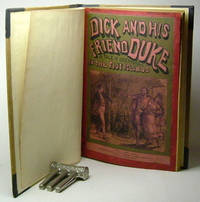
1890ref. 27012London: Brett Limited 1890. 1st Edition. Soft cover. 1st Edition. Soft cover. DICK AND HIS FRIEND DUKE. A Tale Of Adventure In the Fiji Islands. London: Edwin J. Brett Limited. n.d. c.1890 4to. 138pp. Half dark blue cloth over plain beige boards. Illustrated throughout. Original Illustrated front cover carefully backed & bound-in some early sympathetic colour enhancement. Complete. In very good antiquarian condition. Brett published Jack Harkaway in America c. 1890 Penny Dreadful Dime Novels were the American version was a term applied to nineteenth century British fiction publications usually lurid serial stories appearing in parts over a number of weeks each part costing a penny. The term however soon came to encompass a variety of publications that featured cheap sensational fiction such as story papers and booklet "libraries." The Penny Dreadfuls were printed on cheap pulp paper and were aimed primarily at teenage boys from the working class though there is some evidence that many girls read them as well. Penny Parts The penny part stories got underway in the 1830s originally as a cheaper alternative for the working class adults but by the 1850s the serial stories were aimed exclusively at teenagers. The stories themselves were reprints or sometimes rewrites of Gothic thrillers such as The Monk or The Castle of Otranto as well as new stories about famous criminals. Some of the most famous of these penny part stories were The String of Pearls which ostensibly introduced Sweeney Todd The Mysteries of London inspired by the French serial The Mysteries of Paris and Varney the Vampire. Highwaymen were popular heroes. Black Bess or the Knight of the Road outlining the largely imaginary exploits of real-life highwayman Dick Turpin continued for 254 episodes. Working class boys who could not afford a penny a week often formed clubs that would share the cost passing the flimsy booklets from reader to reader. Other enterprising youngsters would collect a number of consecutive parts then rent the volume out to friends. Penny Dreadfuls In 1866 Boys of England was introduced as a new type of publication an eight page magazine that featured serial stories as well as articles and shorts of interests. It was printed on the same cheap paper though sporting a larger format than the penny parts. Numerous competitors quickly followed with such titles as Boys Leisure Hour Boys Standard Young Men of Great Britain etc. As the price and quality of fiction was the same these storypapers also fell under the general definition of Penny Dreadfuls also known as Penny Bloods or Blood and Thunders in their early days. American dime novels were edited and rewritten for a British audience. These appeared in booklet form such as the Boys First Rate Pocket Library. Frank Reade Buffalo Bill and Deadwood Dick were all popular with the Penny Dreadful audience. Half-penny Dreadful In the mid-1890s a publisher Alfred Harmsworth decided to do something about what was widely perceived as the corrupting influence of the Penny Dreadfuls. He issued new story papers The Half-penny Marvel The Union Jack and Pluck all priced at one half-penny. At first the stories were high-minded moral tales reportedly based on true experiences but it was not long before these papers started using the same kind of material as the publications they competed against. A.A. Milne once said "Harmsworth killed the penny dreadful by the simple process of producing the hapenny dreadfuller." Legacy Two phenomenally popular characters to come out of the "Penny Dreadfuls" were Jack Harkaway introduced in the Boys of England in 1871 and Sexton Blake who began in the Half-penny Marvel in 1893. Blake soon took over the lead spot in Union Jack and appeared in roughly 4000 adventures right up into the 1970s a record only exceeded by Nick Carter and Dixon Hawke. Harkaway was also popular in America and had many imitators. Over time the Penny Dreadfuls morphed into the British comic magazines. Brett Limited unknown
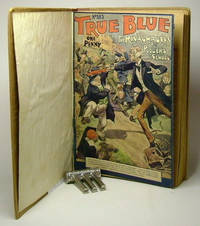
1904ref. 33049London: Aldine Publishing Co 1904. 1st Edition. 1st Edition. TRUE BLUE LIBRARY. Published Weekly. 4to. 32 pages per issue. THE RIVAL HALVES OF PODGER'S SCHOOL plus 11 other titles. London : Aldine Publishing Co. 1904. 4to. tan cloth backed untitled plain beige boards. Original coloured wrappers bound-in. Illustrated throughout in black & white. A run of 12 isssues: Nos 263 264 265 267 268 270 271 276 277 278 282 286. In very good antiquarian condition. TRUE BLUE weekly magazine was published for boys just prior to the turn of the 19th century & featured one complete & patriotic adventure story per issue set. Intended to celebrate Britain 's glorious national past in a creative range of historical periods each issue had a full colour illustrated themed wrapper with black & white drawings inside. Each issue generally ran 32 pages. Extremely popular in their day these junior magazines had a lengthy run waning only as alternative forms of entertainments gradually took over their audience's attention. Penny Dreadful Dime Novels were the American version was a term applied to nineteenth century British fiction publications usually lurid serial stories appearing in parts over a number of weeks each part costing a penny. The term however soon came to encompass a variety of publications that featured cheap sensational fiction such as story papers and booklet "libraries." The Penny Dreadfuls were printed on cheap pulp paper and were aimed primarily at teenage boys from the working class though there is some evidence that many girls read them as well. Penny Parts The penny part stories got underway in the 1830s originally as a cheaper alternative for the working class adults but by the 1850s the serial stories were aimed exclusively at teenagers. The stories themselves were reprints or sometimes rewrites of Gothic thrillers such as The Monk or The Castle of Otranto as well as new stories about famous criminals. Some of the most famous of these penny part stories were The String of Pearls which ostensibly introduced Sweeney Todd The Mysteries of London inspired by the French serial The Mysteries of Paris and Varney the Vampire. Highwaymen were popular heroes. Black Bess or the Knight of the Road outlining the largely imaginary exploits of real-life highwayman Dick Turpin continued for 254 episodes. Working class boys who could not afford a penny a week often formed clubs that would share the cost passing the flimsy booklets from reader to reader. Other enterprising youngsters would collect a number of consecutive parts then rent the volume out to friends. Penny Dreadfuls In 1866 Boys of England was introduced as a new type of publication an eight page magazine that featured serial stories as well as articles and shorts of interests. It was printed on the same cheap paper though sporting a larger format than the penny parts. Numerous competitors quickly followed with such titles as Boys Leisure Hour Boys Standard Young Men of Great Britain etc. As the price and quality of fiction was the same these storypapers also fell under the general definition of Penny Dreadfuls also known as Penny Bloods or Blood and Thunders in their early days. American dime novels were edited and rewritten for a British audience. These appeared in booklet form such as the Boys First Rate Pocket Library. Frank Reade Buffalo Bill and Deadwood Dick were all popular with the Penny Dreadful audience. Half-penny Dreadful In the mid-1890s a publisher Alfred Harmsworth decided to do something about what was widely perceived as the corrupting influence of the Penny Dreadfuls. He issued new story papers The Half-penny Marvel The Union Jack and Pluck all priced at one half-penny. At first the stories were high-minded moral tales reportedly based on true experiences but it was not long before these papers started using the same kind of material as the publications they competed against. A.A. Milne once said 'Harmsworth killed the penny dreadful by the simple process of producing the ha'penny dreadfuller. '. Aldine Publishing Co unknown
1718ref. 045548Antwerp: Typographia Plantiniana Plantin Press 1718. Hardcover Full Leather. Very Good Condition. Contemporary calf wear at corners spine a little dry with wear at the ends clasps intact - quite attractive overall. Printed in red and black scattered light browning internally. A nice copy of this Plantin printed Breviary in a well used but well preserved period binding. 72 616 ccxliv 4pp. Size: Octavo 8vo. Quantity Available: 1. Shipped Weight: Under 1 kilo. Category: Religion & Theology; Antiquarian & Rare. Inventory No: 045548. Typographia Plantiniana (Plantin Press) hardcover
1863ref. 53110St. Paul: Whitney's Gallery 1863-1867. 1863-1867. PHOTOGRAPH. Original Photograph of a drawing of Camp Atchison. CDV. Image: 3.625"x 2.25". Mount: 4"x2.375". In response to the Sioux Uprising in Minnesota in August 1862 two punitive expeditions one under General Alfred Sully and one under General Sibley went in pursuit of the hostiles known to have fled to the Dakotas. General Sibley pursued in the direction of Devil's Lake but learned that the Sioux were no longer there and were in flight to reach and cross the Missouri River. On July 18 1863 upon learning this Sibley immediately established Camp Atchison in what is now east-central North Dakota. He garrisoned the new camp with 6 companies of infantry 1 company of cavalry 2 cannons and the sick and disabled naming it after Captain Charles Atchison the command's Ordinance and Assistant Commissary Officer. General Sibley left 2 days later with 2500 men and 1000 horses. Twenty-one days later Sibley and his troops returned to Camp Atchison having marched 300 miles and fought 3 battles and several skirmishes in 21 days. Sibley's man's first battle was at Big Mound and the Sioux attacked Sibley's troops at Dead Buffalo Lake and Stony Lake but the big battle was Whitestone Hill. The Sioux had 100 men killed and another 100 wounded with 156 captured. It's believed to be the largest number of Indian casualties of any one western Indian battle. On August 12 two days after his return to Camp Atchison General Sibley and his men abandoned Camp Atchison and returned to Forts Snelling and Ridgely. Image shows some slight fading else clean and undamaged. The imprint on the back of the mount dates this image to the period of 1863-1867. A very scarce image of a short-lived military camp of the Sibley Expedition of 1863. Whitney's Gallery, 1863-1867. unknown