7.298 Ergebnisse
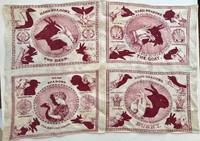
1870Best.-Nr. 26035UK ca1870. As issued. Very good. Bright deep impressions in red ink. A short marginal tear. There is NO staining or spotting. A complete uncut "sheet" 405 x 590 mm of four illustrated children's educational/game handkerchiefs printed on muslin recto only. This has four variants of Hand Shadows: The Deer the goat the bunny and the boy and the goose note the example of "The Negro" in this last. A rare survival. An uncut sheet of individual handkerchiefs - each a variant with different illustrations. See Murphy Children's Handkerchiefs p. 24 illustrating only two variants. books
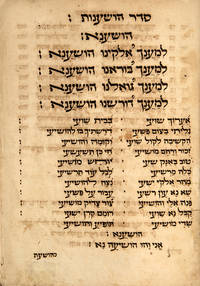
Best.-Nr. 113791Italy 19th century. . Hebrew manuscript on paper 27.8 x 20.6 cm rebacked contemporary blind-tooled calf; 17 ll. last leaf blank. The Hosha'anot prayers are recited every day during the holiday of Sukkot as a reminder of the holiday ceremonies that were performed in the days of the Temple. Instead of circling the altar raising willow branches the willow being one of the Four Species of Sukkot the worshipers circle around the 'bimah' in the synagogue while holding the Four Species and reciting the Hosha'anot. The Torah Scrolls are taken out from the ark and also carried around the 'bimah' during the ceremony. [Italy], [19th century]. unknown
1830Best.-Nr. 0080231830. Hardcover. Very Good. 4to - over 9¾ - 12" tall. Mostly unknown. A fascinating collection of hand coloured French coaching and other scenes. In c1830 full red morocco album gilt & blind tooling corners & edges rubbed Spine worn raised bands gilt decorative tooling & title. Internally MS calligraphic style title 76 hand coloured lithographic illustrations tipped onto 71 leaves various colours most with guards 1 dated 1831 & another 1829 with gilt or ink borders a.e.g. Quarto including many Coaching Scenes artists possibly include Bellange S Baptiste RR S Bellange Ballec Lesk Noel & Charles Davies. hardcover
1975Best.-Nr. SBBI-mon0000006404World Distributors Manchester 1975. board_book. Acceptable. Some stickers missing/used. Please see the condition note after this for details if this is missing please consider Acceptable to mean poor quality that could include major staining water damage writing missing dustjacket etc etc. Our books are dispatched from a Yorkshire former cotton mill. We list via barcode/ISBN so please note that the images are stock images and may not be the exact copy you receive furthermore the details about edition and year might not be accurate as many publishers reuse the same ISBN for multiple editions and as we simply scan a barcode or enter an ISBN we do not check the validity of the edition data when listing. If you're looking for an exact edition please don't order at least not without checking with us first although we don't always have time to check. We aim to dispatch prompty the service used will depend on order value and book size. We can ship to most countries see our shipping policies. Payment is via Abe only. World Distributors (Manchester) unknown
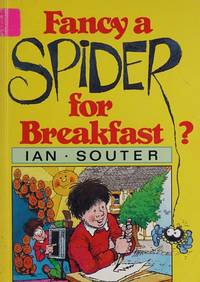
1989Best.-Nr. SBBIH-BY7H7O2Y43JMGinn & Company 1989. paperback. Acceptable. Please see the condition note after this for details if this is missing please consider Acceptable to mean poor quality that could include major staining water damage writing missing dustjacket etc etc. Our books are dispatched from a Yorkshire former cotton mill. We list via barcode/ISBN so please note that the images are stock images and may not be the exact copy you receive furthermore the details about edition and year might not be accurate as many publishers reuse the same ISBN for multiple editions and as we simply scan a barcode or enter an ISBN we do not check the validity of the edition data when listing. If you're looking for an exact edition please don't order at least not without checking with us first although we don't always have time to check. We aim to dispatch prompty the service used will depend on order value and book size. We can ship to most countries see our shipping policies. Payment is via Abe only. Ginn & Company paperback
1766Best.-Nr. 060313Paris: Chez Cailleau Librairie 1765 / Sebastien Jorry 1766 / Chez La Veuve Duchesne 1766 1766. 1st Edition . Hardcover. Very Good. X 11-64 Viii 9-51 32 38 I 30. Several Items 1765 And 1766 Bound In One Full Patterned Calf Spine Elaborately Gilt. Worldcat Shows Only Four Institutional Holdings One In France Of The Calas Title 64 Pp. WearClean No Marks Fraying At Corners. Jean Calas 1698 - 10 March 1762 Was A Merchant Living In Toulouse Languedoc France Who Was Tried Judicially Tortured And Executed For The Murder Of His Son Despite His Protestations Of Innocence. Calas Was A Protestant In An Officially Catholic Society. Calas Along With His Wife Was A Protestant. France Was Then A Catholic Country; Catholicism Was The State Religion With No Legal Right For Individuals To Practice Different Faiths. While The Harsh Oppression Of Protestantism Initiated By King Louis Xiv Had Largely Receded Protestants Were At Best Tolerated. Louis One Of Calas's Sons Converted To Catholicism In 1756. On 13-14 October 1761 Another Of The Calas Sons Marc-Antoine Was Found Dead On The Ground Floor Of The Family's Home. Rumors Had It That Jean Calas Had Killed His Son Because He Intended To Convert To Catholicism. When Interrogated The Family Initially Claimed That Marc-Antoine Had Been Killed By A Murderer. Then They Declared That They Had Found Marc-Antoine Dead Hanged; Because Suicide Was Considered A Heinous Crime Against God And Since The Dead Bodies Of Suicides Were Defiled They Had Arranged For Their Son's Suicide To Look Like A Murder. Despite Jean Calas's Claiming That His Son Died By Suicide And The Testimony Of Jeanne Viguière Calas's Catholic Governess The Parlement Regional Court Of Toulouse Held That Jean Calas Had Murdered His Son. And On 9 March 1762 The Court Sentenced Him To Death By Torture. The Government Stretched His Arms And Legs Until They Were Pulled Out Of Their Sockets. Seventeen Litres 36 Us Pints Of Water Was Poured Down His Throat. He Was Tied To A Cross In The Cathedral Square On Which Each Of His Limbs Was Broken Twice By An Iron Bar. Yet Even Under This Torture Calas Continued To Declare His Innocence. French Philosopher Voltaire Was Contacted About The Case And After Initial Suspicions That Calas Was Guilty Of Anti-Catholic Fanaticism Were Dispelled By His Investigations He Began A Campaign To Get Calas's Sentence Overturned Claiming That Marc-Antoine Had Committed Suicide Because Of Gambling Debts And Not Being Able To Finish His University Studies Due To His Denomination.Voltaire's Efforts Were Successful And King Louis Xv Received The Family And Had The Sentence Annulled In 1764. The King Fired The Chief Magistrate Of Toulouse The Capitoul The Trial Was Done Over And In 1765 Jean Calas Posthumously Was Exonerated On A "Vice De Procédure" Not On The Original Charges With The Family Paid 36000 Livres By The King In Compensation.2 Voltaire An Outspoken Critic Of The Catholic Church Cited The Instance As An Example Of The Church's Severity In His 1763 Work Treatise On Tolerance. Édouard-Thomas Simon Known As " Simon De Troyes " 1740-1818 Was A French Doctor And Librarian .Simon Practiced Medicine In Troyes For Twenty Years Before Moving To Paris In 1786 Where He Divided His Time Between His Profession And The Pursuit Of Literature. At The Beginning Of The Revolution He Was Appointed A Member Of The Councils Of Public Health Public Relief Etc. Of The Capital. During The Establishment Of The Constitution Of The Year Iii Simon De Troyes Had The Plan For A Common Library For The Two Legislative Councils Adopted Became Its Curator And Under The Consulate Passed With The Same Title To The Library Of The Tribunate . After The Suppression Of The Tribunate He Entered Public Education And Became A Professor Of Literature At The Lycée In Besançon. Chez Cailleau, Librairie (1765) / Sebastien Jorry (1766) / Chez La Veuve Duchesne (1766) hardcover
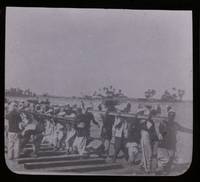
1898Best.-Nr. 763L6N/A: N/A c1898. Unbound. Very Good Indeed. N/A. N/A. A scarce box of ten photographic glass slides depicting the Anglo-Egyptian Sudan Campaign commanded by Kitchener. The images include a group picture of the 21st Lancers two of whom received the Victoria Cross for actions at the Battle of Omdurman. There are also images of British soldiers in Khartoum Guards at Shabluka and military railway construction. The Sudan Military Railroad was constructed from 1896-1897 by Kitchener to supply the Anglo-Egyptian army prosecuting the Mahdist War. This railway was the predecessor line for the present-day Sudan Railway. The Kitchener campaign was from 1896-1898. And was a reconquest of territory lost by the Khedives of Egypt in 1884 and 1885 during the Mahdist War. The plates are in a relatively good condition with some tape repairs to the edges of some. Housed in a wooden box. These images are an original source from this historical campaign. In a wooden box. All but one of the plates are paper taped at the edges. There are a few small cracks to the edges of the plates with the image mostly unaffected. Very Good Indeed N/A unknown
1830Best.-Nr. 0046431830. Full Straight-Grained Morocco. Very Good. An exquisite manuscript copy of plates from the 1644 work by Wencelaus Hollar. While a copy the pen-and-ink work here is absolutely exceptional requiring a loupe or magnifying glass to fully appreciate the niceties of detailing achieved by the artist copier. It is also clear that this copier did not merely trace the original work. Heightening the pen-and-ink work are touches of watercolor. 8vo. 173 by 117 mm. Unpaginated half-title page with a handwritten copy of the verse from "The Merchant of Venice entitled "The Folly of Fashion the Deceit of Ornament or Appearance" second title copied from the 1644 work followed by 36 mounted pen and ink copies of fashion etchings from the 1644 work and a final page with a drawing of a trophy and two musings written out. The drawings besides being meticulous with near-microscopic detail are austere with the pen and ink work heightened with only touches of flesh color for the women's faces and tiny dabs of gold for jewelry buttons and the like. The austerity we would stress is befitting the fashions represented as the early and mid-17th century was a time that garments tended to be more monochromatic and sober meant to suggest piety as any student of portraits from this era coincident with the Puritan Revolution and religious wars on the continent would have absorbed. And we would add the austerity is not just of the dress but also the expression on the women depicted here. The flesh color applied to the faces and also hands is just as nuanced as everything else about these portraits. There is a gradient of coloration capturing very realistically the actual pigment of human flesh. The one exception to the limited color usage is a depiction of a woman from Virginia a Native American whose bare garment is painted red and who is wearing jewelry that is captured with bolder applications of gold. This exotic specimen also shows a woman with a tattoo on her arms something that was completely alien from European cultures at the time. The Virginian is not the only non-European depicted however as there is a woman from Algiers a Moresco woman an Argentinian. Also shown is a Turkish woman and the dress shown is from different strata of the societies represented. Short cursive handwritten captions identify for us where the model is from. All the handwriting including on the title the poem etc. is rendered in a tight minute script. Unfortunately there is no indication who the artist copyist was other than the initials PC by several of the drawings. In the front there is an ownership inscription of an Elizabeth Cobbett. There is a watercolored bookplate with the Hillman family crest. unknown
1830Best.-Nr. 0046431830. Full Straight-Grained Morocco. Very Good. An exquisite manuscript copy of plates from the 1644 work by Wencelaus Hollar. While a copy the pen-and-ink work here is absolutely exceptional requiring a loupe or magnifying glass to fully appreciate the niceties of detailing achieved by the artist copier. It is also clear that this copier did not merely trace the original work. Heightening the pen-and-ink work are touches of watercolor. 8vo. 173 by 117 mm. Unpaginated half-title page with a handwritten copy of the verse from "The Merchant of Venice entitled "The Folly of Fashion the Deceit of Ornament or Appearance" second title copied from the 1644 work followed by 36 mounted pen and ink copies of fashion etchings from the 1644 work and a final page with a drawing of a trophy and two musings written out. The drawings besides being meticulous with near-microscopic detail are austere with the pen and ink work heightened with only touches of flesh color for the women's faces and tiny dabs of gold for jewelry buttons and the like. The austerity we would stress is befitting the fashions represented as the early and mid-17th century was a time that garments tended to be more monochromatic and sober meant to suggest piety as any student of portraits from this era coincident with the Puritan Revolution and religious wars on the continent would have absorbed. And we would add the austerity is not just of the dress but also the expression on the women depicted here. The flesh color applied to the faces and also hands is just as nuanced as everything else about these portraits. There is a gradient of coloration capturing very realistically the actual pigment of human flesh. The one exception to the limited color usage is a depiction of a woman from Virginia a Native American whose bare garment is painted red and who is wearing jewelry that is captured with bolder applications of gold. This exotic specimen also shows a woman with a tattoo on her arms something that was completely alien from European cultures at the time. The Virginian is not the only non-European depicted however as there is a woman from Algiers a Moresco woman an Argentinian. Also shown is a Turkish woman and the dress shown is from different strata of the societies represented. Short cursive handwritten captions identify for us where the model is from. All the handwriting including on the title the poem etc. is rendered in a tight minute script. Unfortunately there is no indication who the artist copyist was other than the initials PC by several of the drawings. In the front there is an ownership inscription of an Elizabeth Cobbett. There is a watercolored bookplate with the Hillman family crest. unknown books
1814Best.-Nr. V74766London printed L. Harrison & J.C. Leigh.: R. Ackermann 1814. Hardcover. Very Good-. Hand-coloured plates 81 uncoloured portrait of the dedicatee by Westall Pugin Nash Mackenzie Turner & Sir J. Reynolds costume plates by Unwins. Large quarto 36x28.5cm page size/binding height 38cm contemporary sugar paper covered boards rebacked with printed labels tips worn & lower edge somewhat shelf worn/corners a bit bumped. Half title coloured frontisplate title uncoloured Grenville portrait dedication leaf vi-xiv subscribers & plate list 1-xxv the city 275pp 6p index; Vol.II half title colour frontisplate title 262pp 6pp index. Without the Founders' portraits which are not called for in the plate list and which Tooley notes were 'not issued till a later date' so the book is complete without these. Some off-setting of plates to adjacent text leaves but not affecting legibility. More than a dozen plates carry the watermark of WHATMAN 1812 and most plates are uncut ie not trimmed thus with slight narrow edge tanning. Ex Library with circular blind stamps 1.6cm throughout. The verso of both titlepages have 3x4mm stamp with accession & shelf number and "enf.trans.4/70" filled in neatly. It does not show through to recto of leaf and there is now a gift book plate tipped over this. The pastedown has bookplate of F.W. Searle initials & 1" red ink circle. Newer free endpaper watermarked 1833 and is not part of the pastedown or next free sheet. Beautiful and very clean copy with large margins clean unsmudged coloring on thick crisp paper Abbey Scenery 278. R. Ackermann hardcover
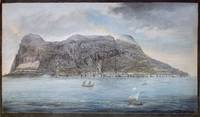
Best.-Nr. 52115c.1800. Fine gouache painting of the Rock of Gibraltar with ships in the foreground 39 x 65.5 cm to outside black neat line. Indecipherabe signature to bottom right obscured by black ink border line. c.1800 unknown
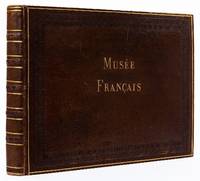
Best.-Nr. 60957France: c.1820-1850. Oblong folio 23 x 29 cm. 85 leaves of Whatman wove paper watermarked 1820. Contemporary straight-grained brown morocco sides ruled with blind and gilt borders gilt lettering to upper cover spine with raised bands and gilt rules gilt inner dentelles pink-coated endpapers all edges gilt. Comprising 27 original sketches and watercolours of a variety of subjects including views botanicals caricatures romantic scenes etc. plus one loose leaf of arabic design richly gilt with manuscript caption "A bord de l'Euphrate" and dated 1850. Generally a charming album in a handsome binding. [France: c.1820-1850.] hardcover
Best.-Nr. 66354N.p. London. 1750. Folio. pp. 53 i. Uncut in modern cloth the title with the lower margin repaired with tape recto and several small marginal tears taped verso no loss of text some marginal spotting the top half of the blank verso of the final leaf heavily dusty old fold vestiges in the text photos available. COPAC-JISC gives 5 locations for 1750 issue including BL and WELLCOME INST.; ESTC #T12377. We also have a small collection of ACTS OF PARLIAMENT going back to the reign of Queen Anne relating to the slave trade please enquire. N.p. London. 1750. Folio. hardcover
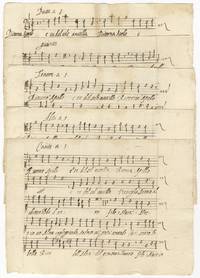
Best.-Nr. 39321Large oblong octavo ca. 175 x 235 mm. 10 pp. Notated in ink on 5 staves per page each voice on both sides of a leaf. Watermark of a small crown and 6-pointed star. Slightly worn and soiled; creased at folds. We have not located any other sources of the present work either manuscript or printed. unknown
Best.-Nr. 39321Large oblong octavo ca. 175 x 235 mm. 10 pp. Notated in ink on 5 staves per page each voice on both sides of a leaf. Watermark of a small crown and 6-pointed star. Slightly worn and soiled; creased at folds. We have not located any other sources of the present work either manuscript or printed. unknown books
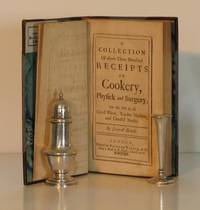
1714Best.-Nr. 7280London: For Richard Wilkin 1714. Octavo 19 x 12.5 cm. 16 218 13 pages. FIRST EDITION. “Mary Kettilby’s collection of cookery recipes and medicinal and home remedies from a tasty “green-pease soop without meat” to gooseberry wine. Households that could not afford French cooks or French cooking came to form a growing audience for books by women that contained unpretentious recipes cut to suit a less costly cloth for pickling and collaring rather than ragouts. Where Hannah Woolley had led plenty of female cooks with their eye on the profitable middle market followed with books like Mary Kettilby’s collection of recipes 1714 and Eliza Smith’s Compleat Housewife 1734” Colquhoun Taste: The Story of Britain through its Cookery 2015. Kettilby’s book purported to be a collective effort: the preface stating that ‘a Number of very Curious and Delicate House-wives Club’d to furnish out this Collection’. Maclean however pages 79-82 doubts this and notes that evidence from later editions indicate Kettilby to be the main author. Apart from the Preface there is no introduction of any sort: the recipes follow immediately after the chapter headings. The book is clearly divided into chapters of recipes for food and for remedies but within the chapters there is no definite structure. For example the first chapter begins with six recipes for soups followed by recipes for collared beef ‘French-Cutlets’ collared mutton stewed pigeons broiled pigeons dressed turbot and then patties ‘for a Dish of Fish’. The recipes are given either as goals as ‘To make Hogs-Puddings’ or as titles sometimes with descriptions as ‘A very good Tansy’. Quantities are given in whichever units are convenient as ‘a Gallon of grated Bread’ ‘three Pounds of Currants’ or ‘nine Eggs’. Often quantities rely on the cook’s judgment as ‘as much Sugar as will make it very sweet’. Temperatures and timings are given when necessary as ‘a cool Oven: Half an Hour bakes it’. Later binding in 19th century style. Half-calf gilt-decorated spine marbled endpapers. The front paste-down contains the bookplates of two significant culinary collections: Thomas Scruggs & Margaret Cook and Marian Hatch. The Hatch bookplate was designed and engraved by British engraver Alfred J. Downey. With the bookseller's ticket of Philip C. Duschnes to the rear pastedown. Ink ownership mark to half-title "1718 Eliseab; and inscription on final page of text "illeg. near New College Oxford". OCLC locates eighteen copies; Bitting page 258; Cagle 789; Maclean pages 79-82; Oxford page 54; Wellcome II page 389. For Richard Wilkin hardcover
1714Best.-Nr. 7280London: For Richard Wilkin 1714. Octavo 19 x 12.5 cm. 16 218 13 pages. FIRST EDITION. “Mary Kettilby’s collection of cookery recipes and medicinal and home remedies from a tasty “green-pease soop without meat” to gooseberry wine. Households that could not afford French cooks or French cooking came to form a growing audience for books by women that contained unpretentious recipes cut to suit a less costly cloth for pickling and collaring rather than ragouts. Where Hannah Woolley had led plenty of female cooks with their eye on the profitable middle market followed with books like Mary Kettilby’s collection of recipes 1714 and Eliza Smith’s Compleat Housewife 1734” Colquhoun Taste: The Story of Britain through its Cookery 2015. Kettilby’s book purported to be a collective effort: the preface stating that ‘a Number of very Curious and Delicate House-wives Club’d to furnish out this Collection’. Maclean however pages 79-82 doubts this and notes that evidence from later editions indicate Kettilby to be the main author. Apart from the Preface there is no introduction of any sort: the recipes follow immediately after the chapter headings. The book is clearly divided into chapters of recipes for food and for remedies but within the chapters there is no definite structure. For example the first chapter begins with six recipes for soups followed by recipes for collared beef ‘French-Cutlets’ collared mutton stewed pigeons broiled pigeons dressed turbot and then patties ‘for a Dish of Fish’. The recipes are given either as goals as ‘To make Hogs-Puddings’ or as titles sometimes with descriptions as ‘A very good Tansy’. Quantities are given in whichever units are convenient as ‘a Gallon of grated Bread’ ‘three Pounds of Currants’ or ‘nine Eggs’. Often quantities rely on the cook’s judgment as ‘as much Sugar as will make it very sweet’. Temperatures and timings are given when necessary as ‘a cool Oven: Half an Hour bakes it’. Later binding in 19th century style. Half-calf gilt-decorated spine marbled endpapers. The front paste-down contains the bookplates of two significant culinary collections: Thomas Scruggs & Margaret Cook and Marian Hatch. The Hatch bookplate was designed and engraved by British engraver Alfred J. Downey. With the bookseller's ticket of Philip C. Duschnes to the rear pastedown. Ink ownership mark to half-title "1718 Eliseab; and inscription on final page of text "illeg. near New College Oxford". OCLC locates eighteen copies; Bitting page 258; Cagle 789; Maclean pages 79-82; Oxford page 54; Wellcome II page 389. For Richard Wilkin hardcover books
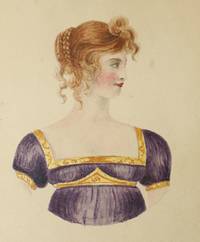
Best.-Nr. 007299Cloth portfolio. Very Good. Fabulous Regency fashion including its affinity for the exotic shown in seven overlay metamorphics. N.d. circa 1816. Based on paper watermark of that date. Thus these were executed then or shortly afterward as fashions shown are very much of the Regency period. The base leaf is 16.5 by 13.5 cm. The overlays are captioned: "Turkish Dress" "Spanish Dress" "Winter Dress" "Virgin of the Sun" "Ball Dress" "Shepherdess" and "Queen's Dress". The overlays a variable in size and they have to be and moved just so to fit correctly with the base head. One of the overlays has a small amount of tissue reinforcement. The group is housed in a modern custom cloth portfolio with flaps to hold the paper in and a ribbon tie to seal the portfolio. unknown
Best.-Nr. 007299Cloth portfolio. Very Good. Fabulous Regency fashion including its affinity for the exotic shown in seven overlay metamorphics. N.d. circa 1816. Based on paper watermark of that date. Thus these were executed then or shortly afterward as fashions shown are very much of the Regency period. The base leaf is 16.5 by 13.5 cm. The overlays are captioned: "Turkish Dress" "Spanish Dress" "Winter Dress" "Virgin of the Sun" "Ball Dress" "Shepherdess" and "Queen's Dress". The overlays a variable in size and they have to be and moved just so to fit correctly with the base head. One of the overlays has a small amount of tissue reinforcement. The group is housed in a modern custom cloth portfolio with flaps to hold the paper in and a ribbon tie to seal the portfolio. unknown books
1688Best.-Nr. 8031Paris: L D`Houry 1688. First Edition. Full contemporary calf. A very good copy; binding somewhat rubbed; some toning; light stain in the top margin. 12mo 24 142 2 pp. Contents leaf bound after the text. An anonymous work by one of the members of the small group of connoisseur plantsman of 17th century France known as the ' jardiniers fleuristes '. The work is dedicated to Andre LeNotre the creator of the gardens at Versailles. The book treats the cultivation of the four most prized and novel flowers of the day : the tulip carnation anemone and primrose. The author mentions many of his fellow floriculturists in passing. Oak Spring Flora #34 - "sophisticated little book" ; OCLC - 4 copies. L D`Houry unknown books
1819Best.-Nr. 24118English 18th - late 19th century. Very good; some sunning around the spine; small wear spots. A green moire silk book "chemise" with an elaborate border edging of metallic and cotton thread integrated in a "wave" pattern and a color silk thread needlework decoration "lozenge" shaped without outline applied to the front cover. It meas. appx. 175 x 115 mm. A handsome and unusual artifact. Rare. The term "chemise" is broadly applied to include those book coverings that were not created for and secured to an individual book but rather intended for interchangeable use on a variety of printed books notebooks or personal diaries. Internally the book would have been secured by the extended silk moire "pockets" sewn to the chemise covers into which a book cover could be slid - front and rear. The size and single decorative cover suggest an item that would have been personal to the owner - most likely a woman - and frequently carried closed cover facing out thereby displaying the decorative stitching. A summation of source information with references is Vanessa Robb's article available at: https://arhpee.typepad.com/Chemise%20bindings.pdf. Apparently no other examples of this type of cover have been indexed in public collections e.g. there is nothing akin to it in the Lefèvre catalog Livres en broderie . - restricted to only French examples - or in Davenport's study. The color needlework decoration is most likely 17th century Italian. The probability is that the needlework was a piece of salvage that survived into the 19th century and then was utilized as an applied decorative "plaque". Evidence for this is shown in the overlap of the wave pattern edging along all four edges of the front cover that appears to secure the needlework in place. The matrix for the needlework also shows through at one small spot and sits atop the green silk backing. The metallic and cotton thread edging is problematical to date. There is delicate couching securing it to the green silk backing. It could be as late as 1900 or much earlier. If later the overall design suits an "Arts & Crafts" motif given the indulgent use of earlier decorative needlework that this chemise exhibits. A most interesting survival. unknown books
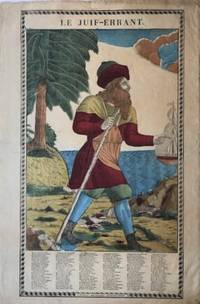
1830Best.-Nr. 18048Epinal: Pellerin ca1830. Matted; two linen backed mounts along upper margin. Near fine; horizontal fold; untrimmed. Broadside stencil/hand colored woodcut and letterpress text; 63.5 x 42.5 cm. A superb example of a French popular print depicting the legendary 'Wandering Jew' - the mythical immortal man said to have been present at the Crucifixion who was cursed thereafter to walk the earth until the Second Coming. The figure in the broadside has a long beard and walking stick set against the backdrop of a ship at sea in the distance alluding to travels beyond Europe. At the base of the print are 6 columns to text. The text is the lyrics of a popular song about the Jew's here given the name Isaac Laquedem encounter with two Frenchmen on the road near Brussels. The legend of the Wandering Jew had its roots in Biblical scripture but gained renewed force in the 13th century in parallel to the legend of Joseph of Arimathea. Both had supposedly been present at the Crucifixion and provided eye-witness testimony and hence the 'veracity' of the Christian religion. But through the centuries the story became more about the fate of the Jewish people in the European context. The broadside offered here was one of several similar designs in smaller formats issued at this time apparently inspired by the rise of the "Jewish Question" in the wake of Napoleon's emancipating reforms lifting ghetto laws granting citizenship religious worship property rights etc. The design of the woodcut of this Épinal imprint along with similar song lyrics in several versions from presses in Montbeliar Nantes Caen etc. each is rare. OCLC locates but one copy of this broadside at JCB. See T Kselman Conscience and Conversion: Religious Liberty in Post Revolutionary France; F Maguet 'Le développement de thème du Juif errant dans l'imagerie populaire de France et en Europe" in J Braillon-Philippe and L Golstenne Le Juif errant . pp. 90 - 107. Pellerin unknown books
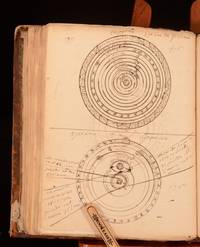
1780Best.-Nr. EXP2-F-7Anon: Anon c1780. Leather. Good. 9" by 7". Anon. A unique handwritten volume covering predominantly Astronomy and the Use of Globes. Handwritten in a neat and legible hand across 400 pages numbered 1-90 and 1-300. Occasionally with blank page breaks but continuous numbering. An interesting specimen this volume contains exercises diagrams and notes on science geography and astronomy. Primarily focusing on the Use of Globes it contains four diagrams of celestial movements and pages of charts and lists relating to the planets and stars. Written in French with one passage in English describing the fixed stars of the Lion's Tale and Virgin's Spike. The first 90 pages are concerned with broader geography and written in a question and answer style. The second section contains explanations on the use of Globes both terrestrial and celestial and the information that can be gleaned from a practical application of this knowledge. Similar in style to 'Introduction to the Use of Globes' by W Field the text follows an instructive pattern whereby the information is transcribed and then applied to a series of problems. The author seems to have been working through Thomas Hood's 'The Use of both the Globes Celestial and Terrestrial' and making a practical collection of notes for personal or educational use. One section is titled 'Responses aux Questions de ''appendix qui est a la suite de l'introduction a l'usage des Globes par mr Molineux' that is 'responses to questions in the appendix to the introduction of the use of Globes by Molyneux'. Emery Molyneux was an English Elizabethan maker of Globes and his terrestrial and celestial globes were the first to be made in England. Though Molyneux published his own treatise on Globes entitled 'The Globes Celestial and Terrestrial Set Forth in Plano' it has now been lost. In the same year Thomas Hood published 'The Use of Both the Globes' which referenced Molyneux's works. Because of this we believe it is Hood's work to which the author of this manuscript is referring. The work has been dated based on the predictions of celestial movements made in the text up to the year 1800. In a full mottled calf binding wiith gilt detailing. Externally worn with loss to leather at extremities and spine. Worn spine label reading 'usage de globes'. Front pastedown with ridge as quirk of binding. Marbled endpapers and pastedowns. Personal label to front pastedown. Internally generally firmly bound. Approx 100 smaller pages bound in to front and 304 full sized pages follwoing 300 numbered. 2 pages loosening to rear block. Pages bright generally clean with marginal age toning and handling marks. Occasional scattered spots. Creasing to foredge. Good Anon hardcover
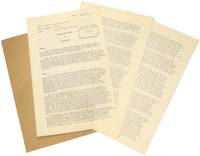
Best.-Nr. 74291N.p. London: Elstree Studios 1960. Literary and cinematic critique Elstree Studios' unfavourable report of Ian Fleming's For Your Eyes Only written five days prior to publication from page proofs submitted by Fleming's agents Pearn Pollinger & Higham. 8pp. typed report on rectos only reader's delivery stamp to first page dated 15 December 1955. Perforations down left edge from office binding. Well preserved. The fourth James Bond novel Diamonds Are Forever was published on 26 March 1956. Elstree's reader report notes that Fleming's literary agents Pearn Pollinger and Higham Ltd. submitted page proofs of the novel to the studio on 15 December 1955. The Summary begins favourably 'Another fast-moving exciting thriller starring Ian Fleming's hero James Bond.' but goes on to comment that the book 'contains a less arresting plot than Moonraker or Casino Royale'. The outline of the plot in the Story section runs to six and a half pages - after which the reader's Comment is less than positive: 'Ian Fleming has been aptly described as "Peter Cheyney for the carriage trade" and it would be difficult to find a better summing up. He writes better than the majority of thriller-writers but his smooth style occasionally trips up with the over-unusual simile designed to arrest and startle the reader. Also in order to tickle jaded palates he goes all out for the unusual locale and in this book jumps from the Saratoga race-track to a frontier ghost town just outside Las Vegas laying on too much local colour altogether. One cannot overlook him for he is rapidly becoming one of the most popular thriller writers of his day. But this book while it could make a film does not immediately suggest itself for screen adaptation. There is nothing sufficiently startling or unusual in the story to lift it above the 'B' class. Not recommended.' According to its first page this report was specifically compiled for Warner Bros. who had acquired a controlling interest in Elstree in the 1940s. N.p. [London: Elstree Studios], 1960 unknown
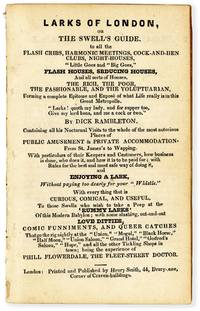
1839Best.-Nr. 88235London UK: Henry Smith 44 Drury Lane 1839-1840. First Thus. 12mo. 14.5cm. Disbound retaining buff rear wrap stitched possibly at some point removed from a sammelband. 36pp. Clean and bright with a 1" closed tear to the lower spine edge of the title page; internally fresh lacking the frontispiece plate depicting "The Marquis and His Molls at The Union and Mother Emerson's". A very good clean copy indeed of a vanishingly scarce publication. Published under two identifiable imprints; one by "John Wilson" of Long Acre actually the rather shady Edward Duncombe and this volume by "Henry Smith" who was actually notorious smut peddler William Dugdale. Wilson's imprint is the one from the Madeline Kripke Collection currently residing at the Lilly Library in Bloomington Indiana and was long thought to be the only surviving copy. Another copy of the Wilson/Duncombe surfaced in trade in a catalog from the luminous and erudite Karen Thomson in the mid 20-teens and presumably disappeared into a private collection. This copy is the only traceable copy of the Henry Smith imprint with no visibility in OCLC at all. Precedence is undeniably difficult to establish; Dugdale was trading at 94 Drury Lane in 1837-1838 and was next door or more likely downstairs at 94 ½ Drury Lane in late 1839 after a brief few months over on Wych Street. He was verifiably printing and publishing work under the "Henry Smith" shingle in 1838 and was presumably still using it in 1839 but in 1840 he was over on Holywell St. off The Strand. Duncombe on the other hand can be placed at 78 Long Acre having taken a rental on a shop in what was most likely late 1839 it is recorded that in 1841 he hung the name "John Wilson" over the door apparently to the surprise of his landlord who testified in court that there was no such person at that address although there is scant evidence to suggest he wasn't publishing under Wilson prior to that. Purely for amusement purposes it should be noted that during the time this work was printed neither of these two piratical gentlemen was further than 4 minutes walk from each other. Ms. Kripke stuck to a date of 1840 for her "Wilson" copy and a date of 1840 can be applied to the Smith imprint via a periodical advertisement discovered by the publisher of "The Penny Bibliography"; Mr. John Adcock https://john-adcock.blogspot.com/2009/03/penny-bibliography.html. The fact that it bears the 94 Drury Lane address suggests a printing date of late 1839 although seeing as both Dugdale and Duncombe were perpetually in and out of court and jail for various crimes against decency throughout their entire careers any accuracy in the timeline can be ascribed to accident rather than intention. This copy rather sadly lacks the frontispiece which presumably would have looked much like the one Duncombe/Wilson used in his publication although his has a rather proprietorial publisher's imprint across it depicting a virile young rake cavorting through a number of the establishments mentioned within. A significant link in a long chain of bawdy guides rake's progressions and "Gentlemen's Kalendars" that owes much to Harris's Lists of half a century earlier; "Larks of London" occupies a clearly rather cramped space alongside "The Swell's Night Guide Through The Metropolis" by "F.L.G." and the "Man of Pleasure's Illustrated Pocket Book" and their ilk. Stopping short of active descriptions of sexual acts but making no bones about their availability and the addresses where they could or should be purchased it also expands into discussions of the relative quality of food drink and gaming facilities whether the company can be construed to be "Low" or of a more elevated nature and a certain strategic interest in how to get the very best from a night on the most irredeemably vice-ridden town in the Empire. Henry Smith, 44 Drury Lane unknown