7.410 resultados
1987ref. 5781Shanghai Shanghai Education Publishing House 1987 Un joli lot de ces affiches pédagogiques, racontant l'histoire de « Qui a perdu la balle ? ». Il s'agit d'un lot complet de neuf affiches, de différentes tailles. (Lot complet). Il existe une dixième affiche il semble s'agir d'un « avant-goût » d'un autre ensemble d'affiches. Elles sont destinées aux enfants de maternelle. La série portait le titre accrocheur de « Affiches pédagogiques pour la narration d'histoires illustrées en maternelle (Classe moyenne, série 2, n° 9-1) ». La plupart des affiches sont en parfait état, n'ayant jamais été utilisées. Deux d'entre elles ont été accrochées dans une salle de classe ; elles présentent donc de légères traces d'usure sur les bords et des résidus de ruban adhésif au dos. Un bel ensemble d'affiches. Leurs dimensions varient légèrement, mais elles mesurent généralement 530 × 780 mm (20Ÿ × 30Ÿ pouces).
1925ref. 5783Paris S.P. C1925 Une jolie photographie de la Seine avec Notre-Dame en arrière-plan. Au centre de la photo, on aperçoit les magnifiques bâtiments de la rue du Cloître Notre-Dame et le pont Saint-Louis. À l'arrière-plan se trouve l'église Saint-Gervais. À droite, on distingue le quai d'Orléans. Il s'agit d'une photo assez grande, mesurant 19 cm x 42 cm. Dans l'ensemble, elle est en bon état et présente une légère teinte sépia. Anonyme, à l'exception du titre « Notre-Dame de Paris » en lettres blanches, la photographie date de l'époque où l'échafaudage de la flèche de Notre-Dame était en place. Celui-ci a été installé entre 1920 et 1930 environ. La surface de la photographie présente une légère décoloration, une ou deux petites marques et quelques légers plis, mais dans l'ensemble, elle est très belle. Idéale pour être encadrée. Verso vierge.
1825ref. 5799Paris Mme Ve J. Decle & Renard 1825 Réimpression. Publié à l'origine en 1796, cet ouvrage retrace la dépréciation de la monnaie révolutionnaire en France à partir de l'exécution du roi par le nouveau régime. Reliure en cuir avec titres et décor dorés sur le dos. Couvertures marbrées. Dans l'ensemble en très bon état, avec quelques légères éraflures au sommet du dos. L'intérieur est propre et soigné sur l'ensemble, avec seulement un léger noircissement des pages. 306 [i] pages avec un errata à la fin. 130 × 90 mm (5 × 3œ pouces). Conforme à WorldCat / OCLC : 716024096. La nouvelle République émit des « assignats », c'est-à-dire des billets de banque nominalement garantis par les biens confisqués à l'Église et aux domaines nationaux. Ces assignats ont été surimprimés de manière massive au début des années 1790 et ont entraîné une hyperinflation catastrophique. Le Directoire a tenté diverses solutions, mais a dû les abolir et revenir à la monnaie métallique en 1797. Ce document était essentiel pour permettre aux tribunaux de déterminer la valeur de la monnaie dans un département donné à une date donnée. Il s'agit d'un document de première main permettant de comprendre les mécanismes de l'effondrement des assignats. Traduit avec DeepL.com (version gratuite)
1875ref. 5808France S.P. C1875 Première édition. Un magnifique manuscrit enluminé à caractère pieux. Probablement un cadeau de première communion ou similaire. Non daté, mais vers 1875. Le texte est le Memorare / Oraison de Saint Bernard. Il s'agit d'une prière adressée à la Vierge Marie, attribuée à tort pendant de nombreuses années à saint Bernard. En réalité, elle est l'uvre de Nicolas Salicetus. Papier d'art rigide de grande qualité. Présente aujourd'hui quelques traces d'usure. Au verso, on aperçoit les traces laissées lorsque la feuille a été collée sur un support en carton rigide en vue d'un encadrement. La partie enluminée est propre et soignée. Texte en français. Le blason « C.M. » en bas correspond presque certainement à l'artiste. La zone peinte mesure 16 cm x 12 cm. La feuille mesure 26,5 cm x 22 cm. Verso vierge. Le manuscrit est réalisé dans le style de l'enluminure néo-gothique/troubadour, très en vogue dans la seconde moitié du XIXe siècle.
1737ref. 5825London Ward and Chandler... C. Corbett, E. Withers. 1737 Deux volumes, in-12, 150 × 90 mm (6 × 3œ pouces). [12], 238, [2] ; [2], 329, [5] pages, avec un frontispice gravé dans chaque volume. Complet. Titres imprimés en rouge et noir. Les frontispices représentent des comédiens sur scène et ne sont pas signés. Lettres initiales historiées, en-têtes et séparateurs de sections ornementaux. Reliure en cuir pleine peau, dos doré en compartiments avec étiquettes en maroquin bordeaux et noir, et dentelles dorées. ESTC T134816. Deuxième édition, et première sous ce titre, d'une anthologie anonyme d'extraits dramatiques. Publiée pour la première fois en 1724 sous le titre Thesaurus Dramaticus, elle est ici « poursuivie jusqu'à l'année en cours ». Les extraits sont classés par ordre alphabétique de sujet, à partir de « Anger » et « Angels », chacun étant attribué à sa pièce et à son auteur Dryden et Shakespeare figurant en bonne place , à la manière d'un recueil de citations destiné aux lecteurs, aux orateurs et aux écrivains en herbe. Une troisième édition, étendue à trois volumes, suivit en 1756, et l'ouvrage fut remanié sous le titre *The Beauties of the English Drama* en 1777. De telles compilations contribuèrent à établir le canon du théâtre anglais citable au XVIIIe siècle, et elles révèlent les passages que les lecteurs de l'époque admiraient le plus. Imprimé par William Bowyer, dont les registres font état d'un tirage de 1 000 exemplaires. Il semble toutefois qu'il n'en subsiste que très peu sur le marché : nous n'avons trouvé aucun autre exemplaire à vendre ni aucune mention dans les registres de ventes aux enchères. La plupart des fonds institutionnels répertoriés sur WorldCat sont des copies numériques plutôt que des exemplaires physiques. Reliures légèrement abîmées, avec une légère perte de dorures et quelques traces d'usure en surface, mais solides. Intérieur propre, avec un minimum de rousseurs. Un ex-libris héraldique antérieur dans chaque volume a été recouvert par la page de garde avant et transparaît faiblement. Un très bel ensemble.
1890ref. 5830Paris S.P. 1890 Sans date ni mention d'éditeur. Un carnet de danse français de la fin du XIXe siècle. Se présentant sous la forme d'un petit éventail, muni d'un rivet en laiton. Le carton, toujours de couleur bleu pâle / vert, est découpé et décoré jusqu'aux bords. Il se compose de six feuillets. À l'intérieur, ceux-ci offrent de la place pour noter les noms des personnes à qui vous avez promis de danser chaque type de danse. Il s'agit de la quadrille (7 danses) ; la valse (7) ; la polka (4) ; la mazurka (2) ; les lanciers (3) ; la redowa (3) ; la scotish (2) ; le galop (2) ; et le cotillon (1). Le carnet n'a pas été rempli. En excellent état, ne présentant que de très légères traces d'usure. 90 × 55 mm.
ref. 24232S. e. En feuille S. l.
ref. 24239S. e. En feuille S. l.
ref. 24242S. e. En feuille S. l.
ref. 40045par A-I-C-A, France ,1973, in-4 de 74 pages ,illustrations in-texte et hors-texte ,broché ,Bon état , .(4 photos du livre sur mon site https://www.vieuxlivre.fr) .Les frais de port pour la France sont offerts à partir de 25 euros d'achat (Mondial relay ). (colissimo suivi +6,90 ).
1887ref. 64851887 in-8, XXIV-92pp., en ff. Digne Chaspoul 1887,
ref. lc_108810Taschen 2002
ref. lc_95588Air Data Publications
ref. lc_95587Air Data Publications
ref. 31555VPJF
ref. ENA60AP973
2004ref. R100073721Editions du temps. 2004. In-8. Broché. Bon état, Couv. convenable, Dos satisfaisant, Intérieur frais. 191 pages - une étiquette collée sur le 2ème plat - ouvrage en français avec des passages en espagnol. . . . Classification Dewey : 372.4-Livre scolaire : lecture
ref. RO80214174Dels Noranta. Non daté. In-4. Relié. Bon état, Couv. convenable, Dos satisfaisant, Intérieur frais. 131 pages. nombreuses photographies en couleurs hors texte. Texte en langue espagnole Jaquette et sous-emboîtage en excellent état.. Avec Jaquette. . . Classification Dewey : 990-Histoire générale des autres pays
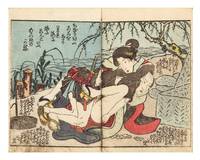
ref. 771516 double-page & four single-page color-printed woodcuts. 13; 11; 9 folding leaves. Three vols. Small 8vo orig. speckled semi-stiff boards boards rubbed orig. block-printed title labels on upper covers new stitching. Japan probably Edo: manuscript inscription dated "1832" at end of each volume. First edition and very rare; we do not find this book listed in WorldCat or in the Union Catalogue of Japanese Books. The Preface is signed by Akikei or Akikage Higashikuni. This work is an erotic version of Shiki no en an 18th-century group of songs on the four seasons of love from the Yamada ryu school of the Japanese harp koto. The poems of Haku Rakuten or Bai Letian 772-846 the Chinese poet of the mid-Tang dynasty are sources for the songs along with Japanese waka poems. Haku Rakuten "became the favorite poet of Heian times.He was the Chinese poet to whom allusions and from whom recollections were most frequent in Heian Japan. His verses were often used for kudai waka and he epitomized Chinese poetry."-Earl Miner et al. The Princeton Companion to Classical Japanese Literature p. 160. The first color-printed woodcut depicts a woman preparing to play the koto. There follows a series of erotic double-page woodcuts: kabuki actors young samurai Chinese characters and women of various social classes are shown engaged in sex through the changing seasons. It is fascinating to see the various rooms and their furnishings the participants' costumes and the landscapes in the background. The fine woodcuts were clearly created by a member of the Utagawa school however we are unable to establish their artistic authorship. Very good set but with some thumbing. The second and third volumes have some worming touching several of the woodcuts. unknown books
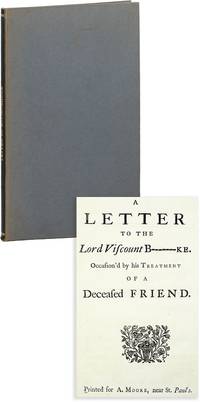
1749ref. 89871London: A. Moore 1749. First Edition. Octavo in fours. 21cm. Functional blue paper covered boards with a leather and gilt title label that runs the length of the spine. 16pp. Binding is solid and tight with a touch of sunning around the spine edges; internally clean and fresh half-title present some light soiling to verso of final leaf. A very good clean copy indeed in a functional later binding. An appalled excoriation of arch-rake Lord Viscount Bolingbroke castigating him upon his treatement and comments regarding Alexander Pope following the poet's death. Warburton Bishop of Gloucester and Pope's friend supporter and eventual executor was something of an authority on speaking truth to power although it is unlikely that his criticism had any effect upon Bolingbroke a man who was known for having a moral compass so eccentric it was a wonder he could find Parliament. A. Moore unknown books
1820ref. 88903London: J. Bailey 116 Chancery Lane 1820. First Edition. Slim Twelvemo. 18cm. Late 19th century half mottled calf over marbled paper covered boards by Bayntun of Bath with a red title label to the spine titled in gilt very much in the style of an older binding. 24pp. with 24pp binder's blanks to rear to stabilize the binding. Light scuffing to corners and spine ends darkening to spine label and a little dulling of the gilt strong tight and handsome; internally clean all edges gilt marbled endpapers later ex libris to front pastedown with traces showing removal of an older one visible beneath hand colored frontispiece illustration with later tissue guard and a small archival tissue repair to a small tear on the fore-edge offsetting of the color and some light soiling to title page the work would originally have been issued as a chapbook in paper wraps. A very good attractive copy of an obscure piece of early 19th century pop culture. John Bailey was one of those highly-energetic and slightly scurrilous printer-publishers of the early 1800's running alongside Stockdale Dugdale Duncombe and the like in a frenetic race to recognise the current zeitgeist and mine it for pamphlets chapbooks and on occasional multi-volume exposés until the vein ran out and they moved on to the next thing. It could be the sporting Fancy the murky doings of the Ton memoirs of ladies of negotiable virtue the scandalous habits of the French or the diabolical behavior of home grown rakes; if it could be illustrated with a lurid cut and sold to popular acclaim but no legal outcry then it was prime for publication. This is an indicative offering; a tale of a lady maligned a wandering-handed husband and some untrustworthy foreign types Italians in this case portrayed as being of a nation of bandits promoting the popular and rather thrilling idea that nobody really knows what the aristocracy gets up to but slim little volumes like this can give you a fair idea. Unusually studded with relatively competent verse commentary and enough arch detail for the suggestive reader to wonder whether it is entirely fictional. It isn't in case you were wondering; it forms part of the Caroline Scandal blizzard of pamphlets and cartoons directed at the indiscretions and marital strife of Caroline of Brunswick the oft estranged wife of King George IV. George despised his wife even after the birth of their daughter and Queen Caroline retired to Italy where her chief advisor and confidante was a gentleman named Bartolomeo Pergami - in short order Caroline and Pergami were rumored to be lovers accusations of adultery and possible treason flew in all directions and a legal deadlock began with both parties George and Caroline whose middle name was of course Amelia denying infidelity whilst pointing the finger at each other. The "Green Ridicule" is a reference to the bags presented at the reading of the bill intended to grant the King a divorce; large green sacks of "evidence" collected by the Milanese authorities much of which was rather hilarious and involved a lot of innkeepers and coachmen testifying to having seen Pergami in flagrante whilst within 20 feet of the noble lady. The resulting legal wrangling and backstabbing had the opposite effect from the one desired by George and rendered Caroline something of a public and political heroine misused by her abusive husband and adopted by reformist political figures seeking to gain ground on an increasingly eccentric and damaging monarchy. The tone of the tale is therefore rather sympathetic to Lady Amelia in keeping with public sentiment. It is also stated to hopefully be the first part of a series of exposures of the travails of "Lady Amelia" and her somewhat ungallant spouse which suggests it was rushed out mid-trial and may have had subsequent installments as the proceedings continued through 1820. The title itself is possibly a riff on Mary Charlton's work; she published a substantial and popular work with a similar title a few years earlier. Scarce and a little obscure with three holdings in US institutions. J. Bailey, 116 Chancery Lane unknown books
1733ref. 89311London: W. Dickenson in Witch Street 1733. First Edition. Folio. 32.5cm. Disbound with slight residual crust of old calf to spine region. 18pp. Some old ink spots to title page which effectively comprises the front wrap strong and durable toning to the extremities of both outer wraps and a little internal thumbing otherwise clean and fresh woodcut head and tailpieces luxuriously wide margins. A very good long disbound example of a well-aimed piece of 18th century satire. A vastly Popean excoriating satire of the Whig government of the 1830's under Robert Walpole James Ralph William Stanhope as Secretary of State George Byng as First Lord of The Admiralty and a host of other aristocratic pillars of the British aristocratic system. Written in full flow as faux-Pope Whitehead with full reference to The Dunciad and wielding the righteous wrath of a breakfast table diplomat under full sail tears into the sitting government and bemoans with Pope how nothing has changed since the last crop of dunces. A successful part II was published in the same year and the two are often found bound together this copy comprises only part I. Whitehead's uncanny ability to ape Popean epic actually made him something of a living during the 1830's-40's allowing him to pen political and social satire like a Temu Alexander Pope but available at Witch Street prices. Foxon gives priority to this one which also contains 24 lines eliminated in the others.This was the poem that Whitehead sold for an advance of ten guineas provoking Johnson to demand the same for London in 1738. Foxon W426; ESTC T48572. W. Dickenson in Witch Street unknown books
ref. 80649N.p. n.d. s.i. Octavo 23cm. Printed buff wrappers; 32pp all halftone photographic reproductions. Mild external creasing and soil; pencil note to front cover "from Leslie / Sept 11th 1932"; another faint pencil annotation to rear wrapper indecipherable; else clean and unmarked Very Good. Reproduces thirty official U.S. War Department and Signal Corps photographs all being battlefield photos of atrocities from the European theatre in WW1. Most are extremely graphic images of dead and mutilated soldiers the only text being brief captions providing sardonic commentary: "Abandoned;" "Decapitated;" "Asphyxiated;" "Where Children Played;" "The Price They Paid" etc. Issued without date or attribution nor has our research uncovered any definitive bibliographical data but the pamphlet was clearly intended to generate anti-war sentiment. Date uncertain; most OCLC records suggest a 1920s date but we suspect the pamphlet was issued later probably around the penciled date on front cover to discourage further American entanglements in the European conflict then just predictable on the far horizon. unknown books