7 298 résultats
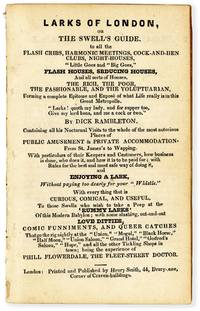
1839réf. 88235London UK: Henry Smith 44 Drury Lane 1839-1840. First Thus. 12mo. 14.5cm. Disbound retaining buff rear wrap stitched possibly at some point removed from a sammelband. 36pp. Clean and bright with a 1" closed tear to the lower spine edge of the title page; internally fresh lacking the frontispiece plate depicting "The Marquis and His Molls at The Union and Mother Emerson's". A very good clean copy indeed of a vanishingly scarce publication. Published under two identifiable imprints; one by "John Wilson" of Long Acre actually the rather shady Edward Duncombe and this volume by "Henry Smith" who was actually notorious smut peddler William Dugdale. Wilson's imprint is the one from the Madeline Kripke Collection currently residing at the Lilly Library in Bloomington Indiana and was long thought to be the only surviving copy. Another copy of the Wilson/Duncombe surfaced in trade in a catalog from the luminous and erudite Karen Thomson in the mid 20-teens and presumably disappeared into a private collection. This copy is the only traceable copy of the Henry Smith imprint with no visibility in OCLC at all. Precedence is undeniably difficult to establish; Dugdale was trading at 94 Drury Lane in 1837-1838 and was next door or more likely downstairs at 94 ½ Drury Lane in late 1839 after a brief few months over on Wych Street. He was verifiably printing and publishing work under the "Henry Smith" shingle in 1838 and was presumably still using it in 1839 but in 1840 he was over on Holywell St. off The Strand. Duncombe on the other hand can be placed at 78 Long Acre having taken a rental on a shop in what was most likely late 1839 it is recorded that in 1841 he hung the name "John Wilson" over the door apparently to the surprise of his landlord who testified in court that there was no such person at that address although there is scant evidence to suggest he wasn't publishing under Wilson prior to that. Purely for amusement purposes it should be noted that during the time this work was printed neither of these two piratical gentlemen was further than 4 minutes walk from each other. Ms. Kripke stuck to a date of 1840 for her "Wilson" copy and a date of 1840 can be applied to the Smith imprint via a periodical advertisement discovered by the publisher of "The Penny Bibliography"; Mr. John Adcock https://john-adcock.blogspot.com/2009/03/penny-bibliography.html. The fact that it bears the 94 Drury Lane address suggests a printing date of late 1839 although seeing as both Dugdale and Duncombe were perpetually in and out of court and jail for various crimes against decency throughout their entire careers any accuracy in the timeline can be ascribed to accident rather than intention. This copy rather sadly lacks the frontispiece which presumably would have looked much like the one Duncombe/Wilson used in his publication although his has a rather proprietorial publisher's imprint across it depicting a virile young rake cavorting through a number of the establishments mentioned within. A significant link in a long chain of bawdy guides rake's progressions and "Gentlemen's Kalendars" that owes much to Harris's Lists of half a century earlier; "Larks of London" occupies a clearly rather cramped space alongside "The Swell's Night Guide Through The Metropolis" by "F.L.G." and the "Man of Pleasure's Illustrated Pocket Book" and their ilk. Stopping short of active descriptions of sexual acts but making no bones about their availability and the addresses where they could or should be purchased it also expands into discussions of the relative quality of food drink and gaming facilities whether the company can be construed to be "Low" or of a more elevated nature and a certain strategic interest in how to get the very best from a night on the most irredeemably vice-ridden town in the Empire. Henry Smith, 44 Drury Lane unknown books
1772réf. CAT000842Paris: Chez Lottin 1772. Nouvelle. Hardcover rebound in leather. Very Good Condition. Contemporary acid calf repair to leather on upp right surface rubbing bottom corners worn through but sound and attractive overall. Scattered browning foxing old bookplate of Bernard Junisc inside front cover top corner of first few dozen pages v. slightly nibbled marbled endpapers. Two volumes in one bound without the second title. xiv 2 372 367pp. A nouvelle edition. Often noted as having been first published in 1765 or 1762 but maybe through a confusion with the associated Dictionnaire Domestique Portatif an ad for this and other portatif books appears before the title page. The first located edition was 1767. Cagle 162 1767 ed. Bitting 5543 Oberle 2 98 Vicaire 276 Often lost among the more original Menon Massialot or charming Le Cuisinier Gascon cookbooks that preceded it and the post-revolutionary works that followed Beauvilliers Careme the Dictionnaire Portatif marks an interesting if largely derivative moment in French cuisine. Like the contemporary also anonymous Manuel des officiers de bouche it serves as a summation of centuries of French cuisine from Taillevent and the Menagier to the brink of the revolution all in a handy alphabetical form. Size: 8vo. Quantity Available: 1. Shipped Weight: Under 1 kilo. Category: Cooking Wine & Dining; Inventory No: CAT000842. Chez Lottin hardcover books
1820réf. 88903London: J. Bailey 116 Chancery Lane 1820. First Edition. Slim Twelvemo. 18cm. Late 19th century half mottled calf over marbled paper covered boards by Bayntun of Bath with a red title label to the spine titled in gilt very much in the style of an older binding. 24pp. with 24pp binder's blanks to rear to stabilize the binding. Light scuffing to corners and spine ends darkening to spine label and a little dulling of the gilt strong tight and handsome; internally clean all edges gilt marbled endpapers later ex libris to front pastedown with traces showing removal of an older one visible beneath hand colored frontispiece illustration with later tissue guard and a small archival tissue repair to a small tear on the fore-edge offsetting of the color and some light soiling to title page the work would originally have been issued as a chapbook in paper wraps. A very good attractive copy of an obscure piece of early 19th century pop culture. John Bailey was one of those highly-energetic and slightly scurrilous printer-publishers of the early 1800's running alongside Stockdale Dugdale Duncombe and the like in a frenetic race to recognise the current zeitgeist and mine it for pamphlets chapbooks and on occasional multi-volume exposés until the vein ran out and they moved on to the next thing. It could be the sporting Fancy the murky doings of the Ton memoirs of ladies of negotiable virtue the scandalous habits of the French or the diabolical behavior of home grown rakes; if it could be illustrated with a lurid cut and sold to popular acclaim but no legal outcry then it was prime for publication. This is an indicative offering; a tale of a lady maligned a wandering-handed husband and some untrustworthy foreign types Italians in this case portrayed as being of a nation of bandits promoting the popular and rather thrilling idea that nobody really knows what the aristocracy gets up to but slim little volumes like this can give you a fair idea. Unusually studded with relatively competent verse commentary and enough arch detail for the suggestive reader to wonder whether it is entirely fictional. It isn't in case you were wondering; it forms part of the Caroline Scandal blizzard of pamphlets and cartoons directed at the indiscretions and marital strife of Caroline of Brunswick the oft estranged wife of King George IV. George despised his wife even after the birth of their daughter and Queen Caroline retired to Italy where her chief advisor and confidante was a gentleman named Bartolomeo Pergami - in short order Caroline and Pergami were rumored to be lovers accusations of adultery and possible treason flew in all directions and a legal deadlock began with both parties George and Caroline whose middle name was of course Amelia denying infidelity whilst pointing the finger at each other. The "Green Ridicule" is a reference to the bags presented at the reading of the bill intended to grant the King a divorce; large green sacks of "evidence" collected by the Milanese authorities much of which was rather hilarious and involved a lot of innkeepers and coachmen testifying to having seen Pergami in flagrante whilst within 20 feet of the noble lady. The resulting legal wrangling and backstabbing had the opposite effect from the one desired by George and rendered Caroline something of a public and political heroine misused by her abusive husband and adopted by reformist political figures seeking to gain ground on an increasingly eccentric and damaging monarchy. The tone of the tale is therefore rather sympathetic to Lady Amelia in keeping with public sentiment. It is also stated to hopefully be the first part of a series of exposures of the travails of "Lady Amelia" and her somewhat ungallant spouse which suggests it was rushed out mid-trial and may have had subsequent installments as the proceedings continued through 1820. The title itself is possibly a riff on Mary Charlton's work; she published a substantial and popular work with a similar title a few years earlier. Scarce and a little obscure with three holdings in US institutions. J. Bailey, 116 Chancery Lane unknown books
réf. 80649N.p. n.d. s.i. Octavo 23cm. Printed buff wrappers; 32pp all halftone photographic reproductions. Mild external creasing and soil; pencil note to front cover "from Leslie / Sept 11th 1932"; another faint pencil annotation to rear wrapper indecipherable; else clean and unmarked Very Good. Reproduces thirty official U.S. War Department and Signal Corps photographs all being battlefield photos of atrocities from the European theatre in WW1. Most are extremely graphic images of dead and mutilated soldiers the only text being brief captions providing sardonic commentary: "Abandoned;" "Decapitated;" "Asphyxiated;" "Where Children Played;" "The Price They Paid" etc. Issued without date or attribution nor has our research uncovered any definitive bibliographical data but the pamphlet was clearly intended to generate anti-war sentiment. Date uncertain; most OCLC records suggest a 1920s date but we suspect the pamphlet was issued later probably around the penciled date on front cover to discourage further American entanglements in the European conflict then just predictable on the far horizon. unknown books
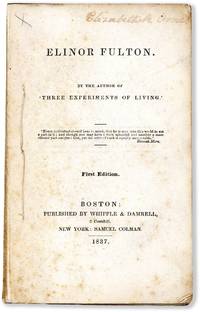
1837réf. 86896Boston: Whipple & Damrell 1837. Stated First Edition. Small Octavo. 15cm. Stab bound with no evidence of ever having been in wraps or a binding. 144pp. The title page and last leaf form the covers for this volume so there is some light soiling and spotting to both leaves with some old flattened creasing and discoloration to the final leaf; internally clean and fresh ownership signature to title page strong and solid with a little dogearing to the lower front corner. A very good copy of a volume that really had nothing to assist in its survival thus far. The sequel to Hannah Lee's bestselling "Three Experiments of Living" which by the time of the anonymous publication of this work was well into its 18th printing or more. "Elinor Fulton" also ran to multiple editions following on from the earlier works gentle and woman-oriented 'guide to navigating married life' theme which was pushed into public focus by the financial collapses of 1837 and the bubbling and roilings of the women's emancipation that was to come. The book dealt with a fictionalized demonstration of a married couple living within and beyond their means and how careful domestic financial management was actually the key to happiness in marriage and life. Actually Lee's fourth published work but her first novel in 1830 "Grace Seymour" seems to have disappeared without contemporary notice. A contemporary signature to the title page appears to all evidence to be that of Elizabeth Ropes Orne of the enormously influential New England Orne family who married and allied themselves closely with the Ropes the Baldwins the Tappan family and the Cushings - which effectively made them little less than New England wealthy aristocracy on a par with European great houses. Elizabeth died of consumption at the age of 24 in the Ropes mansion now part of the Peabody Essex Museum where her room is preserved in its contemporary state. She was a correspondent of William P. Upham the Salem Witch Trials authority which makes sense for a woman born in Salem and is memorialised as an intelligent imaginative and creative young woman. Whipple & Damrell unknown books
2000réf. 83050San Francisco: S.i. n.d. but 2000s. Original illustrated poster with text and pictorial elements silkscreened in black and red on white posterboard measuring 66.5cm x 51cm 26 1/8" x 20 1/8". Faint foxing around upper right corner some trivial dustiness on verso; Near Fine. Bay Area poster designed by an anonymous artist featuring a simple message above the corpse of the Monopoly Man who is clutching a bag of money in one hand and a fist full of cash in the other with a knife protruding from his back. A response to the increasing gentrification of Bay Area communities in the wake of the Dot Com boom. 83050. S.i. unknown books
1890réf. 84528London: Longmans Green and Co 1890. First Edition. Octavo. 19.5cm. Publisher's dark blue bevelled boards titled in gilt and blind to spine and front board. 289pp.16pp. ads to rear. Light bumping to spine ends a little scuffing to extremities strong and handsome; internally clean with some marginal toning to page edges top-edge untrimmed. A very good strong copy with only light wear. Published anonymously and one of only three "romance" titles written by Professor Nicholson presumably in spare moments of release from his day job which was being a very notable and respected British economist. His output more normally consisted of works on tariff reform and influential titles like "Effects of Machinery on Wages" and "Tenant's Gain Not Landlord's Loss" his works also include "A Revival of Marxism" in 1920 his last published work. When he wasn't writing studious treatises on the finer aspects of international economics and trade relations he was immersing himself into the creation of complex bits of Ancient Greek weirdness involving torrid rivalries doomed love cursed gemstones and mysterious oracular types holding forth on the wisdom of the gods. Found in Bleiler but not easily found in acceptable condition. Longmans, Green, and Co unknown books
1832réf. 84913London: Effingham Wilson 1832. A New Edition Greatly Enlarged and Corrected. Octavo. 23cm. Bound in later rather institutional black buckram with paper title label. 16pp. ads to front matter; xxxii; 683pp. 1pp ads to rear. Minor wear and bumping to extremities with a little rippling of the cloth to the front board strong and tight; internally clean later endpapers ink ownerships to front flyleaf frontispiece portrait "Friends of Reform - Foes of Revolution" quite heavily spotted with some offsetting to the title page edges untrimmed some occasional light spotting within. A very good copy in a later binding of a rather unwieldy work. A later printing of Wade's incendiary 1820 catalog of abuses performed by the Church The King the Government and various business interests against the people security and progress of Great Britain. A continued bestseller demonstrating a fervent appetite on the part of the British public to read Wade's excoriating denunciation of the upper classes and their merely wealthy counterparts. On a number of fronts this public airing of secretly dirty laundry met with some political and social success and led to some very public gestures at reform. Effingham Wilson unknown books
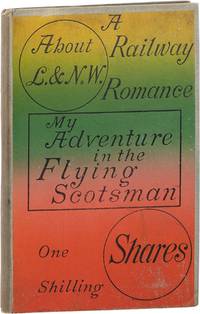
1888réf. 82711London: James Hogg and Sons 1888. First Edition. 12mo 18cm. Publisher's original grey cloth covered boards titled and decorated in polychrome; 63pp. A handsome copy lightly rubbed on covers and with a touch of foxing to pastedowns but still quite bright and clean in the lovely polychrome cloth bidning; Very Good to Near Fine and most unusual thus. The author's rare first book a rollicking bit of railway-based melodrama of a type much beloved of the Victorians published in the year of the London Matchgirls Strike and the reign of Jack the Ripper. Far and away the finest copy we've handled of this early Queen's Quorum title uncommon in any condition. The binding has been recorded in a variety of cloth colours and colour variations with no known priority. QUEENS QUORUM 13. James Hogg and Sons unknown books
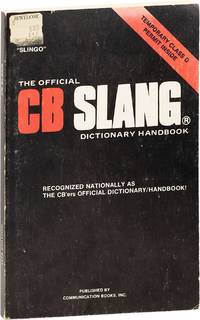
1976réf. 83614Communication Books Inc 1976. First Edition. First Printing. Octavo 21.5cm; black wrappers; 185pp. Price sticker to front cover with modest shelfwear and clean interior; Very Good. Describes information and terminology related to operation of CB type radios and includes cross references and code lists. 83614. Communication Books, Inc unknown books
1916réf. 83564Chicago: Izdala RadniÄka Knjižara 1916. 12mo 19cm.; publisher's pale red staplebound card wrappers; 20pp. Minor wear and toning to wrappers; mild toning to text; Very Good or better. Slovak translation of an anonymous Russian Marxist theoretical work issued as Narodna Knjižnica Folk Library no. 9. Includes a chapter on the lumpenproletariat and anarchism. The source is possibly Pavel Rosenthal's "Люмпенпролетариат и революциÑ" "Lumpenproletariat & Revolution." St. Petersburg 1906. One copy located in OCLC Michigan as of 2024. Izdala RadniÄka Knjižara unknown books
1865réf. 69031New York: Bromley & Co 1865. Second edition. 19 cm. 251 pp. Illus. Original dark blue green blindstamped cloth title stamped in gilt on spine. Some wear to spine ends foxing to endpapers. Previous owner's signature on front pastedown. Wright II 1542 for the first edition of 1864. Hamilton p. 87 for Bur. Lusk 998. Sabin and BAL disavow possible authorship by Seba Smith or Charles A. Davis both of whom lived a few years past the end of the war. Sabin 84179. This is the edition of 1864 published by Bromley and Feeks with a printed slip pasted over the date and Feeks' name in the imprint providing the date 1865 and the statement "second edition." The anonymous author ridicules Lincoln's war policies. Bromley & Co unknown books
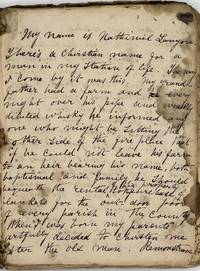
1867réf. 69292London England 1867. Plain stiff paper wrappers soiled ink marks stitched. 15 x 11 cm. approx. 106 pp. of text rest blank ca. 10000 words in ink and occasionally pencil in a neat hand. The unnamed author commences three or four different stories penning a chapter or two for at least three of them. His subjects include a country house party and the interactions of the guests; a family in mourning and a solicitous guest; a young man down on his luck who forges his employer's signature on a check; etc. There are moments of humor and self-absorption by some of the characters food and drink seem to pre-occupy the author's thoughts there are curious turns of phrase and spelling aberrations. The first line of the first story introduces his main character: "My name is Nathiniel Lanyon. There's a Chirstian name for a man in my station of life." He goes on to say he was named after his grandfather who taught him how to drink "whisky of the strength of seven parts of the spirit to one of water.so I can now drink my evening comfort as strong as that with an unteared that is to say tearless eye." In another story a woman describes her turncoat friends as having been tested and their loyalty "snapped like rotten twigs." In another a young man is described as having "an head conically inclined." There are numerous ink corrections and alterations in the text. The rear pastedown has a short ink recipe for cold cream and a clipped article offering advice for brushing teeth with a combination of gin nutmeg and lemon juice. A clue to the author's identity comes on the final page of the notebook where he pens the text of an advertisement: "A dispenser to board out of the house in the country address stating terms to E.L. care of Messrs Gale & Co. Bouverie Street Fleet Street London." In the classified section of the November 9 1867 edition of the Lancet General Advertiser London: A Journal of British and Foreign Medicine George Fall: 1867 this ad appears almost verbatim: "Wanted by a General Practitioner in the country a DISPENSER; to board out of the house -- Address stating terms to E.L. care of Messrs. Gale and Co. Bouverie-street Fleet-street London." Presumably the author of these amateur sketches was himself a doctor. unknown books
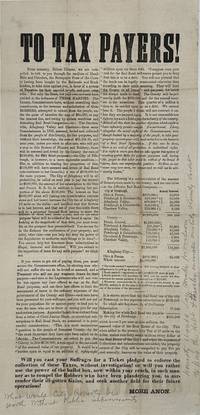
1858réf. 69335NP Allegheny County PA 1858. Broadside 49 x 23 cm. Text in two columns with caption title in large bold type. Old fold lines a few tiny holes and some toning previous owner's pencil margin notes. The text reads in part: "From necessity Fellow Citizens we are compelled to talk to you through the medium of Hand-Bills and Circulars the Newspaper Press of the County having been bought by the Railroads and Bondholders." The anonymous author warns fellow taxpayers their hard earned money is being plundered to finance the debts of "worthless and defaulting Rail Road Companies -- viz: The Steubenville Allegeheny Valley and Chartiers." The appeal challenges taxpayers to use their votes to elect a Commissioner and Treasurer who "will not suffer the tax to be levied or assessed." Statistics related to the debts for the cities of Pittsburgh and Allegheny as well as the county totalling $5500000 are given. Noted are roads "repudiated" in 1856 and 1857 and an estimate for ones that "will repudiate in 1858" helping to date this piece. "Will you cast your Suffrages for a Ticket pledged to enforce the collection of these Taxes. or will you rather use the power of the ballot box. to compel the Robbers who have been plundering you to surrender their ill-gotten Gains. The 1850s were an era of increasing infrastructure investments in railroads at least partially financed through taxes and bonds. The Pennsylvania Railroad chartered by the state legislature in 1846 ran its first excursion train to Pittsburgh in 1851. The Ohio & Pennsylvania Railroad chartered two years later began to use a station at Allegheny City in 1851. The two lines were connected by a bridge across the Allegheny River in 1858. The pencil notes on this copy posit a question: "What would City Property be worth without Public improvements." see: William Kenneth Schusler's essay part of his doctoral dissertation "The Railroad Comes to Pittsburgh". unknown books
réf. 61542S.i. n.d. ca 1918. No author or imprint; dated from text. Oblong octavo 6" x 10". Gilt-titled blue cloth; 22pp text; 8 inserted photographic plates. Occasional hand-corrections to text. Text has been reproduced from typescript cut and pasted onto leaves. "This book contains photographs of 23 rifles and carbines. The selection is designed to show the regulation weapons of England France Russia Belgium Italy Roumania Japan Austria and Germany.there is also shown three single-loading rifles of 50 years ago which were used in the struggle.2 automatic rifles are pictured which are considered steps toward the rifle of the future.the list showing the varieties of arms captured is made from the personal observation of the writer from the collections at Springfield Armory and Fort Newark Army Base" from the first page of text. Apparently unrecorded. unknown books
1934réf. 61632Carlisle Barracks PA: Medical Field Service School 1934. First Edition. Octavo. Textured thick paper wrappers; 108pp. Conspicuous scuff to lower front wrapper; creasing to covers; Very Good. Unattributed memoir of a German field surgeon in WW1 translated for the use of American students at the American Field Service School. Uncommon. Medical Field Service School unknown books
1851réf. 57711Philadelphia: Troutman & Hayes 1851. A New American from the latest London Edition." Octavo 23.5cm. Modern half black leather with red marbled paper over boards titled in gilt on spine; modern cream endpapers; 456pp. Bookplate of Charles William Gordon. Rebound internally foxed with old dampstain to top edge of pages mostly not affecting text: Good or better. Reprint of a popular cookbook including recipes for food and household needs as well as multiple crafts and trades: the title page mentions calico printing farriery painting pickling tanning and more. Troutman & Hayes unknown books
1863réf. 66742New York NY: P.W. Derham Printer and Stationer 15 Nassua Street Corner of Pine 1863. Folio broadside 48 x 29.5 cm. text in two columns beneath the title in display type. Old folds with slight damage; some foxing. Professionally rebacked. This broadside printed ca. 1863-4 offers a political analysis of the options for reconciliation with the Confederacy and a denunciation of the statements of Gov. Horatio Seymour. Printed by P.W. Derham a stationer from New York whose other surviving works include an 1862-4 broadside reprint of a pre-secession speech by Alexander H. Stephens Vice President of the Confederacy in which Stephens argues for preserving the Union Hummel 542: notes this is a "forged speech for the political campaign; 1864". The author of the broadside presents four scenarios for reconciliation with the South and examines the Confederate response to each by quoting several Southern newspapers including the Richmond Dispatch the Atlanta Intelligencer the Richmond Enquirer and the Charleston Mercury among others. The author proposes several solutions including applying for foreign intervention surrendering and appealing to the South to rejoin the Union and recognizing the independence of the Confederacy though invariably Confederate viewpoints making each option impossible are presented. For example the author proposes to "Hold out the olive branch confess our error in having resented the bombardment of Fort Sumter propose Peace and Union and with becoming dignity await the answer which the South cannot fail to give its faithful ally the Democratic Party" but then notes "that answer we have already." The author goes on to provide several quotes in which zealous Southern newspaper writers declare that they can never rejoin the Union again under any circumstances. The author also quotes several statements from Horatio Seymour who was running for re-election as governor of the state of New York implying he was a Southern sympathizer. Ultimately the author of the broadside in satirical style is unable to reach any convincing conclusion for the best method of attaining "Peace and Union" but represents an early rejection of the Peace Democrat or Copperhead positions which were to become so frequent 1862-64. Two listings found on OCLC: Lib. of Congress; NY Hist. Society. The New York Historical Society notes that the printer P.W. Derham was listed in New York City directories as at this address from 1863-1877 and that this broadside's purpose was "opposing the Democratic Party platform and the reelection of New York Democratic governor Horatio Seymour." Seymour 1810-1886 who had been elected governor of New York in 1852 and again in 1862 was running for re-election in 1864. He supported the Crittenden Compromise of 1860 in an effort to keep the South from seceding but supported the Civil War once it commenced. According to his biography in the DAB he continued to oppose some of Pres. Lincoln's policies during the war and "insisted that the extra-constitutional powers assumed by the Lincoln administration were the most serious problem arising from the Civil War." For his actions in re-establishing order after the New York Draft Riots Horace Greeley characterized Seymour as a temporizing "Copperhead." Seymour lost his bid for re-election. P.W. Derham, Printer and Stationer, 15 Nassua Street, Corner of Pine unknown books
1911réf. 20234New York: Harper and Brothers 1911. First Edition. Demi octavo 18cm. Original olive-green cloth boards lettered in black on spine and front cover; dustjacket; 231pp; 8 inserted leaves of plates by Arthur William Brown. Bit of dusting to upper edge of text block else a tight Near Fine copy in the scarce pictorial dustwrapper lightly nicked at spine ends and with a small Harper and Brothers unknown books
réf. 456Browning D.M. ANNUAL REPORT OF THE COMMISSIONER OF INDIAN AFFAIRS 1896. Washington Government Printing Office 1896. Fold-out map at back. Faint library marks on spine. Head and heel of spine taped otherwise tight. unknown books
réf. 1133London: The Religious Tract Society. Hardcover. Very Good -. Hardcover. SCARCE. 12mo. Very good-. Colorful embossed and illustrated grey cloth covered boards with gilt title to front board and black title to spine. Rubbing and wear to boards. Minor discoloration to rear board. Minor browning to end pages and to title page. Full colored illustrated frontis. 64 pp. CHILD/6252. The Religious Tract Society hardcover books
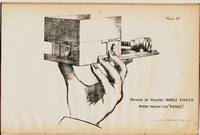
1900réf. 4792London: HMSO ca 1900. First Edition. Original publisher's gilt stamped linen cloth. Very good; front hinge weak. 8vo 4 5 - 30 2 pp. 4 full page lithographic plates one color. The explanation and use of a range finder to determine distances over ground in order to site-in weapons. There is an addenda to the text citing examples of how to use the device. HMSO hardcover books
réf. 39914The designs depict the characters Knowledge Angel and Confession with colored fabric swatches attached to each Executed on quality watercolor paper. Sheet size 510 x 380 mm. Some browning. "Everyman an English morality play of the 15th century probably a version of a Dutch play Elckerlyc. It achieves a beautiful simple solemnity in treating allegorically the theme of death and the fate of the human soul-of Everyman's soul as he tries to justify his time on earth. Though morality plays on the whole failed to achieve the vigorous realism of the Middle Ages' scriptural drama this short play about 900 lines is more than an allegorical sermon because vivid characterization gives it dramatic energy. It is generally regarded as the finest of the morality plays." Britannica Online revised and updated by J.E. Luebering. Perdziola an internationally-recognized set and costume designer for theater opera and ballet has worked extensively throughout the United States at such venues as the Metropolitan Opera San Francisco Opera Santa Fe Opera Lyric Theatre of Chicago American Ballet Theater Shakespeare Theater in Washington Boston Ballet and Miami Ballet as well as for various Broadway productions. He has also worked internationally for productions at the Monte Carlo Opera the Niedersächsische Staatsorchester in Hannover the Garsington Opera in the United Kingdom the Finnish National Ballet the Saito Kinen Festival in Japan and the Sydney Opera House. The artist has received three Helen Hayes awards and a Helpmann award; he has also been nominated for numerous additional awards. unknown books
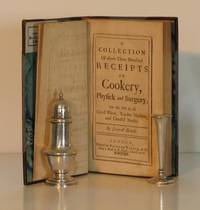
1714réf. 7280London: For Richard Wilkin 1714. Octavo 19 x 12.5 cm. 16 218 13 pages. FIRST EDITION. “Mary Kettilby’s collection of cookery recipes and medicinal and home remedies from a tasty “green-pease soop without meat” to gooseberry wine. Households that could not afford French cooks or French cooking came to form a growing audience for books by women that contained unpretentious recipes cut to suit a less costly cloth for pickling and collaring rather than ragouts. Where Hannah Woolley had led plenty of female cooks with their eye on the profitable middle market followed with books like Mary Kettilby’s collection of recipes 1714 and Eliza Smith’s Compleat Housewife 1734” Colquhoun Taste: The Story of Britain through its Cookery 2015. Kettilby’s book purported to be a collective effort: the preface stating that ‘a Number of very Curious and Delicate House-wives Club’d to furnish out this Collection’. Maclean however pages 79-82 doubts this and notes that evidence from later editions indicate Kettilby to be the main author. Apart from the Preface there is no introduction of any sort: the recipes follow immediately after the chapter headings. The book is clearly divided into chapters of recipes for food and for remedies but within the chapters there is no definite structure. For example the first chapter begins with six recipes for soups followed by recipes for collared beef ‘French-Cutlets’ collared mutton stewed pigeons broiled pigeons dressed turbot and then patties ‘for a Dish of Fish’. The recipes are given either as goals as ‘To make Hogs-Puddings’ or as titles sometimes with descriptions as ‘A very good Tansy’. Quantities are given in whichever units are convenient as ‘a Gallon of grated Bread’ ‘three Pounds of Currants’ or ‘nine Eggs’. Often quantities rely on the cook’s judgment as ‘as much Sugar as will make it very sweet’. Temperatures and timings are given when necessary as ‘a cool Oven: Half an Hour bakes it’. Later binding in 19th century style. Half-calf gilt-decorated spine marbled endpapers. The front paste-down contains the bookplates of two significant culinary collections: Thomas Scruggs & Margaret Cook and Marian Hatch. The Hatch bookplate was designed and engraved by British engraver Alfred J. Downey. With the bookseller's ticket of Philip C. Duschnes to the rear pastedown. Ink ownership mark to half-title "1718 Eliseab; and inscription on final page of text "illeg. near New College Oxford". OCLC locates eighteen copies; Bitting page 258; Cagle 789; Maclean pages 79-82; Oxford page 54; Wellcome II page 389. For Richard Wilkin hardcover books
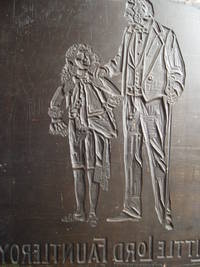
1887réf. 5556Hartford : Calhoun Print Co. ca. 1887. Unique. Very good with remnants of the print glued to the rear surface of the board. Folio. A carved woodblock for printing an advertising broadside. The block meas. appx. 20 x 24 inches. The original hand carved woodblock for printing an illustrated advertising broadside for F H Burnett's book Little Lord Fauntleroy. The author and title of the book are cut in large block type design across the bottom margin below a central field of two large figures in the foyer of a mansion a similar illus. is used on the front cover of the original book. The surface of the carved block is excellent. The two central figures are carved in great detail. The block is identified by the use of a small carved seal on a blank portion of the printing surface identifying it as originating with Calhoun Print Hartford. Calhoun Print Co. unknown books