Anon [EL?] E LABAA
7428 risultati
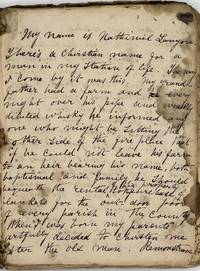
1867rif. 69292London England 1867. Plain stiff paper wrappers soiled ink marks stitched. 15 x 11 cm. approx. 106 pp. of text rest blank ca. 10000 words in ink and occasionally pencil in a neat hand. The unnamed author commences three or four different stories penning a chapter or two for at least three of them. His subjects include a country house party and the interactions of the guests; a family in mourning and a solicitous guest; a young man down on his luck who forges his employer's signature on a check; etc. There are moments of humor and self-absorption by some of the characters food and drink seem to pre-occupy the author's thoughts there are curious turns of phrase and spelling aberrations. The first line of the first story introduces his main character: "My name is Nathiniel Lanyon. There's a Chirstian name for a man in my station of life." He goes on to say he was named after his grandfather who taught him how to drink "whisky of the strength of seven parts of the spirit to one of water.so I can now drink my evening comfort as strong as that with an unteared that is to say tearless eye." In another story a woman describes her turncoat friends as having been tested and their loyalty "snapped like rotten twigs." In another a young man is described as having "an head conically inclined." There are numerous ink corrections and alterations in the text. The rear pastedown has a short ink recipe for cold cream and a clipped article offering advice for brushing teeth with a combination of gin nutmeg and lemon juice. A clue to the author's identity comes on the final page of the notebook where he pens the text of an advertisement: "A dispenser to board out of the house in the country address stating terms to E.L. care of Messrs Gale & Co. Bouverie Street Fleet Street London." In the classified section of the November 9 1867 edition of the Lancet General Advertiser London: A Journal of British and Foreign Medicine George Fall: 1867 this ad appears almost verbatim: "Wanted by a General Practitioner in the country a DISPENSER; to board out of the house -- Address stating terms to E.L. care of Messrs. Gale and Co. Bouverie-street Fleet-street London." Presumably the author of these amateur sketches was himself a doctor. unknown books
1925rif. 0069221925. Wraps. Near Fine. Eighteen mounted black and white sepia toned photographs of a replica model of King Ludwig II's castle Neuschwanstein. 12mo. 18 by 13.5 cm. The model was constructed between November 20 1924 and May 1 1925 by an unknown artist. The replica was done with meticulous attention to detail -- it is very impressive. The model looks like one of the elaborate confections made from Lego blocks but the model predates Lego which began in 1932. The photos show the model from different angles and ranges with both panoramic and close-up photos. The photos are mostly near full page with two smaller photos sharing a page. The ink writing on the cover is in a cursive now long in disuse and so we aren't able to decipher it in its entirely unfortunately. unknown books
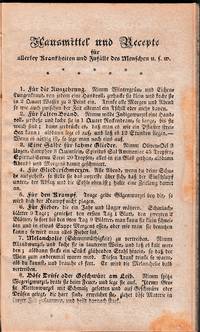
1837rif. 21083Osnaburg Stark County Ohio: Heinrich Kurtz 1837. First Edition. Original muslin backed marbled paper over boards. Very good; some spotting. 8vo 57 3 - index pp. The book is signed with numbers and bound in fours with an inserted bifolium in each signature signed with the number and an asterisk. Thus there are 6 leaves in each of the five signatures. The paper is not watermarked. A most unusual manual of folk remedies and herbal compounds that contains 470 numbered paragraphs of succinct medical formulae cures and advice for man and animals. The copy offered here is without the title page that bears the Kurtz imprint. The listed title is taken from the copy at the NLM http://resource.nlm.nih.gov/8308472. At some point close to the publication date the title page was omitted or cancelled. After inspection of the title page in another copy it is worth noting that it was printed from an engraved plate and inserted. Kurtz may have run out of copies to insert. So what appears in the text is the truncated drop-title at the head of the text on page 1 thus omitting the imprint and title reference to the manuscripts of the famous Virginia physician that are as Kurtz claimed the basis for the text. The copy offered here is bound in a contemporary cloth backed boards. A coarse type of muslin was used as the backing and is the same on the three copies that have come into our possession. The bindings are identical on all the copies the pattern and color of the marbled paper are the same on two copies with the third having a color variant in the marbling. The books derive from one source and appear to have been bound in this manner so that they could be offered while masking the printer and the origin. The book is unlike anything Kurtz printed during his career see Durnbaugh "Henry Kurtz Man of the Book" in Ohio History v. 76 #3 1967 - i.e. religious periodicals hymnals ABCs. [Heinrich Kurtz] hardcover books
1841rif. 2222159Early edition. 4 3/4" x 2 3/4". Full contemporary black calf. Two page preface by Henry Hobbs Samuel Beede William Burr. 1832 copyright by David Marks. Very good. 608 pages. Printed by The Boston Type and Stereotype Foundry. Includes: Table of First Lines. Index of subjects. The Trustees of the Free-Will Baptist Connection hardcover books
1964rif. 9089New York: Nutrix Corporation 1964. First Edition. Original Wraps. Very Good in Wraps. First Edition. Original Wraps. Contains text and black and white illustrations of various bondage and latex role-play situations. Film producer Irving Klaw Bettie Page fame produced these small edition bondage magazines through Nutrix publications and featured artists like Eric Stanton Gene Bilbrew and Adolfo Ruiz. Light shelf/edge wear else tight and bright. Glossy wraps staplebound. 8vo. 62pp. Illus. b/w plates. Nutrix Corporation unknown books
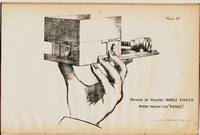
1900rif. 4792London: HMSO ca 1900. First Edition. Original publisher's gilt stamped linen cloth. Very good; front hinge weak. 8vo 4 5 - 30 2 pp. 4 full page lithographic plates one color. The explanation and use of a range finder to determine distances over ground in order to site-in weapons. There is an addenda to the text citing examples of how to use the device. HMSO hardcover books
1712rif. 17916London: John Morphew 1712. First edn. 8vo pp. viii 265 139. Bound in recent calf backed boards by Grey Parrot with some scattered soiling and foxing a very good copy. Not in Halkett & Laing. Under the reign of Queen Anne England went to war to wrest the Spanish dominions from Philip of Spain and give them to Austrain Archduke Charles. This caused a split between the British Whigs who supported the war and the Torries who were less interested. Eventually the Peace of Utrecht was signed in 1713 stipulating for the permanent separation of the Crowns of France and Spain. John Morphew unknown books
1790rif. 24683Dublin: Byrne 1790. First Irish Edition. 8vo pp. 160. Front hinge loose. Bound in rubbed and some worn leather backed paper boards paper lacking from front cover with some library stamps inside. A good copy for all that. Entirely printed in red. An English edition appeared the same year. See Tourneux Bibliographie de l'histoire de Paris pendant la revolution Francaise 3.13483; ESTC T108411 for the UK Edition; not in Martin-Waller or Saricks. The original French edition of this pretended to be the official list of pensioners published by the government. It was more likely issued to embarrass the ruling class portraying them as a group of loafers living off the work of the population burdened with taxes. It's appearance in England is an indication of the British Jacobean interest in the French goings on. The existence of a Dublin printing is especially strange given that the Irish working population spoke mostly Gaelic and this nasty work is not really aimed at the ruling class who were the subject of its satire. The British library Catalogue offers a possible attribution to Jean-Baptiste Martin Louis La Reynie de la Bruyere q.v. Querard 4.558-559. Byrne unknown books
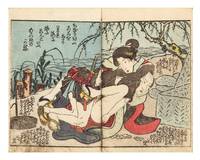
rif. 771516 double-page & four single-page color-printed woodcuts. 13; 11; 9 folding leaves. Three vols. Small 8vo orig. speckled semi-stiff boards boards rubbed orig. block-printed title labels on upper covers new stitching. Japan probably Edo: manuscript inscription dated "1832" at end of each volume. First edition and very rare; we do not find this book listed in WorldCat or in the Union Catalogue of Japanese Books. The Preface is signed by Akikei or Akikage Higashikuni. This work is an erotic version of Shiki no en an 18th-century group of songs on the four seasons of love from the Yamada ryu school of the Japanese harp koto. The poems of Haku Rakuten or Bai Letian 772-846 the Chinese poet of the mid-Tang dynasty are sources for the songs along with Japanese waka poems. Haku Rakuten "became the favorite poet of Heian times.He was the Chinese poet to whom allusions and from whom recollections were most frequent in Heian Japan. His verses were often used for kudai waka and he epitomized Chinese poetry."-Earl Miner et al. The Princeton Companion to Classical Japanese Literature p. 160. The first color-printed woodcut depicts a woman preparing to play the koto. There follows a series of erotic double-page woodcuts: kabuki actors young samurai Chinese characters and women of various social classes are shown engaged in sex through the changing seasons. It is fascinating to see the various rooms and their furnishings the participants' costumes and the landscapes in the background. The fine woodcuts were clearly created by a member of the Utagawa school however we are unable to establish their artistic authorship. Very good set but with some thumbing. The second and third volumes have some worming touching several of the woodcuts. unknown books
1772rif. CAT000842Paris: Chez Lottin 1772. Nouvelle. Hardcover rebound in leather. Very Good Condition. Contemporary acid calf repair to leather on upp right surface rubbing bottom corners worn through but sound and attractive overall. Scattered browning foxing old bookplate of Bernard Junisc inside front cover top corner of first few dozen pages v. slightly nibbled marbled endpapers. Two volumes in one bound without the second title. xiv 2 372 367pp. A nouvelle edition. Often noted as having been first published in 1765 or 1762 but maybe through a confusion with the associated Dictionnaire Domestique Portatif an ad for this and other portatif books appears before the title page. The first located edition was 1767. Cagle 162 1767 ed. Bitting 5543 Oberle 2 98 Vicaire 276 Often lost among the more original Menon Massialot or charming Le Cuisinier Gascon cookbooks that preceded it and the post-revolutionary works that followed Beauvilliers Careme the Dictionnaire Portatif marks an interesting if largely derivative moment in French cuisine. Like the contemporary also anonymous Manuel des officiers de bouche it serves as a summation of centuries of French cuisine from Taillevent and the Menagier to the brink of the revolution all in a handy alphabetical form. Size: 8vo. Quantity Available: 1. Shipped Weight: Under 1 kilo. Category: Cooking Wine & Dining; Inventory No: CAT000842. Chez Lottin hardcover books
rif. 47600Berlin: 1848: Vereins Buchdruckerei. Broadside 27cm x 20cm ca 10-3/4" x 8". Printed in blackletter on white wove stock. Slightly toned with old vertical and horizontal fold-lines; creased at margins; Very Good. Satirical broadside in the form of a fictional speech by King Friedrich Wilhelm IV in which he ironically expresses support for the demands made by liberal parliamentarians at the May 18th Parliamentary Assembly in Frankfurt-am-Main. These included expanded rights for the underprivileged classes including most importantly universal male suffrage; attenuation of executive power; the election of a permanent German parliament and monetary reforms including a unified German currency. The great wave of liberal revolt that washed over the European Continent in 1848 proved short-lived; by 1851 most of the newly-established liberal régimes had been quashed by reactionary movements with radical leaders either imprisoned murdered or driven into exile. Out of this crucible would arise the Franco-Prussian War and the militant Marxist nihilist and anarchist movements of later in the century. A highly evocative document of the first wave of German radical revolt. Rare; OCLC and KVK note three locations only all in Germany. Vereins Buchdruckerei unknown books
1865rif. 69031New York: Bromley & Co 1865. Second edition. 19 cm. 251 pp. Illus. Original dark blue green blindstamped cloth title stamped in gilt on spine. Some wear to spine ends foxing to endpapers. Previous owner's signature on front pastedown. Wright II 1542 for the first edition of 1864. Hamilton p. 87 for Bur. Lusk 998. Sabin and BAL disavow possible authorship by Seba Smith or Charles A. Davis both of whom lived a few years past the end of the war. Sabin 84179. This is the edition of 1864 published by Bromley and Feeks with a printed slip pasted over the date and Feeks' name in the imprint providing the date 1865 and the statement "second edition." The anonymous author ridicules Lincoln's war policies. Bromley & Co unknown books
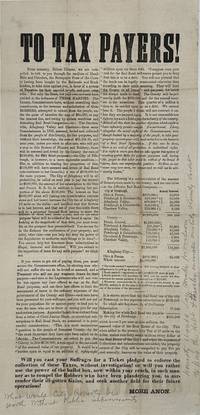
1858rif. 69335NP Allegheny County PA 1858. Broadside 49 x 23 cm. Text in two columns with caption title in large bold type. Old fold lines a few tiny holes and some toning previous owner's pencil margin notes. The text reads in part: "From necessity Fellow Citizens we are compelled to talk to you through the medium of Hand-Bills and Circulars the Newspaper Press of the County having been bought by the Railroads and Bondholders." The anonymous author warns fellow taxpayers their hard earned money is being plundered to finance the debts of "worthless and defaulting Rail Road Companies -- viz: The Steubenville Allegeheny Valley and Chartiers." The appeal challenges taxpayers to use their votes to elect a Commissioner and Treasurer who "will not suffer the tax to be levied or assessed." Statistics related to the debts for the cities of Pittsburgh and Allegheny as well as the county totalling $5500000 are given. Noted are roads "repudiated" in 1856 and 1857 and an estimate for ones that "will repudiate in 1858" helping to date this piece. "Will you cast your Suffrages for a Ticket pledged to enforce the collection of these Taxes. or will you rather use the power of the ballot box. to compel the Robbers who have been plundering you to surrender their ill-gotten Gains. The 1850s were an era of increasing infrastructure investments in railroads at least partially financed through taxes and bonds. The Pennsylvania Railroad chartered by the state legislature in 1846 ran its first excursion train to Pittsburgh in 1851. The Ohio & Pennsylvania Railroad chartered two years later began to use a station at Allegheny City in 1851. The two lines were connected by a bridge across the Allegheny River in 1858. The pencil notes on this copy posit a question: "What would City Property be worth without Public improvements." see: William Kenneth Schusler's essay part of his doctoral dissertation "The Railroad Comes to Pittsburgh". unknown books
1863rif. 66742New York NY: P.W. Derham Printer and Stationer 15 Nassua Street Corner of Pine 1863. Folio broadside 48 x 29.5 cm. text in two columns beneath the title in display type. Old folds with slight damage; some foxing. Professionally rebacked. This broadside printed ca. 1863-4 offers a political analysis of the options for reconciliation with the Confederacy and a denunciation of the statements of Gov. Horatio Seymour. Printed by P.W. Derham a stationer from New York whose other surviving works include an 1862-4 broadside reprint of a pre-secession speech by Alexander H. Stephens Vice President of the Confederacy in which Stephens argues for preserving the Union Hummel 542: notes this is a "forged speech for the political campaign; 1864". The author of the broadside presents four scenarios for reconciliation with the South and examines the Confederate response to each by quoting several Southern newspapers including the Richmond Dispatch the Atlanta Intelligencer the Richmond Enquirer and the Charleston Mercury among others. The author proposes several solutions including applying for foreign intervention surrendering and appealing to the South to rejoin the Union and recognizing the independence of the Confederacy though invariably Confederate viewpoints making each option impossible are presented. For example the author proposes to "Hold out the olive branch confess our error in having resented the bombardment of Fort Sumter propose Peace and Union and with becoming dignity await the answer which the South cannot fail to give its faithful ally the Democratic Party" but then notes "that answer we have already." The author goes on to provide several quotes in which zealous Southern newspaper writers declare that they can never rejoin the Union again under any circumstances. The author also quotes several statements from Horatio Seymour who was running for re-election as governor of the state of New York implying he was a Southern sympathizer. Ultimately the author of the broadside in satirical style is unable to reach any convincing conclusion for the best method of attaining "Peace and Union" but represents an early rejection of the Peace Democrat or Copperhead positions which were to become so frequent 1862-64. Two listings found on OCLC: Lib. of Congress; NY Hist. Society. The New York Historical Society notes that the printer P.W. Derham was listed in New York City directories as at this address from 1863-1877 and that this broadside's purpose was "opposing the Democratic Party platform and the reelection of New York Democratic governor Horatio Seymour." Seymour 1810-1886 who had been elected governor of New York in 1852 and again in 1862 was running for re-election in 1864. He supported the Crittenden Compromise of 1860 in an effort to keep the South from seceding but supported the Civil War once it commenced. According to his biography in the DAB he continued to oppose some of Pres. Lincoln's policies during the war and "insisted that the extra-constitutional powers assumed by the Lincoln administration were the most serious problem arising from the Civil War." For his actions in re-establishing order after the New York Draft Riots Horace Greeley characterized Seymour as a temporizing "Copperhead." Seymour lost his bid for re-election. P.W. Derham, Printer and Stationer, 15 Nassua Street, Corner of Pine unknown books
rif. 1133London: The Religious Tract Society. Hardcover. Very Good -. Hardcover. SCARCE. 12mo. Very good-. Colorful embossed and illustrated grey cloth covered boards with gilt title to front board and black title to spine. Rubbing and wear to boards. Minor discoloration to rear board. Minor browning to end pages and to title page. Full colored illustrated frontis. 64 pp. CHILD/6252. The Religious Tract Society hardcover books
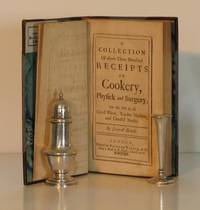
1714rif. 7280London: For Richard Wilkin 1714. Octavo 19 x 12.5 cm. 16 218 13 pages. FIRST EDITION. “Mary Kettilby’s collection of cookery recipes and medicinal and home remedies from a tasty “green-pease soop without meat” to gooseberry wine. Households that could not afford French cooks or French cooking came to form a growing audience for books by women that contained unpretentious recipes cut to suit a less costly cloth for pickling and collaring rather than ragouts. Where Hannah Woolley had led plenty of female cooks with their eye on the profitable middle market followed with books like Mary Kettilby’s collection of recipes 1714 and Eliza Smith’s Compleat Housewife 1734” Colquhoun Taste: The Story of Britain through its Cookery 2015. Kettilby’s book purported to be a collective effort: the preface stating that ‘a Number of very Curious and Delicate House-wives Club’d to furnish out this Collection’. Maclean however pages 79-82 doubts this and notes that evidence from later editions indicate Kettilby to be the main author. Apart from the Preface there is no introduction of any sort: the recipes follow immediately after the chapter headings. The book is clearly divided into chapters of recipes for food and for remedies but within the chapters there is no definite structure. For example the first chapter begins with six recipes for soups followed by recipes for collared beef ‘French-Cutlets’ collared mutton stewed pigeons broiled pigeons dressed turbot and then patties ‘for a Dish of Fish’. The recipes are given either as goals as ‘To make Hogs-Puddings’ or as titles sometimes with descriptions as ‘A very good Tansy’. Quantities are given in whichever units are convenient as ‘a Gallon of grated Bread’ ‘three Pounds of Currants’ or ‘nine Eggs’. Often quantities rely on the cook’s judgment as ‘as much Sugar as will make it very sweet’. Temperatures and timings are given when necessary as ‘a cool Oven: Half an Hour bakes it’. Later binding in 19th century style. Half-calf gilt-decorated spine marbled endpapers. The front paste-down contains the bookplates of two significant culinary collections: Thomas Scruggs & Margaret Cook and Marian Hatch. The Hatch bookplate was designed and engraved by British engraver Alfred J. Downey. With the bookseller's ticket of Philip C. Duschnes to the rear pastedown. Ink ownership mark to half-title "1718 Eliseab; and inscription on final page of text "illeg. near New College Oxford". OCLC locates eighteen copies; Bitting page 258; Cagle 789; Maclean pages 79-82; Oxford page 54; Wellcome II page 389. For Richard Wilkin hardcover books
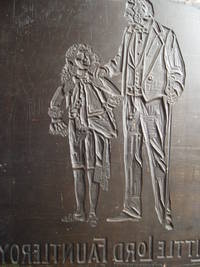
1887rif. 5556Hartford : Calhoun Print Co. ca. 1887. Unique. Very good with remnants of the print glued to the rear surface of the board. Folio. A carved woodblock for printing an advertising broadside. The block meas. appx. 20 x 24 inches. The original hand carved woodblock for printing an illustrated advertising broadside for F H Burnett's book Little Lord Fauntleroy. The author and title of the book are cut in large block type design across the bottom margin below a central field of two large figures in the foyer of a mansion a similar illus. is used on the front cover of the original book. The surface of the carved block is excellent. The two central figures are carved in great detail. The block is identified by the use of a small carved seal on a blank portion of the printing surface identifying it as originating with Calhoun Print Hartford. Calhoun Print Co. unknown books
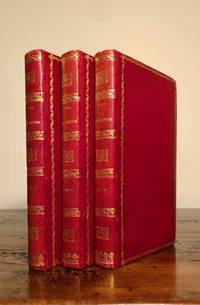
1827rif. 7229Paris: Hector Bossange 1827. First Edition. Three volumes in full red morocco. Very Good. Three volumes. 12mo. Pp. viii 1 2-284; 1 2-310; 1 2-312. Half titles present. Marbled endpapers; all edges gilt. In later full polished calf decoratively bordered in gilt spine with gilt rules lettering and flourishes. Inner dentelles. Contemporary owner initials on free endpapers. Spines a tad faded negligible rubbing to covers. Interior quite fresh. First edition of Cooper's early novel of the sea following The Pilot involving a Rhode Island setting and importantly characters of African background. His first novel to be published overseas this printed exceptionally well by Lachevardiere perhaps owing to Cooper's presence in overseeing the effort. Predates the London edition. Scarce: Last offered at auction in 1996 Swann. A charming well preserved set. BAL 3837. Hector Bossange unknown books
1891rif. 35909Philadelphia 1891. Philadelphia 1891. Color plates. 12mo. 127 pp. plus plates. First year under this name. Seven color plates of private signals of the club and of member yachts. Not in Morris & Howland. Worldcat shows no libraries holding copies of this year. Hinges cracked sewing weak. Bound in original printed cloth. hardcover books
1907rif. 9072New York: Ullman Manufacturing Company 1907. First Edition. Original Wraps. Very Good. First Edition. Original Wraps. An example of early 20th century Black Americana ephemera or as some refer to as 'Negrobilia' referring to a wide array of materials including mass advertisements postcards tourist souvenirs etc. with the image of an African American universally portrayed in a derogatory and racist manner. These items were produced and manufactured by and for white audiences that enhanced the perception of white racial superiority and class status. These type of items are particularly challenging to many communities however many scholars and private collectors alike agree these materials are historical records and reminders of the racist history of the United States and should not be invisible. The puzzle postcard is an example of mass produced racial stereotyping manufactured for an actual mailing enclosure. The instructions on the outside of the mailer state: "Arrange the flaps by placing one over another in such a manner as to show ONLY the eleven pickaninnies." Reference: Goings Kenneth. "Mammy and Uncle Mose: Black Collectibles and American Stereotyping." Bloomington Indiana University Press 1994. Full color off-set printed multi-flap post card mailer with die-cut holes for puzzle and tab for closing. 3.5x5.5"; bright and unmarred with fully intact flaps. Ullman Manufacturing Company unknown books
1764rif. 5740London: J Pottinger and J Seymour 1764. Second Edition. Hardcover. Very Good Textblock Fine. Second Edition. Hardcover. A wonderfully unflattering short biography of the notorious Judge Jeffreys. Jeffreys infamously presided over the trial of Titus Oates and numerous other significant cases.bringing his unusual blend of apathy arrogance and brutality to the bench. It is said that he was "reckless of everything save his own advancement." This volume contains a list of some 240 names organized by towns of those who suffered his convictions. A very handsome copy of this minor classic. Light shelf/edge wear tips through minor scratch in paper front board else tight bright and unmarred. Quarterbound burgundy leather spine marbled paper boards. Small 8vo. 54pp plus 2pp ad. J Pottinger and J Seymour hardcover books
1971rif. 295182London: Cornmarket Press 1971. Reprint. hardcover. very good. 8 folding plans. Short thin 4to blue cloth London: Cornmarklet Press 1971. Facsimile reprint. Covers slightly scuffed and dust-soiled else near fine. Cornmarket Press unknown books
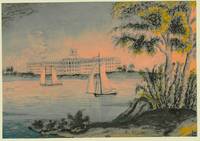
1835rif. 26036New York City ca1835. Not bound. Very good. A unique conté crayon ink and watercolor rendering 98 x 140 mm of the prison from Manhattan Island. A dream-like rendering of the prison in an arcadian setting adorned with a flight of birds over the prison in finely delineated ink outline. Alas there is no back story to add. It is however an unsual subject. The perspective if correct is across the East River from Kips Bay. Please note that the color temperatures are to the blue in the scan offered here. New York City purchased the East River island in 1828. In 1832 a penitentiary was built on the island. This physically isolated prisoners from the city and from the mainland. However prisoners were not the only inmates on Blackwells Island. Nineteenth century Blackwells Island was also home to a complex of workhouses a general hospital an almshouse a hospital for incurables the insane and for a time a smallpox hospital. The watercolor offered here appears to duplicate a "view" issued by the Peabody Co. in their Views in New York . 1830-1834. books
1912rif. TB29110Boston Edinburgh & London: Le Roy Phillips and T. N. Foulis 1912. First Edition. A sewn binding of three signatures covered with flexible tan boards with no backstrip in near fine condition. A small octavo measuring 8 by 5 inches with faint soiling to the front board. In a very good dust jacket with wrap around art with minor 1/8" chips from the ends of the spine area. Unpaginated containing 56 pages illustrated with 25 tipped-on sepia photo reproductions of Stevenson's last portrait family members scenes of Swanson the schooner Equator Vailima and Stevenson's tomb. Le Roy Phillips and T. N. Foulis hardcover books
rif. 1265Book. Also different methods of making ice cream sherbet etc. These receipts are from the best New York Philadelphia and Boston confectioners and include a large number from the French and other foreign nations. Boston: J. E. Tilton and Company 1866. 8vo maroon gilt pictorial bevelled cloth. Pp. 346. Title in red and black. Spine faded chipped at extremities first signature beginning to loosen; otherwise very nice within. First edition a substantial work on the subject with chapters on spirits and domestic wines. Bitting p. 518; Culinary Americana 1496; Cagle & Stafford 48 noting that over half the book is taken from Charles Elmé Francatelli's "The Royal English and Foreign Confectioner.". hardcover books