[ANON]Biblio.com

rif. 61049c.1870. . Albumen print. Good tonal range with slight foxing otherwise captivating image of this famous mausoleum; Dimensions: 235 x 135mm. 10 x 7 inches. [c.1870]. unknown
rif. 3733866New York: Printed by George F. Hopkins at Washington’s Head No. 118 Pearl Street 1803. Octavo signed in fours. 1–3 4–56 2pp. Heavily foxed removed from a nonce volume; a good sound copy. First American edition and reasonably scarce to commerce. Born into a military family in Queen’s County Ireland Edward Marcus Despard 1751–1803 joined the British Army as an ensign in 1766 and quickly rose through the ranks distinguishing himself as a military engineer and gaining recognition for his efforts during the capture of Fort San Juan from Spain in 1779. ODNB Despard’s career took a controversial turn when he became involved in revolutionary activities upon his return to Britain. He became affiliated with radical groups such as the London Corresponding Society and the United Irishmen ultimately leading to his arrest in November 1802 for allegedly plotting a coup against the government. At his trial in February 1803 Despard was found guilty of treason despite efforts to paint him as a victim of government conspiracy. He was executed on 21 February 1803 leaving behind a legacy marked by both his military service and his radical political ambitions. ibid Shaw & Shoemaker; 4076. unknown
1887rif. 57481NY: Fords Howard & Hulbert 1887. First Edition. 8vo pp. 350 adv. Bound in red cloth stamped in black a VG tight copy. Scarce. A scarce account of the New York City draft riot of 1863. Minor riots occurred in Rutland Vt. Wooster Ohio Boston MA. and Portsmouth NH but none equaled in length or destructiveness those in New York City. Fanned by Democratic opposition to the war . for four days the city was a welter of conflagrations assaults and defiances costing a thousand casualties and 1.5 Million property lossDictionary of American History vol. 2 p. 164. Fords, Howard & Hulbert unknown
1887rif. 57481NY: Fords Howard & Hulbert 1887. First Edition. 8vo pp. 350 adv. Bound in red cloth stamped in black a VG tight copy. Scarce. A scarce account of the New York City draft riot of 1863. Minor riots occurred in Rutland Vt. Wooster Ohio Boston MA. and Portsmouth NH but none equaled in length or destructiveness those in New York City. Fanned by Democratic opposition to the war . for four days the city was a welter of conflagrations assaults and defiances costing a thousand casualties and 1.5 Million property lossDictionary of American History vol. 2 p. 164. Fords, Howard & Hulbert unknown books
rif. 59209c.1870. . Albumen print. Very good rich tones and in good condition; Dimensions: 202 x 208mm. 9 x 11 inches. [c.1870]. unknown
1679rif. 2489London: Langley Curtis LC 1679. Clean and tidy with very slight darkening to the page edge only. . A single issue of a weekly anti-Catholic diatribe in the form of a contemporary broadside issued at the time of the Popish Plot 1678-1681. The Weekly Pacquet is Number 16 - Both of the broadsides were issued Friday 24th October 1679. Pagination is continuous presumably from issue 1 and these leaves are numbered page 121 - 128. They are held together but would appear to have been bound together with other issues at some point. 16 pages. 190 by 140mm 7½ by 5½ inches. Clean and tidy with very slight darkening to the page edge only. Langley Curtis [LC] unknown
rif. 320unknown books
1820rif. 88903London: J. Bailey 116 Chancery Lane 1820. First Edition. Slim Twelvemo. 18cm. Late 19th century half mottled calf over marbled paper covered boards by Bayntun of Bath with a red title label to the spine titled in gilt very much in the style of an older binding. 24pp. with 24pp binder's blanks to rear to stabilize the binding. Light scuffing to corners and spine ends darkening to spine label and a little dulling of the gilt strong tight and handsome; internally clean all edges gilt marbled endpapers later ex libris to front pastedown with traces showing removal of an older one visible beneath hand colored frontispiece illustration with later tissue guard and a small archival tissue repair to a small tear on the fore-edge offsetting of the color and some light soiling to title page the work would originally have been issued as a chapbook in paper wraps. A very good attractive copy of an obscure piece of early 19th century pop culture. John Bailey was one of those highly-energetic and slightly scurrilous printer-publishers of the early 1800's running alongside Stockdale Dugdale Duncombe and the like in a frenetic race to recognise the current zeitgeist and mine it for pamphlets chapbooks and on occasional multi-volume exposés until the vein ran out and they moved on to the next thing. It could be the sporting Fancy the murky doings of the Ton memoirs of ladies of negotiable virtue the scandalous habits of the French or the diabolical behavior of home grown rakes; if it could be illustrated with a lurid cut and sold to popular acclaim but no legal outcry then it was prime for publication. This is an indicative offering; a tale of a lady maligned a wandering-handed husband and some untrustworthy foreign types Italians in this case portrayed as being of a nation of bandits promoting the popular and rather thrilling idea that nobody really knows what the aristocracy gets up to but slim little volumes like this can give you a fair idea. Unusually studded with relatively competent verse commentary and enough arch detail for the suggestive reader to wonder whether it is entirely fictional. It isn't in case you were wondering; it forms part of the Caroline Scandal blizzard of pamphlets and cartoons directed at the indiscretions and marital strife of Caroline of Brunswick the oft estranged wife of King George IV. George despised his wife even after the birth of their daughter and Queen Caroline retired to Italy where her chief advisor and confidante was a gentleman named Bartolomeo Pergami - in short order Caroline and Pergami were rumored to be lovers accusations of adultery and possible treason flew in all directions and a legal deadlock began with both parties George and Caroline whose middle name was of course Amelia denying infidelity whilst pointing the finger at each other. The "Green Ridicule" is a reference to the bags presented at the reading of the bill intended to grant the King a divorce; large green sacks of "evidence" collected by the Milanese authorities much of which was rather hilarious and involved a lot of innkeepers and coachmen testifying to having seen Pergami in flagrante whilst within 20 feet of the noble lady. The resulting legal wrangling and backstabbing had the opposite effect from the one desired by George and rendered Caroline something of a public and political heroine misused by her abusive husband and adopted by reformist political figures seeking to gain ground on an increasingly eccentric and damaging monarchy. The tone of the tale is therefore rather sympathetic to Lady Amelia in keeping with public sentiment. It is also stated to hopefully be the first part of a series of exposures of the travails of "Lady Amelia" and her somewhat ungallant spouse which suggests it was rushed out mid-trial and may have had subsequent installments as the proceedings continued through 1820. The title itself is possibly a riff on Mary Charlton's work; she published a substantial and popular work with a similar title a few years earlier. Scarce and a little obscure with three holdings in US institutions. J. Bailey, 116 Chancery Lane unknown
1820rif. 88903London: J. Bailey 116 Chancery Lane 1820. First Edition. Slim Twelvemo. 18cm. Late 19th century half mottled calf over marbled paper covered boards by Bayntun of Bath with a red title label to the spine titled in gilt very much in the style of an older binding. 24pp. with 24pp binder's blanks to rear to stabilize the binding. Light scuffing to corners and spine ends darkening to spine label and a little dulling of the gilt strong tight and handsome; internally clean all edges gilt marbled endpapers later ex libris to front pastedown with traces showing removal of an older one visible beneath hand colored frontispiece illustration with later tissue guard and a small archival tissue repair to a small tear on the fore-edge offsetting of the color and some light soiling to title page the work would originally have been issued as a chapbook in paper wraps. A very good attractive copy of an obscure piece of early 19th century pop culture. John Bailey was one of those highly-energetic and slightly scurrilous printer-publishers of the early 1800's running alongside Stockdale Dugdale Duncombe and the like in a frenetic race to recognise the current zeitgeist and mine it for pamphlets chapbooks and on occasional multi-volume exposés until the vein ran out and they moved on to the next thing. It could be the sporting Fancy the murky doings of the Ton memoirs of ladies of negotiable virtue the scandalous habits of the French or the diabolical behavior of home grown rakes; if it could be illustrated with a lurid cut and sold to popular acclaim but no legal outcry then it was prime for publication. This is an indicative offering; a tale of a lady maligned a wandering-handed husband and some untrustworthy foreign types Italians in this case portrayed as being of a nation of bandits promoting the popular and rather thrilling idea that nobody really knows what the aristocracy gets up to but slim little volumes like this can give you a fair idea. Unusually studded with relatively competent verse commentary and enough arch detail for the suggestive reader to wonder whether it is entirely fictional. It isn't in case you were wondering; it forms part of the Caroline Scandal blizzard of pamphlets and cartoons directed at the indiscretions and marital strife of Caroline of Brunswick the oft estranged wife of King George IV. George despised his wife even after the birth of their daughter and Queen Caroline retired to Italy where her chief advisor and confidante was a gentleman named Bartolomeo Pergami - in short order Caroline and Pergami were rumored to be lovers accusations of adultery and possible treason flew in all directions and a legal deadlock began with both parties George and Caroline whose middle name was of course Amelia denying infidelity whilst pointing the finger at each other. The "Green Ridicule" is a reference to the bags presented at the reading of the bill intended to grant the King a divorce; large green sacks of "evidence" collected by the Milanese authorities much of which was rather hilarious and involved a lot of innkeepers and coachmen testifying to having seen Pergami in flagrante whilst within 20 feet of the noble lady. The resulting legal wrangling and backstabbing had the opposite effect from the one desired by George and rendered Caroline something of a public and political heroine misused by her abusive husband and adopted by reformist political figures seeking to gain ground on an increasingly eccentric and damaging monarchy. The tone of the tale is therefore rather sympathetic to Lady Amelia in keeping with public sentiment. It is also stated to hopefully be the first part of a series of exposures of the travails of "Lady Amelia" and her somewhat ungallant spouse which suggests it was rushed out mid-trial and may have had subsequent installments as the proceedings continued through 1820. The title itself is possibly a riff on Mary Charlton's work; she published a substantial and popular work with a similar title a few years earlier. Scarce and a little obscure with three holdings in US institutions. J. Bailey, 116 Chancery Lane unknown books
1830rif. 5311France: S.P. C1830. Three lovely papier maché snuff boxes. French circa 1830. Each has an engraving under varnish to the lid. One is coloured two are uncoloured. The boxes have painted edges around the image. The images are a touch darkened and the edges are a little scuffed but the boxes are still very presentable. The three are as follows: 1 "Devinequi" "Guess who." Two young men in an arcadian scene. One is behind and covering his friends eyes. Coloured image Appears to be a watercolour under varnish. 8.5cm diameter 1.5cm depth. Sound but with slight damage to the base. 2 "La Veillée" "The Vigil" A group of five in a cottage waiting expectantly although who knows what for. Woodcut under varnish. 9cm diameter. 2cm depth. Sound but with slight damage to the base. 3 "La tendresse Maternelle" "a mother's tenderness." Appears to be a mother trying to save a child from drowning. Woodcut under varnish. 8.5cm x 2cm. Gold painted edges and wood veneer base. Good condition. . Trois jolies tabatières en papier maché. Françaises vers 1830. Chacune présente une gravure sous vernis sur le couvercle. L'une est colorée les deux autres ne le sont pas. Les boîtes ont des bords peints autour de l'image. Les images sont un peu assombries et les bords sont un peu éraflés mais les boîtes sont encore très présentables. Les trois images sont les suivantes : 1 "Devinequi " "Devinez qui". Deux jeunes hommes dans une scène arcadienne. L'un d'eux est derrière et couvre les yeux de son ami. Image colorée Semble être une aquarelle sous vernis. 85 cm de diamètre 15 cm de profondeur. Sain mais avec un léger dommage à la base. 2 "La Veillée" Un groupe de cinq personnes dans une chaumière attendant avec impatience mais on ne sait pas pourquoi. Gravure sur bois sous vernis. 9 cm de diamètre. Profondeur de 2 cm. Sain mais avec un léger dommage à la base. 3 "La tendresse Maternelle" "La tendresse d'une mère". Semble représenter une mère essayant de sauver un enfant de la noyade. Gravure sur bois sous vernis. 85 cm x 2 cm. Bords peints à l'or et base en placage de bois. Bon état. S.P. unknown
1950rif. 48571950. Three attractive postcard sized original water colours pasted onto a dark paper background. Held in a simple wooden frame under glass. Unsigned and anonymous. The first image shows a woman and officer inspecting a parade of Algerian soldiers in uniform with Fez. One of them is smoking! The second shows a woman approaching a statue of St Raphael seemingly in devotion but actually reaching for a bottle of wine the statue is holding. The third shows a line of circus / carnival folk queuing at an optician's reception. All are in good clean condition and painted by a competent hand. Each image is 8.5cm x 14cm. Frame is 21cm x 48cm. . Trois jolies originale aquarelles de la taille d'une carte postale collées sur un fond de papier sombre. Elles sont présentées dans un simple cadre en bois sous verre. Non signées et anonymes. La première image montre une femme et un officier inspectant un défilé de soldats algériens en uniforme avec Fez. L'un d'entre eux fume ! La deuxième image montre une femme s'approchant d'une statue de Saint-Raphaël apparemment en signe de dévotion mais cherchant en fait à attraper une bouteille de vin que la statue tient à la main. La troisième montre une file d'attente de gens du cirque ou du carnaval à la réception d'un opticien. Toutes les images sont en bon état propres et peintes par une main compétente. Chaque image mesure 85 cm x 14 cm. Le cadre mesure 21 cm x 48 cm. unknown
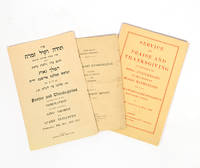
rif. 1126601934-1937. . 8vo three pamphlets text in Hebrew and English; 1st - 18 pp. wrappers printed in red ink; 2nd - 4 pp. fold mark small worming mark education in old black ink dated '19th Oct. 1935'; 3rd - 12 pp. closed tear to front wrapper affecting text professionally repaired. Including Memorial Service for George V and a sermon delivered at the Coronation Service of George VI. 1934-1937. unknown
rif. 121212Jerusalem c.1920. . Three small cloth backed albums 9.5 x 16 cm; 8.5 x 12 cm; 9.5 x 14 cm olive wood boards one of them carved containing colour-lithograthed plates and pressed flowers protected by tissue paper on opposite pages pages slightly browned. 9 ll.; 13 ll.; 13 ll. Early 20th-century souvenirs from Jerusalem containing local dried flowers and colour-lithograthed views of the Holy Land. Jerusalem, [c.1920]. hardcover
1919rif. 001969Little Brown 1919 84 pages. Pencil inscriptions on front free endpaper some foxing to text otherwise a nice clean copy. "Occult Bookshelf San Diego" stamp on title page. Scarce. Small 8vo. Hardcover. Very Good/Dust Jacket Included. Little, Brown hardcover
rif. 3730412Pittsburgh. 1835. 12¼ x 7½ inches. One page circular previously folded and bound. A Large notched-out area to inner margin does not affect text short edge-tears else Very Good. Printed circular and subscription announcing to Pittsburgh’s citizens a meeting of the Board of Trustees to raise money to hire Gilbert Morgan the second chancellor of what is today University of Pittsburgh. Testimonials give on behalf of Morgan were made by Theodore D. Weld Dr. Miller of Princeton Rev. Breckenridge Rev. Uffold and so forth. The trustees announce: “The undersigned approve heartily of that part of Mr. Morgan’s plan which would impart a more popular cast to the Institution by enlarging the range of studies and yielding a prominent place and consideration to such as may be turned to account in active life in whatever sphere. Our citizens have had too much reason perhaps to regard it heretofore as something which stood apart in lofty seclusion from their pursuits and and sympathies. This erroneous notion will be discarded and a deep interest claimed from all in that which is designed for the common benefit of all.” “The University’s buildings along with most of its records and files were destroyed in a widespread 1845 fire that wiped out 20 square blocks of the most valuable part of Pittsburgh.” Wikipedia Unrecorded in OCLC. unknown
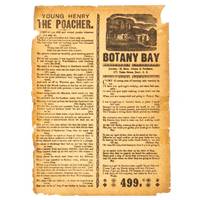
rif. 50719London : H. Such Printer & Publisher 177 Union Street Boro' S. E. after 1863. Broadside sheet size 255 x 185 mm printed in two columns with title of the first ballad in bold at the head of the left-hand column and with a woodcut illustration and title of the second ballad at the head of the right-hand column; publisher's serial number '499' in bold at lower right; printed on cheap and brittle paper which has browned edges with chipping and a few old tape repairs to verso partial loss of the opening capital letter of Young Henry otherwise the texts of both ballads are complete. An extremely late transportation broadside with versions of two convict ballads that are both known from much earlier printings. The State Library of New South Wales appears to hold the only copy of this particular broadside in Australian collections. The narrator of Young Henry the poacher sings that he was brought up near Southam in Warwickshire. After being caught poaching game one night in Squire Dunhill's Park he is convicted at the Warwick Assizes and sentenced to 14 years' penal servitude in Van Diemen's Land. He is brought out on the transport Speedwell then with some poetic licence! ""marched to Sydney"" where he is sold to a gentleman as a book-keeper. Having found happiness in his work he then falls in love with a convict servant from Wolverhampton named Rosanna and in the final stanza he proclaims that he and his sweetheart are now ""rattling off our chains in foreign lands to roam"". The ballad Botany Bay is also told in the first person. Its narrator sends a stark warning to other young men to heed his advice and ""quit night walking and shun bad company"" else they suffer the same fate and are transported to New South Wales. However it is important to note that the London printer and publisher Henry P. Such did not commence business at 177 Union Street until 1863 meaning that this broadside was printed at least two decades after January 1842 when the last ships bringing convicts arrived in New South Wales; and at least a decade after the last convict transport arrived in Van Diemen's Land in May 1853. While it is true that convict transportation to Western Australia persisted up until 1868 neither of the ballads in this broadside makes mention of that destination. Interestingly the present broadside is listed as number 499 out of 930 songs in the Henry P. Such catalogue of songs published around 1890. On the title-page of his catalogue which has been digitised - see below Such states that these songs are 'constantly kept in stock'. If they were also constantly being added to this might suggest an original publication date as late as 1875 for number 499 Young Henry the Poacher / Botany Bay - roughly the mid-point between 1863 and 1890: 'Henry Parker Such was one of the last London publishers of broadside ballads. In a letter to the folk song collector Francis James Child dated 23 August 1890 Harvard University MS Eng 863 Appendix no. 5 Sabine Baring-Gould writes: The only three printers of Broadside ballads now in London are Fortey S. Andrew’s St Seven Dials. He has no catalogue & no collection of his old ballads. Still – you can have something from him. Then there is Such 177 Union St Borough who has a catalogue. It is now out of print but he is reprinting. A third is Taylor 92 Brick Lane Spitalfields. I have not been to him to see if he has a catalogue.' Ian Maxted Exeter Working Papers in Book History https://bookhistory.blogspot.com/2013/01/baring-gould-and-such-song-catalogue.html This all leads us to conclude that the present broadside was already being regarded as a historical and musicological curiosity when it was printed and sold - whether that was in 1863 or as late as 1875 - as by this time the two ballads had already become part of the burgeoning phenomenon that was the craze for English folk-song collecting; and needless to say neither ballad by this time carried the same urgency or potency as it would have done in the 1820s or 1830s. unknown
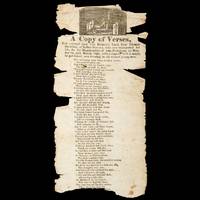
rif. 49747Drophead title. Westmorland U.K. : s.n 1834 or 1835. Narrow quarto 280 x 130 mm lithograph printed on rag paper recto only vignette illustration at head of text depicting a convict in a prison cell; in a fragile state with creasing and numerous tears and sections of loss at margins most critically at the foot of the document which has resulted in the loss of the final couplet of the ballad and possibly an imprint. A completely unrecorded transportation broadside concerning a real historical figure who was transported to New South Wales for life for the crime of manslaughter in 1833. With its prominent reference to the tiny village of Nether Staveley the broadside would appear to have been printed for a local readership in the Westmorland district of northwest England. The text written in verse by an anonymous author but purporting to have been penned in Van Diemen's Land by the transportee himself contains a number of inaccuracies. The most significant of these is the mis-rendering of the convict's surname as Rushford. In fact it was Thomas Rushforth 1810-1893 who was convicted at Westmorland Assizes of the manslaughter of his mother-in-law Ann Nicholson; he was one of 250 convicts transported on the Hive 15 January 1834 which arrived in Sydney New South Wales not Van Diemen's Land! on 11 June 1834. Rushforth received a conditional pardon in 1847 which released him from penal servitude but forbade him to return to his homeland. He married Jane Matthews on 27 April 1854 in St. Saviour's Cathedral Goulburn New South Wales. The following is an extract from an article titled The Beehive Inn Nether Staveley : a tale of murder and intrigue at this forgotten venue published in the Staveley & District History Society Journal Spring 2008 that attempts to reconstruct the events surrounding Thomas Rushford's crime of manslaughter which took place at the Beehive Inn Nether Staveley in Westmorland on 24 March 1833: 'On Sunday March 24th 1833 there was some conflict between Thomas Rushforth and his wife serious enough for Grace his wife that evening to seek ""refuge and protection"" in the house of her father and mother. The following evening at around 5 p.m. Thomas Rushforth came to the house and demanded to be served ale. James was not present at the time and Grace was upstairs with fourteen-year-old Betsy Henderson who helped out at the ""Shop"" – known locally as The Beehive Inn. Downstairs were Ann Nicholson and Dorothy Dobson a long-time lodger with the Nicholsons. From witness accounts it appears that an argument started between Ann and Thomas which eventually escalated to the exchanging of blows. Ann was forced to defend herself with a small table. Exactly what happened next is not entirely clear for both Dorothy and Grace had fled the house to fetch Thomas Furness this time in his role as the Village Constable and Betsy had shut herself in a bedroom for safety. It seemed that Ann either fell and hit her head on the stone floor or was struck a blow by Thomas wielding a coal-hammer. However it happened by the time Furness arrived on the scene fifty-two-year-old Ann Nicholson was lying dead on the floor and Thomas Rushforth had disappeared down the road towards the Eagle & Child. Rushforth was subsequently arrested and charged with murdering his mother-in law. He appeared at the Kendal assizes and pleaded not guilty. The Gazette describes in great detail the medical evidence given by the Staveley surgeon Miles Read and a Kendal surgeon Mr. W. Longmire. Mr. Read had attended Ann Nicholson immediately following the incident – he had even made an effort to bleed her in a futile attempt at resuscitation – and was subsequently present at the autopsy. The defending counsel Mr. Dundas took great pains to extract from the surgeons an admission of the possibility that Ann had died purely as a result of the fall and not directly as a result of a blow to the head from a blunt instrument. This together with a direction from the judge that a verdict of manslaughter was permissible was sufficient to convince the jury that Thomas was not guilty of murder which in those days meant instant execution but rather of the lesser crime of manslaughter. Even so and despite pleas from Mr. Dundas for clemency the Judge sentenced Thomas to ""transportation for life"" the standard at the time for such crimes. Thomas was transported to Australia in 1834. In a strange coincidence the ship on which he left England never to return was named ""the Hive""! . Thomas Rushforth appears to have been ""of good conduct"" and was finally given a conditional pardon by the colony of New South Wales in 1847. However the condition attached to his pardon was that he should not return to the United Kingdom of Great Britain and Ireland and as a result Thomas spent the rest of his life in Australia. He remarried to a woman called Jane Matthews in 1853 and Jane bore him three more children. He worked as a Postal Assistant and finally died in Australia in 1893 at the ripe old age of 82.' We have not been able to trace another example of this broadside and can find no reference to it in the literature. The example offered here is although defective clearly exceedingly rare: conceivably it is the only surviving copy. unknown
rif. 60107c.1880. . Albumen print. Good tonal range with slight damage to top right-hand corner otherwise a good print in good overall condition. [c.1880]. unknown
1875rif. 5523Paris: N.D. Photo / X. Photo. C1875. Two attractive albumen photographs of Paris pasted onto two sides of the same piece of stiff card. Both are 21cm x 28cm. One is a view of the Champ Elysées taken from on top of the Arc de Triomphe. A good clean and bright image showing quite a crowd of carriages on the road with pedestrians on the wide pavements to the side. The view fades into the distance. Clean and good photograph. The second side shows the front of the National Opera with carriages omnibuses and pedestrians milling around. What is particularly interesting in this shot is that the lamp posts are being installed in Front of the Opera. These enable us to date the photograph as they were originally installed in 1875. These form part of the "Ring of Light" Ceinture de Lumière a set of 60 lighting fixtures designed by architect Charles Garnier as integral to the opera house's exterior when it opened on January 5 1875. A nice photograph if slightly faded. The backing card is 25.5cm x 30.5cm and has a couple of closed tears to the edges. not affecting the prints. The sheet has obviously been removed from an album at some point. . Deux superbes photographies sur papier albuminé représentant Paris collées sur les deux faces d'un même carton rigide. Elles mesurent toutes deux 21 cm x 28 cm. L'une représente une vue des Champs-Élysées prise depuis le sommet de l'Arc de Triomphe. Une image nette et lumineuse montrant une foule de voitures sur la route avec des piétons sur les larges trottoirs latéraux. La vue s'estompe au loin. Une photographie nette et de bonne qualité. Le deuxième côté montre la façade de l'Opéra national avec des voitures des omnibus et des piétons qui s'affairent. Ce qui est particulièrement intéressant dans cette photo c'est que des lampadaires sont en cours d'installation devant l'Opéra. Cela nous permet de dater la photographie car ils ont été installés à l'origine en 1875. Ils font partie de la « Ceinture de Lumière » un ensemble de 60 luminaires conçus par l'architecte Charles Garnier comme partie intégrante de l'extérieur de l'opéra lors de son ouverture le 5 janvier 1875. Une belle photographie bien qu'un peu décolorée. La carte de support mesure 255 cm x 305 cm et présente quelques déchirures fermées sur les bords qui n'affectent pas les tirages. La feuille a manifestement été retirée d'un album à un moment donné. N.D. Photo / X. Photo. unknown
1953rif. 13063n.p. Bender 1953. 1953. Square 4to. Publisher's preface. Text by various sportsmen. Illustrated. Original eige boards stamped in blue soiling. Very good. Includes race results winners and place winners for 1952. 1st Edition. Hardcover. Very Good/No Jacket. [n.p., Bender, 1953]. hardcover books
rif. 3734846N.p. n.d. ca. 1880s–1890s. 10¼ x 7¼ inches. Printed via a photomechanical process. A very good example. This broadside poem voices the imagined last words of a dying Union soldier held at Camp Sumter more widely known as Andersonville. The text is set in display type with decorative borders and features a central image of a flag-bearing Zouave soldier rendered in a style simulating a wood engraving. The anonymous verse describes thirst starvation and emotional torment portraying the prison as a “cruel rebel den.” It emphasizes separation from home appeals for letters and rescue and ends with a vision of death as release. The soldier dreams of water“green fields in which to roam” and peace beyond the “Dead Line”—a reference to the real boundary in Andersonville beyond which prisoners were shot. Poems like this circulated widely in the decades following the war reinforcing narratives of Confederate cruelty and the martyrdom of Union soldiers. Likely produced in the 1880s or 1890s using a photo-mechanical process this piece reflects the ongoing work of remembrance in the North through inexpensive printed ephemera. Curiously the broadside is printed on a single sheet of paper with a soft matte vermilion-pink wash applied only to the verso. Unrecorded in OCLC. unknown
rif. 60225Italy c.1880 . Albumen print. Good rich tones and in good condition. Photographer's number in negative; Dimensions: 180 x 230mm. 7 x 9 inches. Italy [c.1880] unknown
rif. 61178c.1880. . Albumen print. Very good rich tones and in good overall condition. Upper corners have been cut with a very small hole in the middle of image; Dimensions: 195 x 245mm. 7.5 x 9.5 inches. [c.1880]. unknown
1870rif. 4230na: na 1870. First Edition. Circa 1870. Unknown artist the image shows two French soldiers conversing in the foreground outside a sentry post. A couple of youths are talking to another soldier in the background. In the time honoured way of bored soldiers they complain about their lot. Water colour to paper. A touch of staining to the corner of the paper and a little darkening to the page otherwise in excellent original condition. 220 x 280 mm . Artiste inconnu l'image montre deux soldats français conversant au premier plan à l'extérieur d'un poste de garde. À l'arrière-plan deux jeunes gens discutent avec un autre soldat. Selon la tradition des soldats qui s'ennuient ils se plaignent de leur sort. Aquarelle sur papier. Un peu de tache dans le coin du papier et un léger assombrissement de la page sinon en excellent état d'origine. 220 x 280 mm na unknown
1980rif. 5249France: S.P. C1980. First edition / original artwork. Anonymous and unsigned. An original water colour illustration of a fox watching himself or his neighbours through a complex system of pipes. The work appears to be a piece being prepared for a publication. There are pencil grid lines to the the edge. The "splatter effect" on the wall also continues beyond the pencil margin of the page although doesn't affect the sign so applied where the artist wanted. Although virtually finished on close inspection the fox figure may not have been completed or may be intended to be a black and white figure. A little edgewear to the top right corner. A surreal scene. 50cm x 35cm. . Première édition / œuvre d'art originale. Anonyme et non signée. Illustration originale à l'aquarelle d'un renard s'observant ou observant ses voisins à travers un système complexe de tuyaux. L'œuvre semble avoir été préparée pour une publication. Il y a des lignes de quadrillage au crayon sur le bord. L'effet d'éclaboussure sur le mur se prolonge également au-delà de la marge de crayon de la page bien qu'il n'affecte pas le signe il a donc été appliqué là où l'artiste le souhaitait. Bien qu'elle soit virtuellement terminée en y regardant de plus près la figure du renard n'a peut-être pas été achevée ou est peut-être destinée à être une figure en noir et blanc. Le coin supérieur droit est légèrement usé. Une scène surréaliste. 50cm x 35cm. S.P. unknown