Faust, DavidBiblio.com

2 235 résultats
2011réf. Q-0195174119Oxford University Press 2011-12-29. Hardcover. New. In shrink wrap. Looks like an interesting title! Oxford University Press hardcover
1968réf. 39302HEYNE WILHELM 1968. 1. softcover. WESTERN CLASSICS HEYNE, WILHELM paperback
2019réf. __1781951802Edward Elgar Pub 2019. Hardcover. New. 1856 pages. 9.50x6.75x4.00 inches. Edward Elgar Pub hardcover
1797réf. 24310Edinburgh: William Creech 1797. Book. Good. Full-Leather. First Edition. 16mo - over 5¾" - 6¾" tall. 146 pages. Selected and translated from the German of Dr. Faust. Illustrated with copperplates. Now first published for the use of the inhabitants of Scotland by the recommendation of Dr. Gregory. This book only has plate II which is detached. William Creech Hardcover
2001réf. SONG0155060333Heinle ELT 2001-11-20. First Edition. paperback. Used: Good. 6.50x0.50x9.00. Buy with confidence. Excellent Customer Service & Return policy. Heinle ELT paperback
réf. SONG0314160949Rossi Faust F 0000-00-00. 2005. audioCD. Used: Good. 7.00x1.50x6.25. Buy with confidence. Excellent Customer Service & Return policy. Rossi, Faust F unknown
1509réf. 045603Paris: de Marnef 1509. Hardcover rebound in leather. Near Fine Condition. Rebound in full red morocco with a black morocco label to the front board new endpapers. No printer listed but the printer's mark of de Marnef on the title page. A few minor stains bright and clean overall. 35 leaves. A lovely Parisian edition of Francesco Ottavio's 1447-1490 neo-latin poetry edited by the great editor and printer Josse Badius and the poet critic and friend of Erasmus Andrelini. Just one copy of the 1509 edition in OCLC. First printed with Petit in 1503 in a different edition. Also appeared with the printer's mark of Poncet le Preux in 1509 according to reproductions in the BN in a 35 leaf edition. Size: Octavo 8vo. Quantity Available: 1. Shipped Weight: Under 1 kilo. Category: Poetry; Antiquarian & Rare. Inventory No: 045603. de Marnef hardcover
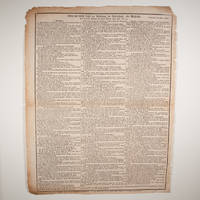
1798réf. 00341CATTLE PLAGUE BROADSIDE BY DR. FAUST --- 1 broadsheet 463 x 363 mm --- One of at least a dozen broadside editions of the prolific German physician's advice on treating the devastating cattle plague. We find others published at Stuttgart 1797; Bückeburg 1797; Leipzig 1797; Dresden 1799; Bamberg 1801; Leipzig 1813; a 1797 edition without place of production; undated editions at Karlsruhe and Gotha; an 1800 French version Strasbourg and another undated French edition. We suspect the content derives from the author's much more extensive Über die Rindvieh-PestStuttgart 1797. His advice was also issued in pamphlet form on which subject our broadside has a terse promotional note at end: "I have also written a book on rinderpest. Read it!" No doubt selling advice from any Dr. Faust required extra effort though he was admittedly quite respected and widely known for his Catechism of Health. At bottom are prices for the broadside both individually and in wholesale quantities of 100 and 600. ¶ There was good reason to produce and post these broadsides widely. "Cattle plague or rinderpest the highly infectious and most lethal of bovine diseases described as the most dreaded above all of animal contagions had repeatedly ravaged Europe since time immemorial" Spinage. Europe was hit especially hard in the 18th and 19th centuries where Germany alone lost an estimated 28 million cattle between 1711 and 1865. Beyond the tragic loss of life livelihoods were destroyed and economies distressed. ¶ Faust here provides a list of symptoms both external and internal; remarks on the fatality of the disease indicating that 25 million German cattle had been killed since 1711 the year of a notorious Italian epidemic; sundry facts and characteristics of the scourge "It's present in every season in all weather and in every country"; details on its transmission; comments on the uselessness of certificates of health and the dangers of the cattle trade; and preventative measures and treatment these accounting for roughly half of the broadside's content with discrete sections on actions to take based on when the disease arrived "If the plague has arrived within 30 or fewer hours there is danger!" plus advice should an infected animal be found in your community "Killing the first sick animal is the best and surest means of putting an end to rinderpest". We expect anyone literate charged with caring for cattle might have kept a broadside like this handy and communities at risk certainly would have benefited from sharing the information publicly. The vast geographic spread of their production betrayed the importance of reaching every corner of the country. Lemgo for example was hardly a great metropolis yet our printer thought it reasonable to offer this broadside in quantities of 600. ¶ We locate no other copies of this Lemgo edition. --- CONDITION: Printed on the recto only of a full sheet of laid paper. Hinged into a hinged matte. ¶ Brittle at the edges with some creases and chips; creased across both dimensions with a pinhole at the intersection and some toning along the horizontal crease. --- REFERENCES: C.A. Spinage Cattle Plague: A HistoryKluwer Academic 2003 p. 3; Alan L. Olmstead "The First Line of Defense: Inventing the Infrastructure to Combat Animal Diseases" The Journal of Economic History69.2 June 2009 p. 330 "Whatever the total losses a serious problem with rinderpest was that it shocked economies by rapidly wiping out much of the regional cattle stock" Meyerschen Buchhandlung (Heirs of Heinrich Wilhelm Meyer)
2009réf. 101559Edizioni Polistampa. New. Paperback. FREE UPGRADE to Courier/Priority Shipping Upon Request - IN STOCK AND IMMEDIATELY AVAILABLE FOR SHIPMENT - Flawless copy brand new pristine never opened -- Text in Italian. 312 pages. -- with a bonus offer--; English summary: This guide to the museum of natural history of the University of Florence reconstructs the historical context of the museum's late 18th-century foundation illustrating how it became an important research center while introducing the reader to the museum's different themes and collections. Italian text. Italian description: Il volume ricostruisce il contesto illuministico di acculturazione popolare in cui il Granduca Pietro Leopoldo fondo l'Imperiale e Reale Museo di Fisica e Storia Naturale. Ne affido la direzione a Felice Fontana 1730-1805 con il compito di organizzare le collezioni naturalistiche e gli strumenti scientifici dell'Accademia del Cimento fino ad allora conservati nella Galleria degli Uffizi. L'apertura al pubblico nel 1775 costitui un evento senza precedenti nel panorama dei musei di storia naturale e nel giro di pochi anni il Museo divenne il maggior centro italiano di ricerca fisica e naturalistica e le sue collezioni ebbero un incremento tale da essere considerate tra le piu importanti d'Europa. A cio contribui anche la creazione dell'officina ceroplastica che produceva fedeli quanto spettacolari modelli anatomici umani in cera. Nel 1780 fu anche portata a termine l'edificazione del torrino con l'osservatorio astronomico ulteriore passo verso il compimento dell'idea di riunire in un'unica sede tutte le discipline scientifiche. La pubblicazione costituisce una guida alle Sezioni di Zoologia La Specola di Antropologia ed Etnologia di Botanica di Geologia e Paleontologia di Mineralogia e Litologia dell'Orto Botanico. Per ciascuna area tematica sono forniti cenni storici e introduttivi la piantina e numerose illustrazioni delle collezioni esposte. . 2009. 8859606799 . Edizioni Polistampa paperback
2008réf. 79602Edizioni Polistampa. New. Paperback. FREE UPGRADE to Courier/Priority Shipping Upon Request - IN STOCK AND IMMEDIATELY AVAILABLE FOR SHIPMENT - Flawless copy brand new pristine never opened -- Text in English and Italian. 368 pp. -- with a bonus offer--; English and Italian Edition; The Ceramics Museum of Montelupo Fiorentino derives from the excavations that have been carried out in the old town centre since 1973 when rehabilitation works brought to light a large water well that after being abandoned had been filled up with a vast quantity of firing waste from the nearby kilns. From 24 May 2008 Montelupo will be able to boast a new Ceramics Museum extending over a surface area of 2500 metres with a collection of more than 1000 ceramics exemplars. This volume is not intended to be a catalogue of the Montelupo Ceramics Museum in the traditional sense but rather a publication that addresses the history of Montelupo as a whole with a large section devoted to the technology and organisation of work in the workshops and kilns from the Middle Ages up to the end of the Modern Age. Finally an extensive descriptive section is devoted to the most important types of ceramic ware produced over the span of five centuries. The author Fausto Berti has been the director of the Montelupo museum since 1982 and has to his credit an extensive series of specialist publications including the work in five volumes Storia della ceramica di Montelupo and an important catalogue on the Capolavori della maiolica rinascimentale ; moreover in 2004 he also published an edition of one of the most complete ceramic formularies in Italy I segreti di fornace by Dionigi Marmi. Contents: The historical-environmental framework. Population the castle and the unforeseen evolution of a florentine walled land in the XIII and XIV centuries - Montelupo and ceramics production in pre industrial Italy - The production of ceramics: technology methodology and organization of the workshops in Montelupo from XIV to XVIII century - The Museum of Ceramics. Short description of the exhibition areas - Types of ceramic production in Montelup o Presentazioni di / Forewords by Rossana Mori Paolo Cocchi Matteo Renzi Edoardo Speranza Prefazione di / Preface by Antonio Paolucci Testi in italiano e in inglese / Italian and english text. . 2008. 8859603951 . Edizioni Polistampa paperback
1989réf. 67451Le Musee. New. Paperback. FREE UPGRADE to Courier/Priority Shipping Upon Request - IN STOCK AND IMMEDIATELY AVAILABLE FOR SHIPMENT - Flawless copy brand new pristine never opened -- Corresponds to ISBN: 2551121612. TWO 2 VOLUME SET. Text in French and English with portions in French only. Vol. 1: 184 pp. With 57 ills. 25 col. Vol. 2: 84 pp. With 7 ills. 30 x 23 cm. -- with a bonus offer-- . 1989. 2551121612 . Le Musee paperback
1989réf. 67450Le Musee. New. Paperback. FREE UPGRADE to Courier/Priority Shipping Upon Request - IN STOCK AND IMMEDIATELY AVAILABLE FOR SHIPMENT - Flawless copy brand new pristine never opened -- TWO 2 VOLUME SET. Text in French and English with portions in French only. Vol. 1: 184 pp. With 57 ills. 25 col. Vol. 2: 84 pp. With 7 ills. 30 x 23 cm. -- with a bonus offer--; 2551121612 //// 2980159506 . 1989. Le Musee paperback
1998réf. 60495Edizioni Charta; Et Al. New. Paperback. FREE UPGRADE to Courier/Priority Shipping Upon Request – – IN STOCK AND IMMEDIATELY AVAILABLE FOR SHIPMENT - Flawless copy brand new pristine never opened -- Text in Italian. 262 pp. With 307 ills. 101 col. . 27 x 21 cm. -- with a bonus offer-- . 1998. 8881582007 . Edizioni Charta; Et Al paperback
2011réf. 98169Periscope. New. Hardcover. FREE UPGRADE to Courier/Priority Shipping Upon Request - IN STOCK AND IMMEDIATELY AVAILABLE FOR SHIPMENT - Flawless copy brand new pristine never opened -- 328 pp. ; 457 illus. 393 in color. -- with a bonus offer--; Best known for its collection of masterpiece paintings the Gardner Museum is also one of the first museums to include a large quantity of Italian furniture. Ranging from renaissance wedding chests and inlaid credenza to Rococo Venetian pieces of the 18th century the collection is perhaps the largest of its type in the United States. Although relying upon several advisors for her acquisitions of paintings and sculptures most famously Bernard Berenson Isabella Gardner bought her furniture entirely on her own recognizing the critical role furniture played in the function and decoration of Italian interiors from the 15th century to the early 19th century. This meticulously designed catalogue includes numerous photographs that focus on individual objects and reveal characteristic forms and styles. Observations made by the museum conversation department about the techniques and materials of the pieces which differ significantly from furniture of other countries are also published. Long overlooked very little has appeared in English on the subject of Italian furniture. Yet these magnificent objects are finally given the careful study and attention they deserve in this beautifully produced catalogue. . 2011. 0914660276 . Periscope hardcover
2004réf. 94464Museum Publications. New. Hardcover. FREE UPGRADE to Courier/Priority Shipping Upon Request - IN STOCK AND IMMEDIATELY AVAILABLE FOR SHIPMENT - Flawless copy brand new pristine never opened -- 288 pages; 240 color illustrations. Description: "After colonizing the Aegean islands and the coast of Asia Minor the ancient Greeks turned toward southern Italy and Sicily driven by the unrest that troubled their homeland in the eighth and seventh centuries B. C. The new arrivals brought with them their language their cultural and religious traditions and the institution of the polis. In Italy they created an autonomous political community that eventually surpassed the cities of Greece in wealth military power and architectural and cultural splendor. Such forefathers of Western philosophy as Pythagoras Parmenides and Archimedes lived and worked within this civilization. The Greek Cities of Magna Graecia and Sicily presents an overview of Greek colonization in Italy and the principal historical events that took place in this area from the Archaic period until the ascendancy of the Romans. This comprehensive survey is followed by a review of the major archaeological sites in the region." -- with a bonus offer--; After colonizing the Aegean islands and the coast of Asia Minor the ancient Greeks turned toward southern Italy and Sicily driven by the unrest that troubled their homeland in the eighth and seventh centuries B.C. The new arrivals brought with them their language as well as their cultural and religious traditions and the institution of the polis. In Italy they created an autonomous political community that eventually surpassed the cities of Greece in wealth military power and architectural and cultural splendor. Such forefathers of Western philosophy as Pythagoras Parmenides and Archimedes lived and worked within this civilization. The Greek Cities of Magna Graecia and Sicily presents an overview of Greek colonization in Italy and the principal historical events that took place in this area from the Archaic period until the ascendancy of the Romans. This comprehensive survey is followed by a review of the major archaeological sites in the region. . 2004. 0892367512 . Museum Publications hardcover
2010réf. 88309Electa. New. Paperback. FREE UPGRADE to Courier/Priority Shipping Upon Request - IN STOCK AND IMMEDIATELY AVAILABLE FOR SHIPMENT - Flawless copy brand new pristine never opened -- Text in Italian and English. 148 pp. ; 87 color illustrations. -- with a bonus offer-- . 2010. 8837077009 . Electa paperback
2016réf. 122169Snoeck. New. Hardcover. FREE UPGRADE to Courier/Priority Shipping Upon Request - IN STOCK AND IMMEDIATELY AVAILABLE FOR SHIPMENT - Flawless copy brand new pristine never opened – with a bonus offer-- . 2016. 3864421608 . Snoeck hardcover
2012réf. 107352Gallery. New. Hardcover. FREE UPGRADE to Courier/Priority Shipping Upon Request - IN STOCK AND IMMEDIATELY AVAILABLE FOR SHIPMENT - Flawless copy brand new pristine never opened - -- with a bonus offer-- . 2012. 1935263692 . Gallery hardcover
2015réf. 125631Mousse. New. Paperback. FREE UPGRADE to Courier/Priority Shipping Upon Request - IN STOCK AND IMMEDIATELY AVAILABLE FOR SHIPMENT - Flawless copy brand new pristine never opened. Text in English French and Italian -- with a bonus offer-- . 2015. 2954713968 . Mousse paperback
2002réf. 624935 Continents Editions Srl. New. Paperback. FREE UPGRADE to Courier/Priority Shipping Upon Request – – IN STOCK AND IMMEDIATELY AVAILABLE FOR SHIPMENT - Flawless copy brand new pristine never opened --Text in French. 120 pp. With 89 ills. 57 col. . 28 x 24 cm. -- with a bonus offer-- . 2002. 8874390114 . 5 Continents Editions Srl paperback
1973réf. 63352Gallery. As New. Paperback. FREE UPGRADE to Courier/Priority Shipping Upon Request – – IN STOCK AND IMMEDIATELY AVAILABLE FOR SHIPMENT - AS NEW THE TEXT BLOCK IS PRISTINE CLEAN UNMARKED AND IN EXCELLENT CONDITION - - Text in English Italian and German. 80 pp. With 47 ills. 10 col. . 30 x 22 cm. -- with a bonus offer-- . 1973. Gallery paperback
2003réf. 35448Cumberland Rhode Island U.S.A.: Yale Univ Pr. New. Paperback. FREE UPGRADE to Courier/Priority Shipping Upon Request – – IN STOCK AND IMMEDIATELY AVAILABLE FOR SHIPMENT - BRAND NEW FLAWLESS COPY NEVER OPENED - 304 pages -- DESCRIPTION: Motivated by a suspicion that schools fail to teach what "matters" Simon director of research at the Coalition of Essential Schools in California spent months observing literature history and biology classes at a public a Catholic and a Jewish high school. What "matters" to Simon is the integration of moral and existential inquiry into the classroom; she argues that not only are moral and existential questions at the heart of the major disciplines they are also extremely compelling to students. But too much of what goes on in schools she contends is "the forming of uninformed opinions" and "decontextualized fact acquisition." Although she shows how even good teachers sometimes deflect or shut down important discussions Simon places the blame squarely on the education system that works "against teachers being able to incorporate discussions of substantive issues into their classrooms." As in many recent books the villain is the standardized test and the stakes for both students and teachers attached to it. Simon writes fluently integrating transcripts of classroom discussions smoothly into her narrative and engagingly conveying her idealist's passion for reform. To reconsider education's entire enterprise is a very tall order however and Simon acknowledges the enormous obstacles her project faces. Readers will agree that students shouldn't continue to feel disengaged in school because they're denied the chance to ask and answer essential questions but they may be skeptical of Simon's starry-eyed recipe for change. - Publishers Weekly -- with a bonus offer--; 520-simkg; Simon Katherine G. Katherine G. Simon; foreword by Theodore R. Sizer and Nancy Faust Sizer Moral Questions in the Classroom: How to Get Kids to Think Deeply About Real Life and Their Schoolwork MORAL EDUCATION HIGH SCHOOL TEACHING Motivated by a suspicio . 2003. 0300101686 . Yale Univ Pr paperback
2001réf. 35447Cumberland Rhode Island U.S.A.: Yale Univ Pr. New. Hardcover. FREE UPGRADE to Courier/Priority Shipping Upon Request – – IN STOCK AND IMMEDIATELY AVAILABLE FOR SHIPMENT - BRAND NEW FLAWLESS COPY NEVER OPENED - 304 pages -- DESCRIPTION: Motivated by a suspicion that schools fail to teach what "matters" Simon director of research at the Coalition of Essential Schools in California spent months observing literature history and biology classes at a public a Catholic and a Jewish high school. What "matters" to Simon is the integration of moral and existential inquiry into the classroom; she argues that not only are moral and existential questions at the heart of the major disciplines they are also extremely compelling to students. But too much of what goes on in schools she contends is "the forming of uninformed opinions" and "decontextualized fact acquisition." Although she shows how even good teachers sometimes deflect or shut down important discussions Simon places the blame squarely on the education system that works "against teachers being able to incorporate discussions of substantive issues into their classrooms." As in many recent books the villain is the standardized test and the stakes for both students and teachers attached to it. Simon writes fluently integrating transcripts of classroom discussions smoothly into her narrative and engagingly conveying her idealist's passion for reform. To reconsider education's entire enterprise is a very tall order however and Simon acknowledges the enormous obstacles her project faces. Readers will agree that students shouldn't continue to feel disengaged in school because they're denied the chance to ask and answer essential questions but they may be skeptical of Simon's starry-eyed recipe for change. - Publishers Weekly -- with a bonus offer--; 520-simok; Simon Katherine G. Katherine G. Simon; foreword by Theodore R. Sizer and Nancy Faust Sizer Moral Questions in the Classroom: How to Get Kids to Think Deeply About Real Life and Their Schoolwork MORAL EDUCATION HIGH SCHOOL TEACHING Motivated by a suspicio . 2001. 0300090323 . Yale Univ Pr hardcover
réf. Z1-C-084-03011Lea & Febiger. Used - Good. Ships from UK in 48 hours or less usually same day. Your purchase helps support Sri Lankan Children's Charity 'The Rainbow Centre'. Ex-library so some stamps and wear but in good overall condition. 100% money back guarantee. We are a world class secondhand bookstore based in Hertfordshire United Kingdom and specialize in high quality textbooks across an enormous variety of subjects. We aim to provide a vast range of textbooks rare and collectible books at a great price. Our donations to The Rainbow Centre have helped provide an education and a safe haven to hundreds of children who live in appalling conditions. We provide a 100% money back guarantee and are dedicated to providing our customers with the highest standards of service in the bookselling industry. Lea & Febiger unknown
1554réf. 6336Venice: Plinio Pietrasanta 1554. First edition. Very Good. Quarto 22 cm; 45 3 pages last leaf blank. Title within woodcut architectural border. Historiated woodcut initials throughout. In half vellum over 17th- or 18th-century woodblock printed paste paper titled in manuscript on spine. Lower board ruptured near corner subsequently rebuilt. Some leaves toned brown. Early ownership inscriptions and later bibliographical notes on front free endpaper and on rear pastedown. References: Adams F-182; Olschki Choix de livres anciens VI 5817 This essay extolling marriage is an early artifact of modern ethnography in that it poses as a survey of marriage customs through history and around the world. In true humanist fashion Fausto mines the ancient historians for most of his material. So we find out that in Lacedaemonia or Atlantis men who refused to marry were forced to run naked through the forum in the dead of winter and that in Assyria husbands were bound by law to obey their wives. The text concludes with a long series of Q&A "quesiti" concerning marriage ceremonies in which we find out why the Boetians crowned brides with asparagus why Persian couples wait until spring to "consummate" any marriage and why it is customary to grease the newlyweds' doorway with pig fat or wolf fat. The book is also notable for its lovely large woodcut initials including a letter T showing a satyr and a man at table together a P with a bare-breasted woman driving a triumphal chariot and an N with a lion-headed man astride a swimming horse. Plinio Pietrasanta hardcover