Fausto da Longiano, Sebastiano; PlutarchBiblio.com

2236 risultati
1554rif. 6336Venice: Plinio Pietrasanta 1554. First edition. Very Good. Quarto 22 cm; 45 3 pages last leaf blank. Title within woodcut architectural border. Historiated woodcut initials throughout. In half vellum over 17th- or 18th-century woodblock printed paste paper titled in manuscript on spine. Lower board ruptured near corner subsequently rebuilt. Some leaves toned brown. Early ownership inscriptions and later bibliographical notes on front free endpaper and on rear pastedown. References: Adams F-182; Olschki Choix de livres anciens VI 5817 This essay extolling marriage is an early artifact of modern ethnography in that it poses as a survey of marriage customs through history and around the world. In true humanist fashion Fausto mines the ancient historians for most of his material. So we find out that in Lacedaemonia or Atlantis men who refused to marry were forced to run naked through the forum in the dead of winter and that in Assyria husbands were bound by law to obey their wives. The text concludes with a long series of Q&A "quesiti" concerning marriage ceremonies in which we find out why the Boetians crowned brides with asparagus why Persian couples wait until spring to "consummate" any marriage and why it is customary to grease the newlyweds' doorway with pig fat or wolf fat. The book is also notable for its lovely large woodcut initials including a letter T showing a satyr and a man at table together a P with a bare-breasted woman driving a triumphal chariot and an N with a lion-headed man astride a swimming horse. Plinio Pietrasanta hardcover
2010rif. 93872Edizioni Polistampa. New. 2010. Paperback. 8859607973 . FREE UPGRADE to Courier/Priority Shipping Upon Request - IN STOCK AND IMMEDIATELY AVAILABLE FOR SHIPMENT - Flawless copy brand new pristine never opened -- Text in Italian. 224 pp. ; 252 illus. most in color. -- with a bonus offer-- . Edizioni Polistampa paperback
1946rif. 560415Napoli / Roma: Gaspare Casella Editore / De Luigi Editore 1946. Softcover. Very Good. Nos. 1-18 in 15 issues i.e. three double issues. Slim octavos. Text in Italian. Printed wrappers paper still supple. Owner's signature of author and critic Michele Cantarella a leading anti-fascist Italian expatriate on the cover of one issue and three issues with a bit of pencilled marginal bracketing by him. Modest toning wear and soil a few tiny tears at the spine ends the first five issues with the pages somewhat toned and occasional very light foxing mostly confined to the first and last leaves a nice very good or better run of this somewhat delicate Italian literary magazine that featured two publishers and three editors during this time period. Of particular note is the inclusion of "Angoscia" "Anguish" later known as "Anguish in the Barracks" in issue 16 a very early possibly the earliest published story by Italo Calvino predating his first book by two years. The final issue prints a "Referendum" of four questions for poets about their work and claim that they have already received responses from Eugenio Montale Cesare Pavesi Corrado Alvaro and others and will begin publishing their responses in the next issue but the magazine ceased publication with No. 17/18. A well-preserved set of a cheaply wartime- printed magazine. Gaspare Casella Editore / De Luigi Editore unknown
rif. 3482141973. Softcover. Very Good. A collection of 17 fanzines focused on Frederick Faust a.k.a. Max Brand including a complete four-issue run and partial three issue run of The Fabulous Faust and the complete 10-issue run of The Faust Collector along with other related ephemera. The first issue of The Fabulous Faust is a second edition which was limited to 50 copies all others are first editions. Quartos except the first issue of The Faust Collector which is octavo. Stapled wrappers with Fabulous Faust partial set also bradbound three issues in one. Overall very good or better with some minor wear at the corners and a few pulled staples; two issues of The Fabulous Faust have detached final sheets and one is also missing the second to last sheet. Rounding out the collection is a group of related ephemera including lists of Faust's print appearances; several catalogs from Richardson along with correspondence sent to a collector; copies of a letter from Faust and another from his literary agent Brandt & Brandt; photocopies of Faust's first published story "The King is Dead" from his high school annual; and a double-sided publisher's promotional sheet for Max Brand: The Man and His Work. A wonderful collection of amateur magazines showing the efforts made to organize study and catalog the varied writings of Faust following his death as a correspondent in World War II. OCLC locates one run of The Fabulous Faust along with two other single issues; and no copies of The Faust Collector. Further details available upon request. unknown
1800rif. 30900MADRID: En la Imprenta de Joseph Doblado 1800. Primera edición.- 8º.- Plena pasta española de época lomera con tejuelo y ruedas doradas.- 115 páginas de texto incluida Portada.- 65 láminas fuera de texto grabadas representando planos el último plegado. Desgarro en una hoja de texto en el mapa plegado sin la más mínima pérdida y debidamente restaurado. Por lo demás muy buen ejemplar. En la portada de la obra consta nueva edición pero en ninguna bibliografía se cita una edición anterior salvo que se refiera a un plano conjunto de Madrid y Paris citado en la ""Cartografía de España en la Biblioteca Nacional Siglo XVI al XIX."" número 1268 que fue grabado por Asensio. El último plano que está plegado y grabado como los otros tiene unas dimensiones de 365 x 505 cms. y en la cartela se lee: ""Plano geométrico de Madrid demostrado con los 64 barrios en que está dividido"". Al pie del mismo: ""Fausto Martínez de la Torre lo delineó y grabó"". Es obra muy rara al estar completa. Alfonso García Escuder en su obra ""Mil libros en la Historia de Madrid número 524"" después de la descripción bibliográfica apostilla: ""Libro difícil de encontrar completo particularmente con el plano grande. De hecho solo hemos encontrado dos últimas ventas en 1994 y 1995 en las cuales se describen con 64 láminas y no 65 como tiene este ejemplar"". Palau 156137 - Aguilar Piñal V- 3576 En la Imprenta de Joseph Doblado hardcover
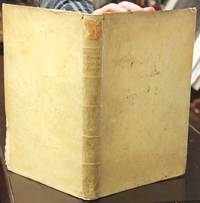
1542rif. B5989Rome / Romae: Francesco Priscianese c.1542. Slight browning to some pages; in very good condition . Binding: Contemporary vellum. Spine with five 5 raised bands and ink title on two; trace of old label on spine. All edges speckled red. Notes: The seven books of Advensus gentes Edited by Franciscus Priscianensis and Hieronymus Ferrarius. Dedication to Franois I of France dated a2v “Calen. Septembris 1543.” Colophon R7r dated 1542. The first edition of a defense of the Christian faith and an attack on paganism with ample descriptions of idolatrous rites and beliefs. Printed from an imperfect manuscript found in Paris it required extensive text editing. This is an unusally tall copy clean and beautifully printed. According to Jerome's chronicle Arnobius of Sicca c. 330 early Christian apologist of Berber origin during the reign of Diocletian 284–305 was a distinguished Numidian rhetorician prior to his conversion in Sicca Veneria El Kef Tunisia a major Christian center in Proconsular Africa. Jerome stated that to help the local bishop overcome his doubts as to the earnestness of his Christian belief he wrote c. 303 from evidence in IV:36 an apologetic work in seven books called ‘Adversus Gentes’ entitled ‘Adversus Nationes’ in the only 9th-century manuscript that survived. Size: Folio 305x208mm Provenance: Title and dedication leaves watermarked with an anchor design. References: Graesse I 225 NUC 22.74-75. Ind. Aur. 108.890; Brunet I: 491; BM STC Italian: 56; Adams A1994. Ascarelli: 12. Pages: Pp. 107 leaves. Category: Book Religious Christianity; Book Europe Italy; Book Early Printed 1500; Francesco Priscianese, hardcover
2008rif. C93876Electa. As New. Hardcover. FREE UPGRADE to Courier/Priority Shipping Upon Request - IN STOCK AND IMMEDIATELY AVAILABLE FOR SHIPMENT - Flawless copy brand new pristine never opened -- TWO 2 VOLUME SET. Text in English and Italian. Volume 1 is titled "Incisioni Volumi e Cartelle 1969-1986" and is 412 pages long; Volume 2 is titled "Esemplari Unici 1969-1986" and consists of 274 pages. Many illustrations in both volumes. Catalogue Raisonné Catalogue Raisonne Catalog Raisonnee Complete Works -- with a bonus offer-- - May be EITHER: out of print OOP and extremely rare in this pristine condition; signed by author or contributor; or a first or special edition; inquire for details . 2008. Electa hardcover
2001rif. 1-0443066019Churchill Livingstone 2001. Paperback. New. 3rd sub edition. 595 pages. 10.75x8.50x1.00 inches. Churchill Livingstone paperback
2008rif. 93876Electa. New. 2008. Hardcover. FREE UPGRADE to Courier/Priority Shipping Upon Request - IN STOCK AND IMMEDIATELY AVAILABLE FOR SHIPMENT - Flawless copy brand new pristine never opened -- TWO 2 VOLUME SET. Text in English and Italian. Volume 1 is titled "Incisioni Volumi e Cartelle 1969-1986" and is 412 pages long; Volume 2 is titled "Esemplari Unici 1969-1986" and consists of 274 pages. Many illustrations in both volumes. Catalogue Raisonné Catalogue Raisonne Catalog Raisonnee Complete Works -- with a bonus offer . Electa hardcover
rif. 2107RS685Tradução de Maria Serpa dos Santos. 2.ª Edição. Fundação Calouste Gulbenkian. Lisboa. 1972. De 23x16 cm. Com ii 526 ii págs. Brochado com sobrecapa de proteção. Ilustrado no texto com gravuras e fotografias a preto e branco em extratexto com guadros de microorganismos biológicos sobre papel couché. I-172-G-4 unknown
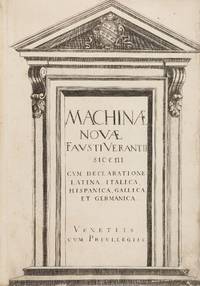
rif. 50561Venice: self-published between 1595 and 1616. Folio 37.3 × 25 cm. Contemporary full vellum; engraved title within architectural border; 49 numbered double-page copperplate engravings 19 1 18 2 20 19 1 19 1 pp. letterpress-printed text in Italian German French Spanish and Latin each with a vignette headpiece at the head of the section. Binding with repairs and somewhat distended; occasional light soil and foxing; small paper repairs to first few leaves and one plate with larger repair slightly affecting the image; else about very good and an apparently unresized copy with wide margins retaining all five text parts. First edition of this important survey of mechanical architectural and technological designs and projects the magnum opus of Fausto Veranzio 1551-1617 a Croatian polymath diplomat and priest who was born in Šibenik on the Adriatic Coast then part of the Republic of Venice. There are two known versions of this print: a Latin-Italian one with Tuscan privilege and our version with an engraved Venetian title page and additional translations of the texts into German French and Spanish. In a reprint of the book published 1965 Friedrich Klemm writes in his introduction: "In the late Renaissance and early Baroque periods we encounter excellently illustrated works of technical literature which were generally intended for aristocratic circles. . Of all these works that of Fausto Veranzio is the rarest. Compared to some of the other mechanical engineering illustrated works of the time Veranzio primarily presents his own designs some of which still reveal the objective spirit of the Renaissance or images of devices he had encountered on his travels. The books on mechanical and military technology of the Cinquecento such as those by Ramelli Lorini and Francesco de' Marchi as well as classical literature were certainly familiar to him the learned author who was active as a philologist philosopher historian administrator fortress commander mechanical engineer and churchman. The influence of Leonardo da Vinci also seems to be evident in Verancio's book." Veranzio attended school in Venice and studied law engineering mechanics and physics at Padua before entering the services of Rudolf II in Prague as whose secretary he is thought to have conversed with Johannes Kepler and Tycho Brahe. He also published works of lexicography and logic. Following the death of his wife he relocated to Venice where he joined the Barnabite Order and devoted his remaining years to the study of science and engineering. The large plates depict designs for flotation devices a bridge using suspension cables oil and wine presses a rotary printing press a universal clock various types of mills including a design that was used for one of New York's earliest tide mills fountains as well as the famous image showing a man gliding safely from the Campanile di San Marco in Venice likely inspired by Veranzio's familiarity with da Vinci's drafts for a parachute. "It is difficult to determine with certainty whether Veranzio saw Leonardo's notes. Regardless he certainly shared Leonardo's Renaissance spirit. They were both self-taught lovers of learning across different fields including philosophy and history. Like Leonardo Veranzio also harbored a passion for hydraulics and spent 2 years in Rome trying to regulate the flow of the Tiber. Back home in Venice he maintained the wells and water supplies" Innicenzi The Innovators Behind Leonardo p. 69." Veranzio's book also proposes various means to harness solar and hydraulic power. One of the plates shows the church in his birthplace Šibenik. In addition to the most famous illustration "Homo Volans" this magnificent volume contains numerous innovations that were sometimes far ahead of their time and secured Veranzio a place in the history of technology. One example is the iron carriage spring without which modern means of transport would be inconceivable cf. Friedrich Kluge Etymologisches Wörterbuch Berlin 1960 p. 188. Veranzio writes about his invention: "The suspended carriages are necessarily hung with ropes chains or double leather straps so that the passengers do not sit hard. But I wanted to put iron springs underneath them which open and close like the bows of crossbows." Another example is the first use of a gear mechanism in the manufacture of ropes cf. Jürgen Eichhoff in: Die Sprache des niederdeutschen Reepschlägerhandwerks. Cologne and Graz 1968 Low German Studies 16 p. 1041. But his bronze bridge the "Pons Æreus" shown in copperplate engraving no. 33 points furthest into the future. Because the first metal bridge was not built until 1773 over the Savern in England. Equally remarkable is Veranzio's iron bridge "Pons Ferrevs" on the following copperplate engraving which is apparently the first depiction of a chain bridge in Europe. See Nikola Roßbach. Poiesis der Maschine: Barocke Konfigurationen von Technik Literatur und Theater Berlin 2020 p. 99ff. When Veranzio was working on his "Machinae novae" he concerned himself with water regulation in the cities of Rome and Venice which were regularly threatened by the rivers and the sea. The elaborately crafted volume was not intended to enable the machines and architecture shown in it to be replicated but rather to showcase the achievements to educated and wealthy laymen such as potential clients and patrons. This explains the small print run. Veranzio sent the prints primarily to cardinals and generals who ultimately spread his name across the continent. See ibid. Veranzio's work is undated but based on several notes of thanks by friends from July 1616 was presumably printed in or around that year; occasionally it is dated as early as 1595. It has also been suggested that it was financed by the author and thus issued in small installments over a longer period of time. Complete copies are very scarce. Most copies in the market over the last decades have also either lacked one or more of the plates or one or more of the language sections. This copy includes all five versions known to have been issued: Italian German French Spanish and Latin as well as all plates. Copies with some colored plates are also known. Poggendorf vol. II no. 1194; Hausmann and Kapp vol. I no. 1138. As of November 2025 KVK and OCLC locate six copies in North America 2 other copies are marked as incomplete because they are missing several or all of the plates. unknown