Faust, JoanBiblio.com

3 000 résultats
réf. 1611495202.Gpaperback. Good. Access codes and supplements are not guaranteed with used items. May be an ex-library book. paperback
2014réf. x-1611495202Univ of Delaware Pr 2014. Paperback. New. reprint edition. 235 pages. 9.25x6.00x0.75 inches. Univ of Delaware Pr paperback
2012réf. SONG1611494109University of Delaware Press 2012-10-12. hardcover. Used: Good. 6.27x0.94x9.29. Buy with confidence. Excellent Customer Service & Return policy. University of Delaware Press hardcover
réf. Bloomsbury-9781611495201University of Delaware Press. Paperback. New. 236 pages University of Delaware Press paperback
réf. Bloomsbury-9781611495201University of Delaware Press. Paperback. New. 236 pages University of Delaware Press paperback
réf. Bloomsbury-9781611494105University of Delaware Press. Hardback. New. 236 pages University of Delaware Press hardcover
réf. Bloomsbury-9781611494105University of Delaware Press. Hardback. New. 236 pages University of Delaware Press hardcover
réf. ria9781611494105_inpHardcover. New. New Book; Fast Shipping from UK; Not signed; Not First Edition; The work is an interdisciplinary study of the major lyric poems of seventeenth-century British metaphysical poet Andrew Marvell. It invites Marvell readers to view the poet and some of his representative lyrics in the context of the ant hardcover
réf. ria9781611495201_inpPaperback. New. New Book; Fast Shipping from UK; Not signed; Not First Edition; The work is an interdisciplinary study of the major lyric poems of seventeenth-century British metaphysical poet Andrew Marvell. It invites Marvell readers to view the poet and some of his representative lyrics in the context of the ant paperback
réf. 0916418774.Gpaperback. Good. Access codes and supplements are not guaranteed with used items. May be an ex-library book. paperback
réf. 1538230089.Glibrary. Good. Access codes and supplements are not guaranteed with used items. May be an ex-library book. unknown
réf. 1538230038.Glibrary. Good. Access codes and supplements are not guaranteed with used items. May be an ex-library book. unknown
réf. 1538230046.Glibrary. Good. Access codes and supplements are not guaranteed with used items. May be an ex-library book. unknown
1893réf. 32410Author. Good. 1893. Hardcover. Good hardcover exlibrary edition with the usual marks. Cover has some soiling and wear. ; Ex-Library; 12mo 7" - 7½" tall; 248 pages . Author hardcover
réf. 0483378232.Ghardcover. Good. Access codes and supplements are not guaranteed with used items. May be an ex-library book. hardcover
réf. 1333961561.Gpaperback. Good. Access codes and supplements are not guaranteed with used items. May be an ex-library book. paperback
1962réf. R118326Rome, Orbis Catholicus/ Herder 1962 211pp., 24cm., reliure cart., dans la série "Studia Anselmiana" vol.50, peu de rousseurs (surtout aux tranches), bon état, R188326
1888réf. 1195200(Halle, Niemeyer, 1888). Gr.-8vo. (17) S. (Sdr. aus: Genethliacon Goettingense XXIV). Hlwd.
1952réf. 710516PN. New. 1952. Soft Cover. Date is original print. This is a reprint edition. . PN paperback
1952réf. 432623PN. New. 1952. Soft Cover. Date is original print. This is a reprint edition. . PN paperback
2015réf. x-3662460416Springer Verlag 2015. Hardcover. New. 2015 edition. 888 pages. French language. 9.30x6.20x2.00 inches. Springer Verlag hardcover
2016réf. x-3662510898Springer Verlag 2016. Paperback. New. 2nd enl rev edition. 865 pages. French language. 9.00x6.00x1.75 inches. Springer Verlag paperback
1994réf. 49597Amsterdam: North-Holland 1994. Hardcover Octavo no dust jacket. Hardcover. Very good. illustrated boards no dust jacket 751 pp volume seven only Standard shipping no tracking / Priority with tracking / Custom quote for large or heavy orders. North-Holland hardcover
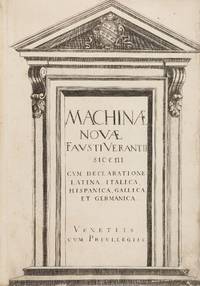
réf. 50561Venice: self-published between 1595 and 1616. Folio 37.3 × 25 cm. Contemporary full vellum; engraved title within architectural border; 49 numbered double-page copperplate engravings 19 1 18 2 20 19 1 19 1 pp. letterpress-printed text in Italian German French Spanish and Latin each with a vignette headpiece at the head of the section. Binding with repairs and somewhat distended; occasional light soil and foxing; small paper repairs to first few leaves and one plate with larger repair slightly affecting the image; else about very good and an apparently unresized copy with wide margins retaining all five text parts. First edition of this important survey of mechanical architectural and technological designs and projects the magnum opus of Fausto Veranzio 1551-1617 a Croatian polymath diplomat and priest who was born in Šibenik on the Adriatic Coast then part of the Republic of Venice. There are two known versions of this print: a Latin-Italian one with Tuscan privilege and our version with an engraved Venetian title page and additional translations of the texts into German French and Spanish. In a reprint of the book published 1965 Friedrich Klemm writes in his introduction: "In the late Renaissance and early Baroque periods we encounter excellently illustrated works of technical literature which were generally intended for aristocratic circles. . Of all these works that of Fausto Veranzio is the rarest. Compared to some of the other mechanical engineering illustrated works of the time Veranzio primarily presents his own designs some of which still reveal the objective spirit of the Renaissance or images of devices he had encountered on his travels. The books on mechanical and military technology of the Cinquecento such as those by Ramelli Lorini and Francesco de' Marchi as well as classical literature were certainly familiar to him the learned author who was active as a philologist philosopher historian administrator fortress commander mechanical engineer and churchman. The influence of Leonardo da Vinci also seems to be evident in Verancio's book." Veranzio attended school in Venice and studied law engineering mechanics and physics at Padua before entering the services of Rudolf II in Prague as whose secretary he is thought to have conversed with Johannes Kepler and Tycho Brahe. He also published works of lexicography and logic. Following the death of his wife he relocated to Venice where he joined the Barnabite Order and devoted his remaining years to the study of science and engineering. The large plates depict designs for flotation devices a bridge using suspension cables oil and wine presses a rotary printing press a universal clock various types of mills including a design that was used for one of New York's earliest tide mills fountains as well as the famous image showing a man gliding safely from the Campanile di San Marco in Venice likely inspired by Veranzio's familiarity with da Vinci's drafts for a parachute. "It is difficult to determine with certainty whether Veranzio saw Leonardo's notes. Regardless he certainly shared Leonardo's Renaissance spirit. They were both self-taught lovers of learning across different fields including philosophy and history. Like Leonardo Veranzio also harbored a passion for hydraulics and spent 2 years in Rome trying to regulate the flow of the Tiber. Back home in Venice he maintained the wells and water supplies" Innicenzi The Innovators Behind Leonardo p. 69." Veranzio's book also proposes various means to harness solar and hydraulic power. One of the plates shows the church in his birthplace Šibenik. In addition to the most famous illustration "Homo Volans" this magnificent volume contains numerous innovations that were sometimes far ahead of their time and secured Veranzio a place in the history of technology. One example is the iron carriage spring without which modern means of transport would be inconceivable cf. Friedrich Kluge Etymologisches Wörterbuch Berlin 1960 p. 188. Veranzio writes about his invention: "The suspended carriages are necessarily hung with ropes chains or double leather straps so that the passengers do not sit hard. But I wanted to put iron springs underneath them which open and close like the bows of crossbows." Another example is the first use of a gear mechanism in the manufacture of ropes cf. Jürgen Eichhoff in: Die Sprache des niederdeutschen Reepschlägerhandwerks. Cologne and Graz 1968 Low German Studies 16 p. 1041. But his bronze bridge the "Pons Æreus" shown in copperplate engraving no. 33 points furthest into the future. Because the first metal bridge was not built until 1773 over the Savern in England. Equally remarkable is Veranzio's iron bridge "Pons Ferrevs" on the following copperplate engraving which is apparently the first depiction of a chain bridge in Europe. See Nikola Roßbach. Poiesis der Maschine: Barocke Konfigurationen von Technik Literatur und Theater Berlin 2020 p. 99ff. When Veranzio was working on his "Machinae novae" he concerned himself with water regulation in the cities of Rome and Venice which were regularly threatened by the rivers and the sea. The elaborately crafted volume was not intended to enable the machines and architecture shown in it to be replicated but rather to showcase the achievements to educated and wealthy laymen such as potential clients and patrons. This explains the small print run. Veranzio sent the prints primarily to cardinals and generals who ultimately spread his name across the continent. See ibid. Veranzio's work is undated but based on several notes of thanks by friends from July 1616 was presumably printed in or around that year; occasionally it is dated as early as 1595. It has also been suggested that it was financed by the author and thus issued in small installments over a longer period of time. Complete copies are very scarce. Most copies in the market over the last decades have also either lacked one or more of the plates or one or more of the language sections. This copy includes all five versions known to have been issued: Italian German French Spanish and Latin as well as all plates. Copies with some colored plates are also known. Poggendorf vol. II no. 1194; Hausmann and Kapp vol. I no. 1138. As of November 2025 KVK and OCLC locate six copies in North America 2 other copies are marked as incomplete because they are missing several or all of the plates. unknown
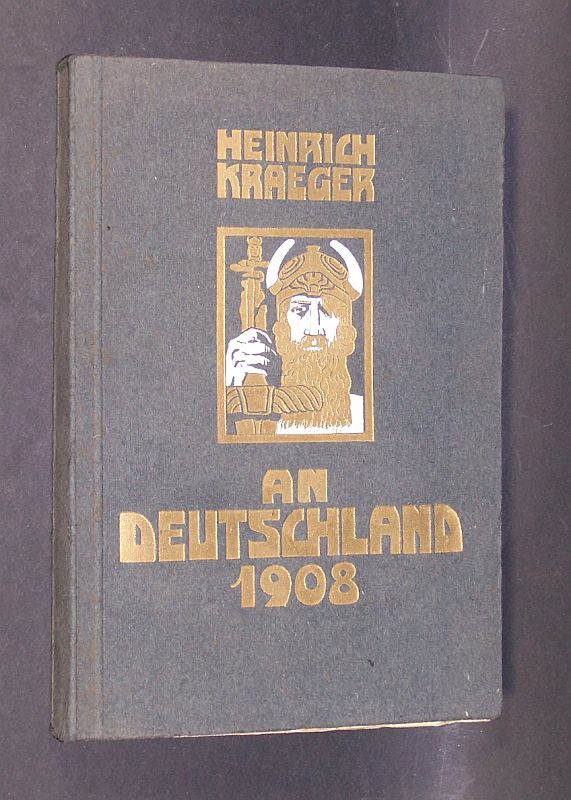
1908réf. 32854Berlin, Martin Warneck 1908. 207 (1) Seiten, 8° (21,5 x 15 cm), Softcover/Paperback, Orig.-Pappeinband.