Aragon, LouisBiblio.com
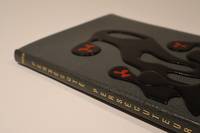
1931réf. 49605Paris: Editions surrealistes Les Editions Denoel et Steele 1931. Hardcover. Fine. 4to pp. 83 5 errata leaf tipped in at end. Full leather design binding with original wrappers bound in with cancel slip over publisher's imprint on the title page and upper cover of the original red paper wrapper. The work is a collection of poems by Louis Aragon published in 1931. A radical turning point in his career marking the end of his Surrealist phase and his full commitment to communist political engagement. The collection comprises thirteen long poems characterized by violent imagery and destruction. It opens with the well known and highly politicized poem Front rouge which calls for the violent overthrow of capitalism and celebrates proletarian revolution. A couple of pamphlets relating to "Front Rouge" are loosely inserted. Finely bound by Georges Leroux in full grey morocco with gilt spine lettering and thick sculpted black leather onlays depicting oppressive figures marked with red inlays to their heads above figures without red inlays. A striking design binding in fine condition. Housed in a red card chemise with a felt-lined interior together within a matching red card slipcase. From a total edition of 1015 copies this being no. 675. Editions surrealistes [Les Editions Denoel et Steele] hardcover
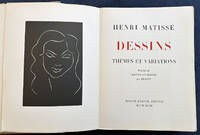
1943réf. B-2022-0939Paris: Martin Fabiani 1943. Preface Matisse-en-France by Louis Aragon. Limited numbered edition in 950 copies of which this is copy N 404. Loose as issued in the original publisher's lace-up hard chemise. Illustrated by Matisse with an original linocut on a black background in frontispiece three lithographs and 158 reproductions of drawings in full page and hors-texte. Ref: C. Duthuit Les Livres Illustres No. 9.; Monod 7847.Chemise is missing spine and is detached some of the reproductions are lightly tanned but linocut is in very good condition. Martin Fabiani Editeur
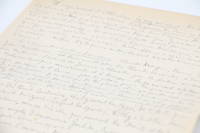
1948réf. 872391948. Fine. ""Nose in the air arms flying with nonchalance with joy as Willy Ronis says. black shoes a large hat a wasp waist skirt in the wind and not the slightest idea what all this could be for but all the sunshine of late April in the veil. and like Paris absurdly inimitable."" s. d. avril 1948 21 x 30 cm 4 pages sur 4 feuillets Exceptional complete autograph manuscript by Louis Aragon. 4 pages in pencil on 4 leaves numbered in his hand. Discrete trace of rust discharge on the first leaf and on the verso of the last. Horizontal fold across all leaves. The article would be published under the title ""L'Art de prendre une photo pour Les Lettres Françaises"" Regards May 14 1948. Aragon accompanies the great Willy Ronis during a photographic session for a fashion portrait for Les Lettres Françaises. Following in Ronis's footsteps as he directs his spinning model the writer takes us through four pages across an enchanting Paris where popular life and worldly elegance intermingle. ""The aim was to illustrate Le Nez au vent by Louis Chéronnet. The column's theme was: The Elegance of Paris is moving westward and more specifically focused on avenue Montaigne"" begins Aragon in his chronicle. For the duration of a day the writer documents with fascination the photographer's work in one of his favorite settings: the streets of Paris. Several tableaux unfold in succession in the Montorgueil quarter at the milliner's in Ronis's studio on avenue Montaigne at the Théâtre des Champs-Elysées. The key word for both Aragon and Ronis is movement. Photography is not static nor are Aragon's impressions. We jump like the model in the photographer's shots from one place to another. The portrait of the elegant woman expands under the writer's pen to her surroundings to the bubbling life of Paris that stops for an instant to contemplate the model's silhouette animated by the photographer's instructions. Sixty years later Ronis would remember that memorable day: ""Aragon had a very beautiful regard for photography. He knew what an image was. Elsa too. He had me work when he founded and directed Les Lettres françaises. I did several reports for him. The first small report was in 1947 or 48 a report on fashion on avenue Montaigne. Aragon came with me we had chosen a model. I was a bit intimidated by Aragon it was my first contact with him. I wanted to get the maximum from my model I was working very hard because I was nervous. Seeing me work amused him so much that he didn't write the report about the model but about me working. I had seen him quite many times afterward we used the familiar form with each other."" Willy Ronis interview in Libération September 14 2009 Their militant paths crossed on numerous occasions - Ronis contributed through his photographs to witness the social revolts that shook the 1930s while Aragon devoted many articles to them. In 1949 the photographer would follow the commemorative day of the Oradour-sur-Glane tragedy in which nearly 400 artists participated at Aragon's initiative. He would also be the author of beautiful portraits of the Aragon-Triolet couple. Excerpts from the manuscript: Willy Ronis had arranged to meet me at 10:30 at the corner of rue Tiquetonne and rue Montorgueil. Apparently he was photographing athletes there. Ah! it was that restaurant where in the past we used to go eat with Vaillant-Couturier and there were Action Française types who would shoot daggers at us with their eyes. Instead of athletes Willy was there in his velvet jacket with his spectacles taking shots left and right at the counter of a couple of lovers. Sweet the lovers. The little one especially. Perhaps it's a sport. . There is nothing more solemn than Caroline Reboux. It is the temple of hats. If he lived in our times this is where Aristotle would write. Caroline Reboux herself made the bonnets for Nana and Eugénie de Montijo; at her place Bel-Ami would twist h unknown
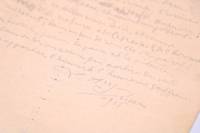
1945réf. 641571945. Fine. s. d. 1944-1945 19.80 x 26.50 cm une feuille sous étui-chemise Exceptionally rare autograph satirical poem by Louis Aragon entitled Distiques pour une Carmagnole de la Honte written between September 1944 and February 1945. 26 lines penned in black ink on a single leaf with a note from the author in blue ink at the foot of the page. Our manuscript belongs to a group of thirteen poems composed during the first half of 1945 intended for publication in a poetry anthology Aragon published by Pierre Seghers in Paris Collection Poètes daujourdhui no. 2 20 July 1945. It was sent by Aragon as a working copy to his editor and friend Claude Roy. This autograph poem is the only known manuscript of the Distiques with neither manuscript nor proofs held in the extensive Triolet-Aragon archives at the Bibliothèque nationale de France. The autograph poem is housed in a midnight blue half-morocco folder with patterned paper boards beige lambskin doublures and a matching morocco-edged slipcase. Binding signed by Thomas Boichot. A true historical document and scathing indictment of the collaborators who sought refuge in Sigmaringen Aragons Distiques were composed during the winter of 19441945 following the publication of Musée Grévin. A quintessential example of Aragons resistance poetry this octosyllabic and ten-line verse composition denounces in no uncertain terms the leaders of the Vichy regime and their most ardent supporters. Sarcasm insult and invective fuel a vengeful poetry reminiscent of the fiery tone of Front Rouge which marked his break with surrealism. Yet the poems tone remains brisk and lively: the residents of Sigmaringen castle sing dance and play and Aragon concludes with a rousing quatrain: « Ah ça ira ça ira Les Pétain Laval tous à la lanterne Ah ça ira ça ira ça ira Les Pétain Laval tous on les pendra » borrowed from the revolutionary anthem « Ah ça ira ça ira ça ira Les aristocrates à la lanterne. Ah ! ça ira ça ira ça ira ! Les aristocrates on les pendra. » Despite numerous appeals to flee France at the outbreak of war Aragon chose to remain going underground with Elsa Triolet after serving bravely during the German offensive. The Occupation marked a period of intense activity for the writer who clandestinely published his collections of resistance poetry Le Crève-cur 1941 Les Yeux dElsa 1942 Le Musée Grévin 1943 La Diane française 1944 and under various pseudonyms poems and responses to collaborationists in the Lettres Françaises. At the same time he was commissioned by the Communist Party to rally writers and intellectuals in the southern zone where he founded a branch of the Comité National des Écrivains bringing together Stanislas Fumet Auguste Anglès Henry Malherbe and Jean Prévost. Aragons example proved that in times of war poetry could itself be a form of resistance a refusal to yield. As Claude Roy recipient of the manuscript later remarked: « La parole dAragon sélevait avec une violence et une aisance qui se répercutaient dun bout de la France à lautre. » « Ça doit avoir de la dégaine/Le château de Siegmaringen/On sy retrouve entre félons/Sous les lustres du grand salon » Aragon wrote two poems about Sigmaringen the former Swabian stronghold of the Hohenzollern family which hosted Pétain and his entourage after their flight from Vichy and Belfort. As Allied forces advanced and on orders from the Reich the Marshal and his supporters set up a puppet government there in September 1944 later replaced by the Gouvernemental Delegation for the Defence of French Interests in Germany during the wars final months. Aragon dedicates a distich to Laval who had been ousted from power by this new structure: « Laval a lair bien embêté / Dêtre en disponibilit頻. Notably Aragon adds an e to Sigmaringen likely a sardonic play on the Nazi salute Sieg Heil. For nearly eight months until April 1945 this extraterritorial enclave shelter hardcover
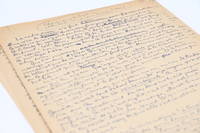
1948réf. 871601948. Fine. ""Pour moi l'amitié des assasins n'est pas l'amitié . tant pis si l'on me juge esclave et qu'on me juge sans coeur !"" For me the friendship of assassins is not friendship . too bad if I am judged a slave and judged heartless! s. d. 1948 21 x 30 cm 8 pages et demi sur 9 feuillets Exceptional autograph manuscript by Louis Aragon entitled ""Chronique de la pluie et du beau temps pour Europe mai"". 8 and a half pages in blue ink on 9 uniformly browned leaves. Numerous deletions and rewritings. Published in Europe no 29 May 1948 and does not appear in the book collecting these chronicles E.F.R. 1979. Superb nine-page militant profession of faith published in the anti-fascist literary review Europe. Aragon finds himself courted after the war in the name of ""friendship"" and ""freedom"" by various reviews but categorically refuses to publish alongside writers with Pétainist tendencies. The writer delivers his impressions after a radio interview in Belgium and meditates on ""two abstract monsters: freedom and friendship"" perverted at will in this early Cold War period when Sovietism becomes - to his great dismay - the new fascism. Very attached to the unified discourse advocated by communism which he calls ""national truth"" this notion serves as the guiding thread of his chronicle. Aragon writes in the midst of the Kravchenko affair and remains convinced by Sovietism which remains for him the great victor over Nazism. As a great literary witness to the suffering endured during the Occupation he is alarmed by the editorial choices of reviews seeking to obtain contributions from him: one shamelessly publishes a text by Montherlant totally oblivious to the Parisian martyrs during the war while the other affectionately justifies the allegiances of many French people to Marshal Pétain. It is also the occasion for a long and beautiful analysis of the idea of nation by Aragon who is unquestionably the national poet of this century. We find there in his inspired tirades the Aragonian ideal of healthy emulation among nations turned toward progress. Beautiful pages by Aragon in the midst of the crystallization of the Eastern and Western blocs. Aragon's ambition is to honor the memory of the Resistance by choosing to ""trust words when they are used for peace"". ""La Nation qui me paraît aujourd'hui encore être le groupe le plus étendu qui puisse se porter garant d'une vérité . la radio peut et doit transmettre à son public la vérité nationale . 'Qu'entendez-vous concrètement par vérité nationale ' Me demande-t-il comme il m'aurait sûrement demandé : qu'entendez-vous en disant qu'il fait grand jour en plein midi si je l'avais dit. C'est là le mécanisme des interviews. J'ai donc pris deux exemples concrets pour expliquer à quoi sert le maniement des abstractions. Deux cas récents où j'ai eu à me mesurer avec deux monstres abstraits : la liberté et l'amitié. La liberté d'abord. On sait comment les pires ennemis de la liberté font usage d'un livre qui s'appelle : J'ai choisi la liberté donnant le bénéfice d'un préjugé favorable de ce mot à tous ceux qui trahissent leur pays quand c'est pour choisir le système capitaliste . . Une revue qui s'édite à Montréal m'avait récemment écrit pour me demander ma collaboration. Son directeur littéraire faisait appel à l'homme libre l'italique est sienne que je suis. Cette façon de distinguer par la typographie en moi la possibilité d'être parfois un homme libre parfois non m'avait un peu inquiété. J'ai voulu voir sa revue . Mon Dieu le fait que ce numéro s'ouvre par un texte de M. de Montherlant me laisse libre de ne pas parler du contexte. On sait et j'imagine que M. Victor Barbeau de Montréal n'ignore pas que M. de Montherlant est sur la liste des écrivains avec lesquels les membres du Comité National des Ecrivains se refusent à collaborer. Ce qui doit sans doute m'expliquer pourquoi M. Barbeau s'adresse en moi à l'homme libre : c'est- unknown
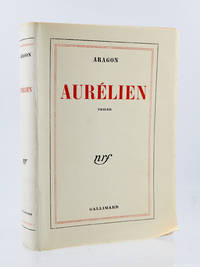
1948réf. 328702Paris: Gallimard 1948. First. hardcover. fine. Small 8vo full garnet crushed levant both covers decorated with important design of stars and gold white and blue fillets leading toward a central abstract figure gilt over uncut edges by P.L. Martin original wrappers bound in. Morocco edged chemise and slipcase. Paris: Gallimard FRS Limited First Edition. Fine. Number IV of only 14 large-paper copies on papier velin de Hollande in a handsome binding by one of the great modern masters. Gallimard unknown
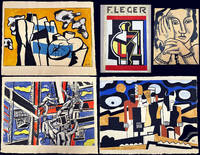
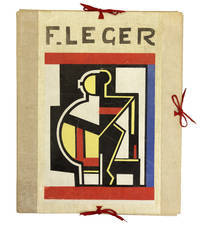
1959réf. N - 2026 - 13Contrastes 13 Aquarelles Gouache Lavis Crayon. Edition Au Vent d'Arles Paris 1959. Preface by Louis Aragon. Large portfolio with 13 pochoirs realized by Daniel Jacomet after Leger art works. Limited and numbered edition of 300 copies in Arabic 20 out of commerce in Roman numbered HC I to HC XX printed in Richard de Bass paper especially watermarked for this edition. Loose as issued and collected in the original pictorial cloth portfolio folder with Leger artwork. Published after Leger with the supervision of Nadia Leger Ref. Monod 7049. Au Vent d'Arles
1959réf. 1733531959. LEGER Fernand. Contrastes. With a préface by Louis Aragon entitled "La Lumière de Léger". Illustrated with 13 pochoir plates. Folio 508 x 393 mm loose as issued in the publisher's illustrated linen portfolio. Paris: Aux Vent d'Arles 1959. A spectacular portfolio of pochoir plates after Leger paintings executed by Daniel Jacomet whose atelier made some of the finest pochoirs. Very scarce because presumably most copies have been dismembered. Number 79 of 320 numbered copies. unknown
1944réf. 79256Paris: Gallimard 1944. Fine. Gallimard Paris 1944 14.50 x 21 cm broché First edition one of 88 numbered copies on pur fil paper deluxe copies after 13 on Holland paper. Rare and very handsome copy. Gallimard unknown
1915réf. 92341n. l. 1915. Fine. Aragon's Earliest Known Poem: The Birth of a Poet Soon to be Buried Beneath the Shells of the Great War n. l. 31 mars 1915 15.3 x 19.7 cm Un feuillet Autograph poem by Louis Aragon signed and dated 31 March 1915. Fourteen lines written in pencil on a single leaf with unpublished autograph calculations on the verso. Published in 2008 by Michel Apel-Muller in Le Continent Aragon special issue of LHumanité 2008 p. 17 and reissued under the title Poème in Le Rayonnement international dAragon Strasbourg coll. Recherches croisées Aragon / Elsa Triolet no. 16 2018 p. 251. Numerous traces of handling with vertical and horizontal folds that have caused minor paper losses without affecting the text. A precious fragment of literary history this sonnet published only in 2008 is the earliest known poem by Aragon according to its discoverer Michel Apel-Muller. Aragon wrote this lyrical reverie inspired by Baudelaires Parisian tableaux and by the Parnassian poets at the age of eighteen. He gifted it to his schoolfriend and inspiration for his novel Anicet Pierre Maison who succumbed to the Spanish flu in 1918 after fighting in the war. The Seine The pontoons draw away toward the hill That bounds the horizon with a bluish silhouette. The river bends at the foot of the quivering slope Of April reborn amid the hawthorn. In the red reflection of the setting sun Rises the factory black smoking and alive. The smoke and the sky are tinged with sanguine; A house stands and smiles at the passer-by. How life rises from this valley and how The work of nature and the labour of man Unite in a tone of evening rust! One senses amid the peace and the silence The song of birds that will rise from the vale To bring love to human suffering. translation our own Absent from accounts of Aragons life up to Philippe Forests most recent biography the sonnet was given to Pierre Maison this schoolfriend who had enlisted ahead of his call-up and who like Apollinaire succumbed to the Spanish flu in 1918. Aragon portrayed him in Anicet before burying the painful memory by assuming the characters identity in the famous phrase Anicet is me. Before André Breton and Drieu La Rochelle it was with Pierre Maison that he shared a profound intellectual friendship. Paradoxically this newly discovered princeps sonnet by Aragon comes accompanied by a rare wealth of context. The verses can be read in the light of a letter itself long unpublished addressed to Pierre Maison a few months later. This sprawling letter reveals that this poetic landscape of the Seine is in fact a memory: I thought of our good old discussions of days gone by. The memory came back to me as I was defending Wagner from the day we had gone down the Seine together talking about The Flying Dutchman Do you remember The weather was fine but the sun had something indefinably sad about it and the new spring resembled an autumn. When we stopped on the bank past Javel the sun was already low though it was not yet five oclock sic. Its rays already weakened and horizontal came from behind the distant hill where the houses along the Seine cling the river vanishing swiftly around a bend. Despite the dark green mass of the trees on the opposite bank bent over the flowing water everything seemed covered with an imperceptible tinge of rust: one might have said sic it was the dusty grip of the great city so near at hand upon the countryside. rise. And behind in an evening haze the hills of Meudon rose tier upon tier their woods concealing arbours and open-air taverns. This bleak landscape animated only by the movement of the Seine still lives on intensely in my memory. Aragon makes an almost literal reference to the poem which had captured on the spot this aesthetic emotion of the young student during an escapade among a band of high-spirited companions soon to be separated by the war: Aragon reminded me in unknown
1524réf. 7312Valencia 1524. Hardcover Tapa dura. 320x220mm. 12½x8¾". Manuscrito. Dado en Valencia a 23 días del mes de diciembre de 1524. En folio 320 x 220mm. 6 hojas sobre pergamino. Escritura cursiva. 32 líneas por página. Letras iniciales doradas. Firma autógrafa de Germana de Foix. Guardas de papel. Manuscrito de excepcional importancia dado por Germana de Foix viuda de Fernando el Católico reina de Aragón y Lugarteniente General en el Reino de Valencia en nombre del Emperador Carlos V y de su madre Doña Juana actúa como "Lugarteniente general de este dicho reyno de Valencia" y hace relación de los graves desmanes cometidos por las Germanías y a las familias valencianas a las que concede el indulto imponiéndoles una fuerte sanción económica. La rebelión de las Germanías fue un conflicto que se produjo en los reinos de Valencia y Mallorca a comienzos del reinado de Carlos I entre 1519 y 1523. Tuvo lugar paralelamente a la rebelión de las Comunidades de Castilla. Fue un movimiento social y político complejo de origen urbano pero que se extendió por todo el territorio con tintes antiseñoriales y que desencadenó una guerra civil. Gran parte de los artesanos y campesinos se enfrentaron a los señores territoriales y sus vasallos con especial presencia de los mudéjares. El emperador apoyó al bando señorial que fue el que finalmente salió victorioso. Tras la toma en marzo de 1522 de la ciudad de Valencia y la ejecución de los rebeldes con su líder Vicente Peris al frente la rebelión de las Germanías tocaba a su fin. Únicamente Játiva y Alcira quedaron bajo dominio agermanado lo que dio lugar a un rebrote de la rebelión esta vez acaudillada por un misterioso personaje conocido por "El Encubierto". Sin embargo tras el asesinato en Burjasot de "El Encubierto" en mayo de 1522 por dos seguidores suyos para cobrar la recompensa ofrecida por el virrey y la caída de Játiva y Alcira se produce la derrota definitiva de los agermanados nombrándose virreina de Valencia a Germana de Foix la cual gobernó duramente hasta su muerte. Germana de Foix Foix Francia 1488 - Liria Valencia 1536 esposa de Fernando II de Aragón El Católico fue reina consorte de Aragón 1505-1516 tras enviudar se casó con Juan de Brandeburgo en 1519. A lo largo de su reinado Germana de Foix ejerció como lugarteniente general durante las ausencias del rey Fernando y en 1523 fue nombrada virreina de Valencia 1523-1536 por el Emperador Carlos V cargo que ejerció hasta su muerte. Instalada como virreina de Valencia en el Palacio Real reprimió desde allí con severidad y brutal fuerza el movimiento de las germanías. Finalmente el día 23 de diciembre de 1524 Germana concedió un indulto a los "perayres" en este documento oficial que es considerado como uno de los primeros redactados en castellano en el Reino de Valencia. En el documento se hace una relación de las familias valencianas que lucharon con los rebeldes en las Germanías y se les concede indulto a cambio de fuertes sanciones económicas incautación de bienes tierras y astronómicas multas algunas de entre 1-2 millones de ducados en conceptos de indemnización y daños causados cantidades imposibles de pagar tanto a particulares como a gremios y gobiernos municipales implicados en la revuelta. hardcover
1976réf. 2091202133212860Maeght Editor 1976. Soft Cover. Fine. Volume: 1 Maeght Editor paperback