232 risultati
1876rif. 19972Aix-en-Provence, Remondet-Aubin, 1876 in-12 broché, couverture rose imprimée. 204 pp. (Dos endommagé, couverture en partie salie).
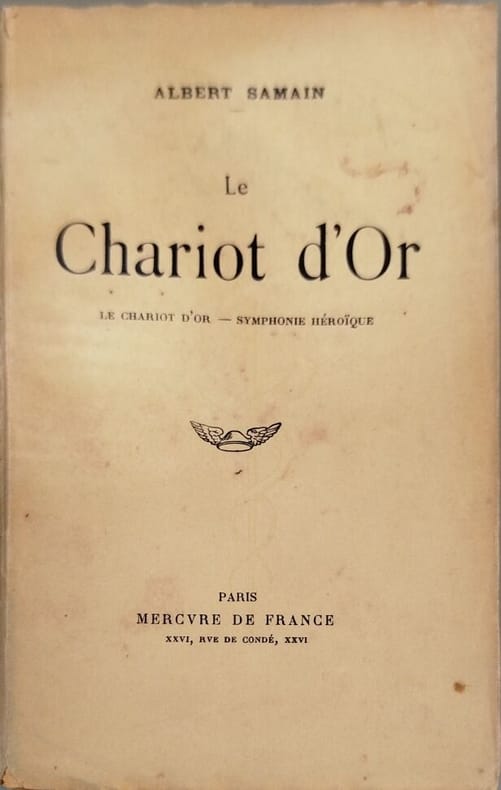
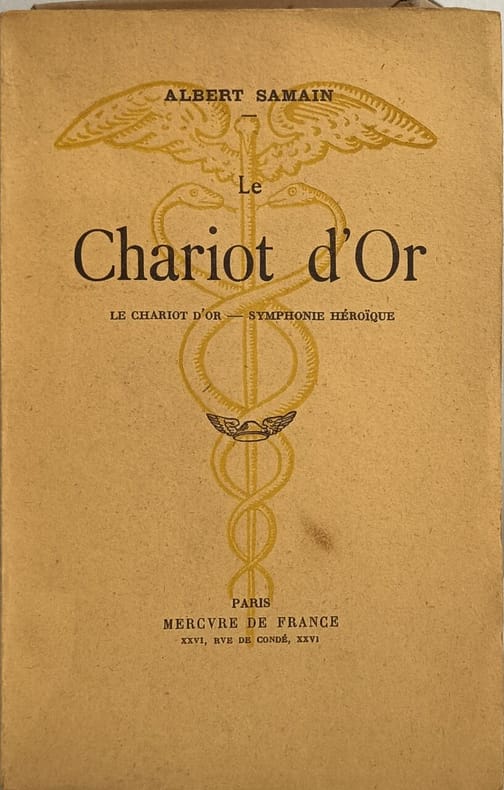
1943rif. 6504Mercvre de France 1943 236 pages in8. 1943. broché. 236 pages. Le Chariot d'Or est le troisième recueil posthume du poète symboliste Albert Samain publié en 1901. Il s'agit d'une œuvre poétique mélancolique riche en imagerie et métaphores qui connut un succès retentissant à la fin du XIXe siècle
1930rif. 7571Mercvre de France 1930 236 pages in8. 1930. broché. 236 pages. Le Chariot d'Or est le troisième recueil posthume du poète symboliste Albert Samain publié en 1901. Cette œuvre poétique mélancolique riche en imagerie et métaphores mêle musicalité raffinement et une sensualité voilée influencée par Baudelaire et Verlaine. Elle connut un succès retentissant à la fin du XIXe siècle
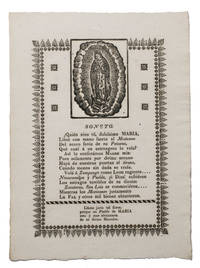
1821rif. ABC_48761Mexico 1821. Ca. 21.5 x 15.5 cm. The text is set within a decorative woodcut border together with a woodcut illustration of the Virgin of Guadalupe. 1 leaf. Beautifully printed broadside sonnet thanking the Virgin of Guadalupe for Mexico's victory over Spain after the Mexican War of Independence 1810-1821. Because the Virgin's image was used from the very start of the war she became a central symbol in Mexico's fight for independence. The present broadside reflects her significance. Broadsides like this were publicly distributed and quickly discarded thus making surviving examples quite scarce. Only a few copies have been recorded in libraries exclusively in the United States.The Mexican War of Independence was a series of local and regional armed struggles that resulted in Mexico's independence from the Spanish Empire. Spain's grip on its overseas possessions began to falter when Napoleon Bonaparte 1769-1821 invaded Spain in 1808 and forced King Charles IV 1748-1819 to abdicate. The instability of the colonial government allowed resentment towards the old regime to grow in Mexico. The first to issue a call to arms to denounce the bad government was Miguel Hidalgo y Castillo 1753-1811 a Catholic priest who led the first uprising of the war. He used the image of the Virgin of Guadalupe on his banner and most likely mentioned her name in his famous battle cry the grito de Dolores of which the exact words are unknown. Although his uprising did not last long due to tactical errors on his side the image of the Virgin stuck and she became the symbol for Mexico's rebellion.The Virgin of Guadalupe also known as the vírgen morena dark virgin already had a following in Mexico before the war. According to the tradition she appeared four times to Juan Diego a Chichimec peasant in December 1531. She asked him to build a church in her honour on the Hill of Tepeyac the place where she appeared. The bishop demanded proof when Diego relayed the message to him so the Virgin gave him roses which do not grow in December and placed them in Diego's cloak. When Diego unfolded his cloak for the bishop the roses were miraculously arranged in a perfect image of the Virgin of Guadalupe. The chapel was built and the Virgin was revered throughout the country. She became especially popular during and after the war however. The present broadside acknowledges the Virgins role in the independence movement illustrating her impact on Mexico's national identity and revolutionary spirit.In very good condition.l WorldCat 818219426 62559914 9 copies. AMERICAS LITERATURE & LINGUISTICS RELIGION & DEVOTION Broadsides Ephemera & Pamphlets Latin America Literature Mexico Middle America Religion 19th Century unknown
1877rif. 14504Paris, Impression Phototypique de Gleymet d'après les clichés de M. Franck ; in-folio, demi-chagrin vert, faux-nerfs à froid et dorés, fleurons dorés, titre doré sur le plat, en arc, plats de percaline (reliure de l'époque) ; (51) ff. montés sur onglets dont le titre, composition emblématique : juchée sur le pare-chocs d'une locomotive, l'Ecole Centrale, représentée par une femme nue tenant haut une torche dont les rayons Arts, Métallurgie, Construction, Mécanique et Chimie symbolisent le Progrès qui bouscule et écrase le clergé, les Indiens, les Allemands à casque à pointe, les "ânes", les Musulmans, une sorte de Juif errant, les incrédules et les oies ; les phares de la locomotive sont triangulaires ! Viennent ensuite 50 photographies ou sympathiques caricatures des dirigeants et professeurs de l'Ecole ; identité imprimée sur des papillons collés au dos de chaque planche.
1954rif. 016247G.l.m. Guy Lévis Mano 1954 In-16 à l'italienne En feuilles, couverture à rabat
rif. 48306Lemerre.(s.d.)In-12 demi-relié à coins.228 p. Bel exemplaire.En demi-vélin à coins,dos peint.Tête dorée.