226 resultados
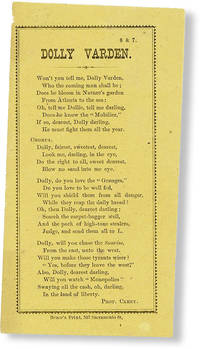
1870ref. 48786San Francisco: Bruce's Print n.d. ca. 1870s. First Edition. Small broadside 16x8.5cm. printed within typographically decorative border on yellow stock. Miniscule loss at top left-hand margin else Near Fine. Printed at head of title "8 & 7." Reconstruction-era three verse ballad broadside addressed to Dolly Varden not /the/ Dolly Varden of Charles Dickens' novel "Barnaby Rudge" though the name was hugely popular as a result of the work and inspired a fashion craze and the name of a trout. The text makes mention of the 1872 Crédit Mobilier fraud; promotes the work of the Patrons of Husbandry "Dolly do you love the 'Granges' / Do you love to be well fed / Will you shield them from all danger / While they reap the daily bread"; and attacks the spread of carpet-bagging in the South "Search the carpet-bagger well / And the pack of high-tone stealers / Judge and send them all to L. Bruce's Print unknown books
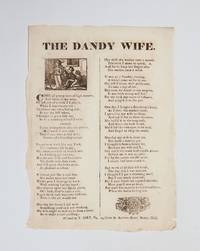
1828ref. 5421London: T. Birt 1828. First edition. Single sheet measuring 250 x 185mm and printed in two columns to recto. Some edgewear to margins not affecting text; a bit of foxing and toning largely confined to margins. A scarce and delicate survivor OCLC documents only one example at the National Library of Scotland. The present is the only example on the market. The Dandy Wife is narrated by a man who aimed "to choose me out a loving wife" at the age of twenty-one but whose experience becomes a warning to "all young men of high renown": "If you want a tidy wife Beware of a boarding school." What unfolds is a satire of how the marriage economy is affected when women have access to knowledge -- intellectual and physical -- and how by meeting a man's superficial expectations a woman can fulfill her own more pressing needs. Thinking that a boarding school girl will have the innocence submissiveness and domestic skill he desires the narrator selects a wife from among their ranks. Thinking only of what he can obtain from such a bargain he is unprepared for what an educated woman brings into his house. The Dandy Wife he describes understands the commodity value of her own beauty and material adornment and that these are her key means for acquiring wealth of her own. "She takes one-half of what I earn In drinking gin and tea; Besides such frills and furbelows My Dandy Wife does wear.Her sleeves upon her dandy gown Oh! Lack they're such a size You'd think they were two balloons that in the air would rise." Aside from staying on par with fashion trends her clothing assists her in avoiding domestic tasks she abhors. She refuses to do laundry more than monthly and through ridiculous cooking failures she rapidly establishes that the kitchen is not a showcase for her skillset. Accustomed to a life of learning she is not trained to conduct domestic business. By the ballad's end it becomes clear that the Dandy Wife was savvier in managing a marriage than her husband was. For not only does her superior intellect help her carve out a more satisfying role but she also has physical knowledge that predates him: "The day that I was married I thought I'd got a charming maid But I was much deceived.For scarce five months we'd married been When she had a darling son. T. Birt unknown books
1738ref. 16147London. 1738. Catching the British Lion by the Tail First edition first issue. An appealing 18th-century British ballad critical of Walpole's dealing with Spain. The full-page woodcut shows the Spanish king pulling the tale of the British lion which is about to mount a cart and be led away by a group of clerics harnessed to the wagon. The text attacks the British conciliation with Spain in 1738-39 and suggests that "you excise them in land I'll excise them by sea" in other words buccaneering. 7pp. Woodcut frontispiece. Folio. Later wrappers. Minor tears at folds of leaves else very good. unknown books
ref. 12420BBBerlin, Insel (= Insel-Bücherei Band 2006), 2018. 8°, 78 S., mit einer ganzseitig farbig illustrierte Titelseite sowie zahlreichen ganzseitigen Farbabbildungen, farbig illustr. original Pappband (Hardcover), Sonderausgabe Rückdeckel und Einbandkanten mit vereinzelten, dünnen, winzigkleinen Beschabungen, sonst aber ein sehr schönes, frisches, sauberes Exemplar mit ebensolchem Rücken.
2013ref. 55263Island, 2013. Auflage: Standard Version CD CD
1992ref. 55154Atlantic, 1992. CD CD
1991ref. 29102Teldec, 1991. 9031-72025-2 1 CD CD
2002ref. 51114Traumton, 2002. 4464 CD Digipack
1997ref. 54539Beaux, 1997. 4444 CD CD
1997ref. 54559Beaux, 1997. 4444 CD CD
2004ref. 54082FNM, 2004. 0263 2 DVD DVD
1989ref. 53970Time Life, 1989. RRC-G02 CD CD
ref. 50071Warner Rec., 2019. 2 CD CD
1989ref. 53127Elektra, 1989. CD CD
1995ref. 53581Zyx, 1995. 20343-2 CD CD
1991ref. 48431Prestige, 1991. OJCCD-298-2 CD CD
2014ref. 49575Naive, 2014. NV832011 CD Digipack
1990ref. 54226Island Records, 1990. 260604 CD CD
ref. 52901Air Music And Media, [o.J.]. AMU048 2 CD CD
2002ref. 54421Columbia, 2002. 506226-2 CD CD
1988ref. 54040A & M Records (Universal Music), 1988. 395224-2 CD CD
1991ref. 3119219Cambridge: Harvard University Press 1991. VIII, 317 Seiten. 8° (17,5-22,5 cm). Orig.-Broschur. [Softcover / Paperback].
1997ref. 38452ABFreies Schauspiel Ensemble Franfurt, um 1997. CD, Laufzeit: ca. 1 Std., im original Jewel Case und mit dem original booklet, sehr guter Zustand
1826ref. 014495T. Davison, Whitefriars 1826. 1.Auflage Dieser Ausgabe Goldgeprägter Ganzlederband Gut, Schön, Solide
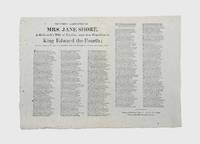
1810ref. 174973London: printed and sold by J. Pitts c. 1810. An ephemeral broadside ballad detailing the story of Jane Shore a mistress of Edward IV and a popular cultural reference for many centuries. Shore's heavily fictionalized story featured many elements considered to have mass appeal in the era: a sexually voracious woman a relationship that transcended social hierarchies and an ending that punished transgressive behaviour. In Mrs. Jane Shore the eponymous character is described as a married woman who became King Edward's concubine and "lived in the court/With lords and ladies of great sort". Whilst she had influence over the King she ensured "to help the people that were poor" and "sav'd their lives condemned to die". Regardless her infidelity ultimately led to her social disgrace and she died in a ditch in East London. As detailed in the ballad urban mythology claimed that her unfortunate death gave the Shoreditch district its name. Ballads such as this were sung in a variety of communal spaces including pubs lodging houses and the streets and typically took criminal or socially deviant behaviour as their subject. In their own time broadside ballads were believed "to foster immorality and to glorify crime" O'Brien p. 16. More recent interpretations appreciate their literary and social value and consider that "their job was to voice tensions to work over the contradictions of human life" Gammon p. 237. Landscape single sheet 362 x 252 mm printed in columns. A little chipped at the edges but overall a well-preserved copy of a fragile publication. Vic Gammon "Song Sex and Society in England 1600-1850" Folk Music Journal vol. 4 no. 3 1982; Ellen L. O'Brien "'The Most Beautiful Murder': The Transgressive Aesthetics of Murder in Victorian Street Ballads" Victorian Literature and Culture vol. 28 no. 1 2000. unknown