BROADSIDE BALLADBiblio.com
226 resultados
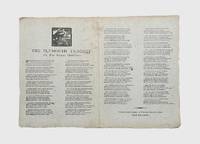
1809ref. 174972London: printed and sold by Jennings c. 1809. A ballad telling a tragic tale of lovers tricked apart by "cruel" and "covetous" parents. Similar ballads often feature an unfaithful and avaricious antiheroine who suffers a cautionary downfall. Here however Susan is a "harmless maid" and it is families who are warned against prioritizing wealth over the happiness of the younger generation. The love triangle between a woman her husband and a sailor was a common trope in 17th- to 19th-century ballads but most had several key differences to this version. The woman was normally the one to prioritize financial gain unlike Susan who declares that "No wealth nor riches shall make me disloyal". The sailor was typically a demonic character sometimes the Devil in disguise whereas "sweet William" is an honest and faithful man. In most ballads only the woman dies while the sailor-demon escapes; both Susan and William perish here. Such entertaining ballads were an outlet for people "to voice tensions to work over the contradictions of human life" Gammon p. 237. The Plymouth Tragedy reflects an exasperation with the requirements on the young especially women to conform with their parents' desires at the expense of their own happiness. Single sheet 255 x 360 mm printed in columns. Woodcut vignette. A little nicked at edges old centre fold reinforced on verso with paper; overall a well-preserved copy of a fragile publication. Vic Gammon "Song Sex and Society in England 1600-1850" Folk Music Journal vol. 4 no. 3 1982. unknown
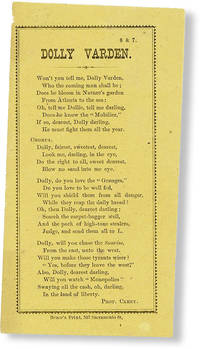
1870ref. 48786San Francisco: Bruce's Print n.d. ca. 1870s. First Edition. Small broadside 16x8.5cm. printed within typographically decorative border on yellow stock. Miniscule loss at top left-hand margin else Near Fine. Printed at head of title "8 & 7." Reconstruction-era three verse ballad broadside addressed to Dolly Varden not /the/ Dolly Varden of Charles Dickens' novel "Barnaby Rudge" though the name was hugely popular as a result of the work and inspired a fashion craze and the name of a trout. The text makes mention of the 1872 Crédit Mobilier fraud; promotes the work of the Patrons of Husbandry "Dolly do you love the 'Granges' / Do you love to be well fed / Will you shield them from all danger / While they reap the daily bread"; and attacks the spread of carpet-bagging in the South "Search the carpet-bagger well / And the pack of high-tone stealers / Judge and send them all to L. Bruce's Print unknown
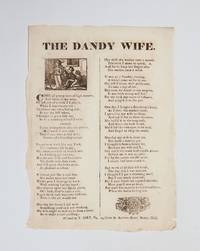
1828ref. 5421London: T. Birt 1828. First edition. Single sheet measuring 250 x 185mm and printed in two columns to recto. Some edgewear to margins not affecting text; a bit of foxing and toning largely confined to margins. A scarce and delicate survivor OCLC documents only one example at the National Library of Scotland. The present is the only example on the market. The Dandy Wife is narrated by a man who aimed "to choose me out a loving wife" at the age of twenty-one but whose experience becomes a warning to "all young men of high renown": "If you want a tidy wife Beware of a boarding school." What unfolds is a satire of how the marriage economy is affected when women have access to knowledge -- intellectual and physical -- and how by meeting a man's superficial expectations a woman can fulfill her own more pressing needs. Thinking that a boarding school girl will have the innocence submissiveness and domestic skill he desires the narrator selects a wife from among their ranks. Thinking only of what he can obtain from such a bargain he is unprepared for what an educated woman brings into his house. The Dandy Wife he describes understands the commodity value of her own beauty and material adornment and that these are her key means for acquiring wealth of her own. "She takes one-half of what I earn In drinking gin and tea; Besides such frills and furbelows My Dandy Wife does wear.Her sleeves upon her dandy gown Oh! Lack they're such a size You'd think they were two balloons that in the air would rise." Aside from staying on par with fashion trends her clothing assists her in avoiding domestic tasks she abhors. She refuses to do laundry more than monthly and through ridiculous cooking failures she rapidly establishes that the kitchen is not a showcase for her skillset. Accustomed to a life of learning she is not trained to conduct domestic business. By the ballad's end it becomes clear that the Dandy Wife was savvier in managing a marriage than her husband was. For not only does her superior intellect help her carve out a more satisfying role but she also has physical knowledge that predates him: "The day that I was married I thought I'd got a charming maid But I was much deceived.For scarce five months we'd married been When she had a darling son. T. Birt unknown
1830ref. TH262Nottingham: The Review-Office 1830. Original Ediiton . No Binding. Vg. Folio. Broadslip Ballad 32x13cms 12 3/4 x 5 inces. Attractive half page broadside with a fine and attractive printed border to the verses. Small woodcut to the head of the page depicting a printing press.NO COPY TRACED. Believed to be printed at Suttons Review Office in Nottingham and dated 1830. 8 four line verses extolling the press and reflecting on events of the year just gone.William IV had taken the throne and was welcomed as a Royal Navy sailor and a reformer. Charles and Richard Sutton printers and proprietors of the liberal Nottingham Review The Review-Office unknown
1860ref. 214168Glasgow: Printed for the Booksellers" 1860. No. 20 printed at foot of title. Title with woodcut vigentt of "Fair Rosanna". 8 pp. 1 vols. 12mo. Single sheet folded twice; unopened and unbound. A little dusty and wrinkled otherise very good. No. 20 printed at foot of title. Title with woodcut vigentt of "Fair Rosanna". 8 pp. 1 vols. 12mo. Printed for the Booksellers" unknown
ref. 61810842Jones & Bartlett Publishers Incorporated . Papeback. New. pp. xvii 391 1st Edition Jones & Bartlett Publishers, Incorporated unknown
1894ref. j2359aDurham: Thos Caldcleugh. G : in Good condition without dust jacket. Cover rubbed and soiled. 1894. First Edition. Brown hardback boards with blue cloth spine. 260mm x 200mm 10" x 8". 43pp. Line drawings by Rev. N Temple Hamlyn. A poem to celebrate the battle of Hedgely Moor in Northumberland in 1463. Dedicated to the Right Honourable Earl Percy - illustrations undertaken with his Lordship's permission. Illustrations include Alnwick Castle Chillingham wild cattle Eglingham and the armorial bearings of the Percys Nevilles and other noble families recounted in the ballad. . Thos Caldcleugh hardcover
2018ref. Gyan-9789361683435Facsimile Publisher 2018. Hardcover. New. 22.59 x 14.34 x 3.41 cm. English Facsimile Publisher hardcover
2018ref. Gyan-9789361683435Facsimile Publisher 2018. Hardcover. New. 22.59 x 14.34 x 3.41 cm. English Facsimile Publisher hardcover
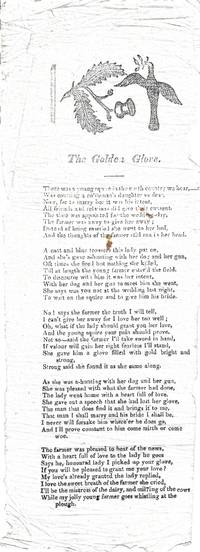
ref. 7461Publisher and date not stated. Circa 1840. Printed on one side of a piece of wove paper roughly 280 x 95 mm. Aged creased and spotted with chipping to extremities but with text and illustration clear and entire. Curious small roughly 40 x 65 mm crude illustration at head showing dove with olive branch and acorn. Forty-line poem arranged in five stanzas. Interestingly-garbled nineteenth-century folk song with ancient antecedents. First stanza reads 'There was a young squire in the north country we hear Was courting a nobleman's daughter so dear Now for to marry her it was his intent All friends and relations did give their consent. The time was appointed for the wedding-day The farmer was sorry to give her away; Instead of being married she went to her bed And the thoughts of the farmer still ran in her head.' The lady puts on 'A coat and blue trousers' and goes 'a-hunting with her dog and her gun'. She converses with the farmer who unaware of her true identity declares his love for her. She gives the farmer a glove full of gold goes home and declares that she has lost her glove and will marry the man who finds it. Last lines: 'I'll be the mistress of the dairy and milking of the cows While my jolly young farmer goes whistling at the plough.' Several copies of items with this title on COPAC but none exactly corresponding to this one and most with the first line reading 'A wealthy young squire of Tamworth we hear'. See Image. Publisher and date not stated. [Circa 1840?] unknown
ref. 7460Date circa 1840 and publisher not stated. On one side of a piece of thin wove paper roughly 260 x 95 mm. Aged and creased with internal 25 mm closed tear affecting four words of text all of which can be completed from the context repaired on blank reverse with archival tape. Otherwise text and illustration clear and entire. Small 30 x 40 mm woodcut at head showing two early nineteenth-century country coves outside a cottage. The poem consists of ten four-line stanzas. The first stanza reads 'When I was young I was much beloved By all young men in the country; When I was blooming in all my blossom A false young lover deceived me.' Last stanza: 'Its time will soon put an end to all things And love will soon put an end to me And sure there is a place of torment To punish my lover for slight'ing me.' A touching poem of betrayed love: 'Its turn you round you wheel of fortune Its turn you round and smile on me For young men's words they're quite uncertain For sad experience teaches me.' Scarce. No copy on COPAC or in the British Library. Image on application. Date [circa 1840?] and publisher not stated. unknown
ref. 7459Date and publisher not stated. London; circa 1840. Printed on one side of a piece of wove paper roughly 230 x 90 mm. On pitted aged paper. Text complete. Approximate 30 x 50 mm piece torn away from top right-hand corner causing loss to small illustration at head which appears to be a crude woodcut of a woman lying in a coffin. The poem consists of thirty-six lines arranged in five stanzas. The first stanza reads 'Dear Peggy read this letter its the last one I'll send Our long correspondence is now at an end. I am wounded through the body no surgeon can cure The pain that I feel is hard to endure.' Last stanza reads 'Farewel my dear Peggy farewel for evermore For I never will see you my own native shore.' The narrator appears to have been shot in battle. He stops the 'flow from my wound . for to gain as much time As to write unto Peggy'. Scarce. No item with this title on COPAC or at the British Library. Image on application. Date and publisher not stated. [London; circa 1840?] unknown
ref. B9781020484889Hardback. New. hardcover
ref. ria9781284031591_inpPaperback. New. New Book; Fast Shipping from UK; Not signed; Not First Edition; N/A paperback
ref. 20397795-nnew. unknown
ref. 20397795like new. unknown
ref. B9781017061826Hardback. New. hardcover
2006ref. 17002JLos Angeles: Netflix 2006. First Edition. Small format paperbound 5 1/2” x 8 1/2” 112 pages. Specially printed for distribution to members of the Academy of Motion Pictures Arts & Sciences in consideration for nomination of the Best Adapted Screenplay. Shooting script for the film The Ballad of Buster Scruggs written and directed by Joel Coen and Ethan Coen from a story by Jack London starring Tim Blake Nelson Willie Watson Clancy Brown and James Franco. A perfectbound book looking like a trade paperback. The film was nominated for 3 Oscars; Best Adapted Screenplay Best Costume Design and Best Original Song ‘When a Cowboy Trades His Spurs for Wings’ by David Rawlings and Gillian Welch. Paperbound. A little rubbing to covers otherwise a fine copy Netflix paperback
2014ref. 108521Museum. New. Paperback. FREE UPGRADE to Courier/Priority Shipping Upon Request - IN STOCK AND IMMEDIATELY AVAILABLE FOR SHIPMENT - Flawless copy brand new pristine never opened - -- with a bonus offer-- . 2014. 0942949382 . Museum paperback
ref. Juanpebooks061117WE ship worldwide. Brand new 100%guarentee unknown
1738ref. 16147London. 1738. Catching the British Lion by the Tail First edition first issue. An appealing 18th-century British ballad critical of Walpole's dealing with Spain. The full-page woodcut shows the Spanish king pulling the tale of the British lion which is about to mount a cart and be led away by a group of clerics harnessed to the wagon. The text attacks the British conciliation with Spain in 1738-39 and suggests that "you excise them in land I'll excise them by sea" in other words buccaneering. 7pp. Woodcut frontispiece. Folio. Later wrappers. Minor tears at folds of leaves else very good. unknown
ref. 1343415365.Ghardcover. Good. Access codes and supplements are not guaranteed with used items. May be an ex-library book. hardcover
2010ref. Q-0763791288Jones & Bartlett Learning 2010-09-24. Paperback. New. In shrink wrap. Looks like an interesting title! Jones & Bartlett Learning paperback
ref. 0484441906.Ghardcover. Good. Access codes and supplements are not guaranteed with used items. May be an ex-library book. hardcover
ref. Sven-Bertil JanssonNot in perfect condition. unknown