(BODONI IMPRINT). ANACREONBiblio.com
429 résultats
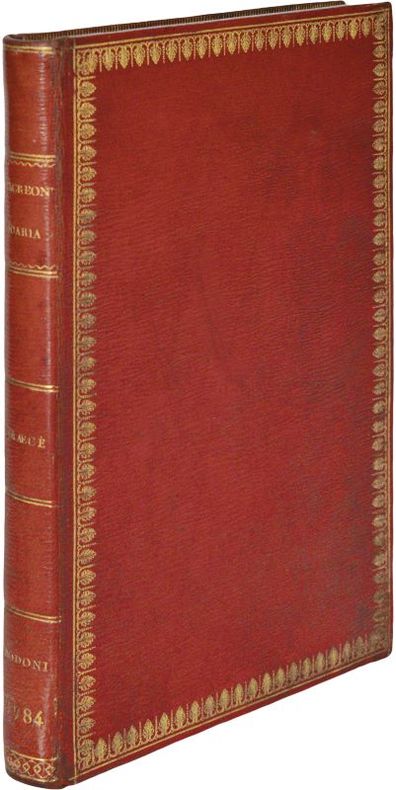
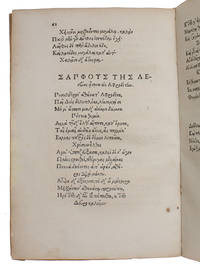
1785réf. ST11935Parmae: Ex Regio Typographeio 1785. ONE OF 50 COPIES ON FINE PAPER of a total of 310 copies. 308 x 216 mm. 12 1/8 x 8 1/2". 2 p.l. xciv 100 pp. 1 leaf. VERY ATTRACTIVE CONTEMPORARY CRIMSON STRAIGHT-GRAIN MOROCCO spine beautifully gilt in compartments between green stylized pentaglyph and metope strips flanked by double raised bands the plain-ruled compartments densely stippled with gold dots surrounding a small central medallion from which emanate a number of wavy vines bearing flowers and small leaves anular dot cornerpieces elaborately gilt turn-ins blue watered silk endpapers the pastedowns framed with elegant gilt garlands and bead-and-lozenge roll free endleaves with cresting gilt frame leather hinges these expertly renewed at top and bottom all edges gilt. In a modern brown cloth chemise and morocco-backed slipcase. Small author portrait tondo on title page large and elaborate armorial vignette on dedication page engraved by Cagnoni. Text of poems in Greek commentary in Latin both printed entirely in majuscules. Front pastedown with morocco monogram bookplate of Charles C. Kalbfleisch engraved bookplate of Hugh Morriston Davies and book label of Charles Whibley see below. Brooks 287; Dibdin I 265; Schweiger 25; Brunet I 252; Graesse I 111. ◆Spine probably a bit sunned though difficult to tell with so much gilt four tiny wormholes to joints extremities with a hint of rubbing but the binding solid lustrous and attractive; A SPECTACULAR COPY INTERNALLY entirely clean fresh and bright and with enormous margins. This is a superb copy of the luxury paper Bodoni printing of the works of the sixth century B.C. lyric poet Anacreon. Imbued with delicacy and grace these works come down to us only in fragments quoted by other authors or in the derived form of imitators and they did not find their way into print until after the middle of the 16th century. Produced by Giambattista Bodoni 1740-1813 the most celebrated European printer of his era this remarkable piece of work is called "magnificent" by Brooks and Dibdin says that a "more elegant and exquisitely finished production . . . cannot be conceived." The appearance of the page printed only with capitals and offered here in a copy with vast margins is simply as stately and powerful as one could ever hope for. Bodoni was not only a great printer but also the most important type designer and punchcutter in Italy during his day. He was responsible for some of the most graceful and immaculate books to be printed during the end of the 18th and beginning of the 19th century and the present item is certainly to be counted among his most beautiful productions. The present copy has a distinguished provenance. Charles C. Kalbfleisch was a discriminating American collector whose library featured a great many beautiful bindings and who was known for choosing only the finest copies available. Parke-Bernet sold much of his collection in January of 1944 in a sale entitled "The Arts of the Book . . . The Splendid Library Formed by the Late Charles C. Kalbfleisch New York." Hugh Morriston Davies 1879-1965 was a pioneering surgeon known as "The Doyen of Thoracic Surgery" who collected fine bindings especially those of the 18th century. Charles Whibley 1859-1930 authored important books and wrote popular periodical columns of literary interest edited a number of works in the substantial and distinguished "Tudor Translations" series was at the center of a British literary circle with links to the Symbolist poets of France and made an enormous contribution to literature by recommending T. S. Eliot to Faber & Faber. Ex Regio Typographeio unknown
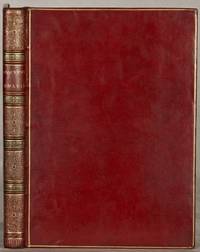
1784réf. 0041201784 Parmae [Parme], Ex Regio Typographeio [Bodoni], 15 septembre 1784. Petit in-quarto (170 X 246 mm) maroquin rouge à grain long, encadrement de dentelle et filet dorés sur les plats, dos lisse fileté, titre doré avec en queue la date d'impression et la mention «Bodoni», chainette dorée en queue, coupes et coiffes filetées, tranches dorées (Reliure de l'époque); (7) ff. dont titre, LXXXII-103 pages, (1) page d'achevé d'imprimer. Deux ex-libris gravés collés sur le premier contreplat.
1554réf. 60114Lutetiae (i.e. Paris), (? Guillaume Morel for) Henri Estienne (II), 1554. 4to. Contemporary limp vellum with remains of ties to boards. Remains of contemporary paper labels to spine and traces of autor in ink in contemporary hand, also to spine.A few smaller worm tracts to boards and a bit of spotting, but overall very nice. A large spot to title-page, presumably erased ink, from the removal of an old owner's name. The spot is in the blank margin, close to the printer's device, but not touching it. Apert from that internally very nice with only light occasional damp staining or browning. Old ink note in Greek characters to front free end-paper and a small note (referring also to ""Lyra"") on A(1)r. A very nice copy with large margins. Woodcut printer's device to title-page, woodcut headpiece and opening initial. Magnificently printed in all three sizes of the famous ""grecs du roi""-type. (8), 110 pp.
1554réf. 60114Lutetiae i.e. Paris Guillaume Morel for Henri Estienne II 1554. 4to. Contemporary limp vellum with remains of ties to boards. Remains of contemporary paper labels to spine and traces of autor in ink in contemporary hand also to spine.A few smaller worm tracts to boards and a bit of spotting but overall very nice. A large spot to title-page presumably erased ink from the removal of an old owner's name. The spot is in the blank margin close to the printer's device but not touching it. Apert from that internally very nice with only light occasional damp staining or browning. Old ink note in Greek characters to front free end-paper and a small note referring also to "Lyra" on A1r. A very nice copy with large margins. Woodcut printer's device to title-page woodcut headpiece and opening initial. Magnificently printed in all three sizes of the famous "grecs du roi"-type. 8 110 pp. Rare first edition of the groundbreaking Anacreon-volume by H. Estienne being the milestone publication that not only constitutes the first book by the brilliant Henri Estienne II but also the extremely influential editio princeps of the Anacreontea. Furthermore this groundbreaking publication contains Sappho’s now immortal Aphrodite-hymn being the very first of any of Sappho’s poems to appear in print here for the second time in print as well as the magnificent “Midnight poem” fragment 168B establishing for the first time since antiquity the gathering together of poems by Sappho: “A momentous point in her transmission. Yet it is ironic that the first collection of a fragmentary Greek poet known and admired beyond any other today should have appeared as a mere appendix to a book dedicated to another author entirely without even her name on the title-page.” Cambridge Companion to Sappho p. 251. The impact that Sappho - “mother of all women poets” - would eventually come to have upon modern poetry and society was not yet known to Estienne and his contemporaries for whom she was more or less unknown. Estienne however recognized the value of the poems of hers that he had encountered and with the publication of them in the present volume began a tradition that would eventually cause her to become arguably the most celebrated Greek poet of all time. “Estienne’s edition of Anacreon’s poetry was enthusiastically received by the Pléiade poets which considerably boosted Sappho’s influence on western European literature”. van Dijk: I Have Heard about You p. 37. This beautifully printed slim volume constitutes an outright Renaissance sensation. “The “Anacreaonta” became the most influential “ancient” Greek poetic text during the Renaissance and Estienne’s “editio princeps” virtually caused a poetic revolution not only in France but also in Italy and Germany – where this influence culminated in the 18th century with the Anacreontic Poets “Die Anakreontiker”.” Schreiber 139. Henri Estienne II – “in many ways the greatest member of the Estienne dynasty and most certainly its most prolific scholar” Schreiber - had travelled extensively through Italy the Low Countries and England in search of Greek manuscripts. It is from one of these that he had printed possibly by Guillaume Morel his first book this editio princeps of the Anacreaontea which is thus also the first book to bear his imprint. Henri Estienne along with his contemporaries believed the work to contain the ancient Greek lyrics of the poet Anakreon 6th century BC whose poems are not extant except for some short fragments. In fact the poems contained in this volume constitute the Anacreontea which is a collection of Greek lyric poems written in the style and imitation of Anacreon at various dates. “Henri’s publication of these “ancient” Greek lyrics caused an immediate literary sensation in France and was celebrated and immortalized by Ronsard in an oft-quoted passage of his “Odes”.” Schreiber. Henri Estienne started out his publishing career with this magnificent publication that catapulted him into fame and he went on to become one of the most influential literary and scholarly figures of the second half of the 16th century in Europe; he dominated Renaissance scholarship with his magnificent publications and has arguably not been superseded by any publisher since. The young Henri Estienne had discovered the present poems in Louvain in a manuscript owned by an Englishman named John Clements who was a friend of Thomas More. Their publication “was a sensation of the first class and the starting-point for a new branch of modern literature” R. Pfeiffer: History of Classical Scholarship” p. 109. “This first edition was greeted with tremendous enthusiasm by the members of the Pléiade who like everyone else believed the poems genuine and each of whom immediately translated or imitated some of the “Anacreontea”.” Schreiber. The poems may not have been “genuine” Anacreon-poems but the influence that the publication of them came to exercise was no less profound than had they been; the mark they have left of modern literature is difficult to compare to anything else. The printing of the original Greek text in all three sizes of the magnificent “grecs du roi”-type is followed by the first Latin translation of the poems done by Estienne himself and by Estienne’s own commentary. The text of this editio princeps has been followed by almost every subsequent editor and today the name Anacreon cannot be mentioned without thinking of Estienne. After the Anacreon-poems themselves are two leaves containing first poems by Alkaios and second the two famous poems by Sappho: The Ode to Aphrodite fragment 1 and the Midnight Poem fragment 168B also known as “The Moon Sets” constituting a momentous point in the Sappho-transmission namely the first time since antiquity that anyone had gathered together poems by her. Soon after more Sappho-collections would appear causing her to eventually become the most admired Greek poet. “In a recent article R. Aulotte… shows how Sappho’s influence on the poets dates from the time when Henri Estienne published the odes then known along with his famous edition of Anacreon. His first edition published in 1554 contained the “Ode to Aphrodite” and the fragment “The Moon has Set”.” Mary Morrison: Henri Estienne and Sappho in: Bibliothèque d’Humanisme et Renaissance T.24 N.2 1962 p. 388. "From time immemorial women poets have had only one norm one touchstone: Sappho the legendary woman poet who lived on the island of Lesbos in the Aegean sea in the 6th century BC. … The Sappho figure is the peg on which views of female poetic genious and female sexuality have been hung century after century.” Suzanne van Dijk: I Have Heard about You… p. 35 . Dibdin I: 258 “A beautiful and rare edition”; Schreiber: 139; Renouard: 115. hardcover