McIlroy, David HBiblio.com

2 963 résultats
réf. 1498254241.Ghardcover. Good. Access codes and supplements are not guaranteed with used items. May be an ex-library book. hardcover
réf. 0872491951.Gpaperback. Good. Access codes and supplements are not guaranteed with used items. May be an ex-library book. paperback
réf. 1009203002.Gpaperback. Good. Access codes and supplements are not guaranteed with used items. May be an ex-library book. paperback
réf. 1107562511.Gpaperback. Good. Access codes and supplements are not guaranteed with used items. May be an ex-library book. paperback
1990réf. 080626Wales: University Of Wales Press 1990. Hard covers in bright condition with a very good dust jacket contents unmarked first edtion uncommon. First Edition. Hardcover. Very Good/Very Good. 4to - over 9¾" - 12" tall. University Of Wales Press Hardcover
réf. 0822342197.Ghardcover. Good. Access codes and supplements are not guaranteed with used items. May be an ex-library book. hardcover
réf. 1800464762.Gpaperback. Good. Access codes and supplements are not guaranteed with used items. May be an ex-library book. paperback
réf. 1107459176.Gpaperback. Good. Access codes and supplements are not guaranteed with used items. May be an ex-library book. paperback
réf. 0736062807.Gpaperback. Good. Access codes and supplements are not guaranteed with used items. May be an ex-library book. paperback
réf. 1607814250.Gpaperback. Good. Access codes and supplements are not guaranteed with used items. May be an ex-library book. paperback
réf. 0521125960.Gpaperback. Good. Access codes and supplements are not guaranteed with used items. May be an ex-library book. paperback
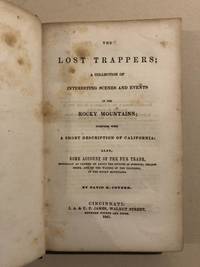
1847réf. 53428Cincinnati: J. A. & U. P. James 1847. 1847. First edition. First Edition. 12mo. Original blind-stamped Cloth with title in gilt on spine. xv 16 - 255 pp. blank plus 7 pp. of Advertisements Introduction Appendix. Graff 897 says "Howes and Wagner-Camp suggest doubt about the veracity of the author the "lost trappers" were from the Lewis and Clark Expedition. Some statements in the work are demonstrably untrue but there are sections which may be proven authentic." Coyner a Presbyterian preacher sojourning in Missouri claims to have compiled this narrative on behalf of a Virginia newspaper seeking frontier material basing it on an old musty mutilated journal kept by Ezekial Williams a Kentucky-born trapper. The main incidents concern the wanderings and adventures and his colleagues in the Rocky Mountains from 1809 to 1813 and the overland journey of two of them - the "Lost Trappers" - to California in 1809-1810. One of the early pictures of California. Professionally rebacked with original cloth spine retained and a little touch-up to corners. Modest amount of foxing scattered throughout. In all a very good copy of a fur trade classic. Interesting small 1"x2" old label of merchant that sold this book affixed to upper front endpaper reads: A. D. Sproat Druggist Chillicothe O. J. A. & U. P. James, 1847. hardcover
réf. 1882987020.Gunknown_binding. Good. Access codes and supplements are not guaranteed with used items. May be an ex-library book. unknown
1960réf. 051640Bookman Associates. dust jacket chipped; inscribed by Zook . Very Good. Hardcover. 1st Edition. 1960. Bookman Associates hardcover
réf. 0932147178.Gpaperback. Good. Access codes and supplements are not guaranteed with used items. May be an ex-library book. paperback
réf. 1025119991.Ghardcover. Good. Access codes and supplements are not guaranteed with used items. May be an ex-library book. hardcover
2004réf. 043302Washington D.C.: Natl Geographic Society 2004. Faux Leather. Fine/Not Issued. 4to - over 9¾ - 12" tall. Deluxe Edition. Includes Bibliographical References And Index. The Book Is Bound In Brown Faux Leather Over Boards With Gilt Lettering On The Spine. Full Color Pastedown Image Of The Hubble Telescope On The Front. Burgundy Marker Ribbon Bound In. Natl Geographic Society hardcover
1996réf. 85947New York: William Morrow and Company Inc 1996. First Edition Stated First Printing Stated. Hardcover. Very good/Very good. 10 350 8 pages. Glossary. Index. Minor edge soiling. Inscribed on the half-title page by the author. Inscription reads 29 Aug. '96 For: Matt An old comrade from the Blue Devil Division. Warmest regards Hack. During World War II the Germans thought the 88th Division of the United States Army was an elite stormtrooper Division. This was most likely due to parallels between the "Blue Devil" nickname and patch rocker and the German SS's use of the Totenkopf death's head insignia. David Haskell Hackworth November 11 1930 - May 4 2005 also known as Hack was a prominent military journalist and a former United States Army colonel who was decorated in both the Korean War and Vietnam War. Hackworth is known for his role in the creation and command of Tiger Force a military unit which was formed in South Vietnam to apply guerrilla warfare tactics against Viet Cong guerrilla fighters. Hackworth is also known for his accusation in 1996 that Chief of Naval Operations Admiral Mike Boorda was wearing two unauthorized service ribbon devices on two of his uniform's awards denoting valor in combat. Although Admiral Boorda had served off the coast of Vietnam in the 1960s and believed he was authorized to wear the two wartime decorations for meritorious service he did not meet the Navy's requirements. Tom Matthews worked for three decades for Newsweek where he served as New York Bureau Chief Senior Writer for National Affairs Foreign Editor Culture Editor and Senior Editor for Special Projects and won a National Magazine Award. In Hazardous Duty - a real life nonfiction thriller set in the ruins of Bosnia and the sands of Saudi Arabia the deadly alleys of Mogadishu and the teeming streets of Port-au-Prince - Colonel David Hackworth completes a second tour of battlefield duty this time as a war correspondent. In his hard-hitting inimitable style he tells of the sacrifices of ordinary grunts in the Balkans the Persian Gulf Somalia Korea and Haiti and offers a tough-love critique of American military leadership explaining America's role in new post-Cold War conflicts. Colonel David H. Hackworth is America's most decorated living soldier with more than one hundred awards including two Distinguished Service Crosses nine Silver Stars eight Bronze Stars for valor and eight Purple Hearts which he considers the most meaningful because he says "they can't be faked." More than any other military commentator he has the trust and confidence of the millions of soldiers - from foreign armies as well as our own - who cheered every word of his widely acclaimed autobiography. A wake-up call for military reform Hazardous Duty pulls no punches in calling America's top political and military leaders to account for selling out duty honor and country. Colonel Hackworth returns from America's new battlefields to report that the Pentagon is wasting billions of dollars. He offers no-nonsense solutions for streamlining the military services and rationalizing their missions to confront the new face of war. Derived from a Kirkus review: An unsparing critique of the US military as well as its industrial and political allies from a been-there/done-that warrior. Hackworth has been in the thick of the action in the Balkans Haiti the Persian Gulf and Somalia. He has also taken unsentimental journeys to Korea and Vietnam venues in which he earned eight Purple Hearts. The colonel's first-person accounts feature hard- hitting observations on the capacities of the US military plus recollections of his time as a front-line commander. Targets include Pentagon contractors who produce expensive weapons systems lawmakers who support megabuck procurement programs and senior officers with a sharper eye for budgetary advantage than for eliminating wasteful duplication. Hackworth has a thoroughgoing reform agenda including amalgamating the National Guard with the Reserves gearing up for brushfire belligerencies and encouraging professionalism rather than careerism in the officer corps. William Morrow and Company, Inc hardcover
1998réf. 83492Washington D.C.: National Aeronautics and Space Administration 1998. Presumed first edition/first printing. Hardcover. Very good/very good. VOLUME III ONLY. xxix 1 608 2 pages. 25 cm. Illustrations. Glossary. Biographical Appendix. Index. Slight wear and soiling to DJ. Inscribed by John Logsdon on the half-title page. Inscription reads: To Lou Jaffe With respects for everything he has mad happen. Best wishes John Logsdon. Reception flyer for the book's release laid in. This is part of the NASA History Series. John M. Logsdon is Charles A. Lindbergh Chair in Aerospace History at the National Air and Space Museum;. From 1987 to mid-2008 Logsdon was Director of the Space Policy Institute at George Washington University's Elliott School of International Affairs where he is also Professor Emeritus of Political Science and International Affairs. Dr. Logsdon's research interests focus on the policy and historical aspects of U.S. and international space activities. Dr. Logsdon is the author of The Decision to Go to the Moon: Project Apollo and the National Interest and is general editor of the eight-volume series Exploring the Unknown: Selected Documents in the History of the U.S. Civil Space Program. He has written numerous articles and reports on space policy and history. He is frequently consulted by the electronic and print media for his views on space issues. Roger D. Launius born May 15 1954 is an American historian and author a former chief historian of NASA. He retired in 2016 as Associate Director for Collections and Curatorial Affairs for the Smithsonian National Air and Space Museum in Washington D.C. Launius is a consulting historian in air and space history. He has written many books on space flight. Stephen J. Garber is a policy analyst in the NASA History Division. He received a B.A. in Politics from Brandeis University a master's degree from the University of Pittsburgh's Graduate School of Public and International Affairs a master's degree in Science and Technology Studies from Virginia Tech and has successfully completed graduate coursework in National Security Space from the George Washington University. Focusing on national security space he has also done a detail in the Pentagon's Space Policy office. His chapter on orbital debris was published in the 2016 Space Security Index and another essay on debris is forthcoming as a journal article. He also works on declassification of historical documents. He has written on such aerospace history topics as NASA's organizational culture project management the design of the Space Shuttle and the Search for Extraterrestrial Intelligence SETI program. A policy history of President George W. Bush's 2004 Vision for Space Exploration written with a co-author. He also has been published on intelligence history. This volume is the third in a series that had its origins almost a decade ago. The individuals involved in initiating the series and producing the first two volumes have been acknowledged in those volumes. An exception must be made for NASA Chief Historian Roger D. Launius who has become not only a strong supporter of this series but also an essential collaborator in its implementation. Focuses on: the use of space for practical applications prints of 112 key documents on the history of satellite communications remote sensing of Earth and space as an investment in economic growth edited for ease of use. National Aeronautics and Space Administration hardcover
2000réf. 81713New York N.Y.: HarperBusiness 2000. First Edition Stated First Printing Stated. Hardcover. Very good/Very good. Tui Stark author photograph. xx 219 1 pages. Inscribed by the author on the fep. Inscription reads: To Jim: I've learned at least one important thing today: Always look up. David H. Freedman 1/19/00. Includes Foreword: The Leadership Imperative by Gen. Charles C. Krulak Thirty-first Commandant United States Marine Corps. Acknowledgments; and Introduction as well as chapters on Planning and Decision-making; Mission; Structure; Educating Managers; Developing Managers; Directing People; Motivating People; Culture; Tactics; and Organizational Change. Also includes Sources The Marine Corps Management Principles and an Index. Also includes Foreword The Leadership Imperative; Acknowledgments; and Introduction; as well as chapters on Planning and Decision-Making; Mission; Structure; Educating Managers; Developing Managers; Directing People; Motivating People; Culture; Tactics; and Organizational Change. Also includes Sources as well as the Marine Corps Management Principles and an index. Freedman is a science journalist and author. he is a contributing writer at The Atlantic where he has had several cover stories and semi-regular cover-story contributor to Newsweek. He has contributed to a number of publications including Scientific American Politico Quanta Men's Journal and others. He is the author of five books including this influential title on the U.S. Marine Corps. The Marines have refined a wide-ranging system of management practices that have undergone continuous evolution under the most demanding conditions conceivable. Armed with these straightforward principles any organization can achieve the high-impact responsiveness demanded by today's ultra-competitive fast-changing business environment. Anyone facing entrenched or predatory competitors short time frames chaotic markets and obstacles in every direction has a simple choice: Learn to move fast change on the fly and inspire employees--or die. What's the best-run enterprise in the world It just may be the Marine Corps. Far from being the hidebound autocratic entity that most people imagine the Corps has created a stunningly nimble almost freewheelingly adaptive organization. The result: Though often faced with extraordinarily dynamic and complex challenges the Marines get the job done every time. Their secret Don't think boot camp. Instead the Marines have refined a wide-ranging system of management practices that have undergone continuous evolution under the most demanding conditions conceivable. Armed with these straightforward principles any organization can achieve the high-impact responsiveness demanded by today's ultra-competitive fast-changing business environments. In Corps Business author David H. Freedman brings these principles--and their application to the business world--to light in clear fascinating form. Freedman brings you along to observe firsthand the high-speed Marine environment where you'll take part in urban combat practice maneuvers sit in on mission planning sessions spend time on a "floating invasion party" and participate in a live-fire combat exercise. Along the way you'll tap the wisdom of scores of Marines from three-star generals to grunts. Here are some examples: Managing by end-state--Tell people what needs to be accomplished and why and leave the details to them. The 70-percent solution--It's better to decide quickly on an imperfect plan than to spend time considering every angle and roll out a perfect plan when it's too late. Authority on demand--While retaining a strong management pyramid encourage people even at the lowest levels to make any and all decisions necessary to accomplish the mission when management guidance isn't at hand. Anyone facing entrenched or predatory competitors short time frames chaotic markets and obstacles in every direction has a simple choice: Learn to move fast change on the fly and inspire employees--or die. The Marines are here to help. HarperBusiness hardcover
2003réf. 81066Albuquerque NM: Sandia National Laboratories 2003. Presumed First Edition First printing. Velobound. Very good. x 74 pages plus covers. Tables. Figures some with color. References Appendices A. - D. Rear cover has mailing label and ink notation. Sandia is currently developing a lead-zirconate-titanate ceramic 95/5-2Nb or PNZT from chemically prepared "chem-prep" precursor powders. Previous PNZT ceramic was fabricated from the powders prepared using a "mixed-oxide" process. The specimens of unpoled PNZT ceramic from batch HF803 were tested under hydrostatic uniaxial and constant stress difference loading conditions within the temperature range of -55 to 75°C and pressures to 500 MPa. The objective of this experimental study was to obtain mechanical properties and phase relationships so that the grain-scale modeling effort can develop and test its models and codes using realistic parameters. The stress-strain behavior of "chem-prep" PNZT under different loading paths was found to be similar to that of "mixed-oxide" PNZT. The phase transformation from ferroelectric to antiferroelectric occurs in unpoled ceramic with abrupt increase in volumetric strain of about 0.7 % when the maximum compressive stress regardless of loading paths equals the hydrostatic pressure at which the transformation otherwise takes place. The stress-volumetric strain relationship of the ceramic undergoing a phase transformation was analyzed quantitatively using a linear regression analysis. The pressure PT1 H required for the onset of phase transformation with respect to temperature is represented by the best-fit line PT1 H MPa = 227 0.76 T °C. We also confirmed that increasing shear stress lowers the mean stress and the volumetric strain required to trigger phase transformation. At the lower bound -55°C of the tested temperature range the phase transformation is permanent and irreversible. However at the upper bound 75°C the phase transformation is completely reversible as the stress causing phase transformation is removed. Sandia National Laboratories unknown
2007réf. 81284Washington DC: National Nuclear Security Administration Office of Defense Programs 2007. Presumed First Edition First issuance thus. Vugraph Briefing Hard copy. Very good. Vugraphs are in a three-hole punched binder with a clear plastic front cover. 27 pages. Some pages have some color. Henry Goodman Chiles Jr. born January 5 1938 is a retired United States Navy four star admiral who served as Commander in Chief United States Strategic Command USCINCSTRAT from 1994 to 1996 the first naval officer to command all of the strategic nuclear forces of the United States. From April 1980 until July 1983 Chiles was special assistant to the director of the Naval Nuclear Propulsion Program U.S. Department of Energy conducting fleet liaison and directing the prospective commanding officer's course for Admiral Hyman G. Rickover and his relief Admiral Kinnaird R. McKee. He was promoted to captain while at this assignment. Promoted to Admiral on 14 February 1994 Chiles took command of STRATCOM the first U.S. flag officer to do so a position that he held until his retirement on 21 February 1996.34 The primary focus of Chiles' tenure as USCINCSTRAT was adjusting the structure and mission for U.S. strategic nuclear forces in a post-Cold War environment. On February 19 2008 Thomas P. D'Agostino Administrator of the Department of Energy's National Nuclear Security Administration NNSA announced the appointment of Dr. David Crandall to the post of NNSA Chief Scientist. Crandall who began his career in the DOE Office of Fusion Energy Sciences has been holding the post of Assistant Deputy Administrator for Research Development and Simulation. In his new post Crandall will report directly to the Administrator. This briefing was related to an effort to update the Chiles Commission report of 1999. The Commission on Maintaining United States Nuclear Weapons Expertise submits this final report in compliance with the National Defense Authorization Acts of 1997 and 1998. These acts directed us to: Develop a plan for recruiting and retaining within the Department of Energy DOE nuclear weapons complex such scientific engineering and technical personnel as the Commission determines appropriate in order to permit the Department to maintain over the long term a safe and reliable nuclear weapons stockpile without engaging in underground nuclear testing. During the past year the Commission visited DOE headquarters and field offices laboratories production facilities and the Nevada Test Site comprising the nuclear weapons complex. We compared personnel efforts ongoing in the nuclear weapons program with workforce retention and recruiting at other laboratories and industries. We assessed attitudes toward work in the nuclear weapons complex with faculty placement officers and students at a number of educational institutions and met with representatives from the Office of the Secretary of Defense Air Force Navy and Defense Nuclear Facilities Safety Board. The Commission developed 12 recommendations whose implementation will have a significant positive impact on personnel recruitment and retention. National Nuclear Security Administration, Office of Defense Programs unknown
1998réf. 76918Washington D.C.: National Aeronautics and Space Administration 1998. Presumed first edition/first printing. Hardcover. Very good/very good. VOLUME III ONLY. xxix 1 608 2 pages. 25 cm. Illustrations. Glossary. Biographical Appendix. Index. Slight wear and soiling to DJ. This is part of the NASA History Series. John M. Logsdon is Charles A. Lindbergh Chair in Aerospace History at the National Air and Space Museum;. From 1987 to mid-2008 Logsdon was Director of the Space Policy Institute at George Washington University's Elliott School of International Affairs where he is also Professor Emeritus of Political Science and International Affairs. Dr. Logsdon's research interests focus on the policy and historical aspects of U.S. and international space activities. Dr. Logsdon is the author of The Decision to Go to the Moon: Project Apollo and the National Interest and is general editor of the eight-volume series Exploring the Unknown: Selected Documents in the History of the U.S. Civil Space Program. He has written numerous articles and reports on space policy and history. He is frequently consulted by the electronic and print media for his views on space issues. Roger D. Launius born May 15 1954 is an American historian and author a former chief historian of NASA. He retired in 2016 as Associate Director for Collections and Curatorial Affairs for the Smithsonian National Air and Space Museum in Washington D.C. Launius is a consulting historian in air and space history. He has written many books on space flight. Stephen J. Garber is a policy analyst in the NASA History Division. He received a B.A. in Politics from Brandeis University a master's degree from the University of Pittsburgh's Graduate School of Public and International Affairs a master's degree in Science and Technology Studies from Virginia Tech and has successfully completed graduate coursework in National Security Space from the George Washington University. Focusing on national security space he has also done a detail in the Pentagon's Space Policy office. His chapter on orbital debris was published in the 2016 Space Security Index and another essay on debris is forthcoming as a journal article. He also works on declassification of historical documents. He has written on such aerospace history topics as NASA's organizational culture project management the design of the Space Shuttle and the Search for Extraterrestrial Intelligence SETI program. A policy history of President George W. Bush's 2004 Vision for Space Exploration written with a co-author. He also has been published on intelligence history. This volume is the third in a series that had its origins almost a decade ago. The individuals involved in initiating the series and producing the first two volumes have been acknowledged in those volumes. An exception must be made for NASA Chief Historian Roger D. Launius who has become not only a strong supporter of this series but also an essential collaborator in its implementation. Focuses on: the use of space for practical applications prints of 112 key documents on the history of satellite communications remote sensing of Earth and space as an investment in economic growth edited for ease of use. National Aeronautics and Space Administration hardcover
2003réf. 76367Albuquerque NM: Sandia National Laboratories 2003. Presumed First Edition First printing. Wraps. Good. x 74 pages plus back cover. Illustrations most with color. References. Velobound. Format is approximately 8.5 inches by 11 inches. Unlimited Release. Ink note on front cover. Mailing label on back. Sandia is currently developing a lead-zirconate-titanate ceramic 95/5-2Nb or PNZT from chemically prepared 'chem-prep' precursor powders. Previous PNZT ceramic was fabricated from the powders prepared using a 'mixed-oxide' process. The specimens of unpoled PNZT ceramic from batch HF803 were tested under hydrostatic uniaxial and constant stress difference loading conditions within the temperature range of -55 to 75 C and pressures to 500 MPa. The objective of this experimental study was to obtain mechanical properties and phase relationships so that the grain-scale modeling effort can develop and test its models and codes using realistic parameters. The stress-strain behavior of 'chem-prep' PNZT under different loading paths was found to be similar to that of 'mixed-oxide' PNZT. The phase transformation from ferroelectric to antiferroelectric occurs in unpoled ceramic with abrupt increase in volumetric strain of about 0.7 % when the maximum compressive stress regardless of loading paths equals the hydrostatic pressure at which the transformation otherwise takes place. The stress-volumetric strain relationship of the ceramic undergoing a phase transformation was analyzed quantitatively using a linear regression analysis. The pressure Psub T1sup H required for the onset of phase transformation with respect to temperature is represented by the best-fit line Psub T1sup H MPa = 227 0.76 T C. We also confirmed that increasing shear stress lowers the mean stress and the volumetric strain required to trigger phase transformation. At the lower bound of the tested temperature range the phase transformation is irreversible. At the upper bound 75 C the phase transformation is completely reversible as the stress causing phase transformation is removed. Sandia National Laboratories paperback
1987réf. 64852Canaan NH: Phoenix Publishing 1987. First Edition limited to 1000 copies. Hardcover. Very good. No dust jacket. Signed by author. Very slight wear and soiling to cover. Signature on t-p is either in pencil or light colored ink. xii 130.1 p. Illustrations. Designed by A. L. Morris the text was composed in Paladium and printed by Sherwin/Dodge Printers in Littleton New Hampshire on Monadnock Caress Text. The binding in Holliston Mills Roxite was executed by New Hampshire Bindery in Concord New Hampshire. Phoenix Publishing hardcover