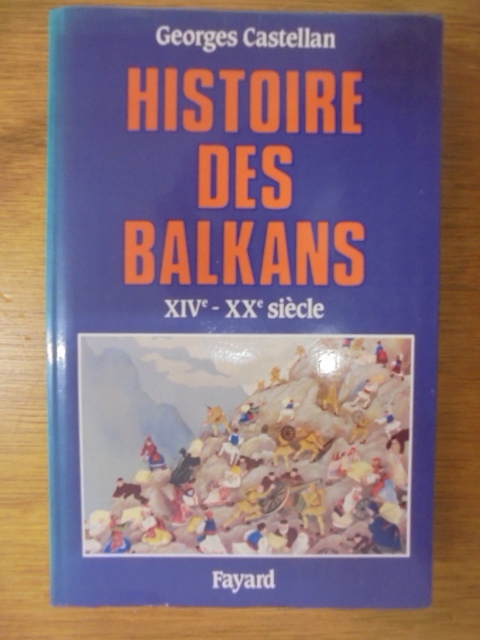
Georges CastellanLivre Rare Book
589 résultats
1993réf. HIS2908M1993 / 526 pages. Broché. Editions Fayard.
réf. HIS976M1993 / 532 pages. Broché. Editions Fayard.
2019New English Paperback. Pbo. Roy. 8vo. (24 x 17 cm). In English. 532 p. The Ottoman Empire and its neighbours II-D. Ottoman diplomatic documents on relations with Montenegro. Pt.4. (1909-1912). Preface Editor's Note Introductory note Index of writers of telegrams and despatches Documents Subject index Index.
2019New French Paperback. Roy. 8vo. (24 x 17 cm). In French. 260 p. A l'ere des empires et des nations: La France et les principautes de Moldavie et de Valachie, (1711-1859). Préface Avant-propos I. Cadre conceptuel et état de la recherche I. 1. Empires, nations, corps intermédiaires et zones d'influence I. 2. L'interdépendance entre centre et périphérie dans les relations internationales à l'époque moderne : une spécificité française par rapport à l'Orient I. 3. Un regard sur l'historiographie de la matière et sur les sources disponibles (pour le xviiie siècle, jusqu'à la Révolution française) II. L'expansion russo-autrichienne vers les principautés de Moldavie et de Valachie dans la première moitié du xviiie siècle : l'émergence de la géopolitique de la périphérie danubienne II. 1. La campagne de Pierre le Grand en Moldavie et en Valachie et ses conséquences II. 2. Dans le sillage des Impériaux : la Russie et ses victoires annulées II. 3. Annexion ou organisation des diversions contre les Ottomans : quelle place pour les principautés de Moldavie et de Valachie dans la stratégie des Impériaux ? II. 4. Le Drang nach Südosten et l'occupation de l'Olténie (1718-1739) III. La France et les périphéries orientales du système international dans la première moitié du xviiie siècle III. 1. La tactique de revers et l'accentuation des rivalités impériales sur la ligne du Danube. Le traité de Prut (1711) III. 2. La nouvelle intervention diplomatique française dans la région intermédiaire. La succession de Pologne et le traité de Belgrade (1739) III. 3. Le facteur prussien et les alliances de revers : un test en Europe orientale avant la guerre de Sept Ans IV. Instabilité politique et rivalités impériales : la perception française des principautés de Moldavie et de Valachie dans la première moitié du xviiie siècle IV. 1. Un espace frontière insuffisamment connu, mais non une terra incognita IV. 2. Religion, guerre et diplomatie dans la perception française des principautés IV. 3. Les princes de Moldavie et de Valachie dans la perception française V. La Moldavie et la Valachie dans la politique de la France : renseignements, transmission des dépêches, diplomatie régionale V. 1. La route des principautés pour la transmission de la correspondance diplomatique française V. 2. Intermédiaires français dans la politique régionale de l'Empire ottoman V. 3. Le renversement des alliances et son impact sur le système des engagements de la France en Europe orientale et du sud-estVI. La France et la question polonaise après la guerre de Sept Ans : le dernier recours aux alliances de revers VI. 1. La montée de la rivalité franco-russe après la guerre de Sept Ans VI. 2. La succession de Pologne et le refroidissement des relations diplomatiques franco-russes VI. 3. Les difficultés de l'offensive diplomatique française à Constantinople VI. 4. L'intensification de l'activité des agents français dans l'Empire ottoman VII. Les guerres russo-austro-ottomanes dans la deuxième moitié du xviiie siècle et les principautés de Moldavie et de Valachie VII. 1. La guerre russo-ottomane de 1768-1774 et le premier partage de la Pologne : la transformation politique de l'Europe orientale VII. 2. Le système politique des principautés de Moldavie et de Valachie après le traité de Kutchouk-Kaynardgi (1774) : coimperium, exceptionnalisme et internationalisation VII. 3. Le facteur autrichien et l'annexion de la Bukovine (1775) VII. 4. L'annexion de la Crimée par la Russie (1783) et la dernière coalition russo-autrichienne contre les Ottomans au xviiie siècle VIII. La guerre russo-ottomane de 1768-1774 et le recul de la France en Europe orientale et du sud-est. L'annulation du traité de Prut et l'annexion de la Bukovine par les Habsbourg VIII. 1. La France et le déclenchement de la guerre russo-ottomane VIII. 2. La France face au système d'engagements russo-austro-prussiens en Europe orientale VIII. 3. L'émergence du « système de la Russie en Orient » et l'annexion de la Bukovine par l'Autr
1992As New Turkish Paperback. Mint. Cr. 8vo. (20 x 14 cm). In Turkish. 151 p. Türk cihadi ve Alman protestanligi, 1551-1555. [= Ottoman imperialism and German protestantism, 1521-1555]. Translated by Neval Öke. Osmanischer Imperialismus und deutscher Protestantismus.
2006Fine Turkish Paperback. Demy 8vo. (21 x 14 cm). In Turkish. 381 p. Alban tarihi: Son Hunlar / Hazarlar / Ermeniler / Terekemeler (Birinci el tarihi kaynaklar).
2016New Turkish Paperback. Demy 8vo. (21 x 14 cm). In Turkish. 204 p., ills. Yarim asirlik tutku, Türkiye ve ben. Vol. 1: Bereketli yillar.
1988Very Good Turkish Paperback. Small 4to. (26 x 19 cm). In Turkish. 47-128 pp., many color ills. Printed on special paper. Fatih ilçesinin Osmanli dönemi eserleri. [Separatum 'Fotograflarla Fatih Anitlari']. Ottoman architectural works in Fatih district of Istanbul. A very comprehensive inventory. Signed and inscribed by Tanman as 'Muhterem Orhan Tükel Beyefendiye...".
1898Very Good Turkish, Ottoman (1500-1928) In contemporary aesthetics 1/3 leather bdg. with five compartments on spine. Third and fourth compartments have lettered gilt title and a personal name (Fikri) in Ottoman script. Other ones have decorated gilts. Cr. 8vo. (20 x 14 cm). In Ottoman script. 359 p. Tesalya'da bir cevelân ve dört aylik seyahâtim. Süleyman Tevfik's, who participated in the Turco-Greco War in 1897 as a war correspondent, travels to Thessaly to watch the Thessaly War. First Edition. Özege 20762.; OCLC: 65794449 / 775132812.
2015New New English Original bdg. Dust wrapper. 4to. (28 x 24 cm). In English and Croatian. 173 p., color ills. Traces of Ottoman culture in Croatia.= Tragovi Osmanske kulture u Hrvatskoj. Text by Andelko Vlasic. "One of the aims of this book is to remind both the Croatian and Turkish public of the significance of the Ottoman heritage for the cultural wealth of Croatia, as well as Turkey and the balkans, because the fullness of ouor common heritage would be seriously lacking in scope if it was not for the Ottoman part. Readers of this book will, hopefully, be surprised byb the sheer number of Croatian towns and villages whose historical development included (unfortunately, mostly poorly researched) an Ottoman period, and whose topography includes numerous buildings, monuments and historical remains originating in the mentioned period.".
2019New English Paperback. Roy. 8vo. (24 x 17 cm). In English. 130 p. Observing and writing wars: Selected works of a soldier-scholar. Preface 1. Ottoman Strategy and War Aims During the first World War 2. Liman von Sanders and the Ottoman Defence against the Anzac Landings of 25 April 1915 3. Ottoman Third Corps in Crisis: Esad Pasha 4. Who Called for a Ceasefire? Gallipoli 1915 5. Gallipoli's Place in Turkish History 6. The Ottoman Empire and the War with Romania 7. An American Military Observer of Turkish Independence War: Charles Wellington Furlong 8. The Impact of Asymmetric Warfare on the Military Profession and Structure: Lessons Learned from the Ottoman Military (with A. Kadir Varoglu) 9. A UN Type Conflict Management: Dilemmas of Military Observer Missions in the Example of UNOMIG 10. With the Germans in Afghanistan: A Turkish Staff Officer's Experiences during the Foundation of Kabul Multi-National Brigade.
2019New English Paperback. Roy. 8vo. (24 x 17 cm). In English. 522 p. (Br)other converts in the Ottoman Balkans: History, myths, fiction. Illustrations Preface Introduction PART ONE: HISTORYChapter One The Ottoman Conquest of the Balkans Chapter Two Clad in Red: The Devsirme Ruling Class Chapter Three The Question of Conversion: The Case of Bosnia PART TWO: MYTHChapter Four From the Battle to the Black Mountain: The Myth of Kosovo Chapter Five (Br)other: Death of Smail-agha Cengic Chapter Six (Br)other: Njegos's The Mountain Wreath. PART THREE: FICTION Chapter Seven The Bridge between the East and the West: Andric and Kadare Chapter Eight Laying the Foundations for The Bridge on the DrinaChapter Nine Bosnian Muslims in Andric's Novels PART FOUR: ÖMER PASA Chapter Ten A Convert in the Empire of the Pashas: Ömer Pasha Latas 7 Chapter Eleven Bosnia's Second Fall: Ömer Pasha's Military Rule (1850-1852) Chapter Twelve Ivo Andric and His Omerpasa LatasConclusion Bibliography Index.
2019New French Paperback. Roy. 8vo. (24 x 17 cm). In French. 340 p. Assigned a identities: Violence d'etat et experiences minoritaires dans les Balkans Post-Ottomans. Introduction Partie 1.Façonner, dire, interdire le « je » en Bulgarie :Puissance publique et stratégies de résistance minoritaires Chapitre 1. Contribution à l'historiographie de l'assimilation forcée des musulmans de Bulgarie Chapitre 2. Faire taire l'altérité. Police de la langue et mobilisations linguistiques au temps de l'assimilation forcée des Turcs de Bulgarie(1984-1989) Chapitre 3. Voyages en identités. Les espaces-temps du re/de-venir des Turcs de Bulgarie établis en Turquie Chapitre 4. Les mobilités du postcommunisme : Pratiques migratoires et constitution d'un champ de recherche sur les migrations en Bulgarie Chapitre 5. Usages politiques du passé et controverses historiographiques en Bulgarie : le cas du « massacre de Batak » (1876) Chapitre 6. Du balkanisme à une histoire transnationale des Balkans ? Partie 2. Politiques anti-juives, historiographie et mémoire de la Shoah en Bulgarie Chapitre 7. Les Juifs de Bulgarie et des territoires yougoslaves et grecs occupés par la Bulgarie pendant la Seconde Guerre mondiale Chapitre 8. La spoliation des biens juifs en Bulgarie pendant la Seconde Guerre mondiale : un état des lieux historiographique Chapitre 9. Nationalization through Internationalization. Writing, Remembering, and Commemorating the Holocaust in Macedonia and Bulgaria after 1989 Partie 3. Faire État-nation en Macédoine post-yougoslave : de laconflictualité arméeà la concurrence des emblèmes identitaires Chapitre 10. The Former Yugoslav Republic of Macedonia:between Ohrid and Brussels Chapitre 11. Maillage communal, frontières et nation :les imaginaires, enjeuxet pratiques de la décentralisation en Macédoine Chapitre 12. The Political Uses and Social Lives of "National Heroes": Controversies over Skanderbeg's Statue in Skopje Chapitre 13. Macédoine-Grèce: les pouvoirs de la métonymie.
1967Very Good Very Good Turkish Original bdg. Dust wrapper. Demy 8vo. (21 x 14 cm). In Turkish. 202, [4] p. Büyük Oktobr ve biz. 50 yil Oktobr. First and Only Edition. Exremely rare.
1912Very Good German Paperback. Demy 8vo. (22 x 15,5 cm). In German. [8], 222, [2] p., 1 folded map, many b/w plates. Im türkischen Kriegslager durch Albanien: Bekenntnisse zur deutsch-türkischen Freundschaft. Ernst Jaeckh was a German author. He was born in Urach Germany. During the First World War, Jaeckh was one of the main propagandists of the German-Turkish alliance and worked for Eugen Mittwoch and his Nachrichtenstelle für den Orient. In 1920, he founded the Deutsche Hochschule für Politik, a key liberal think tank of the Weimar Republic. Being a staunch Anti-Nazi, he emigrated to Britain in the 1930s. In 1932, he became international director of the newly founded New Commonwealth Society. In 1940, he migrated further to the United States where he became professor at Columbia University and founded the Columbia Middle East Institute in 1948. In the 1940s he headed the Middle Eastern Department of the British Ministry of Information, a close associate was Eugen Mittwoch. He is remembered to be an author and academic. He promoted the German-Turkish Alliance (1908-1914) and founded the German Turkish Association in 1912. He became professor of Turkish history at the University of Berlin in 1914. Ernst Jäckh was a member of the diplomatic service during World War I and with Friedrich Naumann, he organized the liberal movement in Germany (1902-1912). Jäckh emigrated to Britain and held the position of international director of the New Commonwealth Institute until 1940 when he became Professor of Public Law and Government at Columbia University specializing in the politics of Germany the Balkans and the Middle East. He wrote books that include Albanian War, Der Austeigende Halbmonde, Background of the Middle East, Deutschland im Orient. First Edition.
2011New Tatar Paperback. Demy 8vo. (22 x 14 cm). In Crimean Tatar and Turkish. 168 p., b/w ills. Qirim. Prep. by Saim Osman Karahan. 1000 copies were printed.
2010New English Paperback. Pbo. 4to. (30 x 25 cm). In English. Ills. [x], 184 p. The intent of this study is multi fold: on the one hand it introduces and publishes a heretofore unknown annotated secere (genealogical tree), covering the Evrenosogullari (descendants of Haci Evrenos) from the beginning of the 14. through the third quarter of the 17. century, while on the other it presents a collection of seven inscriptions on stone (kitâbeler) relating to the early Ottoman March Lord (Uc Beg) Haci Evrenos, of which only one has been previously published.
1997Fine English Paperback. Demy 8vo. (21 x 14 cm). In English and Bosnian. 160 p. The blindman sings to his city: A book of poetry. Translated into English by Dubravka Dostal. Printed to 1000 copies. Shidran often referred to by his hypocoristic nickname Avdo, is a Bosnian poet and screenwriter.He is best known for writing the poetry book Sarajevski Tabut and the scripts for When Father Was Away on Business and Do You Remember Dolly Bell?.
1846Very Good Turkish, Ottoman (1500-1928) Paperback. Chipped on margins. Some owner notes. Otherwise a good copy. Roy. 8vo. (24 x 18 cm). In Ottoman script. 32 p. This rare book includes the royal travel of Sultan Abdülmecid in 1262 AH [1846 AD] to Roumelia. From Edirne, Abdülmecid proceeded to Eski Zagra (Stara Zagora), Kizanlik (Kazanluk), Gabrova (Gabrovo), Tirnova (Turnovo), Rusçuk (Ruse), Silistre (Silistra), and Varna. The route of the 1846 tour followed closely, except in reverse order, Mahmud II's tour of 1837. According to witness accounts, along the way, the sultan was greeted everywhere with poetic recitations and songs of praise and prayer, both in Ottoman and Bulgarian. The pride of place among welcoming parties invariably fell on students, of all creeds, most clad in white uniforms, some in solemn church-going attire, with flowers and green branches in their hands. At every stop, ceremonial cannon salvos were fired during the day and elaborate firework illuminations were performed at night. In the town of Kizanlik, known then as now for the most fragrant roses and the best rose oil, the sultan's visit coincided, possibly by design, with the rose harvesting season. So the locals sprinkled rose water and poured rose oil before the sultan's cavalcade. According to Hristo Stambolski, in the three days of the sultan's stay in town, no rose harvesting was done so that the whole area would be exquisitely scented in his honor. For his part, the sultan had doctors vaccinate all children against smallpox in public before sending each one off with a small gift of money. Even people with rare diseases were, on occasion, summoned to the sultan's presence so his doctors could cure them. The sublime visit caused the locals, who were unaccustomed to direct contact with the center of power, quite a stir. The most detailed account, albeit from a hostile source, relates the sultan's visit to Rusçuk, which, at four days, may have also been the longest. According to Nayden Gerov, the greeting ceremonies proceeded on a communal basis, with the Jews being placed closest to the town walls, next to them the Armenians, then the Bulgarians, and finally, the Muslims, situated the farthest from town, yet being the first to see and welcome the sultan. As the sultan approached, each group of youngsters would in turn sing for him, everyone else bowing profusely. Based on Gerov's description, it seems that Abdülmecid was dressed in a slightly more luxurious fashion than during state ceremonies in Istanbul. ((Source: Sultan Abdülmecid's Tour of Rumelia and the Trope of Love by Stephanov). The sultan began to travel by the way of the gate of Yedikule in Istanbul in May 6, 1846. He followed the way of Ayastefanos, Silivri, Çorlu, Burgaz, Edirne, Zagra-i Atik, Kizanli, Trnova, Rusçuk, Silistre, Rusçuk, Shumnu, and Varna and came back to Istanbul by way of the sea on June 14, 1846. During this travel, the Sultan listened to people's problems and ordered the authorities to be solved with those problems. He received successful military and administrative authorities in settlements on the way of travel and rewarded them. He also received the governors of Serbia, Eflak and Bogdan, and the representatives of foreign states. With this travel, the Sultan aimed to strengthen the connection to the center of people and administrators in provinces. Özege 17910. First Edition.
1982Fine English Paperback. Demy 8vo. (22 x 16 cm). In English. 1 color portrait, 643 p. The Titoites: Historical notes.
1992Fine English Paperback. Roy. 8vo. (24 x 17 cm). In English. [2], 56-185 pp., [2], [58] p., Ottoman archival documents. Rural and urban population in the Sancak of Euripos in the Early 16th Century.
1920Very Good French Paperback. Roy. 8vo. (24 x 16 cm). In French. [8], [1 frontispiece with a portrait], [xvi], 81, [2] p. Chipped on extremities of wrappers. Spine repaired by restoration tape. Overall a good copy. The Dukagjini were an Albanian feudal noble family. They may have been relatives or descendants of the earlier Progoni, who founded the first Albanian state in recorded history, the Principality of Arbanon. Their domain extended from northern Albania to western Kosovo. The city of Lezhe was its most important holding. The Dukagjini evolved from an extended clan (farefisni) to a feudal family in the late 13th century, when their first known progenitor Gjin Tanushi who became known as a dux (duke) and thus his descendants took the surname Dukagjini. By the early 15th century, they had evolved in one of the most important feudal families in the country. After the Ottoman conquest of Albania, a branch of them found refuge and settled in Venetian Koper, where they became known as the Docaini family which held the governorship of the town until the early 17th century, when the last male line Docaini died. Another branch, converted to Islam from Catholic Christianity and remained in the Ottoman Empire, where they reached the high ranks of Ottoman leadership and produced many governors (pashas) in the Middle East, where descendants of them live in the modern period. Basri Bey, together with names such as Enver Bey and Kazim Karabekir, he was among the founders of the Manastir organization of the Union and Progress Society, which played an important role in the declaration of the Constitutional Monarchy. Basri Bey went to the opposition ranks with the claim that the Unionists, whom he thought was under the influence of a small clique, were moving away from the reforms and ideals, and expressed heavy criticism against them. Albania and the Ottoman Empire are important in terms of witnessing firsthand the approach of the Unionists on the eve of the Balkan War and Albanian independence, as well as the world of feelings and thoughts of the people of the region and especially the rebel Albanians. In this book, Basri Bey explained his thoughts on the nature of the Albanian revolt and the motives of the rebels against the Ottoman Empire.
2020New English Paperback. Demy 8vo. (21 x 14 cm). In English. 456 p. The rivalry between Russia and Britain over the autonomous Province of Eastern Rumelia is a historical fact. This study examines tis fact via two historical events concerning the development of the Province - the process of establishment and administrative organization of Eastern Rumelia (1878-1879) and the event of unification between the Province and the Principality of Bulgaria. It argues that the British authorities created the Province of Eastern Rumelia and later they defended the act of unification with the purpose to thwart the Russian political advancement in the Balkans. The British political aim was successfully accomplished as Russia achieved to preserve its political domination in the Province only until 1885 when it opposed the act of unification. This research is based on archival documentary sources and secondary sources. The archive collections used for preparation of this work are the collections of the Foreign Office of the National Archive. The existing historiography on the issue of Eastern Rumelia is very limited as regards the variety of examined topics, though a considerable number of researches are dedicated to the act of unification and the political, cultural and economic development of the Province from 1878 to 1885.
1914Very Good French Paperback. Cr. 8vo. (20 x 14 cm). In French and Bulgarian. 119 p. An untrimmed andd uncut copy in original wrappers. Only one copy in OCLC: 219525858 (Bayerische Staatsbibliothek in Germany). Sources bibliographiques sur l'histoire de la Turquie et de la Bulgarie avec une preface en franc?ais.= Bibliografski iztocnici za istorijata na Turcija i Bulgarija: [Auch m. franz. Titel.:]. The first volume in Michov's rare work. The complete work has three volumes and it contains a total of 1585 titles of books and articles. A rare and comprehensive thematic bibliography. First Edition.
1979Very Good English Paperback. Roy. 8vo. (24 x 17 cm). In English. 810 p. Enver Hoxha was an Albanian communist politician who served as the head of state of Albania from 1944 until his death in 1985, as the First Secretary of the Party of Labour of Albania. He was chairman of the Democratic Front of Albania and commander-in-chief of the armed forces from 1944 until his death. He served as the 22nd Prime Minister of Albania from 1944 to 1954 and at various times served as foreign minister and defence minister as well. Memoirs of Enver Hoxha of the national liberation struggle. This is the Second book of "Reflections in China" series.
