MARCAIS (Georges).Livre Rare Book

2512 resultados
1958ref. 0044351958 Paris, 1958. Petit in-folio (256 X 335 mm) en feuilles, sous couverture rempliée imprimée en rouge, chemise et étui de l'éditeur ; (1) f. blanc, (2) ff. de faux-titre et titre imprimé en deux couleurs, 183 pages, (1) page, (2) ff. de table et justification du tirage, (1) f. blanc. Quelques rousseurs sur la couverture, sans gravité, petite tache brune en tête du dos de la chemise.
ref. 240319LL. dd., 1901 - 1905 9 pièces en un vol. in-8, demi-chagrin havane, dos à nerfs fleuronné, coins en vélin vert, quelques couvertures conservées (reliure de l'époque).
ref. 240429Paris et Alger, 1887 14 pièces en un vol. in-8, demi-veau blond, dos à nerfs orné de filets, pointillés et semis de grotesques dorés, pièces de titre et de tomaison cerise et bouteille (reliure de l'époque). Rousseurs parfois fortes.
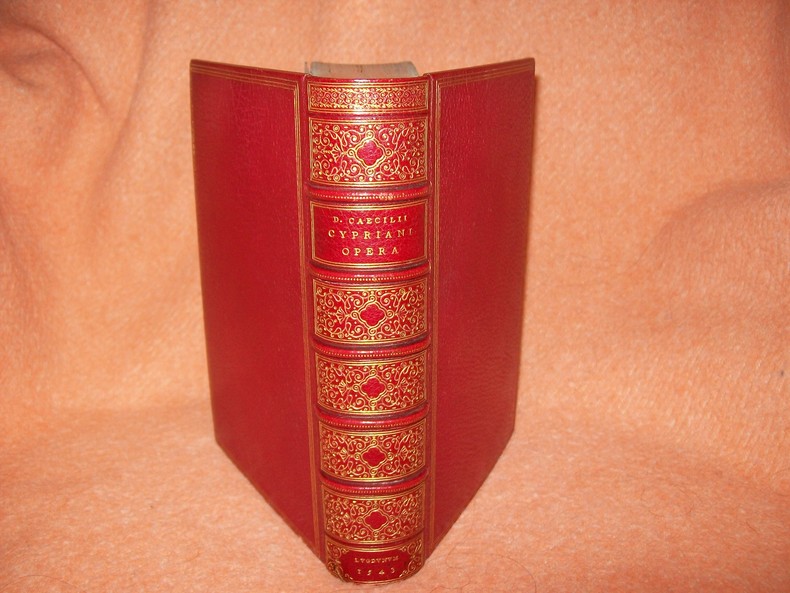
1543ref. GITa719Lugduni apud Seb Gryphium 1543. 2 tomes en 1vol in-8 16ff n ch 1-395pp 6ff n ch et 1f n ch 3-422pp 4ff n ch. Plein maroquin rouge, dos à 5 nerfs rehaussés d'un filet perlé, compartiments dorés aux petits fers, plats encadrés d'un triple filet doré, coupes filetées, belle dentelle dorée sur bordure intérieure, tranches dorées sur marbrure, relié v1850 (Auguste Petit). Belle marque typographique des Gryphe sur la page de titre des deux tomes et sur le dernier feuillet du dernier, jolies lettrines.
ref. 208628Paris, J.-B. Baillière et fils, Alger, Adolphe Jourdan, Madrid, Carlos Bailly-Baillière, 1880 grand in-8, XX-596 pp., avec une carte dépliante en couleurs, demi-chagrin brun, dos à nerfs (reliure de l'époque). Dos et mors un peu frottés. Cachet (annulé).
1937ref. 21634Grenoble, Arthaud (Bellegarde Ain, gravure et impression Sadag), 1937 ; in-8, demi-veau rouge à coins, dos à quatre nerfs encadrant les pièces d’auteur et de titre vert foncé, premier plat et dos en couleurs conservés, non rogné (reliure de l’époque) ; 168 pp., 5 planches hors-texte en couleurs, y compris la couverture et de très nombreuses illustrations de toutes tailles tirées en sépia.
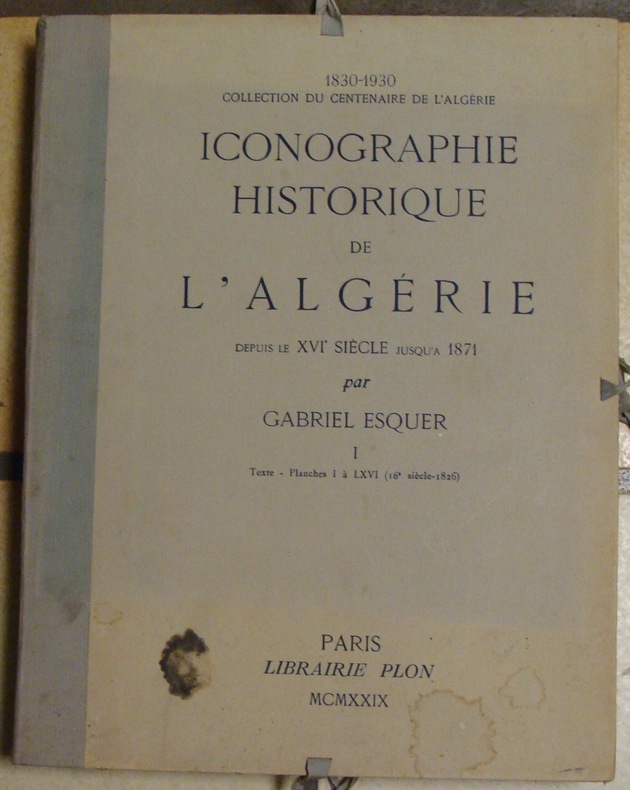
ref. 21947PARIS, Lib. Plon - 1929 - Complet en 3 Portefeuilles(usagés) In-folio, 35,5 x 46 cm - Dos toile, cordons de fermetures conservés -XXXVII-110 pages + Errata - 327 planches sur 354 - Malgré tout bel ensemble constituant une iconographie de plus de mille documents - Bon état général.
PARIS, Lib. Plon - 1929 - Complet en 3 Portefeuilles(usagés) In-folio, 35,5 x 46 cm - Dos toile, cordons de fermetures conservés -XXXVII-110 pages + Errata - 327 planches sur 354 - Malgré tout bel ensemble constituant une iconographie de plus de mille documents - Bon état général. Certainement la meilleure icionographie sur l'algérie d'avant et pendant la conquête française
ref. 123AQUARELLE SUR PAPIER FORMAT 65 X 50 CENTIMETRES ENVIRON, MAROUFLEE SUR TOILE. SIGNEE, DATEE 1906 ET LEGENDEE EN BAS A DROITE. CETTE BATAILLE DECISIVE EUT LIEU EN FAIT LE 16 JUILLET 1212, ENTRE LES CHRETIENS COMMANDES PAR LES ROIS D'ARAGON, DE CASTILLE ET DE NAVARRE, ET LES MAURES AUX ORDRES D'EBN-ABD-ALLAH, ROI ALMOHADE DU MAROC. LES CHRETIENS FURENT VAINQUEURS (LE NOM COURANT DE LAS NAVAS DE TOLOSA EST EL HOSPITALILLO).
1928Very Good Turkish, Ottoman (1500-1928) Contemporary fine dark green cloth bdg. Art-nouveau decorations embossed on boards. Roy. 8vo. (24 x 17 cm). In Ottoman script. 734, [2], [1] p., index. The Scopes trial (1925) fuelled discussion in the United States on the social and political implications of Darwinism. For the defenders of the 1925 Tennessee law - which prohibited the teaching of Darwinism in schools - Darwinism was, amongst other things, responsible for the German militarism which eventually led to the First World War. This view was supported by Ismail Fennî, a late Ottoman intellectual, who authored this book immediately after the trial which aimed to debunk scientific materialism. In it, he claimed that Darwinism blurred the distinction between man and beast and thus destroyed the foundations of morality. However, despite his anti-Darwinist stance, Ismail Fennî argued against laws forbidding the teaching of Darwinism in schools and emphasized that even false theories contributed to the scientific improvement. Indeed, because of his belief in science, he claimed that Muslims should not reject Darwinism if it were supported by future scientific evidence. It is composed of 7+1 chapters to criticize the materialist and positivist philosophical movements and especially the work of the positivist German philosopher Ludwig Bücher 'Kraft und Stoff'. The first part of the book focuses on the evidence presented of the proof of god in the Western and Islamic philosophies. In the second chapter, the issue of immortality of soul and spirit is addressed. In the third chapter, 'the wahdat al-wujud' (vahdet-i vücûd) current is examined. The fourth chapter, examined some famous scholars' thoughts about the matter, materialism, laws of nature, etc. In the fifth chapter, the work of the positivist German philosopher Büchner 'Kraft und Stoff', in the sixth chapter, monism (monism), in the seventh ch. positivism is criticized. In the last ch., there are descriptions and some thoughts on the theory of evolution and the Indian fakirs (fakers). Ismail Fenni Ertugrul was a Turkish mystic, philosopher, writer, musician, lyricist, and composer. He studied traditional madrasah education and learned Arabic and Persian. He was in various state posts. After the retirement, he began to be interested in poetry, music, and philosophy. Before his death, he donated his library including 9050 books to the Library of Beyazit. (Source: An Ottoman response to Darwinism: Ismail Fennî on Islam and evolution, Bilgili). First and Only Edition. Extremely rare. Özege 11879. Alper 195.
ref. 21195o.J. 80 Blatt schwarzer Karton , beidseitig je Seite mit 4 - 6 Bildern beklebt. Format der Bilder: ca. 8, 5 x 7 cm. Kurze und säuberliche handschr. Notizen. Quer groß-8°, (ca.35x 25 cm), grüne Leinwand. Einband sauber und schön.
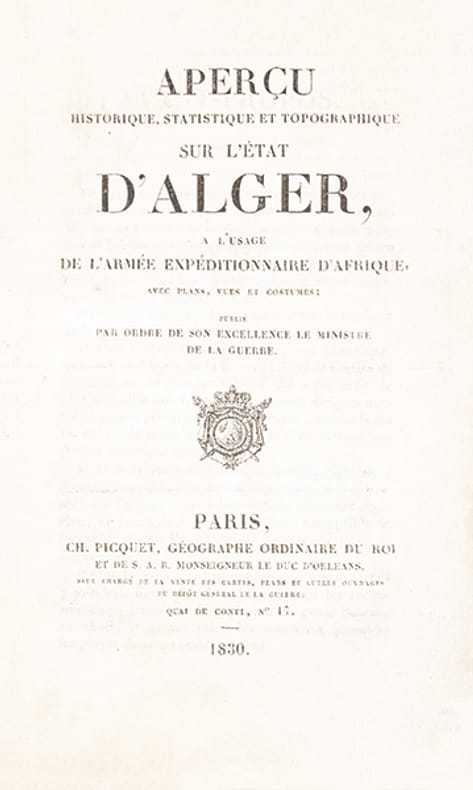
ref. 388922 volumes: un volume de texte in-12 (180 x 110 mm), broché, couverture imprimée, (4), xiii, 256 p. et un volume d'atlas in-folio oblong (265 x 347 mm), 6 cartes et plans dépliants et 11 planches. Paris, Charles Picquet géographe du roi (), 1830.
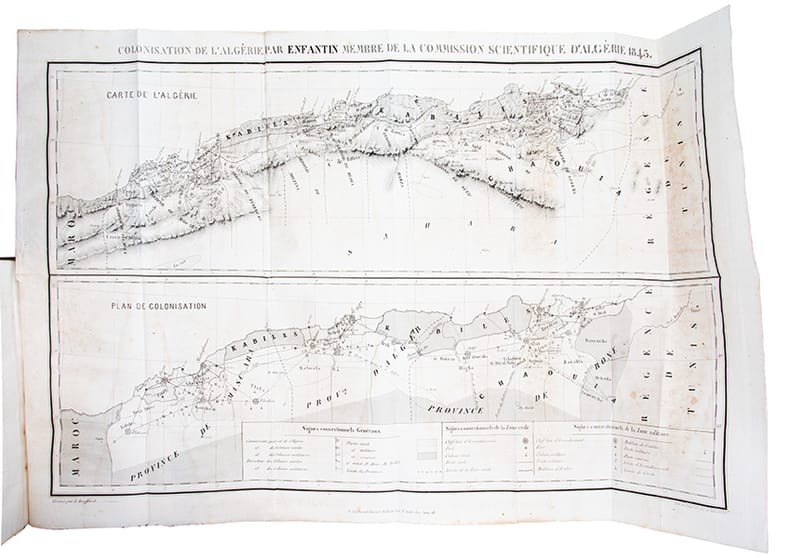
ref. 39394In-8 (225 x 142 mm), demi-chagrin bordeaux, pièce de titre de veau bronze (rel. moderne), (4), 542 pages, 4 pages de catalogue, grande carte (42 x 66 cm) et tableau statistique dépliants. Paris, P. Bertrand, 1843.
ref. 37350Paris Librairie de Firmin Didot et Cie 1883 in 4 (28,5x21) 1 fort volume reliure cartonnage polychrome orné de l'éditeur, dos de chagrin rouge orné d'un riche décor géométrique doré et polychrome, plats de percaline entièrement ornés d'un très riche décor doré et polychrome avec rosace géométrique centrale, dos et plat supérieur titrés en lettre dorées, tranches dorées (goutière parfaite), II [1] 708 pages, illustré plus de 200 gravures sur bois, dont 22 hors-texte, de 4 chromolithograhies hors-texte, et de 3 cartes dépliantes en couleurs in fine. Très bel exemplaire, cartonnage très frais ( Photographies sur demande / We can send pictures of this book on simple request )
ref. 244261[Alger], (1865) in-4, 2 pp. (recto-verso), grande vignette lithographiée aquarellée en-tête Petite déchirure à la pliure. Manque la fin de la lettre qui devait comprendre la signature.
ref. 208355S.l., s.d. (1909-1911) in-4, 43 ff. anopisthographes, ff. 45-86, puis ff. 88-112 ; 35 ff. (Journal de marche de la première colonne), en feuilles, cousu.
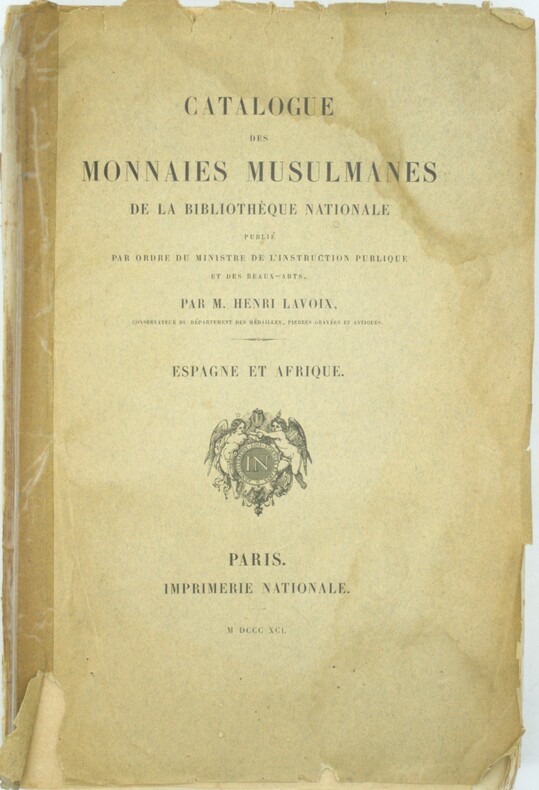
1891ref. PHO-2099Paris, Imprimerie nationale, 1891. In-8 (27x18cm), [4] ff., XLVII, 571 pp., XIV planches hors texte gravées. Brochage éditeur, première de couverture détachée, manque la dernière de couverture, papier uniformément bruni, légères rousseurs. Très rare
ref. 225735Paris, Henri Plon, 1866 - 1872 3 parties en un fort vol in-4, [2] ff. n. ch., XXVII pp., 342 pp., un f. n. ch., 402 pp., un f. n. ch. de table, [2] ff. n. ch., ij pp., 118 pp., un f. n. ch. de table [Suplément et tables]. demi-chagrin noir, dos à nerfs orné de filets à froid et de fleurons dorés, simple filet à froid sur les plats (reliure de l'époque).
1929ref. 594PARIS. PLON. (1830-1930. COLLECTION DU CENTENAIRE DE L'ALGERIE. ARCHEOLOGIE ET HISTOIRE). 1929. 3 PORTEFEUILLES IN-FOLIO (35,5 X 46 CENTIMETRES ENVIRON) DE (4) + XL + 113 + (4) + (4) PAGES ET 354 PLANCHES HORS TEXTE EN NOIR ET EN COULEURS, RELIURE 1/2 PERCALINE GRISE, PLATS CARTONNES, TITRE IMPRIME EN NOIR, FERMETURE A LACETS. COLLATIONNE COMPLET DE TOUTES SES PLANCHES. QUELQUES PETITES TACHES SUR 2 PLATS, SINON BEL EXEMPLAIRE.
1910Very Good Turkish, Ottoman (1500-1928) Original illustrated wrappers. Cr. 8vo. (20 x 13 cm). In Ottoman script (Old Turkish with Arabic letters). 220, [2] p., 41 unnumbered plates (incl. 68 b/w photos), and 3 maps. Pages are partly untrimmed and uncut. Slight stains on cover and wear at spine. Overall a good copy. Roumi: 1326 = Hegira: 1327 = Gregorian: 1910. First and only edition of this extremely rare book, including a historically significant eyewitness account of Cami Baykurt, who was an Ottoman officer during the Tripoli War (1911-1912), describing the flora, and the fauna in the Sahara desert and around Libya; the Bedouins and their customs with their social life, their culinary culture and their special drinks in his book during his travels to the south of Libya, to the Fezzan region, to participate in the Ottoman military operations at the fortress of Ghat, serving as a commander and governor. This book was prepared to present Tripoli, located in the Libyan lands today, Fezzan in the south, and the desert roads in between to the Ottoman court as well as the intelligentsia. Baykurt was a Turkish politician and soldier who served as deputy of the first period of the Turkish Republican Parliament. He was the first minister of Turkish foreign affairs in the Republican period. He had participated as an officer in the Battle of Tripoli back in the day. The provinces of Tripoli and Fezzan were accepted as destinations of exile in the last period of the Ottoman Empire. The province of Tripoli, the last center of a few Ottoman sanjaks, had been the granary of ancient Rome in the past with its large villages. Özege 21177.; Kursun p. 294.; Not in ATYB I (Askeri Tarih Yayinlari Bibliyografyasi).; OCLC 165148162 (with some misread and misspelled words; Kursun mentioned in his bibliography those misread words, especially 'Kazan mebusu -deputy of Kazan- instead of a deputy of Fizan about his title in some catalogs like OCLC. Kursun has a short but useful biography of Câmî).
ref. 100777Paris, Imprimé par autorisation de M. le Garde des Sceaux à L'Imprimerie Nationale, 1875-1881, 2 volumes in-folio de 330x245 mm environ, tome I : xx-609 pages - tome II : iv-381 pages, demi basane vert sapin, dos à nerfs portant et tomaisons dorés, gardes marbrées. Des rousseurs, cartonnage et cuir frottés, coupes et coins émoussés, des épidermures, des tampons sur les deux volumes.
ref. 14773Paris Gide et J. Baudry, Libraires-éditeurs 1849 grand in 8 (27x18) 1 volume reliure demi basane bleue de l'époque, dos lisse, filets dorés, 339 pages, une grande carte hors-texte dépliante (carte de la contrée parcourue par la colonne du général Cavaignac) et 5 planches lithographiées en deux teintes. Petites épidermures au dos de la reliure, et petite restauration marginale sur la grande carte, sinon bon exemplaire, enrichi d'un envoi autographe signé du Général Cavaignac: l'auteur à Mr l'intendant Mr Darricau (sur le faux-titre) Général Louis-Eugéne Cavaignac 1802-1857. Chef du pouvoir éxécutif du 24 juin au 26 décembre 1848
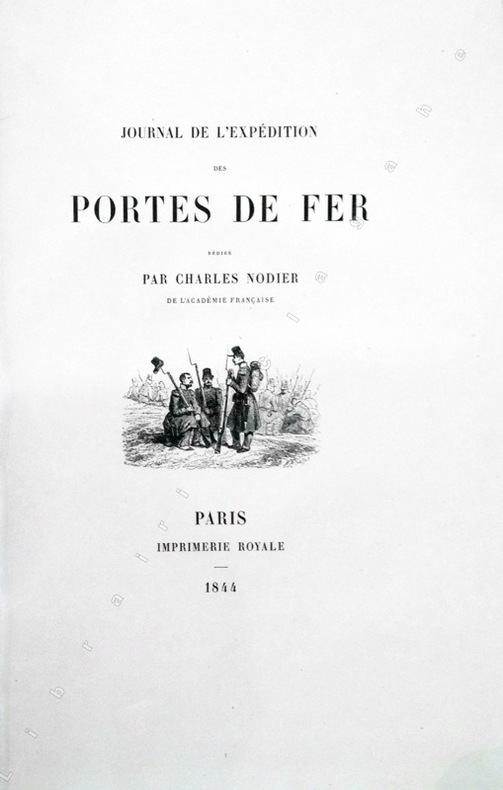
1844ref. 13368Paris, Imprimerie Royale, 1844 ; grand in-8 ; cartonnage à la bradel de l'éditeur ; [4], XVI, 329 pp., [1] f. blanc, 40 planches hors-textes tirées sur chine contrecollées, protégées par des serpentes légendées et une carte dépliante en fin d'ouvrage et 200 vignettes gravées sur bois dans le texte.
1942ref. 0054881942 Pour les Amis du Docteur Lucien-Graux, [1942]. Grand in-quarto (336 X 261 mm) en feuilles sous couverture décorée en couleurs au premier plat, chemise et étui de l'éditeur. Quelques rares rousseurs dans les barbes, plats de la couverture en partie et très légèrement ombrés.
ref. 206201Paris, Michel Lévy frères, 1855 2 vol. in-8, XXVI-[2]-572 pp. ; [2] ff. n. ch., 606 pp., avec un portrait-frontispice lithographié et un fac-similé dépliant, chagrin noir, dos à nerfs ornés de pointillés, filets, guirlandes et caissons dorés, encadrement de triple filet et guirlande dorés sur les plats, pointillé doré sur les coupes, tranches dorées, dentelle intérieure (reliure de l'époque).