257 Ergebnisse
Best.-Nr. DADAX0849375517New unknown
Best.-Nr. SONG0415425778Used: Good unknown
1956Very Good Arabic Original wrappers. Cr. 8vo. (20 x 14 cm). In Arabic. 63, [1] p., 1 portrait of Atilhan. First edition of this Arabic edition of Turkish "Kendi vesikalarina go?re Masonluk nedir?" [i.e. What is Freemasonry according to their own documents?], written by Atilhan who was a Turkish career officer and antisemitic writer, who was one of the initiators of the 1934 Thrace pogroms. It was published in Iraq, probably Qirkuk (The phone number of the publishing house is written on the cover). During the Turkish War of Independence, Atilhan was appointed as the commander of the Zonguldak-Bartin and Havalisi Fronts. It prevented the spread of the French Army in this region. Upon the victory of the War of Independence, he left the army and went into writing. In his anti-semitic book "Suzy Liberman, Jewish Spy", in 1935 the Turkish Army gave the order to buy 40000 copies and distributed them amongst the officers. The book is banned on September 17, 1936. In 1942, he was arrested by the government of the time on the grounds that the coup was being prepared. He was incarcerated for 11 months before being released by the results of an investigation led by Fevzi Çakmak. During the one-party period of Turkey, Atilhan who was close to the ideas of Turkism contributed writings to two of the most influential magazines of Islamic politics in early Turkey; Sebilürresad and Büyük Dogu. His writings and his political activities affected the growing Islamic movements in Turkey. He was one of the founders of Millî Kalkinma Partisi in 1945 and the Islam Democratic Party in 1951. He was arrested in 1952 along with Necip Fazil Kisakürek in Malatya as responsible for the assassination attempt of Ahmet Emin Yalman. He was detained for 11 months and 15 days. In August 1964 he was invited to the congress of Islamic State in Somalia. He was elected as the Chairman of the executive committee of Congress. This post was his last major mission. Only two copies of this edition can be traced in OCLC: 320298568.
1961Very Good Turkish, Ottoman (1500-1928) Original autograph letter signed by Cevat Rifat Atilhan sent to an unnamed recipient. 30x23 cm. In Ottoman script. 15 lines. Full with letterheads. Dated 1961/8/26 with Arabic numbers. A good paper with only an 'extra strong' watermark. It's a feverish letter mentioning the ideas of the readers of Italian and the Turkish nation to an unnamed recipient. Very interesting content. Atilhan was a Turkish career officer and antisemitic writer, who was one of the initiators of the 1934 Thrace pogroms. He was born in 1892 in Vefa, Constantinople. His father Rifat Pasha was the Governor of Damascus. The first years of his childhood passed in Damascus. Then he came to Constantinople and went to Fatih Iptidaisi (primary school). After graduating from primary school, he started to Kuleli Military High School, preferring to military service. In his first days in the lieutenant years, he took part in the Albanian campaign. He was taken prisoner by the Bulgarians in the siege of Edirne. The bondage lasted two years. At the beginning of World War I, he was ordered by Cemal Pasha from Mersin. He came forward with his heroism in the Sinai and Palestinian fronts. Upon the conclusion of the First World War, Cemal Pasha from Mersin came to Konya. The establishment of the National Front had great benefits. He met with Sultan Mehmed VI as the first national representative. When Sultan Mehmed VI left his post, Damat Ferid Pasha had Atilhan arrested because of a conspiracy. He was imprisoned in the Bekir Aga Bölgesi. During the Turkish War of Independence, he was appointed as the commander of Zonguldak-Bartin and Havalisi Fronts. It prevented the spread of the French Army in this region. Upon the victory of the War of Independence, he left the army and went into writing. Of his anti-semitic book "Suzy Liberman, Jewish Spy", in 1935 the Turkish Army gave the order to buy 40000 copies and distributed them amongst the officers. In 1942, he was arrested by the government of the time on the grounds that the coup was being prepared. He was incarcerated for 11 months. In 1952, he was arrested again in Malatya as responsible for the assassination attempt of Ahmet Emin Yalman. He was detained for 11 months and 15 days. He wrote 74 works and thousands of articles. He was influenced by antisemitic politicians like Serif Yaçagaz and Ali Galip Yenen. Because of his antisemitic writings, he was described as the 'Hitler of the Middle East'. In August 1964 he was invited to congress of Islamic State in Somalia. He was elected as the Chairman of the Executive Committee of the Congress. This post was his last major mission. (Source: Wikipedia).
Best.-Nr. DADAX0471549150New unknown
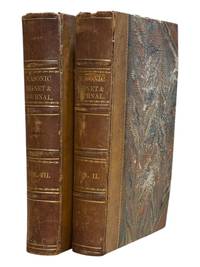
1856Best.-Nr. 9021Marietta GA: Signet & Journal Office 1856. First editions. 2 vols 8vos 572 and 576pp. Contemporary Half polished calf ruled in gilt gilt lettering on spines marbled boards mottled page edges. Upper joint in volume 1 split about 2/3 down from the top but holding boards rubbed and scuffed. Pages heavily toned in portions of both volumes and with moderate foxing throughout. Still a very good set. 2 volumes each collecting 12 issues of this rare monthly Masonic periodical from Marietta GA. This publication was preceded by Masonic Signet and Literary Mirror this "New Series" only running from 1855-1860. The editor Samuel Lawrence 1815-1890 served as the Grand Master of Georgia from 1869-72 and was considered an expert on masonic law and ritual writing and compiling several works on the subject. An interesting and scarce pre-Civil War Masonic journal from the South. OCLC cites holdings for any volumes/issues at just 5 institutions. . Signet & Journal Office unknown
Best.-Nr. SKU0588200The Masonry Society 2016-12-01. paperback. Good. 10x8x0. Textbook May Have Highlights Notes and/or Underlining BOOK ONLY-NO ACCESS CODE NO CD Ships with Tracking The Masonry Society paperback
Best.-Nr. SKU0635707The Masonry Society 2016-12-01. paperback. New. 10x8x0. New Textbook Ships with Tracking The Masonry Society paperback
1895Very Good Greek, Modern (post 1453) Contemporary fine leather bdg. Demy 8vo. (22 x 15 cm). In Greek. 1118 p., richly illustrated (b/w ills.). Period bindery label of E. Watson in London. Ex-library copy on fourth blank page. Otherwise a very good copy. First and extremely rare translation into Greek of Taxil's 'Myste`res de la Franc-Mac?onnerie'. Mysteries of Freemasonry. Marie Joseph Gabriel Antoine Jogand-Pagès, better known by the pen name Léo Taxil was a French writer and journalist who became known for his strong anti-Catholic and anti-clerical views. He is also known for the Taxil hoax, a spurious expose of Freemasonry and the Roman Catholic Church's opposition to it. Marie Joseph Gabriel Antoine Jogand-Pagès was born in Marseille, and at the age of five, he was placed into a Jesuit seminary. After spending his childhood years in the seminary, he became disillusioned with the Catholic faith and began to see the religious ideology as socially harmful. Taxil first became known for writing anti-Clerical or anti-Catholic books, notably "La Bible amusante" (The Amusing Bible) and "La Vie de Jesus" (The Life of Jesus), in which Taxil satirically pointed out inconsistencies, errors, and false beliefs presented in these religious works. In his other books Les Debauches d'un confesseur (with Karl Milo), Les Pornographes sacrés: la confession et les confesseurs, and Les Maîtresses du Pape, Taxil portrays leaders of the Catholic Church as hedonistic creatures exploring their fetishes in the manner of the Marquis de Sade. In 1879, he was tried at the Seine Assizes for writing a pamphlet A Bas la Calotte ("Down with the Cloth"), which was accused of insulting a religion recognized by the state, but he was acquitted. In 1885, he professed conversion to Catholicism, was solemnly received into the church, and renounced his earlier works. In the 1890s, he wrote a series of pamphlets and books denouncing Freemasonry, charging their lodges with worshiping the devil and alleging that Diana Vaughan had written for him her confessions of the Satanic "Palladist" cult. The book had great sales among Catholics, although Diana Vaughan never appeared in public. In 1892, Taxil also began to publish a paper, La France chrétienne anti-maçonnique (Christian Antimasonic France), with his staunch anti-Masonic publishing friend, Abel Clarin de la Rive. In 1887, he had an audience with Pope Leo XIII, who rebuked the bishop of Charleston for denouncing the anti-Masonic confessions as a fraud and, in 1896, sent his blessing to an anti-Masonic Congress of Trent. Doubts about Vaughan's veracity and even her existence began to grow, and finally, Taxil promised to produce her at a lecture to be delivered by him on 19 April 1897. To the amazement of the audience (which included a number of priests), he announced that Diana was one of a series of hoaxes. He had begun, he said, by persuading the commandant of Marseille that the harbor was infested with sharks, and a ship was sent to destroy them. Next, he invented an underwater city in Lake Geneva, drawing tourists and archaeologists to the spot. He thanked the bishops and Catholic newspapers for facilitating his crowning hoax, namely his conversion, which had exposed the anti-Masonic fanaticism of many Catholics. Diana Vaughan was revealed to be a simple typist in his employ, who laughingly allowed her name to be used by him.The audience received these revelations with indignation and contempt. Afterwards, Taxil left the hall, where policemen escorted him to a neighboring café. He then moved away from Paris. He died in Sceaux in 1907. First Greek Edition. Rare. Only one copy in OCLC: 758917323.
1894327 pages. Includes a historical sketch of the origin and progress of Free Masonry and a collection of Masonic songs, Funeral Service, etc. Contents include: On Opening and Closing Lodges; Entered Apprentice's Degree; Fellow-Craft's Degree; Master Mason's Degree; Mark Master's Degree; Past Master's Degree; Most Excellent Master's Degree; Royal Arch Degree; Royal Master's Degree; Select Master's Degree; Order of High Priesthood; Constitution of the General Grand Chapter of Royal Arch Masons for the United States of America; List of Grand Lodges and Grand Chapters in the United States. Gorgeous gilt illustration upon decorated front board. Bright gilt lettering upon spine. Includes numerous attractive and intriguing black and white diagrams. Light wear to greenish-blue cloth boards. Front fixed endpaper bears small bookplate with name peeled off. Prior owner's details written upon front free endpaper else unmarked. Half inch opening to central portion of back hinge. Excellent attractive copy of this most revealing work. Book
Best.-Nr. DADAX0081021100New unknown
1993304 pages. Black and white illustrations. "Few of us have known until the release of this book that NAFTA may be an elaborate camouflage for a totalitarian police state stretching from the Canadian Arctic to the southernmost reaches of Mexico. Yet this is the thrust of a Secret Report by a North American Counter Intelligence Military Team and certain ancillary documents. The Report cites far-reaching legislation which shifted the responsibility for law enforcement in the U.S. to the U.N. The creation of MJTF and FINCEN seem preliminary to a massive round-up of North American citizens opposed to the New World Order." - back cover. Clean and unmarked with moderate wear. Tight and square. A sound copy of this conspiracy classic. Book
Best.-Nr. DADAX041923540XNew unknown
1928Best.-Nr. 0006338Stuttgart: Verlag Wedekind & Co. 1928. First edition. Hardcover. Good. Tall quarto 196 pages clothbacked boards numbered paper sticker on front free endpaper pictorial top cover stained. Very Rare - Worldcat lists only one copy in the U.S.A. This work focusses on new design work in Germany Austria Switzerland Belgium and Holland in 1927 which arose from the "Die Wohnung" exhibition which promoted new materials and new construction methods. This is the book that demonstrates and describes the new construction methods and techniques for the innovative designs. All of it influenced by the Bauhaus. Laid in is a Typed Letter Signed - apparently by Feifel - on Albert Feifel Architekt letterhead and dated 11 March 1928. Verlag Wedekind & Co. hardcover
1998Best.-Nr. x-041923540XSpon Pr 1998. Hardcover. New. 1st edition. 348 pages. 9.50x6.25x1.25 inches. Spon Pr hardcover
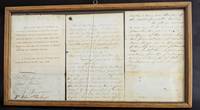
1866Best.-Nr. 1307Newburgh 1866. Framed manuscript Sheets with inserted short typescript. 5 x 8 inches. 6pp. Browned folds small hole at top of one page no loss preserved under glass; front plate cracked. Charter of a new lodge from 1866 which contains the names of many leading businessmen of Newburgh New York. Brother John L. Westervelt presented an original petition to Newburgh Lodge 309 asking if a new lodge could be organized in Newburgh “believing that the best interest of Masonry would be best subserved thereby.” A charter was granted to Hudson River Lodge 607 on June 8 1866. Forty-six signatures are appended to the document. Many are designated “true” and a few are designated “non affiliated”. David A. Scott was voted master; G. Frederick Wiltsie senior warden; Samuel Stanton junior warden and John Alsdorf as first secretary. John L. Westervelt 1826-after 1880 the petitioner was a silversmith whose specialty was repairing and replating Gorham objects. He married Catherine Gorham of New York. “After the Lodge had been declared open the Master arose and on behalf of Bro. John L. Westervelt presented to the Lodge a full set of solid silver jewels for the use of the offices. The following resolution was then offered and adopted unanimously: Resolved That the thanks of this Lodge be and are hereby tendered to Brother John L. Westervelt for the very beautiful set of jewels which he has so generously presented to the Lodge.” History of Hudson River Lodge. Charles Estabrook 1823-1900 bookstore owner and librarian at Newburgh Free Library signed as did Chancy M. Leonard mayor of Newburgh who died in 1874. Another jeweler and silversmith Thomas W. Purdy ca. 1830-after 1880 also signed. David A. Scott 1825-1890 lawyer court judge and first master was also a signatory. Charles H. Halstead. History of Hudson River Lodge. 1896 . unknown
1866Best.-Nr. 1307Newburgh 1866. Framed manuscript Sheets with inserted short typescript. 5 x 8 inches. 6pp. Browned folds small hole at top of one page no loss preserved under glass; front plate cracked. Charter of a new lodge from 1866 which contains the names of many leading businessmen of Newburgh New York. Brother John L. Westervelt presented an original petition to Newburgh Lodge 309 asking if a new lodge could be organized in Newburgh “believing that the best interest of Masonry would be best subserved thereby.” A charter was granted to Hudson River Lodge 607 on June 8 1866. Forty-six signatures are appended to the document. Many are designated “true” and a few are designated “non affiliated”. David A. Scott was voted master; G. Frederick Wiltsie senior warden; Samuel Stanton junior warden and John Alsdorf as first secretary. John L. Westervelt 1826-after 1880 the petitioner was a silversmith whose specialty was repairing and replating Gorham objects. He married Catherine Gorham of New York. “After the Lodge had been declared open the Master arose and on behalf of Bro. John L. Westervelt presented to the Lodge a full set of solid silver jewels for the use of the offices. The following resolution was then offered and adopted unanimously: Resolved That the thanks of this Lodge be and are hereby tendered to Brother John L. Westervelt for the very beautiful set of jewels which he has so generously presented to the Lodge.” History of Hudson River Lodge. Charles Estabrook 1823-1900 bookstore owner and librarian at Newburgh Free Library signed as did Chancy M. Leonard mayor of Newburgh who died in 1874. Another jeweler and silversmith Thomas W. Purdy ca. 1830-after 1880 also signed. David A. Scott 1825-1890 lawyer court judge and first master was also a signatory. Charles H. Halstead. History of Hudson River Lodge. 1896 . unknown books
Best.-Nr. DADAX1929081014New unknown
Best.-Nr. DADAX007005844XNew unknown
1931Fine English Paperback. Pbo. Fine++. Roy. 8vo. (23 x 16 cm). articles in Turkish, French and German. 19 issues full set published in 4 years (1931-1935). When Kemal Atatürk closed all of masonic lodges in Turkish Republic, this periodical's publishing has ended. Extremely rare.
Best.-Nr. DADAX0931790573New unknown
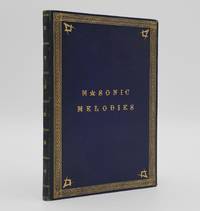
1844Best.-Nr. 373390Boston: Published by Oliver Ditson 1844. Presentation copy inscribed on the front endpaper by G. Peverelli to R. F. Gladstone. 105pp. 8vo. Nineteenth century navy morocco covers elaborately bordered in gilt with a Masonic design upper cover lettered in gilt marbled endpapers gilt edges. Presentation copy inscribed on the front endpaper by G. Peverelli to R. F. Gladstone. 105pp. 8vo. Published by Oliver Ditson unknown
1844Best.-Nr. 373390Boston: Published by Oliver Ditson 1844. Presentation copy inscribed on the front endpaper by G. Peverelli to R. F. Gladstone. 105pp. 8vo. Nineteenth century navy morocco covers elaborately bordered in gilt with a Masonic design upper cover lettered in gilt marbled endpapers gilt edges. Presentation copy inscribed on the front endpaper by G. Peverelli to R. F. Gladstone. 105pp. 8vo. Published by Oliver Ditson unknown books
Best.-Nr. DADAX0419149309New unknown
1910Very Good Turkish, Ottoman (1500-1928) Original 1/3 black leather bdg. raised bands to gilded spine 'Usak Askerî Kulübü, the title of the book, and ornamental designs in the compartments. Crescent and star embossing on front board, Imperial Ottoman sign on the backboard. A fine binding. Marbled endpapers in western style. Light wear on spine, fading on boards, ex-owner's inscription on the colophon, and some notes and seal by Usak Askerî Klübü. Sealed by "Ittihat ve Terakki Cemiyeti Usak Kazasi Kulüp Heyeti Idaresi: Uhuvvet - Hürriyet - Musavat" [i.e. Union and Progress Society Usak City Club Directorate: Brotherhood - Freedom - Equality]. Signed and inscribed by Ahmed Saib as 'Usak Askeri Klübü'ne hediye-i acîzânemdir. Vatanimizi kanimiz ile muhafaza ediniz'. Seal is produced in 'July 20, 1908'. Ahmed Saib was born in 1859 in Dagestan. After completing his education in military schools in the Russian Empire, he entered the service of the Ottoman Empire with the rank of captain. He was in the Sultan Abdulhamid II's Hassa Cavalry Regiment and under the aide of Gazi Ahmed Muhtar Pasha, the Extraordinary Commissioner of Egypt. Later, he left his military service and published the newspaper Sancak (1899-1907), which spread the ideas of Ottoman liberals against the tyranny of the sultan since 1899 in Egypt, in the city of Cairo, and included articles on the constitutional struggle and the political structure of the period. Murad V was the 33rd Sultan of the Ottoman Empire who reigned from 30 May to 31 August 1876. The question of Sultan Murad V's enthronement in 1876 was a very strategic move for the Young Turks in its period. Only three copies in OCLC: 427392804.; Özege 19913. First and Only Edition. Extremely rare.