46 761 résultats
1790réf. ST19326Amsterdam: H. Keyzer H. Gartman en W. Vermandel 1790. 555 x 345 mm. 21 7/8 x 13 3/4". 2 p.l. 62 folding plates. Attractive late 19th or early 20th century retrospective polished brown calf by L. Guétant stamp-signed in gilt on tail of spine double gilt-ruled border floral cornerpieces raised bands spine panels with scrolling floral borders and central flower ornament gilt titling. With title vignette and 62 ENGRAVED FOLDING PLATES ALL WITH BEAUTIFUL HAND COLORING AND HIGHLIGHTED WITH GOLD depicting Bible scenes from the Old and New Testament 61 of which are by Jan Luyken. A Large Paper Copy. For earlier editions: Graesse IV p. 308; Brunet III 1245-46; Klaversma & Hannema 159-164. Light rubbing to joints and edges boards just a little marked trivial foxing and faint spots here and there but A REMARKABLY FINE COPY the binding lustrous and showing little wear the paper extremely bright and fresh the margins immense and the paint and gold unusually vibrant. The marvelous illustrations of Dutch engraver and poet Jan Luyken comprise this collection of "remarkable stories" from the Bible each depicted with panoramic grandeur and enhanced with a wide range of finely applied colors and gold. Luyken 1649-1712 had written and illustrated erotic poetry as a young man but later became a devout Pietist after reading the works of German mystic Jakob Böhme. He became a member of the Baptist Church in 1673 and thereafter devoted his talents to producing religious works. The vast scenes here are notable in their scale detail and animation. There are a number of battle scenes from the Old Testament as well as dramatic depictions of the plagues and a fascinating episode from the histories of Josephus depicting Herod's soldiers being lowered down the side of a cliff in large boxes suspended from chains in order to attack the thieves hiding in caverns on the cliffside. There is a majestic portrayal of the Queen of Sheba arriving at the court of Solomon a peaceful scene of Adam naming the beasts in the Garden of Eden and a festive celebration of the Feast of Tabernacles. New Testament scenes include a terrifying final judgment a blinding conversion of St. Paul and scenes from that Apostle's travels. The engravings have one common trait: they are heavily populated whether by men or beasts and one of Luyken's special gifts is to render every person in the crowd as an individual with his own concerns and reactions to the events at hand. The engravings while already greatly pleasing in black and white are even more stirring and memorable when seen in the full color and gold used here. Expansive tableaus are given greater definition and clarity and events such as Noah’s flood and the destruction of Sodom and Gomorrah are rendered even more successful in expressing the awesome powers of the Almighty. The illustrations are quite definitely Protestant in point of view: there are no depictions of the Virgin Mary not even a Nativity scene. Except for engravings of the Annunciation to the Shepherds and the Massacre of the Holy Innocents the illustrations focus on Jesus as an adult and on the work of his Apostles spreading the gospel. There were earlier editions containing Luyken's 62 large plates which originally appeared without text as here in 1708 and they appeared again with a text in Dutch in 1729 and in French in 1732. Copies of these editions appear with some regularity in the marketplace but are usually not colored and are often found incomplete or with other major condition issues. We can trace no record in RBH or OCLC of a copy of our 1790 edition and we can find nothing that compares with the quality of coloring and grand height attained by the monumental margins seen here. H. Keyzer, H. Gartman en W. Vermandel unknown
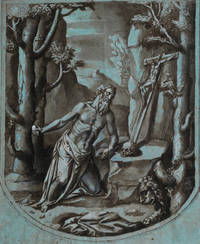
réf. B96280-3Spain circa 1588. Pen and ink and brown wash heightened with white on 2 sheets of heavy blue paper joined together by the artist. Sight: 493 x 402 mm. ca. 19 3/8 x 15 3/4 inches. This is one of a well-known group of drawings for liturgical vestments made by Spanish artists active at the Escorial between 1587 and 1598. Miguel Barroso 1538-1590 who trained with Gaspar Becerra arrived at the Escorial in 1587 and worked there continuously for the rest of his career; he was named painter to Philip II in 1589. Along with his contributions to the frescos and altarpieces in the chief cloister under the direction of Pellegrino Tibaldi he is known to have worked as a draughtsman for embroideries of the vestments of the Monastery of El Escorial and a number of drawings by him for these are conserved at the Library at the Escorial bound together in a single folio. Priscilla E. Muller reviewing the discussion of these in Angulo and Pérez Sánchezs Corpus of Spanish Drawings notes that Twelve drawings by Miguel Barroso a Spaniard of Italianate training who was engaged for work at the Escorial from 1587 until 1590 constitute a group of New Testament scenes drawn in 1588 for the embroidery of vestments several of which remain at the Escorial. Deliberately linear and compositionally stylized the drawings do not reflect a personal manner. as might be expected of any drawings that might be uncovered relating to his Escorial paintings which are less bluntly narrative if hardly less Mannerist than the New Testament embroidery drawings. Angulo and Pérez Sánchez note that additional pattern drawings for these vestments attributed to other masters are also conserved in a second folio at the Escorial Library Corpus catalogue nos. 309-385 and they go on to point out that additional drawings are known to have left the Escorial in the course of the nineteenth century mentioning sheets at the Biblioteca Nacional in Madrid the National Gallery in Edinburgh and the Musée des Beaux-Arts in Orléans; others are known in the collections of the Louvre the Yale University Art Gallery the Metropolitan Museum of Art and the Pierpont Morgan Library. Apart from these few Spanish designs for embroideries seem to have survived. This particular drawing would appear to have been designed for a cope. Whether it relates directly to the groups above remains to be determined given among other things its comparatively high degree of finish and especially its very large size which noticeably exceeds the dimensions of the drawings catalogued by Angulo and Pérez Sánchez; it is also on blue paper whereas most of those are on greenish-grey. That it is neither signed nor pricked for transfer as many but not all of those are is not conclusive. Spain, circa 1588. unknown
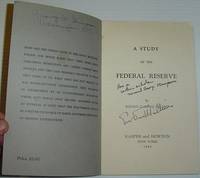
1952réf. 327a2087New York: Kasper and Horton. Good. 1952. First Edition. Paperback. Stellar provenance for this signed first printing example inscribed by Mullins 1923-2010 to dedicatee of a subsequent printing George Stimpson upon title page. Also signed by Stimpson inside front cover. In the Foreword to the 1991 printing of this title Mullins paid tribute to Stimpson by saying he and Ezra Pound were "two of the finest scholars of the twentieth century who generously gave of their vast knowledge to a young writer to guide him in this field which he could not have managed alone. The research for this book at the Library of Congress was directed and reviewed daily by George Stimpson whom the New York Times on September 28 1952 called 'A highly regarded reference source in the capital'". The first nationally circulated revelation of the secret meetings of the international bankers at Jekyll Island Georgia 1907-1910 where the draft of the Federal Reserve Act of 1913 was written. "Has the honor of being among the first books burned by the freedom-loving Allies in Germany after World War II had bailed out the bankers once again." - Robert H. Weems in 'A Populist Bibliography'. Average wear and soiling. Binding intact. A truly extraordinary signed first printing example of what is quite possibly the king of conspiracy titles. Singerman 0865. 8.7 x 5.5" ; 8vo - over 7¾" - 9¾" tall; Mullins on the Federal Reserve Bank the Fed Privately Owned Central Bank President Woodrow Wilson Colonel Mandell House Jekyll Island meetings Rothschild Rockefeller Paul Warburg; Signed by Authors . Kasper and Horton paperback
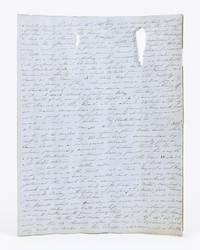
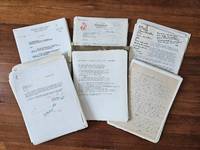
réf. 135288Fair. Quarto 12 pages last two blank. A saddle-sewn gathering of blue paper; two holes to each leaf apparently insect damage with some minor loss to the text; some marks and short edge tears; nevertheless an extraordinary relic in decent condition overall. The first nine pages closely written in ink in a single hand which we know to be that of pastoralist Alfred Barker 1812-1880 contain a version of Stuart's journal for the period from 31 March the beginning of the expedition to 17 May 1859 with some significant variation from the published versions. Importantly the final half-page of text is unmistakably in the hand of John McDouall Stuart himself. This passage - an addendum written in pencil and comprising material not included in published versions of the journal - describes the extent of Stuart's claims of pastoral land at Chambers Creek. The journal is accompanied by a loose bifolium containing manuscript directions to Chambers Creek quarto 2 pages also in Barker's hand with a small diagram of Hummock Hill. The journal ends after the entry for 17 May 1859. Published accounts of the expedition indicate that Stuart spent the following three days in camp finalising his report on the survey of Chambers Creek which was sent back to his patrons James and John Chambers and William Finke on 20 May by way of one of the expeditioners Campbell. The specific nature of the variations from the published versions leads us to conclude that Stuart sent with this material an edited version of his field journal to that date the originals of both manuscripts are now lost. Barker brother-in-law and business partner of the Chambers brothers would have copied the present manuscript directly from Stuart's original manuscript. It pays scant attention to the daily happenings of the expedition but records detailed information about the country with a particular regard to its suitability for pastoral use precisely the information most valuable to patrons intent on building a pastoral empire. Stuart's manuscript addendum to Barker's copy of his report must have been written in the short period between his return on 3 July 1859 and the departure in August of the same year of his third expedition into the interior. He had given John Chambers power of attorney in relation to his claims on the runs at Chambers Creek where he had claimed a staggering 1500 square miles of land. The matter had still not been settled at his departure and Stuart's precise description of the extent of his claim were evidently intended to allow his patrons to consolidate it in his absence. The detailed manuscript text on the separate bifolium also supports a date from the middle of 1859. It gives a set of straightforward directions to Chambers Creek via the crucial series of waterholes that Stuart had identified as well as some details of the surrounding country. Barker was soon to follow this route north to stock Stuart's empty cattle runs the explorer lacking the resources to do so himself. While these instructions are in Barker's hand they must have been prepared in consultation with Stuart in preparation for the cattle drive north. Returning from his third expedition Stuart was pleased to find Barker's cattle thriving on the saltbush on his land. After great difficulty and scandal the grant was finally made for an unprecedented area of 1000 square miles but many suspected that the beneficiary of the vast territory would be Chambers and Finke not the explorer Barker's contribution going unremarked in newspaper accounts of the time. This would be borne out in the coming years. The textual history of the journal of Stuart's second expedition makes the survival of this document all the more important. In her introduction to the edition of the journal published by the Friends of the State Library of South Australia 2002 Valmai Hankel writes: 'This expedition is the only one for which no manuscript diary or fair copy survives. As it was regarded as a private venture unlike the five other expeditions its results were not reported to Parliament so its journal was not published as a parliamentary paper. The only known versions are those published in the "Journal" of the Royal Geographical Society RGS vol.31 1861 pp.65-83 and in "Explorations in Australia. The Journals of John McDouall Stuart during the years 1858 1859 1860 1861 & 1862" edited by William Hardman London: Saunders Otley 1864 .'. The RGS and Hardman versions of the text are generally more discursive but both are the result of editing by third parties and would have been based on fair copies of the journals. Hardman in particular was an unsympathetic editor 'Stuart seems to be almost an illiterate person .' and often redrafted Stuart's matter-of-fact observations to fit more closely the mould of a Victorian travel narrative. Our manuscript on the other hand is not only contemporaneous with the expedition but also likely closer in content to the lost field journals before editorial intervention and judicious redaction and revisions for political and commercial considerations. A full transcription of the journal is available as are a list of variations from the published version. One example will suffice to indicate the significance of this manuscript. Hankel's introduction states that 'The expedition's main aims were to survey the Chambers Creek lease and to prospect for gold . Stuart's major discovery was more links in the chain of springs later known as mound springs which Warburton and Babbage had found in 1858. Hergott found the first on 13 April; although Stuart named them after their discoverer he does not say so in either version of his journal' page x. The manuscript states that 'on the 13th Hergott after finding St Stephens Pool dry and no water in the Range - discovered a batch of Springs South of the Pool - abundance of Water - distance from this camp to Hergotts Springs 30 Miles - Native Cucumbers found here'. These documents were purchased together with an important archive relating to Alfred Barker's pastoral properties offered separately and now sold. The archive contains letters that substantiate serious irregularities in the handling of Stuart's pastoral lease at Chambers Creek which when read in conjunction with the above material make the story of his final years even more distressing. Copies of the relevant letters are included with the manuscript. unknown
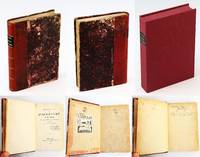
1864réf. 564j1976Bruxelles: Imprimerie de A. Mertens et Fils. Fair with No dust jacket as issued. 1864. First Edition. Hardcover. Is this book the plagiarized source of The Protocols of the Learned Elders of Zion "In his 1870 autobiography Maurice Joly 1829-1878 described how he conceived the idea of a dialogue between Montesquieu and Machiavelli. At that time it was forbidden to openly criticize the regime of Napoleon III but in this way it would be possible through the mouth of Machiavelli to expose the Emperor's motives and methods stripped of the usual camouflage. Thus this book was printed in Belgium and smuggled into France but was immediately seized by the police banned and Joly arrested. Thus few copies survive. Joly's reflections on the despotism of Napoleon III provide insights applicable to authoritarian regimes of today. Moreover something of Joly's insights even survived when his book was transformed into The Protocols of the Elders of Zion thus The Protocols often seem to forecast twentieth-century authoritarianism." - pages 73-76 of Warrant for Genocide by Norman Cohn in which he claims over 160 passages in the Protocols are clearly based on passages in Joly. "The Protocols of the Wise Men of Zion were first circulated in Russia in the early years of the twentieth century purportedly an account of a meeting between Jewish leaders in the fall of 1897. A horrible plot to undermine society overthrow governments and destroy Christianity is revealed. The 'minutes' are copied verbatim from A Dialogue in Hades Between Machiavelli and Montesquiou written by Maurice Joly. The 'Protocols' merely substituted the word 'Jew' for Joly's own devils." - Footnotes to pages 423-424 of Mein Kampf Reynal & Hitchcock 1939. Others argue that Joly's work was not the source of The Protocols. We leave it to the reader to decide. 4 i-iii iv 337 1 1 errata p. 18.0 x 12.4 cm. Text in French. Tight maroon quarter leather binding with new leather spine and leather title label. Wear to periphery of older marbled boards which are probably not original. Bookplate of Dr. J.A. Van Praag 1895-1969 inside front board. Van Praag was a lecturer at the University of Amsterdam when he acquired this book in 1931 and wrote his name atop the first blank leaf along with a comment about the purported connection of the book to The Protocols. He also wrote Joly's name on the title page. Pencil notes on pages 47 80 and 94. Evidence of moisture exposure to endpapers and more moderately to contents. Negligible if any waviness to contents. All text clearly legible with pages intact. Includes new custom acid-free clamshell with leather title label upon spine. A rare first edition example of this most contentious work. Provenance: Acquired from an Israeli dealer who purchased it at an Israeli auction which only sells books offered by Israelis. Our research indicates that at least some of Van Praag's books were looted by the Nazis in 1941. Apparently he retired in 1966 and attempted to rebuild his library. However after a fire in his widow's home in 1970 part of the library was destroyed or damaged and she sold the remaining books. We have no definitive way of knowing if this book was looted from Van Praag or if it was if he ever re-acquired it. Perhaps he did re-acquire it only to have it exposed to moisture per our description by firefighting efforts in his widow's home; 12mo . Imprimerie de A. Mertens et Fils hardcover
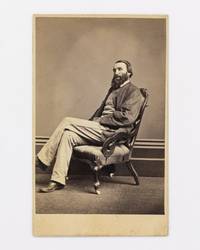
1866réf. 135300Adelaide: Townsend Duryea 1866. Adelaide Townsend Duryea printed circa 1866; original negative circa 1863. An albumen paper photograph 90 × 59 mm mounted on the original card 102 × 62 mm with 'T. Duryea Photographer to His Excellency 66 King William St. Adelaide' printed on the verso under the Vice-Regal Coat of Arms. 'Townsend Duryea began making cartes de visite in late 1862 or early 1863 and was advertising his "new" style of carte in May 1863' Bob Noye AGSA website. The portrait taken in Duryea's Adelaide studio shows Stuart after his epic crossing of the continent of Australia: he is visibly depleted - emaciated even - with his injured hand positioned awkwardly in his lap. The accident that caused this permanent injury occurred on 25 October 1861 the day the main party of the successful sixth expedition departed Adelaide. Stuart later described it in a letter to Charles Sturt: 'the accident I received from one of the horses being in a state of strangulation and endeavoured to release him reared up struck me in the temple knocked me senseless and springing again with his hind feet on my right hand has disabled me for life' Ian Mudie: 'The Heroic Journey of John McDouall Stuart' 1968 page 171. It is a most evocative image of the great explorer towards the end of his life. The negative number 18592/3 is inscribed in ink on the verso below Duryea's imprint. This particular imprint dates to around 1866 see Noye and the negative number is consistent with this date. Noye notes that 'A carte with a number belonging to a much earlier number range would be a reprint from an old negative held in storage'; this suggests that this photograph is not printed from the original negative perhaps lost damaged or destroyed. This further suggests that this photograph is printed from a negative produced by rephotographing an existing print of the portrait of Stuart taken earlier by Duryea. This would explain why Stuart has what appears to be his left hand in his lap: the image is printed in reverse. It was likely produced after news of the explorer's death in London on 5 June 1866 had reached Adelaide. A small item of local news 'Mr T. Duryea's Studio' in the 'South Australian Register' on 23 November 1866 lends weight to this possibility: 'A visitor to Adelaide may spend a very pleasant and profitable half-hour in Mr Duryea's photographic studio where a number of elegant photographs in every style of art are displayed. Mr. Duryea also exhibits some superior examples of photographs worked up in water-colours which are soft and some of them exquisitely finished. Amongst these there is a fine portrait of the late J.M. Stuart the explorer'. This carte de visite is clearly not that exhibition piece but it is most definitely a fine portrait. Townsend Duryea unknown
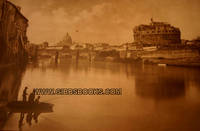
1870réf. 053004-KItaly 1870. Book. Illus. by Giacomo Brogi. Very Fine. No Binding. Albumen Mammoth Print c. 1870's By Giacomo Brogi 1822- 1881 Italian. Very rare photographic image by this artist in the original restored frame . This is not one of the standard tourist pictures that you find but a true work of art by this master photographer. Both Brogi and the Alinari Brothers worked as photographers and took the standard architecture ruins photos in Italy most being small 8"x10" Albumen prints but they did art photography also and to find one is a rare treat . This piece shows three men in a row boat on the Tiber River with Castel Saint`Angelo Mausoleum of Adrian on the right the Saint`Angelo bridge to the castle in the middle in the far distance you can see St. Peter's Dome . Looking around the photo the men in the boat you can see their reflection in the water. With sheep on the right shore and the clouds rolling by above it all this is a very importain photographic image by this artist . Please call for more information on this and other works of art. Size: 32 x 23. unknown
réf. 95963The archive comprises nearly 440 pieces each approximately 320 × 510 mm or larger many from the later 1970s when Mitchell was at the height of his powers. A unique commentary on the personalities and events of the times: when Hawke Fraser and Dunstan were in power Nixon went to China the war in Vietnam ended and the first wave of 'boat people' began to arrive here many Indigenous Australians were in a parlous state cricket and cricketers still caused grief . Approximately 440 items. unknown
1947réf. 0008116Jerusalem Israel British Mandated Palestine. Good. 1947. On offer is a unique historically significant journal handwritten during the final days of British Mandated Palestine most entries made immediately prior to the Declaration of Independence. This is a one-year page a day journal for the Jewish year of 5708 September 1947 to October 1948 has about 50 entries with most entries made between September 1947 and December 1947 and few brief records scattered over the next few months - the last one is dated June 7. It measures 7' by 5' the hardcover is slightly soiled but otherwise the journal is in very good condition. The text is in Hebrew the handwriting is mostly legible. Author's name is not identified but there is a note on the front page: "Vaad Hakehilla. Hanala Klalit" Local Community Council. General Management. It is clear from this note and from the context that the journal was kept by a member of the Hebrew Community Council in Jerusalem the body that was established in 1917 and coordinated and represented different groups of Jerusalem Jews during the British Mandate. Vaad Hakehila was responsible for different aspects of Jewish life in the city including economic and social assistance to the residents. It had a social services department and a society of assistance to kindergartens issues related to them are mentioned in the journal several times. Most entries are the minutes of the Council meetings. Some entries deal with organizational and financial matters taxes elections complaints dispute settlement work of social services purchase of fire engines but most meetings reflect increasingly tense situation in the city and concern food and fuel supply food rationing security and organizing Mishmar ha'am National Guard - unit of volunteers established in September 1947 in Jerusalem for maintenance of public order. The Council was constantly in contact with the state authorities political and religious leaders various Jewish organizations trying to solve various problems facing Jewish community in the city. Among the names mentioned in the journal are Yitzhak Ben-Zvi David-Zvi Pinkas a Zionist activist politician a signatory of the Declaration of independence and a future minister Mordechai Shatner a signatory of the Declaration activist and politician one of the founders of Yad Va-Shem who then was a member of the Jewish National Council Ben-Zion Meir Hai Uziel the Sephardi chief rabbi of Mandatory Palestine who appeared before the Mandatory government as representatives of the Jewish community and on missions on its behalf Itzhak HaLevi Herzog the first Chief Rabbi of Ireland and then the Ashkenazi Chief Rabbi of Mandatory Palestine and of Israel Menashe Elassar a noted Jerusalem businessman and many other. The first entry is dated September 15 and mentions a meeting with Mr. Ben-Zvi who had been the President and a member of the Vaad Haleumi the National Council a post in which he served as the chief representative of the Jewish community vis-a-vis the mandatory authorities. His name is mentioned several times throughout the journal in relation to various matters. A council meeting on September 17 dealt with several issues including social work and house confiscation order of the Babayoff family: "Military Commander refused a request to postpone confiscation order for the Babayoff's House till after the holidays . Chief Rabbi Uziel was asked to speak with the commissioner about postponement of the confiscation order. Rabbi Herzog was also asked to speak with the Military Commander regarding the same matter". Many entries mention searches conducted by the British Army in Jewish neighbourhoods one of such searches on Yom Kippur Eve finished with desecration of a synagogue: "Search in Nachlat Zvi Jerusalem neighbourhood. After we received information regarding the desecration of the synagogue by the army during their search R' Nattan and I went to check if the information was correct. We reached the location after the search had finished and the army left the place. All the synagogue benches the tables chairs and pillows were upside down. All of the study books Mishnayot Zohar Gemaras were scattered on the floor. The holy ark was open and the Torah scrolls were open ." Some of the entries refer to property damage caused by bombings that the council members were assessing: "After the two nights that passed in Jerusalem Shabbat night and Motzei Shabbat when tens of thousands of bullets were shot towards the all the Jewish areas of the city I got up early . to visit the places that were the primary targets of the bullets of the police and soldiers. The primary target was again the homes near the police dormitory in the hospital of the English Mission. The view of the horrifying sight of the destruction caused to these homes and the miracle that nobody's life was taken . testimonies were collected from dozens of people."Nov. 16. One of the constant subjects was ensuring food and fuel supply in the city: "Meeting of the supply committee with bakery owners to ensure sufficient flour supply in case of emergency" ".To bring all wholesalers and demand from them to increase supplies in Jerusalem." they meet with members of the Jewish National Council JNC and devote many meetings to this matter. As part of their activity they meet with mukhtars heads of Arabic neighbourhoods. Va'ad had limited means to cope with the worsening situation and in December the Jerusalem Emergency Committee was set up that took upon itself civil administration of Jewish Jerusalem which explains why there are almost no entries after November. Though it includes only about 50 entries of varying length the journal provides a lot of details from the months preceding the Declaration of Independence and contains names of many people who played an important role in creation of the Israeli State. Overall it's a fascinating document of the life of Jewish community in Jerusalem during the last months of the British Mandate and activity of the Jewish Community Council in Jerusalem.; Manuscript; 12mo - over 6¾" - 7¾" tall; KEYWORDS: HISTORY OF 20TH CENTURY 1940s POST-WW2 ERA MIDDLE EAST ISRAEL JERUSALEM JEWISH QUARTER CREATION OF ISRAEL JEWS OF JERUSALEM BRITISH MANDATE DECLARATION OF INDEPENDENCE MANDATORY PALESTINE BATTLE OF JERUSALEM 1947 BOMBINGS IN JERUSALEM JEWISH SELF-GOVERNING BODIES IN MANDATORY PALESTINE MISHMAR HA'AM NATIONAL GUARD IN JERUSALEM LOCAL COMMUNITY COUNCIL IN JERUSALEM VA'AD HAKEHILA VAAD HAKEHILA JERUSALEM LOCAL AUTHORITIES LEADERS OF JEWISH COMMUNITY OLD CITY PARTITION BRITISH ARMY IN MANDATORY PALESTINE SOCIAL SERVICES DURING THE BRITISH MANDATE ISRAEL BEFORE INDEPENDENCE SELF-GOVERNMENT OF JEWS IN JERUSALEM JEWISH COOPERATION WITH BRITISH ADMINISTRATION IN PALESTINE YITZHAK BEN-ZVI DAVID-ZVI PINKAS MORDECHAI SHATNER END OF THE BRITISH MANDATE FOOD RATIONING IN JERUSALEM FOOD SUPPLY TO JERUSALEM ZIONISM ZIONIST ACTIVISTS JEWISH NATIONAL COUNCIL JNC VAAD HALEUMI 1947 JERUSALEM RIOTS JERUSALEM RELIGIOUS LEADERS HEBRAICA JEWISH HISTORY HANDWRITTEN MANUSCRIPT DOCUMENT LETTER AUTOGRAPH WRITER HAND WRITTEN DOCUMENTS SIGNED LETTERS MANUSCRIPTS DIARY DIARIES JOURNALS PERSONAL HISTORY SOCIAL HISTORY HISTORICAL HOLOGRAPH WRITERS AUTOGRAPHS PERSONAL MEMOIR MEMORIAL ANTIQUITÉ CONTRAT VÉLIN DOCUMENT MANUSCRIT PAPIER ANTIKE BRIEF PERGAMENT DOKUMENT MANUSKRIPT PAPIER OGGETTO D'ANTIQUARIATO ATTO VELINA DOCUMENTO MANOSCRITTO CARTA ANTIGÜEDAD HECHO VITELA DOCUMENTO MANUSCRITO PAPEL . hardcover
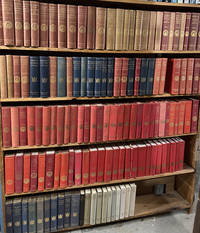
réf. 108858Toronto: The Champlain Society and The Hudson's Bay Record Society Book. Very Good. Hardcover. First Edition. RARE complete run of the CHAMPLAIN SOCIETY PUBLICATIONS plus THE COMPLETE HUDSON'S BAY RECORD SOCIETY PUBLICATIONS and THE COMPETE ONTARIO SERIES within the Champlain Society set This includes 113 Champlain Society books from 1907 to 2015 inclusive plus an additional 21 volumes from the Hudson's Bay Record Society that are not within the publications listed for the Champlain Society. Note 12 of the Hudson's Bay Record Society books are within the listing of the Champlain Society publications as are all of the 16 Ontario Series. The only missing items are 2 of the 3 "occasional papers" within the Champlain Society publications list. All are hard cover books except for the 1 Occasional Paper; 10 of the Hudson's Bay books have dust jackets. All in very good condition a couple have minor wear and or marks. Shipping will be based upon the weight of these books 370 pounds with packing materials and the location they will be sent to. Thus shipping costs will be more than this system allows us to note - please contact us for the exact shipping cost to your location approximately $280. The Champlain Society and The Hudson's Bay Record Society hardcover
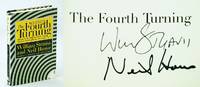
1997réf. 541H2157New York: Broadway Books. Good in Very Good dust jacket. 1997. First Printing. Hardcover. 055306682X . Signed without inscription by both authors upon half-title page. "Offers an utterly persuasive prophecy about a new American era that will begin just after the millennium." - dust jacket. xiv 382 pages. Footnotes. Index. Light overall wear. Binding tight. Yellow high-lighting to eight pages. Dust jacket now in glossy new archival protection. A rare double-signed first printing example of this most extraordinary work. ; 8vo - over 7¾" - 9¾" tall; United States History Cycles Forecasts Future Signed Twenty-First Century Strauss-Howe generational Theory Steve Stephen Bannon Donald Trump Presidential Campaign 2016; Signed by Authors . Broadway Books hardcover
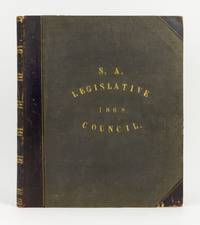
1868réf. 142860Adelaide: Townsend Duryea 1868. First Edition. Hardcover. Very Good. Adelaide Townsend Duryea 1868. A large quarto album approximately 415 × 365 mm containing 18 albumen paper portraits each approximately 280 × 210 mm mounted on the rectos of cloth-hinged thick card leaves interleaved with guards plus one leaf of letterpress see below. Contemporary half roan and cloth lettered and tooled in gilt with a binder's ticket on the front pastedown 'Bound at the "Register" Office Grenfell Street Adelaide'; covers slightly worn; leaves slightly cockled; one guard missing; most photographs lightly discoloured near the right-hand edge; a few light spots of foxing mainly to the guards and the versos of the mounts and some minor signs of age and handling but overall in excellent condition. The subjects include some of the most prominent figures in early colonial South Australia. In order of appearance the portraits depict John Morphett President Henry Ayers Charles Hervey Bagot John Henry Barrow Charles George Everard John Baker William Wedd Tuxford Thomas Elder William Peacock William Morgan Thomas Hogarth John Tuthill Bagot Thomas English Henry Mildred John Crozier William Parkin John Hodgkiss and Emanuel Solomon. The 'South Australian Advertiser' for 20 August 1868 records that: 'Mr. Duryea is preparing a parliamentary group containing the members of both Houses of the Legislature which promises to be an effective affair. The members of the Council have already given him sittings and a fine series of portraits is the result'. In the subsequent months Duryea exhibited the photographs at his King William Street studio but most accounts refer to them assembled as a group around Morphett. This photo-collage with the portraits all heavily cropped is almost certainly the basis for a contemporary carte de visite published by Duryea see SLSA B 9258. However most of the images in this album appear to be rare or even unrecorded in their uncropped form; indeed the only other examples we located were of Henry Ayers and Charles Hervey Bagot. It is also rare to find photographs of early colonists at all let alone of this size quality and quantity. The guard leaves for the portraits of Morphett Hogarth J.T. Bagot and Mildred contain manuscript biographical details in a single hand. Although we have not identified the writer it is likely to be one of the eighteen MLCs as he refers to 'our chamber' in the entry for Morphett. The portrait of C.H. Bagot is accompanied by a similar short biography but this time in letterpress and misspelling his middle name as 'Harvey'. C.H. Bagot English Mildred Crozier Parkin and Solomon are identified in another hand on the mounts beneath the image. Townsend Duryea] hardcover
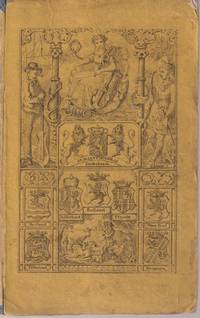
1839réf. 11053Coblenz: Verlag Von K. Baedeker. Very Good-. First Edition. Hardcover. Yellow boards a bit browned and worn. Spine ends and corners lightly chipped. Pages clean and tight with occasional browned pages not affecting contents; In 1839 with the publication of Holland Belgium and Rheinreise 3rd Edition the Baedeker series was launched. An extremely rare book in the original Biedermeier boards including a list of Baedeker's books in front and with a steel engraved fold out map in the back; 16mo 6" - 7" tall; 212 pages . 1839. Verlag Von K. Baedeker hardcover
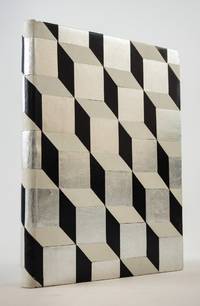
1912réf. ST20811Paris: Eugène Figuière et Cie 1912. FIRST EDITION. PRESENTATION COPY. 240 x 185 mm. 9 1/2 x 7 1/2". 44 pp. 2 leaves. STRIKING 3-D OPTICAL ILLUSION BINDING BY A. CONTRERAS stamp-signed on front turn-in WITH AN ALL-OVER DESIGN OF CUBES rendered in black white and silver morocco smooth spine. In older probably original brown woodgrain drop-back box backed with black buckram. With 26 black & white photographic reproductions of works by Cézanne Picasso Derain Braque Metzinger Laurencin Gleizes Léger Duchamp Picabia and original owner Juan Gris printed on glossy white paper. WITH A HALF TITLE INSCRIPTION in French OF GREAT IMPORTANCE FROM ONE OF THE CO-AUTHORS translated as: "To the painter Juan Gris with all my best wishes J Metzinger." Occasional underlinings in blue pencil. Text leaves with overall light browning and occasional foxing due to paper stock lower corner of half title restored and fore edge with minor chipping otherwise a fine copy the plates clean and bright and the binding unworn. Penned by two Cubist artists this is a highly resonant association copy of the first major treatise on the Cubism movement presented to noted Cubist painter Juan Gris and later put into an illusionistic binding composed of variably colored cubes that seem to jump off the surface. Albert Gleizes 1881-1953 and Jean Metzinger 1883-1956 had painted in both Post-Impressionist and Fauvist styles before their interest in exploring form and structure as well as light and color led them to the style that would become Cubism. Influenced by Cézanne's "brick-by-brick" technique and Poincaré's writings on space and time the new movement sought to examine objects from a mobile perspective and to depict multiple views of a subject in one painting. In "On Cubism" they explain: "An object has not one absolute form; it has many. It has as many as there are planes in the region of perception." The work features black & white illustrations of Cubist paintings by the authors and by fellow pioneers Picasso Braque Derain and Juan Gris to whom this copy was presented by Metzinger. Born in Madrid as José Victoriano González-Pérez 1887-1927 Gris studied engineering before moving to Paris to pursue art. First working as an illustrator for periodicals he was inspired by Metzinger to begin painting seriously. His training in engineering helped him appreciate the importance of mathematics in painting a realization triggered according to art historian John Richardson by Metzinger's painting "Le Goûter Tea Time" exhibited at the Salon d'Automne in 1911. Our volume was later in the collection of and probably bound for Chilean architect and collector Carlos Alberto Cruz 1939-2022. We have been unable to find more information on our binder "A. Contreras" but it seems possible that he was also Chilean as the Valparaiso-based Cruz owned a number of bindings signed with that name. Eugène Figuière et Cie unknown
réf. 108073The very fine portrait visible image size 545 × 395 mm in its original ornate gilt frame external dimensions 740 × 595 mm is exquisitely hand-painted and signed by the famous colonial photographer Townsend Duryea 1823-1888. His original label is affixed to the paper backing on the verso of the frame 'T. Duryea Artist Photographer 66 and 68 King William Street Adelaide' and in our opinion he has created a masterpiece as both artist and photographer with this work. James Hurtle Fisher commenced practice as a solicitor in London in 1816 and 'was drawn into the colonizing movement in 1835. He was selected as resident commissioner one of the most important offices under the South Australian Act . second only to the governor'. Fisher 'left England in July 1836 with the governor's party in the "Buffalo" arriving on 28 December 1836 at Holdfast Bay where the official oaths were administered a proclamation was read and a ceremony marked the beginning of settlement. In January 1837 Fisher erected his reed hut and Land Office near the survey camp of Colonel William Light at the north-western corner of the new capital site; the destruction of these temporary buildings by fire on 23 January 1839 caused both men serious loss. Fisher had been allowed to draft his own instructions which were not shown to Governor Sir John Hindmarsh. Disputes between the two men over their respective powers had begun on the voyage and were soon revived in the new Council of Government and more violently outside and led in February 1837 to the Resident Magistrate's Court binding the participants over to keep the peace towards each other. The new governor George Gawler was appointed both governor and resident commissioner a radical departure from the principles on which the colony had been founded' ADB. Fisher returned to his profession and became a leader of the South Australian Bar. In October 1840 he was elected first mayor of Adelaide; in 1860 he became the first resident South Australian to be knighted. Townsend Duryea was at the King William Street address from 1858 until his illustrious career as a photographer 'was cut short when his studio and entire collection of 50000 negatives were destroyed by fire on 18 April 1875' ADB. We suggest as a date for this magnificent portrait 'circa 1870'. unknown
1969réf. Cat340United States and England 1969. 453 letters with twenty pieces of other material. Of the letters to WBAI: Fourteen letters from 1968; 245 from January 1969; sixty-four from February 1969; five from March and April 1969; eighty-six undated. With thirty-nine sent to the FCC these are copies sent to WBAI. Conditions vary; generally very good. Julius Lester 1939-2018 was a Black academic author civil rights activist photographer and musician. He taught at the New School for several years and then at UMass Amherst from 1971 until his retirement. In his highly decorated career he authored over forty books including a guide to the twelve-string guitar written with Pete Seeger; released several folk-blues albums; exhibited photographs including at the Smithsonian Institution; and won numerous teaching awards.1 From 1968 to 1975 Lester hosted Uncle Tom's Cabin on WBAI an independent New York City radio station. Early in the show's tenure during the 1968 teachers' strike over the firing of a number of mostly Jewish teachers from the majority Black Ocean Hill-Brownsville school district Lester's show aired a poem written by a young Black student at an unidentified New York City high school. The poem was dedicated to the striking United Federation of Teachers' president Albert Shanker and opens: "Hew jew boy with that yamaka on your head / You pale faced jew boy / I wish you were dead / I can see you jew boy /naw you cant hide / I got a scoop on you yeah / you gonna die." Lester-who incidentally converted to Judaism in 1982-defended the poem and its airing provoking backlash from listeners and from the Anti-Defamation League which called for his resignation and picketed the station. Offered here is a large archive of listener mail responding to this broadcast and to the later broadcast of a letter from a Black Queens College graduate. This letter also concerned anti-Semitism in the Black community albeit with a much different tone than the student poem: the writer explains that "until quite recently" they had felt significant anti-Jewish sentiment because having grown up in a Jewish neighborhood they used to conceive of all white people as Jewish-and that listening to WBAI "was very instrumental not only in helping me to recognize my anti-Semitism but in tracing its roots". The original copy of this letter is contained in the archive; as a manuscript note on it remarks it "started a second wave of complaint and precipitated the complaint from Shanker to the FCC". The letter was broadcast on Larry Josephson's In the Beginning and much of the mail is addressed to him. A tally on a filing folder totals the "hate" letters at 728 and "love" letters at 341; however in this collection the response is mostly positive. Moreover within the positive response to the broadcasts are only a handful of openly anti-Semitic ones "Good luck in your fight against the Jewish financial interests of New York City". Nonetheless the "hate" contingent is well-represented: besides threats "Don't walk alone cock-sucker and don't take this lightly - we have pledged to get you and we mean it!"; "'He who lives by the sword will die by the sword.' And you will get yours you may be sure" a number of writers sent in poems of their own usually riffs on the original poem and generally containing abundant racial slurs and stereotypes about crime welfare and police brutality. Occasionally a rationale is offered: the station had defended its broadcasts on the basis of free speech and therefore should air these poems as well. In fact the better part of the supportive letters including ones from listeners who vehemently disagreed with the broadcast content also cite the importance of free speech as a reason for their continued support; for instance Adele Lawrence writes: "I am a subscriber and a Jew. Negro anti-semitism has upset me too. But I support the station's policy 100%. Lets hear what black people are saying. Lets search our souls to find out why. And lets do something about it - instead of all this self-righteous over-reaction." Like Lawrence most listeners felt the need to include some demographic information about themselves. It seems that the broadcasts had prompted listeners to introspect on their own identities and to write in with their experiences often in surprisingly thoughtful ways. A number had fled Nazi Germany such as Liz Frankel who writes: "Who am I to talk I came out of Germany in 1939 at the age of 17. My father was in a concentration camp but was miraculously released. His health was broken though and he died in this country in 1945. I personally have severe psychological scars left from my experiences in Germany that is one reason why I can understand the black man's terrible life in this country. Why other refugees from Nazi Germany cannot is beyond me." Kurt Obernbreit describes his reaction to the broadcasts and how his views changed: "On January 17 I wrote you a letter regarding the now famous Julius Lester/Leslie Campbell program in which I voiced a negative reaction. I did not hear the program but got all my information from the press at that time. Meanwhile you had the courtesy of sending me a copy of your report I heard you on the Barry Gray show and some more material appeared in the press including the Village Voice. I have now a much clearer picture of what actually occured sic and I must compliment you on the clarity of your report. I admit I reacted emotionally and I admit that I am very sensitive maybe overly sensitive to expressions of Anti-Semitism as I am myself a graduate of the real Mc Coy namely the Hitlerian variety which I experienced personally. . I want to withdraw my criticism." One affecting ambivalent letter from an Orthodox Jewish college student reflects on the poem and letter and on her and Josephson's Jewish identity. She writes in part: "You talk about being Jewish but you must realize that my whole life is Jewish and I happen to think that its great and I am very proud of that. I think its because I feel like this that I can understand how a person of any race or ethnic group feels and thats why I respect him. Since I did grow up in this community and went to the schools that I did go to unfortunately for myself I did not come in contact with any black people or even people from any other religious groups. . I can't see anything wrong with the poem and I still don't after all you've got the right to read anything over the air that you want. . my father said to me 'did you hear about the poem that they read over that homo-sexual station that you listen to' . well with my father I'm sometimes able to reason so I said 'so what' . Now thats crazy if we're going to start punishing people for saying what they want then we might as well start having a secret police if we don't already and the whole thing. . Larry I couldn't write an anti-black poem if I wanted to or an anti any other group of people because they've never done anything to me. . I know the reading of the poem over the air can do no harm but further free speech which we need alot more of. But I am really afraid that it did something to me when you were talking this morning I felt you were directing your anger at me as a Jew and I kept on asking why . Unlike the black girl who wrote you who seemed to have found her answer all I have are thousands of questions." Another writer Esther Aronson discusses her historical experiences of Black-Jewish relations in the city: "In the early 1930s my family lived in the Bronx. The scene was in the early depths of the depression. No one that I knew had as much as a spare dime. But there were enough families in this Bronx Jewish ghetto who could afford a day worker. The WASP communities were using white maids . the Jewish people for many obvious reasons used the negroes. And I must say in passing that it is probable that the Jews were the only people as a group who did hire negroes. . And the slave mart shaped up each Friday morning on certain corners in the community. The Jewish women came to the slave block to haggle about the price to test the strength select for whatever characteristic the most desirable their particular day worker. By 8 or 9 A.M. the scene broke up. The Jewish women taking home their particular catch and the unhired negroes returning to Harlem minus 10¢ carfare. I don't mean to imply that the Jewish women alone made the scene. The negro women came willingly to the slave block. These were the only people that would hire them. But then the most sordid bit of this scene developed. Even though I'm sure it wasn't universally true it was true enough to have reached my ears. . 1. Move the clock back so that an extra hour or two could be gleaned from the negro. 2. Cut the wage at the end of the day. 3. Pay part of the wage in old clothes. 4. Humiliate the negro by talking deprecatingly about the lazy stinking schwarter in broken English as if the negro was not there and listening etc. etc. . So the Jewish community has become the first area of vengeance. They were and are most intimately visible. But the police force was equally visible and much more violent and deadly in the negro experience. . So I imagine what may be operating is a transfer of latent all American WASP anti-semitism into the issue." A number write in with their own experiences of ethnic prejudice. The writers are sometimes Jewish: "my son who as a kid in the heart of Manhattan was beaten up by other white kids only because he admitted that he attended afternoon classes in Hebrew school. I was screamed at and insulted in the very same area when I was seen putting posters of the American Jewish Congress in store windows" and sometimes not like Gerhard Weber a German immigrant who "couldn't get away from that epithet 'nazi'"; and Shirly Niebanck whose "son goes to public school and has been in this WASP minority constantly . he is being punished because he's Gentile." Many writers discuss WASP-hood; interestingly there is a noticeable split between writers who identify Jewish people including themselves as distinct from white people versus as "white and Jewish." Several letters also came in from NYC teachers who were in some way invested in the strike. Harriet Haberstroh writes in support: "I . taught in P.S. 144 in Ocean Hill last school year. The strong anti-black sentiment was detectable among some of the Jewish teachers. As a former U.F.T. member I cannot back Al Shanker in his claims of anti-semitism and favoritism of the black side. The UFT was given time." Rita Mandelman writes with a more equivocal tone: "I am a subscriber: white Jewish middle class and a teacher a deadly combination. I voted for and supported the first 2 strikes. I voted against but reluctantly supported the third strike. I have written to you before criticizing WBAI's heavily one-sided coverage of the strike and its repercussions. . WBAI will not be living up to my ideal of 'free speech radio' until I start hearing some genuine discussion of the issues--some confrontations of opposing viewpoints. . You say that you have afforded the teacher's Union many invitations that have not been accepted. I find this difficult to believe but I must accept your word on it. I have written Mr. Shanker to ask why. You are in error when you say that the Union has opposed the experiment in Ocean Hill from the beginning. The U.F.T. was instrumental in setting up the district. Only when things started running badly and Union people were critical of some of the leadership or lack of it did the hostilities erupt. You say the Union's position has been 'extensively reported' in the media implying that this relieves you of the responsibility of airing these views. Certainly the Ocean Hill position has been as extensively reported and supported in the press so something is faulty in your logic. The only place the Union's position is supported is in its own Newspaper and very often highly critical letters are printed there. There is no lack of opposition to Mr. Shanker within the Union as you have so often implied. It is as close to being a democratically run large organization as any I have ever seen." One writer "Eva" a former nurse reflects on her Jewish identity and the parallels between the teachers' strike and the 1959 hospital workers' strike: "Black people hate the Jews because of the Jewish Teachers Union or better because of Shanker who symbolizes it. Nobody loves the Jews because of Local '1199' and its Jewish president Leon Davis. This man 'has laid down his life on the line' to use your words to upgrade the Black and Puerto Rican workers of the hospitals. . I was one of the few white hospital rank and filers who 'laid down her life' to help Black Hospital workers out of their misery. For the last 9 years I have considered this to be the main purpose of my living. For the last 9 years my bosses conducted an extermination campaign against me for my anger hatred of them and my fanatical activity. As a result not only am I out of my job but confined to my bed with an incurable illness. While being in the very same hospital as a patient recently I was treated with bitter hatred by one of the nurses for absolutely no reason at all. The only reason was that she is Black and I am Jewish and I was much too ill to defend myself. . When my son was 9 years old he was beaten up and thrown into the snow by white Americans because he is a Jew. I was cursed and insulted by white Americans because of the same reason. . Well the American Nazi party must be delighted about the way things are turning out in the Black community. . Also all the Nazis in Germany and Austria are jubilant about the way things are developing in this country. My mother was murdered by a German Nazi I and my son will be murdered by an American Negro! Wonderful!" Overall the archive is dense with personal stories and reflections about identity-Jewish and otherwise-in New York City and the contentious relationship between the city's Black and Jewish populations. Of interest to scholars of the city's ethnic tensions at the time the 1960s counterculture and especially the social construction of race. Provenance: From the estate of Rabbi A. Bruce Goldman who hosted Up Against the Wailing Wall on WBAI in the 1970s. 1 Margalit Fox "Julius Lester Chronicler of Black America Is Dead at 78" The New York Times January 19 2018.
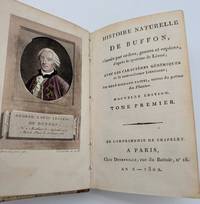
1803réf. 71345Paris: De L'Imprimerie de Crapelet 1803. Nouvelle Édition. Leather Bound. Very Good. Twenty-fourmo 13.5 cm Contemporary 3/4 brown leather with speckled paper over boards. Pale red and green gilt stamped leather spine labels. Six gilt ruled compartments on the spines. Illustrated plates the majority with tissue-guards. This specific set has a frontispiece portrait of Buffon 781 illustrated plates and 5 folding tables the exact number of plates found in each volume is available upon request. Text in French. Extremities very lightly rubbed and soiled. A couple of boards with small red stains. Spines sporadically mottled. Occasional minor chipping to spine ends and a handful of spine labels with loss. Underlying boards peeking through at corners. Endpapers have a previous owner's red ink stamps a small faint ink stamp in black and minute contemporary numerical notations. Stitching visible in gutters here and there. Pp. 125-130 volume 12 are partially detached. Pp. 29-32 volume 44 and pp. 93-96 volume 77 are completely detached but present. Skillful repair to fore-edge margin of p. 169 volume 59. Pages bound out of sequence in volume 59 between p. 136 and p. 185. Periodic printing errors occur in the set's pagination. In a handful of plates the sky in the background appears stained and there is a bit of red staining to plate at p. 258 in volume 70. Two reptile illustrations in volume 42 are a trifle trimmed at the head. Additional Collation Notes: Curiously volumes 56-65 are the only volumes in which the plates are numbered. In volume 58 I believe plate 15 is mislabeled as 13 and it is found between plates 23 and 24. The books are very structurally sound and the pages are strikingly clean and bright. Contents: Théorie de la Terre. Époques de la Nature; Discours Généraux; Quadrupèdes; Oiseaux; Histoire Naturelle des Minéraux; Histoire Naturelle des Poissons; Histoire Naturelle des Reptiles; Histoire Naturelle des Insectes; Histoire Naturelle des Coquilles; Histoire Naturelle des Vers; Histoire Naturelle des Crustacés; Histoire Naturelle des Végétaux. An edition published posthumously of Buffon's most famous work. Buffon's Histoire Naturelle was continued in part by others after his death. It was translated into various languages and read throughout Europe. French naturalist George-Louis Leclerc de Buffon 1707-1788 Comte de Buffon is viewed as the most influential biologist of the 18th century epitomizing the revolutionary changes the Enlightenment brought to the study of nature. The title of Count was bestowed on him by Louis XV in recognition of his accomplishments rather than by birth. He is most famous for Histoire Naturelle a comprehensive work on natural history first begun in 1749. De Buffon began his studies at the College of Godrans in Dijon where he was only an average student. Originally his father wanted him to have a legal career however in 1728 he went to Angers where he studied medicine botany and mathematics. In 1739 he was appointed keeper of the Jardin du Roi the royal botanical garden now the Jardin des Plantes and of the accompanying museum. There he was tasked with creating a catalog of the royal collections in natural history which he transformed into an undertaking to produce a record of the whole of nature. This became his monumental work Histoire Naturelle Générale et Particulière which was the first modern effort to methodically present all existing knowledge in the subjects of natural history geology and anthropology in one publication. Buffon's ideas challenged traditional biological classification and introduced theories of evolutionary thought roughly one hundred years before Darwin. Comte de Buffon is also remembered for his argument that the world had a lengthy history rather than being only a few thousand years old as the naturalists of the 1600s believed. In addition he felt that scientific writing should be energetic and graceful in style thereby allowing his work to be accessible to a wide audience in Europe and beyond. Buffon's work articulated that species were different throughout the world that the planet was much older than the Bible suggested and that plant and animal species were related in intricate ways. Buffon's bold way of looking at the world laid the groundwork for later revolutionary thinkers who are responsible for much of what we know about the natural world. An attractive set of a pivotal work of the Enlightenment richly illustrated with numerous hand-colored plates. De L'Imprimerie de Crapelet unknown
2011réf. 347H4160Singapore: Straits Times Press. Very Good in Very Good dust jacket. 2011. Fifth Impression. Hardcover. 9814266728 . Signed and dated 2012 by Lee Kuan Yew without inscription upon title page. "Lee Kuan Yew's name is nearly synonymous with modern Singapore. Prime Minister for 31 years from 1959 to 1990 he was in the public eye for over 60 years as a revolutionary leader who steered Singapore to independence as a determined Prime Minister who transformed the country and finally as an elder statesman. This book picks up from his memoirs of 2000 as Lee engages a group of journalists over issues that a younger more critical population has raised." - dust jacket. Clean bright and unmarked with very light wear. Unopened DVD inside back board. A wonderful memento of this extraordinary statesman.; 8vo - over 7¾" - 9¾" tall; Lee Kuan Yew - Interviews Lee Kuan Yew - Political And Social Views Prime Ministers - Singapore - Interviews Singapore - Politics and Government - 21st Century Singapore - Social Conditions - 21st century Signed; Signed by Authors . Straits Times Press hardcover
1487réf. 046404Milan: Antonius Zarotus 1487. Second Edition. Hardcover Full Leather. Very Good Condition. 19th century red morocco gilt hinges and spine rubbed and a little weak but still generally sound and attractive. Added marbled endpapers and a description of the edition and a note on the binding penned on added blank endpapers. The second edition of Tacitus much improved by Puteolanus from the first and the first printed with The Life of Agricola first published by Zarotus in a collection of panegyrics ca. 1482. It was once thought to have been printed in the 1470s but now usually pegged as 1487. Likely washed though gently except for the first and final leaves Agricola leaves 176-187 with a dampstain in the margin final two leaves darkened. Four small wormtrails in last section leavs 121-end two trails in the textblock but generally very unobtrusive. Top edge gilt and trimmed slightly when rebound leaf numbers penciled lightly and neatly in the inner gutter. Five 6 line and one 2 line initial colored in early or contemporary color 37 lines set in a fine Roman typeface often compared to Jenson and assumed to be set by him at one point 187 leaves with the blanks at 160 and 176 but lacking the final blank. Graesse T7 Dibdin Bibl. Spenc. v2 461 Brunet V 633 Goff T7 ISTC it00007000 Provenance: With the label of A.C.C. Brodribb but likely from his father C.W. Brodribb who wrote and published in The American Library Annual a poem describing this volume laid in with a penciled date for the binding of 1855; an inscription on an added endpaper bears the same date. Also laid in is a 1949 letter to A.C.C. Brodribb Esq. from L.A. Sheppard at The British Museum describing the volume which he likely inherited following his father's death in 1945 Size: Folio. Quantity Available: 1. Shipped Weight: 2-3 kilos. Category: History; Incunabula. Inventory No: 046404. Antonius Zarotus hardcover
1956réf. 1125558196Montreal : Published for the McGill Poetry Series by Contact Press 1956. Book. Near Fine. Hardcover. 1st Edition. 8vo - over 7¾ - 9¾" tall. black cloth silver spine lettersdust jacket79 pages illustrated five full page line drawings by Freda Guttman with some minor wear to dust jacket at top of spine with very small loss and at top corners of d.j.very slight tone to spine of d.j in protective mylar jacket. a fine example of the author's first book of which approximately 400 copies were printed. part of the McGill Poetry Series operated by Louis Dudek.First published in 1956 when he was twenty-two years old Let Us Compare Mythologies is Leonard Cohen's first collection of poetry. It is an accomplished and passionate collection which demonstrates Cohen's remarkably assured voice even as a young man. An unprecedented debut published to immediate acclaim. [Published for the McGill Poetry Series by Contact Press] Hardcover
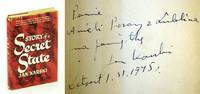
1944réf. 864H4484Boston: Houghton Mifflin Company. Good in Good dust jacket. 1944. First Edition. Hardcover. Signed and inscribed by Jan Karski upon front free endpaper. Karski 1914-2000 recounts his experiences when his homeland of Poland was rent asunder by the joint Nazi and Soviet invasion of 1939 and his harrowing subsequent life as a member of the Polish underground during which he was captured by the Gestapo and severely tortured. Provides a ghastly eyewitness account of life in the Warsaw ghetto into which Karski was smuggled so his observations could be reported to the outside world. Firearms advocates will cringe at Karski's account of what happened after he and a large group of Polish soldiers handed over their weapons to their 'comrades' from the Soviet Union. In 2012 Karski was posthumously awarded America's highest civilan honor the Presidential Medal of Freedom by President Obama. 391 pages. Moderate wear to publisher's red cloth. Dust jacket now preserved in archival-grade Brodart. Binding intact. A sound copy of this truly unforgettable WWII narrative. Laska 672 Kehr & Langmaid 5407 Weiner Library Catalogue Seven 997 Enser p.343.; 8vo - over 7¾" - 9¾" tall; Polish Underground - World War 1939-1945 Gestapo Torture Warsaw Ghetto Poland Resistance Espionage Polska Holocaust; Signed by Authors . Houghton Mifflin Company hardcover
1948réf. 566h5692London: Westropa Press. Good with no dust jacket. 1948. First Edition. Hardcover. "This book is different from other books. First of all it is only in form a book at all. In reality it is a part of the life of action. It is a turning-point in European history a late turning-point but a real one. This book is itself the first blow in the gigantic war for the liberation of Europe. The prime enemy is the traitor within Europe who alone makes possible the starving and looting of Europe by the outer forces. He is the symbol of Chaos and Death. Between him and the spirit of the twentieth century is unremitting war." - Foreword. "The spectacle of Yockey 1917-1960 being persecuted framed and driven to his death simply because he wrote this book is not one we would expect to see in the Twentieth Century in the land of the free and the home of the brave." - Willis Carto. 10 iv 4-405 3 pp. Average wear and soiling to publisher's khaki cloth. Title embossed atop front board. Black lettering upon professionally restored backstrip. Modicum of moisture-induced rippling near fore-edge of back board. Binding sound. Contents tanned at periphery. Foxing to free endpapers. Publisher's address lightly penciled upon copyright page otherwise unmarked. No dust jacket. A sound copy. 7.25" x 5". Singerman 757; 12mo - over 6¾ - 7¾" tall; Francis Parker Yockey Imperium history . Westropa Press hardcover
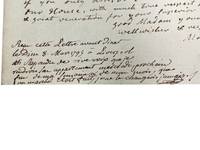
1795réf. 231141795. Transgender and Cross-DressingLGBTQ D'Eon de Beaumont Charlotte Geneviève. Autograph Note Signed 8 March 1795 written and signed by one of the earliest recorded transgender women in Europe. The letter dates to D'Eon's time in England after her diplomatic career military service and public gender transition made her one of the most documented transgender individuals of the eighteenth century. D'Eon de Beaumont Charlotte Geneviève and Mary Watterison. 8 March 1795. 1 manuscript pages on one sheet bifolded. Approx. 8 x 12.5 inches. In English and French. Manuscript letter written from Mary Watterison to Madam D'Eon with a note in D'Eon's hand below signed "D". Watterison writes to D'Eon explaining that she can no longer afford to continue renting her a room at the agreed upon price and that D'Eon will have to vacate the room by the following Wednesday or pay more for her rent. D'Eon writes a note below stating that she responded in person and will leave the apartment rather than changing their deal. The letter reads in part: "1795 My good madam / I am sure your considerate liberality of heart will not only pardon but applaud what nesesety only could compel me to inform you. Which is that the great loss I find from letting the lodgings at the prise I first agreed too is such as I realy cannot afford. for indeed the prise is not equel even to the trouble of our servants without reconing a farthing for the rooms.And now my dr Madam as I never wish to gain anything by you therefore hope you are too good to wish me to lose by you you must pardon me if I say I realy consider myself as a cleer looser of 10/6 per week for the past time you have been here if you give me no more then first proposed therefore must beg you to have other lodgings by next Wednesday or else promise to pay me after the rate of a guinea per week besides five.with much true respect for you person great veneration for you superior talants. I am good Madam your most sincere wellwisher respectful humble servt. / Mary Watterison." Below in Chevalier D'Eon's hand in French translated "Received this letter before dinner on Sunday March 8 1795 in Liverpool. Responded in person that I would return her apartment next Wednesday at the end of my week of my month that I never change a done deal / D." Financial difficulties plagued the Chevalier after she relocated permanently to England in 1785. With her pension abolished her dueling career ended by poor health and many of her old acquaintances in France lost to exile or execution D'Eon turned to her community in England for survival. Her friends and acquaintances provided her with both solace and financial support when she was unable to pay her debts though she always remained dignified proud and unwilling to be taken advantage of as evidenced by her statement at the end of the letter: "I never change a done deal." In correspondence from this point in her life D'Eon expresses both grave financial anxiety and profound gratitude to those keeping her from destitution as well as a deep belief in the manifestation of God as one's community. By 1795 D'Eon had lived publicly as a woman for decades following the international scandal that surrounded her gender in the 1770s. The manuscript offers insight into D'Eon's life and financial difficulties in England while her gender was publicly subject to rumor debate and trial. Notably though expressing frustration and displeasure with D'Eon Mary Watterison always uses the feminine title "Madam" indicating a consistent respect for her gender identity. Soiling and tanning to edges particularly at upper right margin; legible throughout; intact and well preserved. An unusual firsthand document of an early transgender pioneer identifying herself with feminine pronouns in eighteenth century Europe. unknown
1856réf. 12958NY: Derby & Jackson. Very Good with no dust jacket. 1856. Second Edition; First Printing. Hardcover. The spine is dulled with wear to the spine ends & corners light rubbing to the covers. ; Inside the front cover is an inscription gifting the book to Jefferson Davis from "M. P. Abbott . " Also inside the front cover is an inscription telling how the owner's brother was a forager with the Union Army who took the book from Davis' library at his brother's plantation near Vicksburg where it had been moved deemed safer than on his plantation. An anti-slavery book from Jefferson Davis' own library. Wonder what he was thinking when he read it. Brings to mind all the conflicts he had when he took his post with the Confederacy. What an association! ; 12mo 7" - 7½" tall; 298 pages . Derby & Jackson hardcover
1887réf. 42771887. Leather. Very Good. 9.5 x 12.5. Original Public Opinion Journal Complete RARE Huge Set Collection of 1887 to 1906 38 Volumes in 33 Bindings made up of 988 weekly journals over 35000 pages over 400 pounds. Condition: Good to Fine most in Very Good #3 through #29 are half leather and paper or half leather and buckram #30 through #40 are dark green cloth bound. Some of the leather volumes have spine cracks hinge surface cracks 4 volumes have hinge repair #3 through #18 are of a dark red leather binding all leather treated with Klucel G consolidate. volumes 21 to 40 are exlibrary and have gilt lettering of library on spine cover and some stamps inside those some have loose weekly title pages 9.5 x 12.5 tall. Over 400 pounds Motto of: A Comprehensive Summary of The Press Throughout the World on all Important Current Topics Washington D.C. and New York N.Y. Each of the 40 Volumes which is usually 6 months of 26 weekly journals has a nice Index at the beginning. Public Opinion was a lower circulation and is now scarce to find. Most of the volumes include the great advertisements that were in the individual journals first First Ford Advertisement ever. Two days after Ford Motor Company was formed. 1903 FordMobile Advertisement Advertisements 1903 Haynes-Apperson many 1903 up Oldsmobile pistols and guns Radium Spinthariscope Wabash Trains Woodrow Wilson etc. Olive Redpath mentioned in Theater section etc hardcover