[HASEGAWA SADANOBU III] 三代目長谷川貞信.Biblio.com
665 190 résultats
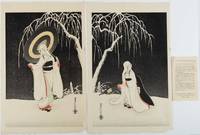
réf. 224354Kyoto.: 内田美術書肆 Uchida Bijutsu Shoshi. Mid 20th Century. Pair of coloured Oban woodblock prints 39.1 x 26.3cm; 45 x 29cm sheet on Uchida watermarked paper with the publisher's black stamp Kento registration cuts lower right corner both in very good condition. Striking woodblock prints: a narrative pair capturing the "Snowy Heron Maiden": one standing with her umbrella open and the other seated with her umbrella closed by the prominent Osaka-school artist Hasegawa Sadanobu III 1881-1963. This complementary pair beautifully captures two distinct evocative scenes from the famous Kabuki dance drama Sagi Musume The Snowy Heron Maiden where a white heron in the figure of a beautiful maiden dances the joy and agony of a doomed love. . 内田美術書肆 [Uchida Bijutsu Shoshi]. unknown
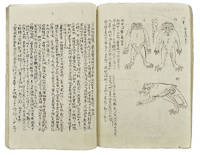
réf. 15702519th century. Black and white ink sketches 120 folded leaves paper covers titled in ink stab binding. Edges and corners creased on a number of leaves covers a little soiled occasional browning but generally very good. 24.5 x 17cm. A collection of manuscript abstracts from various books. The upper cover is titled in ink 雜書鈔錄 Abstracts from Various Books together with the signature of the transcriber Murakami Gozan 村上呉山 and his seal which reads "Gozan". The abstracts in this manuscript come from 26 different books and journals which were published or written in the Edo to Meiji period and mainly cover biography history and encyclopaedic information. On the inside of the upper covers Murakami Gozan has written 28 titles however this list is not entirely accurate as one title appears twice and another does not seem to appear in the content at all. The abstracts that Gozan transcribed include: Shōtei zakki 松亭雑記 Miscellaneous Notes by Shōtei a work which we were not able to locate so may be an unpublished manuscript. Tsureduregusa shoshō taisei 徒然草諸抄大成 Complete Collection of Annotations on Tsureduregusa 1688; Seppō innen-shū 説法因縁集 A collection of Buddhist stories. Kinsei gōketsu-tan 近世豪傑譚 Biographies of the Great People in Pre-modern Times 1892 Meiji shinshi-tan 明治紳士譚 Biographies of Prominent People in Meiji 1892 Naigai kokon itsuwa bunko 内外古今逸話文庫 Library of Episodes of Great People of All Times in and outside of Japan 1893-94 Hyakka setsurin 百家説林 Collection of Essays by Many Scholars1890-92; Nihon taika ronshū 日本大家論集 Anthology of Articles by Japanese Great Experts journal 1887- 89 Tōyō bijutsu 東洋美術 Far Eastern Art journal date Yōnen zasshi 幼年雜誌 Magazine for Young Children journal 1891-94. The manuscript includes some illustrations and notable amongst these are: portraits of Toyotomi Hideyoshi and Oda Nobunaga; kappa lit. "river child" the legendary water animal which appears in Japanese folklore; scenery of Mt.Fuji from Hyaka setsurin; Chinese coins and seals and two Chinese figures painted by legendary painter Gu Kaizhi from Tōyō bijutsu; and water plant and water insects from Yōnen zasshi. . unknown
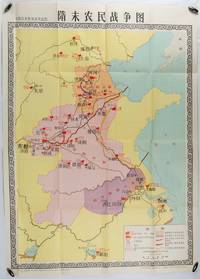
1980réf. 176714北京. Beijing.: 地图出版社.Di tu chu ban she. 1st Edition 1st Printing. 1980. Large Chinese education map folded with original envelope scale 1:1500000 legend left lower corner showing the military advance routes and battle grounds led by several leaders of the agrarian rebels including 王薄 Wang Bo 窦建德 Dou Jiande 杜伏威 Du Fuwei and 翟让 Zhai Rang. Very good copy. Text in Chinese. Sheet measures 106.8 x 76.52cm. . 地图出版社.[Di tu chu ban she]. unknown
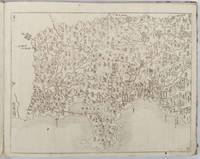
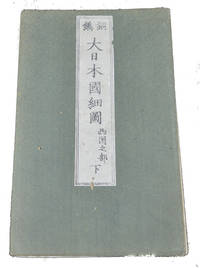
1864réf. 219844京都. Kyoto.: 村上勘兵衛. Murakami Kanbei. Genji 2 1864. Maps 16.5 x 21.5cm 47pp accordion style binding previous owner's chop worm holes lower edge or corners of many leaves and more centrally on 10 leaves cloth on boards torn with loss particularly on lower cover. Sold as a collection of delicately engraved maps. Even though the printed title label on the upper cover states that this volume covers the eastern provinces it in fact includes both eastern and western regions of Japan extending to Shikoku Kyushu Tsushima and the Okinawa Islands. The atlas opens with general maps of Japan and the world. Each delicately executed black and white map depicts towns transport routes and the principal topographical features including mountain ranges. . 村上勘兵衛. [Murakami Kanbei]. hardcover
1865réf. 154031Kyoto Edo Osaka Ise and Nagoya. 元治2. 1865. Part 2 of this atlas only. 4pp of text in Japanese 34 double page copper engraved maps showing the provinces of western Japan accordion style binding. 16.5 x 11cm. A little insect damage lower cover last six leaves of text and final map causing loss to some characters though the text it is still legible some very minor spotting or soiling but generally very good. This atlas shows the provinces in the western part of Honshu Island and those of Shikoku and Kyushu Islands including Okinawa Islands. Each delicate black and white map shows towns traffic routes and rough geographic features of mountains. . unknown
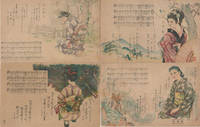
1572réf. 170402東京 Tokyo.: 新興音楽出版社. Shinkō Ongaku Shuppansha. 昭和18 1943. 5 very attractive colour postcards 9 x 14cm attractive pictorial paper envelope slightly browned and creased very good copies. These 5 postcards were published for sending to the front line soldiers from the home front. Each postcard has an illustration of a melancholy young Japanese woman dressed in a kimono printed around her are the words and musical score of a folk song from one of 5 Japanese regions - Akita Kusatsu Yoneyama Kagoshima and Yamanaka. On receipt the soldier would think fondly of home and maybe sing the folk song to or with his companions at the front. . 新興音楽出版社. [Shinkō Ongaku Shuppansha]. unknown
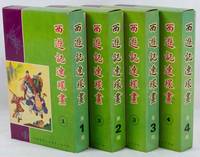
1975réf. 223379Hong Kong.: 新雅七彩畫片公司. Xinya qicai huapian gongsi. 1975. Forty volume graphic novel set of Journey to the West complete illustrated in black and white with captions in traditional Chinese characters below. Presented in 4 boxes of 10 volumes each approximately 44 - 60pp per volume 20.2 x 12.5cm. Coloured paper wrappers each with its own title and list of all titles on lower wrapper. Wrappers slightly foxed a little soiling on boxes but overall the set is in exceptionally good condition. A very appealing graphic lianhuanhua set of Wu Cheng'en's famous novel Journey to the West sometimes translated as "Monkey". . 新雅七彩畫片公司. [Xinya qicai huapian gongsi]. unknown
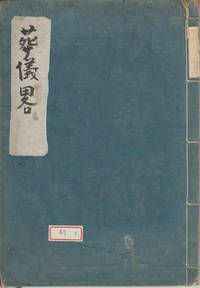
1865réf. 163632No place of publication.: No details of publisher. 慶應元 1865. Japanese late Edo book woodblock printed book on funeral etiquette black and white line illustrations showing objects used at funeral 21 leaves four-hole stabbing binding with strings handwritten title label laid down upper cover a little worming upper margin and in two small places on covers small sticker minor wear and marking covers lower corner a little bumped a good copy. Text in Japanese calligraphy style. 26.8 x 18.7cm. This book explains Shinto style funeral arrangements equipment and etiquette with some illustrations. . No details of publisher. unknown
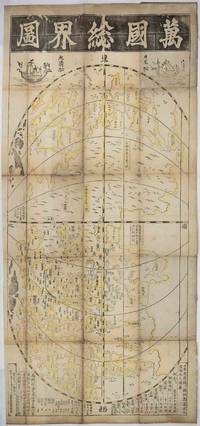
1708réf. 219243東京. Tokyo.: 須原屋茂兵衛. Suwaraya Mohei. Hoei 5 1708. Black and white woodblock map with yellow outlining in original hand colour 55.8 x 127cm map; 59.5 x 131cm sheet folding into the original Japanese wrappers chipped and rather worn 26.4 x 17.4cm the map with old repairs laid down on washi rather browned and wormed at the folds but with no serious loss the sheet age-toned and a little dusty but overall in remarkably good condition. Preserved in a modern blue linen Japanese case with toggle-closures. A famous woodblock-printed Japanese map of the world by renowned Edo Period map-maker Ishikawa Tomonobu who is also known as Ishikawa Ryūsen. This is a revised version of an earlier map produced by Ishikawa in 1688. The map appears to draw on Chinese and Portuguese geographical knowledge. The Chinese production of world maps had been transformed by the influence of the Italian Jesuit Matteo Ricci who collaborated with Chinese cartographers to produce a 1584 map of the world. In Japan the production of maps of "the myriad countries" or "the international countries" bankoku had been inspired by contact with Portuguese missionaries and with the Dutch in the 16th century. Ishikawa's map broadly resembles the Ricci map in being placed in an oval frame with the Pacific and thus also China and Japan at the centre. The content though is different. While Ricci's map is oriented to the north Ishikawa's is oriented to the east with America at the top of the page and the sketchy outlines of Europe including 'Ikiresu' England and a large and clearly marked Holland and Africa 'Kafuri' at the bottom. This orientation apparently influenced by the first world map in Japan "Bankoku Sōzu" 万国総図 which was published in 1645. Interestingly although Ishikawa had earlier produced a quite detailed and fairly accurate map of Japan the Japan shown on this world map is a rather loosely outlined collection of islands in which for example Ryūkyū the Ryukyu Kingdom now Okinawa and Hachijōjima appear much larger than they are in reality. Japan is also unusually oriented making it appear as though Ezo now Hokkaido is in the middle of the Pacific. It seems that the cartographer's interest here was less in outlining Japan in detail than in broadly setting out the country's place in relation to the land masses to the east and west. Like other Japanese world maps of the Edo period and like Ricci's map Ishikawa's image of the world includes imagined countries such as 'The Land of Giants". The continuing centrality of China in Japanese thought is indicated by the fact that Ishikawa's map contains a very clearly marked depiction of the Great Wall and that the map is decorated at the top with depictions of a Japanese and a Chinese sailing ship. The text at the bottom gives estimated distances between Hizen Province where the port of Nagasaki provided Japan's main official outlet to the world in this age of seclusion and various places in China and between Hizen and the Ryūkyū Kingdom. It also gives the estimated distance from Korea to Tsushima Island which served as Japan's gateway for diplomatic and trade relations with Korea. Engelbert Kaempfer a German physician and explorer brought back the 1688 edition of this map printing to Europe after his stay in Japan between 1690 and 1692. The map was introduced to European audiences in the 17th century and impacted on later European cartographic endeavours. Copies of this rare and historically significant map are held only in a handful of major collections: the British Library National Diet Library NDL of Japan the Staatsbibliothek of Berlin University of California Berkeley's Japanese Historic Maps Collection and the University of British Columbia. . 須原屋茂兵衛. [Suwaraya Mohei]. unknown
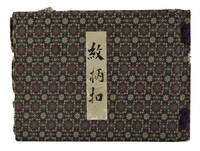
1900réf. 1549731900. Sample album of designs most probably for weaving. The album contains 196 numbered paper slits for holding the design samples in place with 68 samples included. Handwritten paper tabs some damaged with loss attached to the edges of 17 leaves give the names of customers. Bound in cloth covered boards with tassel ties one place on the spine a little gnawed some other minor wear to cloth. Paper title label upper cover. A sample book which has been used for the purpose but is overall in good condition. This album contains samples of design which appear to be designs for the weaving of fabric. Many leaves have paper tabs attached which indicate the names of the customers ordering or interested in a particular design. Below each design is the name of the design and a hiragana letter and number given to the design. It is possible this album comes from Gifu Prefecture as there is a part of the letterhead of "鏡島尋常高等小學校 Kagashima Higher Elementary School. The seal of Sugiyama Shōten 杉山商店Sugiyama Shop is also included but we have not been able to locate this shop. . hardcover
1855réf. 154076Edo. 1855. Volume 5 only. 4 double page black and white woodblocks from copper engravings 18 folded leaves some worming throughout original wrappers considerably worn and wormed with a little loss. A reading copy only of the 5th and last volume of 米利幹新誌 巻之5 New Account of America. 1853 the year the first volume of this set was published was the year Commodore Matthew Perry's American fleet came to Uraga Bay. The four illustrations show: the UK fleet attacking the US port the US volunteers fighting to regain the territories taken by the Western forces a scene of the city of Boston and a family having lunch together. This set deals with the geography and history of North and South America. The author was well-known for his ready reception of western ideas. His work "Gogaku shinsho" is one the first books of Japanese grammar based on Western grammatical rules and conceptions . unknown
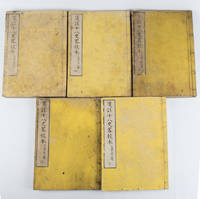
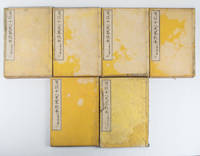
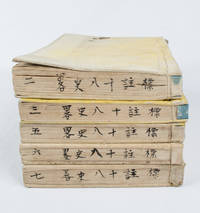
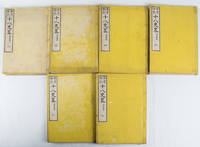
1880réf. 165397大阪.Osaka.: 中川勘助.Nakagawa Kansuke. 明治131880. 5 volumes of 7. Missing volumes two and three bound in Japanese 5 hole stab binding double leaves oriental style. Paper title labels laid down upper covers rubbed with loss soiling and creasing on covers edges little soiled occasional worming still text clean and sound. Text in Chinese with Japanese reading marks. 26 x 18.5cm. A Japanese edition of Jūhasshiryaku 十八史略 Shi ba shi lue in pinyin with extra notes. The text was checked against the authorative text by Japanese scholar 近藤元粹 Kondō Gensui. The Summary of the Eighteen Histories is an introductory Chinese history for children compiled by Zeng Xianzhi 曾先之 in the Yuan period. The full set is complete in 7 volumes. . 中川勘助.[Nakagawa Kansuke]. unknown
1880réf. 165396大阪.Osaka.: 中川勘助.Nakagawa Kansuke. 明治131880. 6 volumes of 7. Lacks volume 1 bound in Japanese 5 hole stab binding double leaves oriental style. Paper title labels laid down upper covers soiling and creasing on covers edges little soiled occasional worming and chops insect damage upper edge volume one still text clean and sound. Text in Chinese with Japanese reading marks. 26 x 18.5cm. A Japanese edition of Jūhasshiryaku 十八史略 Shi ba shi lue in pinyin with extra notes. The text was checked against the authorative text by Japanese scholar 近藤元粹 Kondō Gensui. The Summary of the Eighteen Histories is an introductory Chinese history for children compiled by Zeng Xianzhi 曾先之 in the Yuan period. The full set is complete in 7 volumes. . 中川勘助.[Nakagawa Kansuke]. unknown
1880réf. 165395大阪.Osaka.: 中川勘助.Nakagawa Kansuke. 明治131880. 6 volumes of 7. Lacks volume one bound in Japanese 5 hole stab binding double leaves oriental style. Paper title labels laid down upper covers soiling and creasing on covers edges little soiled ink annotation upper edge some volumes string split volume seven with some browning still text clean and sound. Text in Chinese with Japanese reading marks. 26 x 18.5cm. A Japanese edition of Jūhasshiryaku 十八史略 Shi ba shi lue in pinyin with extra notes. The text was checked against the authorative text by the Japanese scholar 近藤元粹 Kondō Gensui. The Summary of the Eighteen Histories is an introductory Chinese history for children compiled by Zeng Xianzhi 曾先之 in the Yuan period. The full set is complete in 7 volumes. . 中川勘助.[Nakagawa Kansuke]. unknown
1878réf. 165197Tokyo.: 山中市兵衛.Yamanaka Ichibee. 1878. Volumes 2 3 5-7 of 7 volumes a Japanese edition of 18 Chinese histories classics spanning from pre-Qing to Song Dynasty. Originally edited by a Chinese scholar 曽先之 Zeng Xianzhi in Yuan Dynasty it was later annotated by another Chinese scholar 陳殷 Chen Yin in Ming Dynasty. This is Japanese edition compiled by 大賀富二 Ōga Tomoji has Japanese reading marks. Four-hole stab binding double leaves oriental style paper title label missing on volume 2 some marking covers particularly volumes 2 and 3 occasional worming string volume 3 split but still holding in good condition. 18.4 x 12.7cm. . [山中市兵衛?].[Yamanaka Ichibee?]. unknown
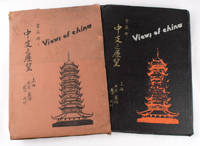
1572réf. 158424上海.Shanghai.: 三益社.Mimasusha. 昭和十三1938. Coloured folding map China as far north as Hebei Province south to Hong Kong west to Sichuan and Guizhou Provinces and corresponding coastal regions. Some folding black and white plates including one of the Bund looking north. 4 full page colour plates black and white photographic plates some highlighted with colour image of Chinese dragon wall sculptures on endpapers pictorial cover in red silver and gold titled in English and characters. The 54 leaves of photographic plates each captioned in Japanese are accompanied by a tissue guard with a somewhat more detailed explanation of the scenes in English and Japanese. Image of Chinese pagoda in red upper cover rubbed with a little loss. Upper corners bumped. Album measures 26.6 x 19.8cm. In original worn and marked pictorial card slipcase. Very good copy. This volume illustrates the famous sightseeing areas in Shanghai Suzhou Wuxi Zhenjiang Nanjing Wuhu Hangzhou Jiaxing and Songjiang. Additionally one leaf show three young Chinese beauties and two others the everyday lives of Chinese people. . 三益社.[Mimasusha]. unknown
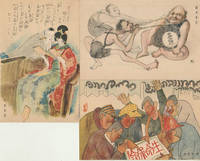
1572réf. 170401大阪. Osaka.: 日本生命保険株式会社. Nihon Seimei Hoken Kabushiki Kaisha. 昭和8 1933. 5 colour manga postcards 9 x 15 cm in slightly foxed original envelope. Postcards are all in very good condition. This set of manga postcards were published in 1933 by Nippon Life Insurance Company to promote the benefits of life insurance. Instead of presenting figures and tables each manga tries to illustrate the sense of reassurance people would experience when they buy this company's insurance. For example a manga by Okamoto Ippei a famous manga illustrator in the pre-war Japan depicts a "Family Boat" where young and old members each wear a lifebelt represent their insurance policy while sailing. Its caption says that a insurance policy is a rescue buoy for life which would make people feel peaceful even on the roughest of seas. Another card features a young attractive geisha sitting coquettishly at home is an advertisement for an old age insurance policy. The text assures the viewer that their policy will be paid back in full when the policy matures. The couple plan to use the money to fund the granddaughter's honeymoon trip and their own holiday anticipating that they would live long enough to receive the matured fund. . [日本生命保険株式会社]. Nihon Seimei Hoken Kabushiki Kaisha. unknown
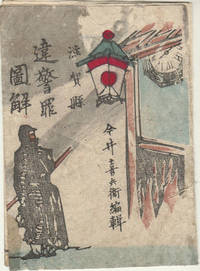
1518réf. 170899今井喜兵衛. Imai Kichibē. Meiji 15 1882. Woodblock Japanese printed booklet containing 3 folded leaves. Text accompanied by small handcoloured illustrations showing the minor criminal offences described above. 7 x 3cm section of loss upper section of colour woodblock upper cover stain lower cover upper cover and first two leaves lacks lower cover but contents are complete neatly rethreaded. Still an attractive copy of a fascinating and scarce item. A fascinating insight into crime and punishment in 1880s Japan this little booklet provides colour-illustrated explanations of minor crimes with details of the punishments which apply to them in Shiga Prefecture. It appears to have been designed for distribution to the public - perhaps to shops small businesses etc. From it we learn amongst other things that you could be imprisoned for between 3 and 10 days or fined a sum between 1 and 1.95 yen for giving lodging to a foreigner without recording their address properly. A sentence of 2 to 5 days imprisonment or a fine applied to people who sold raw fugu highly poisonous without proper treatment sold the meat of diseased animals offered photos or woodblock prints of the Emperor and Empress for sale or cremated the dead without official permission or in a place other than the officially approved cremation sites while a sentence of between 1 and 12 days applied to crimes which included flying paper kites near overhead telegraph lines. . 今井喜兵衛. [Imai Kichibē]. unknown
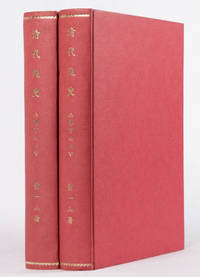
1934réf. 159936No publication details. circa1934. Complete Part Three of the "General History of Qing Dynasty" 清代通史 in 2 volumes by the modern Chinese historian Xiao Yishan 1902-1978. This work is made up of 10 chapters which focuses on the Boxer Rebellion and Chinese Qing government's politics and foreign affairs. Volume I: 38 124 228 280pp. Volume II: 497 130pp. Rebound in modern cloth boards titled in gilt on the spine. Upper wrapper with title and list of contents of both volumes laid down with some loss not affecting the text 8 pages of volume 2 p.123-130are also laid down. Title of volume one gives the incorrect information of the volume number whereas on the spine the correct volume number is shown. Browned throughout with occasional tears and minor loss. A stamp in the set which says "Complete set two volumes cost four Dayang " silver coins which were in use as Chinese currency suggests the books were published and sold during Chinese Minguo period 1911-1949. Text in traditional Chinese. "General History of the Qing Dynasty" was written and published over almost a decade from 1923 to 1930. The first part was first published in 1923 while Xiao Yishan 1902-1978 was still a student at Peking University. This two volume set is the third part of the series and is Xiao's lecture notes from the period he was lecturing at Peking Political College of Culture and History 北平文史政治學院 between 1928 and 1930. He was the founder and principal of the college. Volume one lists very detailed information on the Qing imperial officials both local and central governments and also presents famous Qing scholars' origin and major works. Volume two focuses on the rising and falling of Taiping Rebellion movement in China and also covers the political history under the reign of Tongzhi Emperor 1861-1875 . No publication details. hardcover
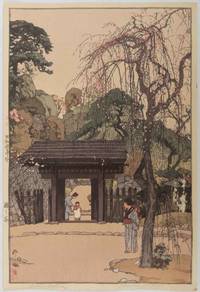
1935réf. 218323Japan.: Self published. 1935. Colour woodblock print 39 x 26.5cms including margins signed in ink with seal Hiroshi pencil signature Hiroshi Yoshida and the jizuri seal faded in the top left-hand margin margins a little toned and two small patches of paper abrasion removing surface colour in the lower right of the image but overall in good condition. Atmospheric woodblock print with delicate tonings the colour of the sky echoing the pink plum blossom of early spring a small child attended by their mother in costume waits at the gateway while a baby sitter looks on; a late career work by the great Hiroshi Yoshida 1876-1950. From the collection of the late John Caiger 1930-2022 lecturer in Asian studies ANU. . Self published. unknown
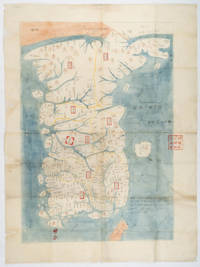
réf. 218441Tokyo. No date. Late Edo. Folding manuscript map ink and watercolour 82 x 61 cm red chop at one edge. Evidence of worming mainly affecting the edges and central fold professionally strengthened with archival washi tide-mark to the verso of the map and the wrappers but an appealing example of this delicately executed and sought-after map of the Korean peninsula. A late Edo period hand-painted colour copy of one five maps produced by Japanese scholar Hayashi Shihei to accompany his famous 1785 banned work "Sangoku Tsuran Zusetsu" "An Illustrated Description of the Three Countries" - the three countries in question being Japan's neighbours Korea the Ryukyu Kingdom now Okinawa Prefecture and Ezo now Hokkaido Sakhalin and the Kuril Islands. This detailed map of "The Eight Provinces of Korea" was probably based on Korean maps but Hayashi added details including the existence of the residence in Busan maintained by envoys from the Japanese Domain of Tsushima which had a relationship with Korea throughout most of the Edo period. He also adds text showing the distance between this residence and the Korean capital in both Japanese and Korean measurements and includes latitude lines though these are somewhat inaccurate - placing the 38th parallel south of the Korean capital. His map interestingly gives the Korean words for the four cardinal directions written in Korean script. Unlike Hayashi's "Illustrated Description of the Three Countries" this map does not show the contentious Takeshima/Dokdo/Liancourt Rocks which are too far out from the coast to fall within the frame of the map although it does include the island of Ulleungdo closer to the east coast of Korea. This copy is undated but inscribed with the words "Map by Hayashi Shihei of Sendai". A red chop in the lower middle shows that the map was owned by the Iijima Family in Matsushiro Domain Nagano Prefecture. The family were known as historians of the domain. . unknown
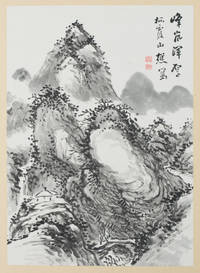
1930réf. 159304Shōwa 5. 1930. Ten ink paintings presented in a cloth covered Japanese accordion style album. Upper and lower edges lightly insect damaged insect damage in three small places within the album itself not affecting the paintings title label a little nibbled but nevertheless a very pleasing album blue cloth case somewhat worn and faded with toggles. 24.5 x 18cm. The ten paintings in this album depict a variety of subjects. They are the works of a skillful group of likely amateur ink painters organised by Seika Sanshō 栖霞山樵 and also include his own works. The ink paintings in this album are: 1 Landscape by Koshū 菰舟; 2 Orchid by Kikusui 菊水; 3 Landscape by Seika Sanshō; 4 Peaches by Koshū; 5 Landscape by Kikusui 菊水; 6 Crabs by Koken 菰軒; 7 Landscape by Rokumei 鹿鳴; 8 Narcissus by Seika Sanshō; 9 Landscape by Rokumei; 10 Otafuku Homely Woman Mask by Seika Sanshō. A double page explanation in calligraphy by Seika Sanshō dated 1930 tells us that this album contains works produced at the second Seika-kai gathering by Seika's group and that he requested Yamada Kokō 山田古香 to contribute the title calligraphy. Kokō's calligraphy "Sei yō shu 静有趣” means "Tranquillity has elegance". Yamada Kokō 1852-1935 orginally from Sanuki Province present Kagawa Prefecture was a professional calligrapher based in Kyoto. . hardcover
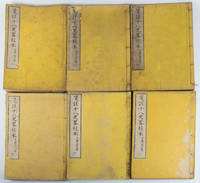
1818réf. 165209京都.Kyoto.: 五車楼.Gosharō. 明治18 1885. 6 volumes of 7 volume-set missing volume one bound in Japanese 5 hole stab binding woodblock printed on double leaves oriental style. Paper title labels laid down on yellow embossed upper covers some rubbing and light soiling in good condition. Text in Chinese with Japanese reading marks. 26 x 18.5cm. A Japanese Meiji edition of Jūhasshiryaku 十八史略 Shibashilue in pinyin with extra notes added by a Kyoto resident 奧野精一 Okuno Seiichi. The Summary of the Eighteen Histories is an introductory Chinese history for children compiled by Zeng Xianzhi 曾先之 in the Yuan period. Complete in 7 volumes. . 五車楼.[Gosharō]. unknown
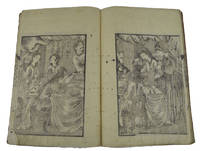
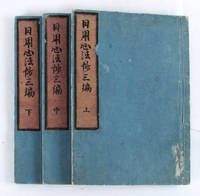
1840réf. 159300Edo.: 須原屋茂兵衛 Suharaya Mohei. Tenpō 11 1840. 3 volumes being the complete Part III of 日用心法鈔三編 Ethical Teachings for Everyday Life. Paper covered card covers paper labels upper covers four hole stab binding string split on last volume but the binding is still sound. Covers a little marked and abraded in places but the binding is sound and generally clean. Occasional light soiling contents but the contents are otherwise very good indeed. This work provided practical ethics for the commoners. It seems that the author Jufukuken Shinkyō 壽福軒眞鏡 was a retired merchant in Edo but other details of his life are not known. This work Nichiyō shinpō-shō Part One to Part Five was published in the period between 1838 to 1855. Practical ethics was widely accepted by the commoners after Japanese philosopher Ishida Baigan 石田梅岩 1685-1744 promoted the Shingaku Mind Learning 心学 movement. In the first passage of the preface Shinkyō writes: "Observing people in this society although many like drinking parties merrymaking seeing theatrical plays and watching Sumo wrestling a very few like to work for their family business. Also although there are some who eat a lot of food a very few eat food while saving a lot of rice grains. Most people eat without preserving food for the future". The book is a collection of ethical advice lessons and moral stories. Shinkyō argues that one should work hard for one's family business be frugal and save money and rice which is the foundation for peace and security of the nation. The book is illustrated by ukiyo-e artist Yanagawa Shigenobu 柳川重信 1787-1833 who was a disciple of Hokusai. Although the name of the publisher does not appear in this book but consultation with other volumes in this series of Nichiyō shinpō-shō it is apparent that Suharaya Mohei 須原屋茂兵衛 was the publisher. . 須原屋茂兵衛 [Suharaya Mohei]? unknown
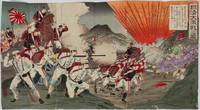
1894réf. 218366Yokoyama.: Ryohachi . 1894. Conjoined triptych of ink and watercolour woodblock prints trimmed to the margins together 35 x 63.3 cm backed onto Japanese scrap paper with some writing title and descriptive cartouches top right red censor's stamp lower left and artist's signature lower right some paper abrasions wear at the joins slight bleeding of ink and offsetting on the verso but overall in good condition. Vivid depiction of the Battle of Seonghwan also known as the battle of Asan in Korea July 29 1894 the first major land battle on of the Sino-Japanese War 1894-1895. Chinese troops are seen fleeing the charging Japanese marines and the silhouettes of airborn casualties are depicted in the bright orange explosion. Yōsai Nobukazu 1872-1944 was active towards the very end of the ukiyo-e period when the popular days of this style were over. Printmakers like Yōsai struggled and he survived as an artist by depicting the Sino-Japanese and Russo-Japanese wars. Yōshū Chikanobu was his teacher active 1838-1912 and Yōsai Nobukazu was considered his best student. The majority of his prints were triptychs of battles of the Sino-Japanese war. See a digitisation of this woodblock from the Lavenberg Collection of Japanese prints online at the University of Oregon The caption on top right praises the Japanese troops' bravery against 500 strong Chinese troops. From the collection of the late John Caiger lecturer in Asian studies ANU. . Ryohachi (?). unknown