Dodie SmithLivre Rare Book

102 résultats
1967réf. 6329Hachette 1967 collection bibliotheque rose illustrée. in12. 1967. Cartonnage editeur. Roman jeunesse de Dodie Smith paru en 1956 racontant l'aventure de Pongo et Missis un couple de dalmatiens qui partent à la rescousse de leurs chiots volés par la cruelle Cruella Diabolo (ou Cruella) qui souhaite en faire un manteau de fourrure. Leur quête à travers la campagne anglaise est soutenue par un réseau de chiens dans une histoire pleine d'humour de gaieté et traitant des thèmes de l'amour familial et de la solidarité
1964réf. 13366ÉDITIONS ALBIN MICHEL 1964 199 pages in8. 1964. Broché couverture rempliée. 199 pages. Ce livre présente pour la première fois les archives secrètes de Peenemünde saisies par les Américains en 1945 retraçant l'histoire des pionniers de l'espace depuis les missiles V2 allemands jusqu'au programme spatial américain de Cap Canaveral
1970réf. 18506Presses Universitaires de France 1970 collection Que sais-je #765. in12. 1970. broché. Ouvrage de la collection Que sais-je ? consacré aux fusées et aux missiles rédigé par Jean Pellandini. Cette troisième édition refondue publiée en 1970 par les Presses universitaires de France présente un contenu technique et documentaire sur le sujet dans un format de poche illustré
1961réf. 9631961 - broché - Numéro 4 - Avril 1961 - 29e année - N° 294 - In-8 (24 x 15 cm) broché - p. 529 à 719 + 12 pages in fine - Jean-Marie DOMENACH (Directeur) - SOMMAIRE : Du nouveau en Amérique latine (M. TUNON DE LARA) - Du cri de Yara à la Sierra Maestra. Journal de marche de Camilo Cienfuegos - Un prototype de révolution (Claude JULIEN) - Un Américain à Cuba (Sidney LENS) - Discours de Fidel Castro aux enfants des écoles - Une réforme agraire accélérée (René DUMONT) - L'Eglise et l'Etat (Claude JULIEN) - La bombe de San Làzaro (Severo SARDUY) - Un exemple de super-castrisme (Juan TERBAD) - Journal à plusieurs voix. Lumumba, Pierre Popie, Algérie quotidienne, Bourguiba à Paris ... - Chroniques - ...
réf. 872Tours. Alfred Mame & fils, éditeurs. 1897. In-4°, reliure pleine percaline rouge à motifs polychromes ; tête et tranches dorées. 285 pages. Illustrations de Zier in et hors texte. E.O. Bon exemplaire.
réf. 873Tours. Alfred Mame & fils, éditeurs. Sans date [vers 1900]. In-8°, reliure d'époque demi-chagrin brun à coins, dos à nerfs ; tête dorée. 379 pages. 19 planches hors texte de Zier tirées en sépia. Edition au format réduit, légèrement postérieure à l'originale. Bon exemplaire.
1982réf. 100127737Westview Press 1982 158 pages in8. 1982. Broché. 158 pages.
1975réf. 100147273Brookings Institution 1975 361 pages 16 256x2 794x23 368cm. 1975. Relié. 361 pages.
réf. 3339Paris, Deux-Rives, 1957 14 x 19, 191 pp., illustrations photo. N/B, broché, bon état (2 cachets)
réf. 26700Bruxelles, Didier Hatier, 1985. 14 x 21, 159 pp., quelques cartes, broché, état neuf.
1964réf. 1022231964 N° 124/125, Juillet/Août 1964 - Petit In-4, broché, couverture et 4ème de couv. illustrées - Revue mensuelle illustrée - 70 p. - Sommaire en image
1997réf. 1260151997 Chatham Publishing, London - 1997 - In-4, reliure pleine toile, sous jaquette illustrée - 321 pages - Nombreuses illustrations en N&B, in et hors texte, dans l'ouvrage - Texte en anglais
2006réf. 1272742006 Editions Le Temps des Cerises - 2006 - In-8 broché, couverture illustrée - 281 pages
1964réf. ABE-1739701255247114 PAGES-IN 4-EN COUVERTURE FRANCE GALL, PHOTO JEAN-MARIE PERIER-LA GALERIE DES SEPT GROUPES QUI GRIMPENT-SYLVIE ET LA CAMERA-LE CANCER, ASTROLOGIE-40 QUESTIONS A ELVIS PRESLEY, PHOTO CENTRALE 2 PAGES-QUI ES-TU CATHERINE DENEUVE?-NOTRE MARSOUIN D'OFFENBURG, JOHNNY HALLYDAY-LE BOWLING DEJA UN JEU, BIENTOT UN SPORT-LE MATCH CLAUDE FRANCOIS DICK RIVERS-CE VINCE TAYLOR QUE L'ON CROYAIT MECHANT.-CHOUCHOU EN VACANCES: UNE GRANDE (MAIS DIFFICILE) EVASION-1 DECOUPE P113/114 (COUPON JEU)
1963réf. 30302Acuff-Rose 1963
1983réf. LFA-126734996Hors Série N° 143 : une revue de 160 pages, format 170 x 240 mm, illustrée, brochée couverture couleurs, bon état
1943réf. LFA-126735007Une revue de 56 pages, format 165 x 245 mm, illustrée, brochée couverture couleurs, bon état
réf. ARM13Etat-Major de l'Armée de l'Air, 195. In-4, 202 pp., 15 planches de graphiques h.t., br.
réf. TAE9P., Eyrolles, 1961. In-8, 256 pp., 52 fig. in-t., photos, graphiques, pl. percaline éditeur.
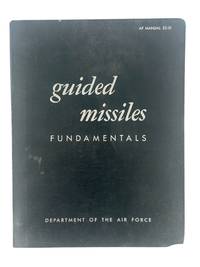
1957réf. 222751957. United States Air Force. Guided Missiles Fundamentals. 1957. This manual presents the technical framework used by the U.S. Air Force to train personnel in guided missile systems during the early Cold War when missile development became central to military strategy and nuclear delivery capability. The text outlines the principles of missile guidance control and accuracy including the classification of guidance systems and the role of onboard computation situating the material within the rapid expansion of aerospace engineering and electronic control technologies in the 1950s. It provides direct evidence of how the Air Force standardized knowledge of missile operation at a time when guided weapons were reshaping military doctrine. United States Air Force. Guided Missiles Fundamentals AFM 52-31. Washington: Department of the Air Force 20 September 1957. First edition. The manual includes sections such as "Components of Guided Missile Guidance Systems" and "Computer Units of Guidance Systems" describing the integration of sensor units reference systems and computational processes required to maintain flight paths. Diagrams illustrate beam-rider guidance celestial navigation and electronic control systems including a "Basic missile guidance block diagram" showing how course corrections are made at "microsecond intervals." The text explains three principal types of guidance systems-active passive and preset-and distinguishes guided missiles from guided bombs by noting that missiles rely on onboard propulsion while bombs depend on aircraft velocity and altitude. A representative passage states "Any guidance system must employ certain components; that is there must be an adequate number of stages in the system to accomplish the guidance function" emphasizing the layered structure of control systems. Issued during a period of accelerated weapons development following World War II the manual reflects the integration of electronics computation and aeronautics that defined Cold War military research and training. Manuals such as this were used to instruct personnel in emerging technologies that supported both conventional and nuclear capabilities. 575 pages; illustrated with technical diagrams; original vinyl covers. Mild chipping to covers and spine; binding tight; interior clean and bright; overall very good. A detailed instructional document of early guided missile systems preserving the technical language and training standards of Cold War aerospace engineering. unknown
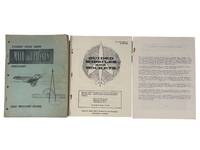
1950réf. 223721950. A rare instructional archive from the height of the Cold War arms and space races documenting the teaching strategies technical priorities and ideological frameworks used by the U.S. military to train service members in missile technology physics and emerging space policy. These materials reflect the growing importance of scientific education within the armed forces during the period of intense technological competition between the United States and the Soviet Union following the launch of Sputnik and the acceleration of missile and space programs. This archive includes three distinct publications produced by branches of the Department of Defense and the U.S. Air Force: a heavily illustrated USAF Preflight School "Math and Physics" Student Study Guide ca. late 1950s 244 pages; the DOD Fact Sheet 3-F on "Guided Missiles and Rockets" 29 April 1960 59 pages; and a striking early federal statement titled "Introduction to Outer Space" ca. late 1950s 11 pages intended to justify a national space program. Together these works reflect the militarized scientific culture of early Cold War America where soldiers were expected to master STEM fundamentals understand atomic missile classifications and absorb the ideological stakes of U.S. supremacy in space. The Preflight School Study Guide opens with a cartoon image of a smiling cadet pointing to a "Table of Contents" listing 20 core lessons including: "Velocity and Acceleration" "Vectors" "Electricity and Magnetism" and "Jet Engine Principles." Designed to bring young recruits up to speed on mathematical and physical foundations this booklet illustrates how the military systematized the transmission of civilian STEM knowledge through instructional cartooning step-by-step reviews and mechanical principles tied directly to aeronautics. The document also reflects broader efforts to professionalize enlisted men into a new technocratic class of Cold War airmen. The DOD Fact Sheet 3-F dated 29 April 1960 is a mimeographed technical manual that lists every operational missile and rocket then used by the Army Navy Air Force and Marine Corps. Each entry is meticulously typed and includes missile name type e.g. "surface-to-surface" speed launch weight prime contractor warhead type and guidance system. Key entries include the NIKE AJAX NIKE HERCULES REDSTONE PERSHING and POLARIS missiles. The NIKE AJAX is described as "the nation's first supersonic anti-aircraft guided missile. designed to intercept and destroy bomber aircraft regardless of evasive action." The HERCULES system is called "a major advance. capable of operation in an electronic countermeasures environment." These materials also serve as a record of U.S. procurement partnerships with Bell Labs Western Electric and Douglas Aircraft-illustrating the military-industrial complex in full effect. The third item titled "Introduction to Outer Space" is a pedagogical and ideological primer explaining the rationale behind federal investment in space exploration. Structured around four key justifications-scientific curiosity military defense national prestige and technological advancement-it declares: "The first of these factors is the compelling urge of man to explore. Most of the surface of the earth has now been explored and men now turn to the exploration of outer space as their next objective." This philosophical argument for militarized space policy also hints at early satellite surveillance goals: "The launching of satellites. can be done with the aid of new things: 1 it can look down at the earth and map out the terrain. 2 it can look out into space. and 3 it can look at the sun." Notably this text served as the basis for a widely distributed 1958 White House document under the Eisenhower Administration laying ideological groundwork for what would soon become NASA and the National Defense Education Act NDEA of 1958. Pages toned with some rusting to staples especially visible on "Introduction to Outer Space." Light wear to edges of math booklet. Overall very good condition. An outstanding and uncommon pedagogical archive documenting how the U.S. military trained its enlisted men to master missile and rocket technologies at the dawn of the space age while also advancing an explicitly ideological case for Cold War space supremacy. unknown
1961réf. 712848PN. New. 1961. Soft Cover. Date is original print. This is a reprint edition. . PN paperback
1950réf. 709266PN. New. 1950. Soft Cover. Date is original print. This is a reprint edition. . PN paperback
1963réf. 722132PN. New. 1963. Soft Cover. Date is original print. This is a reprint edition. . PN paperback
1963réf. 720840PN. New. 1963. Soft Cover. Date is original print. This is a reprint edition. . PN paperback