Hitler, AdolfBiblio.com
582 résultats
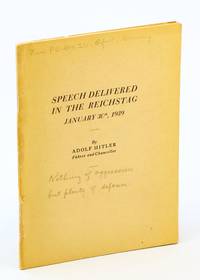
1939réf. 222j3127Berlin Germany: M. Muller & Sohn K.G. Good No dust jacket as issued. First English Edition. Pamphlet. "Members of the Reichstag! When six years ago on this evening tens of thousands of National Socialist fighters marched through the Brandenburg Gate to the light of their torches to express to me their feeling of overwhelming joy and their vows as faithful followers countless anxious eyes all over Germany gazed upon the the beginning of a development the end of which still seemed unknown and unpredictable. I received only a little over a third of all votes cast. The other twenty million were scattered among about 35 other parties. The only thing that united them was their common hatred of our young movement. This united the priests of the Centre Party and Communist atheists the Socialists out to abolish private property capitalists and conservatives. During the long battle of National Socialism for the leadership of the country they had all come together in defence of their interests and had made common cause with Jewry. The complete picture of the extent of the collapse in that period is gradually fading away. It seemed that only a miracle could save Germany. To the Jews and the other enemies of the State however it appeared to be the last flicker of the national power of resistance. They felt that when it had disappeared then they would be able to destroy not only Germany but all Europe as well." - paraphrased from pages 3-4. "During the time of my struggle for power it was in the first instance the Jewish race which only received my prophecies with laughter when I said that I would one day take over the leadership of the State and that I would then among other things settle the Jewish problem. Today I will once more be a prophet: If the international Jewish financiers in and outside Europe should succeed in plunging the nations once more into a world war then the result will not be the bolshevization of the earth and thus the victory of Jewry but the annihilation of the Jewish race in Europe!" - page 42. Text in English. 54 stapled pages. Binding tight. Moderate tanning to contents and covers. Numerous light pencil markings and thoughtful marginalia throughout. Discrete clear tape repairs to covers. A sound vintage example of this historic speech in which some argue Hitler presaged the Holocaust.; 8vo . 1939. M. Muller & Sohn K.G. unknown
1933réf. 295742NY: Houghton Miflin 1933. First Edition from Eher edition. Hardcover no dj. good. Abridged and translated by E T S Dugdale 297 pp. new pastedown covers worn lacks dust jacket crown bit frayed hinge started true first edition In America Houghton Mifflin secured the rights to the Dugdale abridgment on 29 July 1933. The only differences between the American and British versions are that the title was translated as My Struggle in the UK and My Battle in America; and that Dugdale is credited as translator in the U.S. edition while the British version withheld his name. No official reason was given for Dugdale's request for anonymity in the British edition.James Barners Hitler's Mein Kampf Houghton Miflin hardcover
1973réf. 111H4408London: Weidenfeld and Nicolson. Good in Good dust jacket. 1973. Second Edition. Hardcover. 0297765841 . 746 pages. Index. "This extraordinary document which has for many years been unobtainable presents the authentic record of the secret conversations at Hitler's headquarters from July 1941 to November 1944 taken down on Martin Bormann's instructions. The most significant record of Hitler's mind and character in existence." - dust jacket. "A most remarkable addition to our background knowledge of the Nazi era. undoubtedly authentic. fascinating reading." - Chester Wilmot. Unmarked with light wear to publisher's coarse brown cloth. Binding tight. Moderate wear to price-clipped dust jacket now preserved in archival-grade Brodart. A sound copy of this fascinating and important reference. Enser p.209 Kehr & Langmaid 754 Rees G 911.; 8vo - over 7¾" - 9¾" tall; Adolf Hitler Table Talk Martin Bormann . Weidenfeld and Nicolson hardcover
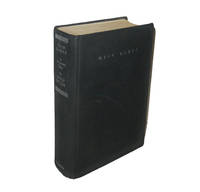
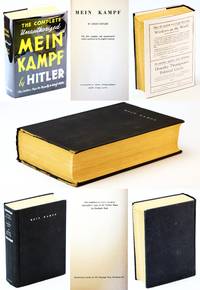
réf. 6New York City: Stackpole Editions 1939. 8vo 669 p. original black cloth stamped in silver. First edition and the first true unexpurgated edition of Mein Kampf published in the United States. Stackpole's issue of Mein Kampf triggered a major legal battle with Houghton Mifflin which had acquired copyright in 1933. Stackpole argued that because Hitler was technically "stateless" having renounced his Austrian citizenship in 1925 before obtaining German citizenship in 1932 he was not covered by U.S. copyright law. Under this theory Stackpole claimed the text was in the public domain and promoted their edition on the basis that they would pay no royalties to Hitler from AI overview. Stackpole eventually lost the lawsuit and was ordered to destroy their remaining inventory after having sold around 12000 copies. As a result the Stackpole edition is uncommon on the market. This is a nice copy with two scuff marks to cloth to front board boards very slightly bowed light soiling to page ends some light scuffing to front page ends; front endpaper lightly soiled; some minor rounding to corners but in all an uncommonly nice copy of a truly scarce item rarely found in this condition. Stackpole Editions hardcover
réf. 72826E-140. Very Good. Paperback. Trade PB. 8vo. Published by Reginald Glossop London UK. 1932. 227 pgs. Issued in illustrated stiff-paper wrappers. Wrappers lightly worn with some light shelf-wear to the extremities present. Book is free of ownership marks. Text is clean and free of marks. Binding tight and solid. Lengthy inscription on half title addressed to "Reich Kanzler Hitler with with compliments of the author." Book includes laid in note on the letterhead of Richard W. Van Wagenen 1923-2003 a former dean of American University's graduate school who retired in 1977 as a World Bank education and training specialist. Note reads: "Liberated from the shelves of a sort of library-closet in Hitler's Chancellory sic in Berlin late July 1945. R. W. VW." Uncommon in its own right this future war novel involving a tunnel under the British Channel would have been very much in keeping with the Aryan ideological model espoused by the Nazi Party. The note suggests the book was taken when the Chancellery was stormed by Allied forces in April 1945 during which time GIs took what souvenirs they could from the Fuhrer's domain. ; 8vo 8" - 9" tall . paperback
1939réf. 542j2764New York City: Stackpole Sons Publishers. Good with no dust jacket. First Edition Thus. Hardcover. "For thirteen years Adolf Hitler has prevented publication of an uncensored unabridged edition of Mein Kampf outside Germany in English. With the appearance of this volume Hitler's censorship ends and the work which Dorothy Thompson calls 'Hitler's blueprint of world conquest' is at last available to readers everywhere." - dust jacket not included. "This Stackpole edition was translated and printed between December 1938 and February 1939. Houghton Mifflin which believed Stackpole to be violating its copyright sought and obtained an injunction against Stackpole on 9 June 1939. By that time only 12000 copies of the Stackpole edition had been sold. It remains a rare and valuable artifact." - Wikipedia. For a thorough description and analysis of the intriguing and complicated legal fight between Houghton Mifflin and Stackpole and the differences between their versions of this title see 'Hitler's Mein Kampf in Britain & America - A Publishing History 1930-39' by James and Patience Barnes. 4-669 pages. Original black cloth mostly rubbed through along bottom edges much less so to top edges. Quarter-inch diameter perforation to very upper left corner of front free endpaper. Marginal pencil lines erased from 14 pages. Short ink marginal lines to 12 pages. Binding intact. Includes new replica dust jacket preserved in archival-grade Brodart. A rare example of this Stackpole edition.; 8vo . 1939. Stackpole Sons Publishers hardcover
1933réf. 002253Munich: Verlag Franz Eher Nachfolger GmbH 1933 1933. FROM THE DACHAU PRISONER CONCENTRATION CAMP LIBRARY. 1 vol. 175 x 115 mm 7 x 4-1/2 inches including the Inseraten-Anhang advertising supplement at end halftone portrait frontispiece printed in sepia facsimile signature complete. Bound in crude half black cloth mottled boards art-laid endpapers all edges trimmed and plain undoubtedly BOUND BY THE PRISONERS' BINDERY AT DACHAU dated 6 May 1936 on a Kontroll-Zettel control-slip tipped in. Worn scattered light foxing half-title lost a few short tears carefully mended without loss. Reference: 1 Cf Printing and the mind of man 1967 1983 415n. 2 For the prisoners' library at Dachau see Torsten Seela 'Die Lagerbucherei im KZ Dachau' Dachauer Hefte Dachau vii 1991 34-46 and his Bucher und Bibliotheken in nationalsozialistischen Konzentrationslagern: Das gedruckte Wort im antifaschistischen Widerstand der Hftlinge 1992. Provenance: 1 BUCHEREI DES KONZENTRATIONSLAGERS DACHAU Library of Dachau concentration camp with their manuscript Kontroll-Zettel control slip tipped on the upper free endpaper printed lending-rules mounted on the frontispiece recto purple stamp Konzentrationslager Dachau Gefangenenlager in about margins. 2 Liberating soldier 1945; by descent to his widow 3 "a woman in New England"; sold 2006 AN EVIL BOOK SNATCHED FROM THE VERY HEART OF EVIL. This copy belonged originally to the prisoners' library 'Lagerbucherei' at Dachau. Now almost forgotten this unlikely library was installed in Barracks 10 along with the infirmary and a sort of canteen. It was conceived as early as October 1933 by an imprisoned publisher Heinrich Bergmann who somehow obtained permission from the commandant Theodor Eicke to set up a lending-library for 'privileged' prisoners. For his part Eicke supplied some books predictable Nazi fare including presumably the present volume. To these were added some tractates and Jesuit relations seconded from a nearby Roman Catholic library and later literature history geography polonica &c from various sources. Perhaps the library appealed to Eicke's sense of Dachau as a 'model' camp or perhaps it was just a bit of practical penology controlling the many by meting out 'privileges' to the few. In any case the prisoners' library became a center of subversive activity within the camp particularly under its later librarians Kurt Schumacher and Viktor Matejka and by 1945 the library held some 15000 volumes: Some of these were carted off into the old town of Dachau where a former prisoner named Albert Zeitler set up a small lending-library in Augsburgerstrasse and the rest were simply scattered among surviving prisoners or mostly lost. Today these books are so rare on the market that the leading historian of concentration-camp libraries has never heard of one. Munich: Verlag Franz Eher Nachfolger GmbH, 1933 hardcover