Sweanor, George; Crease, HarryMareMagnum

613 résultats
1981333 pages including index and glossary. Many black and white illustrations including sketches, maps, and reproductions of photos and documents. The author's Halifax bomber was shot down over Germany in March, 1943 and he was sent to POW camp Stalag Luft III, made famous by the film The Great Escape. Printed upon glossy stock. Small phone number written atop title page, otherwise unmarked. Somewhat above-average external wear. Binding intact. A sound copy. Book
19518vo., First Edition, with portrait frontispiece and 17 plates on 12, some light offsetting from fold-ins to free endpapers, two small erasures on front paste-down, top and fore-edge lightly spotted; navy cloth, gilt back, a very good, bright, clean copy in unclipped dustwrapper, the latter lightly rubbed at extremities, chipped with minor loss (not affecting lettering) at head of backstrip, and with long closed tear across rear panel. The moving story of RAF Bomber Command's most famous squadron and arguably the most famous air exploit of WWII. The stirring 'Dam Busters March', written by Eric Coates as the theme to the movie, was almost immediately adopted as an official march of the Royal Air Force. Increasingly difficult to find in this condition. Enser, p.64; Mulholland & Jordan B121 (recording the first edition).
19468vo., First Edition, with fine portrait frontispiece and photographic front endpapers; attractively bound in full navy blue crushed morocco, sides with gilt frame border, back with raised bands, second and fourth compartments lettered and ruled in gilt, all other compartments tooled in gilt with propeller motif, gilt top, hand-made endpapers, marker ribbon, a most attractive copy ideal as a gift or for presentation. Gibson's own account of his exploits in Bomber Command and a WWII RAF classic, culminating in his account of the 'Dambusters' raid. It contains a ROH of the pilots and crews who flew with him in 83 Squadron, 106 Squadron and the immortal 617 Squadron. The frontispiece reproduces the well-known studio portrait of Gibson by Gordon Anthony; the front endpapers carry the famous 'before and after' aerial photographs of the Mohne dam. Enser, p.65; Mulholland & Jordan, G20.
19518vo., First Edition, with portrait frontispiece and 17 plates on 12; handsomely bound in full navy crushed morocco, sides with gilt frame border, back with raised bands ruled in gilt, second and third compartments lettered and ruled in gilt, all other compartments tooled in gilt with propeller motif, hand-made endpapers, a most attractive copy ideal as a gift or for presentation. The moving story of RAF Bomber Command's most famous squadron and Operation CHASTISE, arguably the most famous air exploit of WWII. This book formed the basis of Michael Anderson's classic feature film (1954) of the same name starring Michael Redgrave, Richard Todd and Nigel Stock. The stirring 'Dam Busters March', written by Eric Coates as the theme to the movie, was almost immediately adopted as an official march of the Royal Air Force. Enser, p.64; Mulholland & Jordan B121
réf. 47114Paris.Cellot.1778.In-8 br.148 p. Bon état.Annotations sans gène sur la page de titre.Sans reliure.Simplement protégé par un Papier léger.
réf. 3117007Fine with no dust jacket. Envelope. Patriotic 1st class envelope. Marine aviator Captain Joe Foss has SIGNED and self-addressed the envelope. Fine with distinctive pictorial eagle with stars and stripes and printed statement - "We Won't Give Up Till They Give In!" Joe Foss nicknamed "Killer Joe Foss" was one of the most colorful Medal of Honor winners of the War. His 23 kills over the contested skies of Guadalcanel in 1942 served to lift the spirits of his comrades in this critically important campaign. . unknown
1990255 pages. Signed and dated by both authors. Hand-numbered copy #1216 of 2000. Index. 65 colour photos. 297 black and white photos. 46 formation diagrams. "Colonel O.B. Philp, know as 'the father of the Snowbirds', has recalled from birth the early years of the internationally renowned aerobatic squadron... Published to mark the Snowbirds 20th anniversary in 1990." - B.C. Bookworld. Clean, bright and unmarked with negligible wear. Dust jacket now preserved in archival-grade Brodart cover. Superb copy. Book
19528vo., Fifth Impression, with portrait frontispiece and 17 plates on 12; navy cloth, gilt back, a very good, bright, clean copy in unclipped dustwrapper, the latter lightly chafed at extremities. SIGNED IN PENCIL ON TITLE BY DAM BUSTERS VETERANS JOHNNY JOHNSON (T-Tommy) AND LES MUNRO (W-Willie), AND ADDITIONALLY BY MARY STOPES-ROE (daughter of Barnes-Wallis). A photograph with printed signature of Richard Todd (Wing Commander Guy Gibson in Michael Anderson's well-known film) is mounted on front free endpaper. Published a year after the first edition. The moving story of RAF Bomber Command's most famous squadron and arguably the most famous air exploit of WWII. The stirring 'Dam Busters March', written by Eric Coates as the theme to the movie, was almost immediately adopted as an official march of the Royal Air Force. Enser, p.64; Mulholland & Jordan B121 (recording the first edition).
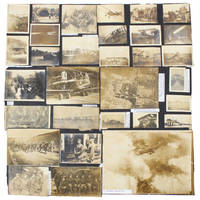
1918réf. 184831918. Photograp Archive documenting U.S. Army Air Service operations and postwar occupation activity in France during and immediately following World War I with material associated with Frank Holder of the 185th Aero Squadron a unit organized for night fighter operations. The archive supports research into early American military aviation night combat development and the operational environment of airfields near the Western Front including activity around Verdun. The 185th Aero Squadron deployed at the end of the war and known as the "Bats" represents the only U.S. unit organized specifically for night fighter operations placing the material within the development of specialized aerial combat roles in 1918. Identified locations including Reims Varennes-en-Argonne and Rembercourt situate the photographs within active and recently contested war zones. Archive of 65 photographs primarily silver gelatin prints France circa 1918-1919 with image sizes ranging from approximately 3 x 2 to 9.5 x 6.5 inches. The photographs include multiple images of aircraft operated by the 185th Aero Squadron at Rembercourt airfield including Sopwith Camel Fokker D.VII SPAD XII and Breguet 14 as well as an unidentified German aircraft shot down in the Somme. Additional images document tank and troop formations moving through northeastern France the ruins of Reims and other towns and a German column escorting American prisoners of war. Naval images include vessels identified as USS Liberation and Entente anti-submarine ships. Several photographs depict Frank Holder and other personnel with images taken during the postwar occupation period alongside wartime installation scenes. Many photographs retain contemporary captions supplemented by later white labels identifying equipment locations and individuals. The archive documents the intersection of aerial warfare ground operations and occupation activity during the final phase and immediate aftermath of World War I when American forces expanded their presence in France and began transitioning from combat operations to stabilization and occupation roles. The inclusion of multiple aircraft types from both Allied and German forces reflects the fluid and contested nature of air combat during the period while the documented destruction of urban centers such as Reims provides visual evidence of the war's impact on civilian environments. The presence of a specialized night fighter squadron further situates the material within the evolution of tactical aviation. Minor chipping to album page margins; photographs remain clean and sharp. Overall very good condition. A detailed photographic record of U.S. air service activity and war zone conditions in France during World War I. unknown
1918réf. 184831918. Photograp Archive documenting U.S. Army Air Service operations and postwar occupation activity in France during and immediately following World War I with material associated with Frank Holder of the 185th Aero Squadron a unit organized for night fighter operations. The archive supports research into early American military aviation night combat development and the operational environment of airfields near the Western Front including activity around Verdun. The 185th Aero Squadron deployed at the end of the war and known as the "Bats" represents the only U.S. unit organized specifically for night fighter operations placing the material within the development of specialized aerial combat roles in 1918. Identified locations including Reims Varennes-en-Argonne and Rembercourt situate the photographs within active and recently contested war zones. Archive of 65 photographs primarily silver gelatin prints France circa 1918-1919 with image sizes ranging from approximately 3 x 2 to 9.5 x 6.5 inches. The photographs include multiple images of aircraft operated by the 185th Aero Squadron at Rembercourt airfield including Sopwith Camel Fokker D.VII SPAD XII and Breguet 14 as well as an unidentified German aircraft shot down in the Somme. Additional images document tank and troop formations moving through northeastern France the ruins of Reims and other towns and a German column escorting American prisoners of war. Naval images include vessels identified as USS Liberation and Entente anti-submarine ships. Several photographs depict Frank Holder and other personnel with images taken during the postwar occupation period alongside wartime installation scenes. Many photographs retain contemporary captions supplemented by later white labels identifying equipment locations and individuals. The archive documents the intersection of aerial warfare ground operations and occupation activity during the final phase and immediate aftermath of World War I when American forces expanded their presence in France and began transitioning from combat operations to stabilization and occupation roles. The inclusion of multiple aircraft types from both Allied and German forces reflects the fluid and contested nature of air combat during the period while the documented destruction of urban centers such as Reims provides visual evidence of the war's impact on civilian environments. The presence of a specialized night fighter squadron further situates the material within the evolution of tactical aviation. Minor chipping to album page margins; photographs remain clean and sharp. Overall very good condition. A detailed photographic record of U.S. air service activity and war zone conditions in France during World War I. unknown books
1974An extraordinary copy. Signed not only by author inside front board, but also by an additional 20 important figures associated with the Regiment. Signatures upon front free endpaper include: LCol David L. Vaughan, CD (World War II Veteran and CO 1961-1964), LCol Archie M. Steacy, CD, (CO 1974-1978), LCol Grant B. Larkin, CD (CO 1970-1973), Honorary Lt Col John W. Toogood, CD (World War II BC Regiment Veteran and CO 1945-1949), Major Ernest Bowmer, MC, RMO (World War II British Army Veteran), Captain Arthur Goodson (World War I and II, BC Regiment Veteran) Musketry Expert, and Chief Warrant Officer Kenneth A. Parr, CD, RSM. Signatures upon back free endpaper include: Captain Robert Elrick (attached to BC Regiment from the Royal Canadian Dragoons), Major Robert Stanley (Squadron Commander), Captain Jack D. Drake (Squadron 2 I/C), Lieutenant Eric B. Foster (Troop Officer), Major Donald E. Hein (Officer's Mess President), Lieutenant Robert J. Baylis (Troup Officer), Lieutenant Norman A. Brown (Troop Officer), Lieutenant Robert B. Gauthier (Troop Officer), Master Warrant Officer Roger W. Prouse (SSM), Lieutenant Ralph D. MacRae (Troop Officer), Major Jack Tipton (Squadron Commander), Captain Brent R. Gray (Squadron 2 I/C), and Officer Cadet Tom Baker (Troop Officer). Printed name of Lieutenant (Donald) Hilton on front free endpaper. 438 pages. "Tells the story of B.C.'s earliest militia units from one of which the British Columbia Regiment has its descent. Describes the Regiment's participation in the South African War and in both World Wars, and much more." - dust jacket. Includes black and white illustrations, index, bibliography, fatality and casualty lists, repatriated prisoners of war (WWII) list, and list of honour and award winners. Contents unmarked. Binding sound. Average wear to book. Small faint coffee drop to bottom edge of text. Dust jacket, now preserved in archival-grade Brodart, bears somewhat above-average wear. We are indebted to LCol Archie M. Steacy, CD, CO (1974 to 1978) for his generous assistance in identifying the signatures in this copy. [Cooke p.130, Hale 1360] Book
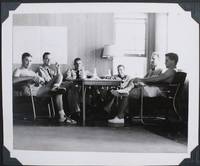
réf. PB62Oblong Folio album ca. 26x33.5 cm. 50 card stock leaves. With ca. 218 mounted and 1 loosely inserted gelatin silver photographs including 2 large images ca. 175x25 cm 7 x 9 ¾ in and 2 panoramas from ca. 75x28 3 x 11 in to ca. 85x21 cm 3 ¼ x 8 ¼ in; the rest of the photos from ca. 12x175 cm 4 ¾ x 7 in to ca. 75x11 cm 2 ¾ x 4 ½ in. Most of the photos with period white ink manuscript captions. Period maroon patterned cloth album fastened with a string; front board with an embossed gilt pictorial image of a ship. A couple of photos removed ca. three images slightly loose A couple of photos with mild silvering but otherwise a very good album with strong interesting photos. Historically important extensive collection of vivid and lively vernacular photos taken by a U.S. Navy serviceman from Aerial Squadron 51 during the Neutrality Patrol in the Caribbean in 1939-1941. The Patrol initiated by President Franklin Roosevelt in September 1939 aimed to preserve American neutrality during the early years of WWII by monitoring and reporting on belligerent warship activities in the Atlantic and the West Indies. The album features over eighty interesting views of Panama Cativa Panama City San Blas Portobello captured during the compiler's stay at Coco Solo Naval Air Station. Most of the candid urban photos portray Colon showcasing local hotspots - the Silver Spray Casino “One of the ‘Elite’ Nite Clubs in Colon” Bilgray’s Tropical Bar 1924-1974 the Atlantic Night Club and the Chinese Bar adorned with delicate posters of Chinese ladies. There are also lively scenes of Panamanian Boy Scouts carrying American flags butchers selling meat in the native market locals buying lottery tickets “Everybody buys a lottery ticket” uniformed men examining theatre posters and people enjoying meals at a soda fountain. About ten photos capture the festive atmosphere of the 1941 Pre-Lent Celebration in local streets several signboards are clearly visible with participants in ceremonial attire joyfully waving from cars. Additionally a series of images document the aftermath of the 1940 Great Fire and the temporary quarters for the fire victims “furnished by the U.S. Army. " The rest of the interesting “Panamanian” photos capture scenes of the San Blas Indian Village including native children swimming in canoes sharing smiles with Squadron soldiers standing alongside native huts and an “Indian family” dressed in traditional clothing seated in a boat. Several photos show the Madden Dam near the city of Gamboa completed in 1935 Berlanga Cathedral in Panama City and likely the compiler posing beside the "Ruins of Old City of Panama. " Most photos from Puerto Rico the San Juan Camp and Cuba Guantanamo Bay Naval Base vividly document Squadron 51’s military life showcasing officers' quarters washrooms tents the exterior & the interior PBY plane lineups morning musters soldiers during exams rifle practices and abandon ship drills. One interesting image features Frank Knox 47th United States Secretary of the Navy on his early inspection trip to the Squadron camp in San Juan. There are also about forty lively group portraits mostly with captions of the squadron members playing baseball volleyball poker & billiard joining in a “tug-of-war” game drinking & laughing at a beer party singing playing violin & drums “quenching thirst in the Jungle” visiting the Caribbean National Park etc. Several photographs show the Capitol and the University of Puerto Rico as well as the aerial view of the Bacardi Rum Mill in Guantanamo. The album also includes two large photos Guantanamo Harbor and "Squadron Baseball Game " and two panoramas the city of New Panama and the U.S. Naval Station in Guantanamo Bay. Overall a historically important collection documenting the American Presence in the Caribbean during the Neutrality Patrol. hardcover
1867réf. 193376Mainly China and Japan: 16 October 1863 - 29 July 1867. Tensions and turbulence in the treaty ports A revealing source spanning Courtenay's entire East Asia command during which Scylla - a wooden screw corvette - patrolled the coast of China and Japan. Courtenay spent five months as the senior officer in charge of the Shanghai division bringing him into contact with the likes of Sir Harry Parkes and also co-ordinated anti-piracy operations. Courtenay 1820-1894 made captain in 1859 and was promoted to vice-admiral in 1881. These letters report on Scylla's movements and occurrences onshore. Many recently opened cities were still tense and Western officers and civilians faced jeering stone-throwing and other acts of xenophobia. A lengthy letter from 2 September 1864 sent to Vice-Admiral Sir Augustus Kuper the commander-in-chief describes anti-foreign sentiment in Nagasaki in the wake of the Namamugi Incident and the Battle of Shimonoseki Straits. He records measures taken to counteract the influence of soldiers deployed in disguise by the hostile Choshu domain and relays rumours of a Choshu attack on the European enclave. "Considering that there are fifty people here either Dutch or under Dutch protection I am surprised that there should be no vessel of war of that nation here." In Amoy the ship's arrival "caused great excitement: numerous reports were spread of the reason of her coming among others are to the effect that we had landed several hundred men and that I was going to the city to seize the tautai" 26 December 1865. Care was also required in dealing with the Russians Courtenay reminding his officers to be "extremely guarded in asking questions or making observations" 25 July 1866. Other correspondence concerns piracy. Courtenay found the Chinese maritime police "utterly inefficient" 30 November 1865 and used his authority to send the gunboat HMS Grasshopper to seize lorchas on the coast. Quarto 320 x 205 mm. With 70 leaves filled with neat manuscript in several hands 2 bound- or tipped-in manuscript slips; additional blank. Recent quarter calf spine lettered in gilt green cloth sides front cover lettered in gilt green endpapers. A little marking internally: a well-preserved example. hardcover