Jean-Baptiste-Jacques Elie de BEAUMONT (1732-1786)Livre Rare Book

633 results
ref. 47114Paris.Cellot.1778.In-8 br.148 p. Bon état.Annotations sans gène sur la page de titre.Sans reliure.Simplement protégé par un Papier léger.
ref. 3117007Fine with no dust jacket. Envelope. Patriotic 1st class envelope. Marine aviator Captain Joe Foss has SIGNED and self-addressed the envelope. Fine with distinctive pictorial eagle with stars and stripes and printed statement - "We Won't Give Up Till They Give In!" Joe Foss nicknamed "Killer Joe Foss" was one of the most colorful Medal of Honor winners of the War. His 23 kills over the contested skies of Guadalcanel in 1942 served to lift the spirits of his comrades in this critically important campaign. . unknown
1990255 pages. Signed and dated by both authors. Hand-numbered copy #1216 of 2000. Index. 65 colour photos. 297 black and white photos. 46 formation diagrams. "Colonel O.B. Philp, know as 'the father of the Snowbirds', has recalled from birth the early years of the internationally renowned aerobatic squadron... Published to mark the Snowbirds 20th anniversary in 1990." - B.C. Bookworld. Clean, bright and unmarked with negligible wear. Dust jacket now preserved in archival-grade Brodart cover. Superb copy. Book
19528vo., Fifth Impression, with portrait frontispiece and 17 plates on 12; navy cloth, gilt back, a very good, bright, clean copy in unclipped dustwrapper, the latter lightly chafed at extremities. SIGNED IN PENCIL ON TITLE BY DAM BUSTERS VETERANS JOHNNY JOHNSON (T-Tommy) AND LES MUNRO (W-Willie), AND ADDITIONALLY BY MARY STOPES-ROE (daughter of Barnes-Wallis). A photograph with printed signature of Richard Todd (Wing Commander Guy Gibson in Michael Anderson's well-known film) is mounted on front free endpaper. Published a year after the first edition. The moving story of RAF Bomber Command's most famous squadron and arguably the most famous air exploit of WWII. The stirring 'Dam Busters March', written by Eric Coates as the theme to the movie, was almost immediately adopted as an official march of the Royal Air Force. Enser, p.64; Mulholland & Jordan B121 (recording the first edition).
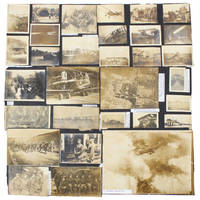
1918ref. 184831918. Photograp Archive documenting U.S. Army Air Service operations and postwar occupation activity in France during and immediately following World War I with material associated with Frank Holder of the 185th Aero Squadron a unit organized for night fighter operations. The archive supports research into early American military aviation night combat development and the operational environment of airfields near the Western Front including activity around Verdun. The 185th Aero Squadron deployed at the end of the war and known as the "Bats" represents the only U.S. unit organized specifically for night fighter operations placing the material within the development of specialized aerial combat roles in 1918. Identified locations including Reims Varennes-en-Argonne and Rembercourt situate the photographs within active and recently contested war zones. Archive of 65 photographs primarily silver gelatin prints France circa 1918-1919 with image sizes ranging from approximately 3 x 2 to 9.5 x 6.5 inches. The photographs include multiple images of aircraft operated by the 185th Aero Squadron at Rembercourt airfield including Sopwith Camel Fokker D.VII SPAD XII and Breguet 14 as well as an unidentified German aircraft shot down in the Somme. Additional images document tank and troop formations moving through northeastern France the ruins of Reims and other towns and a German column escorting American prisoners of war. Naval images include vessels identified as USS Liberation and Entente anti-submarine ships. Several photographs depict Frank Holder and other personnel with images taken during the postwar occupation period alongside wartime installation scenes. Many photographs retain contemporary captions supplemented by later white labels identifying equipment locations and individuals. The archive documents the intersection of aerial warfare ground operations and occupation activity during the final phase and immediate aftermath of World War I when American forces expanded their presence in France and began transitioning from combat operations to stabilization and occupation roles. The inclusion of multiple aircraft types from both Allied and German forces reflects the fluid and contested nature of air combat during the period while the documented destruction of urban centers such as Reims provides visual evidence of the war's impact on civilian environments. The presence of a specialized night fighter squadron further situates the material within the evolution of tactical aviation. Minor chipping to album page margins; photographs remain clean and sharp. Overall very good condition. A detailed photographic record of U.S. air service activity and war zone conditions in France during World War I. unknown
1918ref. 184831918. Photograp Archive documenting U.S. Army Air Service operations and postwar occupation activity in France during and immediately following World War I with material associated with Frank Holder of the 185th Aero Squadron a unit organized for night fighter operations. The archive supports research into early American military aviation night combat development and the operational environment of airfields near the Western Front including activity around Verdun. The 185th Aero Squadron deployed at the end of the war and known as the "Bats" represents the only U.S. unit organized specifically for night fighter operations placing the material within the development of specialized aerial combat roles in 1918. Identified locations including Reims Varennes-en-Argonne and Rembercourt situate the photographs within active and recently contested war zones. Archive of 65 photographs primarily silver gelatin prints France circa 1918-1919 with image sizes ranging from approximately 3 x 2 to 9.5 x 6.5 inches. The photographs include multiple images of aircraft operated by the 185th Aero Squadron at Rembercourt airfield including Sopwith Camel Fokker D.VII SPAD XII and Breguet 14 as well as an unidentified German aircraft shot down in the Somme. Additional images document tank and troop formations moving through northeastern France the ruins of Reims and other towns and a German column escorting American prisoners of war. Naval images include vessels identified as USS Liberation and Entente anti-submarine ships. Several photographs depict Frank Holder and other personnel with images taken during the postwar occupation period alongside wartime installation scenes. Many photographs retain contemporary captions supplemented by later white labels identifying equipment locations and individuals. The archive documents the intersection of aerial warfare ground operations and occupation activity during the final phase and immediate aftermath of World War I when American forces expanded their presence in France and began transitioning from combat operations to stabilization and occupation roles. The inclusion of multiple aircraft types from both Allied and German forces reflects the fluid and contested nature of air combat during the period while the documented destruction of urban centers such as Reims provides visual evidence of the war's impact on civilian environments. The presence of a specialized night fighter squadron further situates the material within the evolution of tactical aviation. Minor chipping to album page margins; photographs remain clean and sharp. Overall very good condition. A detailed photographic record of U.S. air service activity and war zone conditions in France during World War I. unknown books
1974An extraordinary copy. Signed not only by author inside front board, but also by an additional 20 important figures associated with the Regiment. Signatures upon front free endpaper include: LCol David L. Vaughan, CD (World War II Veteran and CO 1961-1964), LCol Archie M. Steacy, CD, (CO 1974-1978), LCol Grant B. Larkin, CD (CO 1970-1973), Honorary Lt Col John W. Toogood, CD (World War II BC Regiment Veteran and CO 1945-1949), Major Ernest Bowmer, MC, RMO (World War II British Army Veteran), Captain Arthur Goodson (World War I and II, BC Regiment Veteran) Musketry Expert, and Chief Warrant Officer Kenneth A. Parr, CD, RSM. Signatures upon back free endpaper include: Captain Robert Elrick (attached to BC Regiment from the Royal Canadian Dragoons), Major Robert Stanley (Squadron Commander), Captain Jack D. Drake (Squadron 2 I/C), Lieutenant Eric B. Foster (Troop Officer), Major Donald E. Hein (Officer's Mess President), Lieutenant Robert J. Baylis (Troup Officer), Lieutenant Norman A. Brown (Troop Officer), Lieutenant Robert B. Gauthier (Troop Officer), Master Warrant Officer Roger W. Prouse (SSM), Lieutenant Ralph D. MacRae (Troop Officer), Major Jack Tipton (Squadron Commander), Captain Brent R. Gray (Squadron 2 I/C), and Officer Cadet Tom Baker (Troop Officer). Printed name of Lieutenant (Donald) Hilton on front free endpaper. 438 pages. "Tells the story of B.C.'s earliest militia units from one of which the British Columbia Regiment has its descent. Describes the Regiment's participation in the South African War and in both World Wars, and much more." - dust jacket. Includes black and white illustrations, index, bibliography, fatality and casualty lists, repatriated prisoners of war (WWII) list, and list of honour and award winners. Contents unmarked. Binding sound. Average wear to book. Small faint coffee drop to bottom edge of text. Dust jacket, now preserved in archival-grade Brodart, bears somewhat above-average wear. We are indebted to LCol Archie M. Steacy, CD, CO (1974 to 1978) for his generous assistance in identifying the signatures in this copy. [Cooke p.130, Hale 1360] Book
1867ref. 193376Mainly China and Japan: 16 October 1863 - 29 July 1867. Tensions and turbulence in the treaty ports A revealing source spanning Courtenay's entire East Asia command during which Scylla - a wooden screw corvette - patrolled the coast of China and Japan. Courtenay spent five months as the senior officer in charge of the Shanghai division bringing him into contact with the likes of Sir Harry Parkes and also co-ordinated anti-piracy operations. Courtenay 1820-1894 made captain in 1859 and was promoted to vice-admiral in 1881. These letters report on Scylla's movements and occurrences onshore. Many recently opened cities were still tense and Western officers and civilians faced jeering stone-throwing and other acts of xenophobia. A lengthy letter from 2 September 1864 sent to Vice-Admiral Sir Augustus Kuper the commander-in-chief describes anti-foreign sentiment in Nagasaki in the wake of the Namamugi Incident and the Battle of Shimonoseki Straits. He records measures taken to counteract the influence of soldiers deployed in disguise by the hostile Choshu domain and relays rumours of a Choshu attack on the European enclave. "Considering that there are fifty people here either Dutch or under Dutch protection I am surprised that there should be no vessel of war of that nation here." In Amoy the ship's arrival "caused great excitement: numerous reports were spread of the reason of her coming among others are to the effect that we had landed several hundred men and that I was going to the city to seize the tautai" 26 December 1865. Care was also required in dealing with the Russians Courtenay reminding his officers to be "extremely guarded in asking questions or making observations" 25 July 1866. Other correspondence concerns piracy. Courtenay found the Chinese maritime police "utterly inefficient" 30 November 1865 and used his authority to send the gunboat HMS Grasshopper to seize lorchas on the coast. Quarto 320 x 205 mm. With 70 leaves filled with neat manuscript in several hands 2 bound- or tipped-in manuscript slips; additional blank. Recent quarter calf spine lettered in gilt green cloth sides front cover lettered in gilt green endpapers. A little marking internally: a well-preserved example. hardcover