489 Ergebnisse
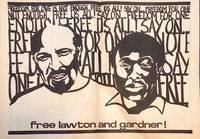
1974Best.-Nr. 187357Chicago: VVAW-WSO National Prison Project 1974. Four-panel brochure in tabloid newspaper format the back cover featuring a poster of the two defendants. Horizontal fold evenly toned old archive stamp in corner. On the case in Riverside CA of two Black defendants accused of killing police. Lawton was a VVAW-WSO member. Front page has a poem dedicated to their case called "Riverside Courthouse;" interior text discusses their case. VVAW-WSO National Prison Project unknown books
1962Best.-Nr. 123965Maplewood NJ: Hammond 1962. Near Fine. Near fine. Hammond unknown books
1996Best.-Nr. 149605Oakland: the Post 1996. Pamphlet. 16p. 7x8.5 inches illustrated with photos program ads very good program in stapled glossy pictorial wraps. the Post unknown books
1823Best.-Nr. 210271Delaware County PA 1823. unbound. 2 pages front and back 9.75 x 8 inches Delaware County Pennsylvania May 13 1823 -- a militia directive sent to Major Samuel Anderson responding to his letter of resignation withdrawing himself from command to which he was elected by the unanimous votes of the officers and men comprising the Delaware County Militia. In small part: ".It would have given us much pleasure could your private arrangements have admitted you to remain with us.we trust that.the prospects you have formed for yourself may be realized in the fullest intent." Minor folds and several tiny creases; otherwise very good condition. The document is signed by the following four veterans who fought gallantly in the War of 1812: Dr. Joseph Wilson Founder in 1812 of the Delaware County Troops; George Hawkins Commander of the Delaware County Blues; Henry Myers Captain Delaware County Volunteers; John Crosby Commanding Regiment Artillery. Samuel Anderson 1774-1850 was a Naval surgeon recommended by Benjamin Rush and subsequently appointed by President John Adams a surgeon's mate in the U.S. Navy in 1799. unknown books
1961Best.-Nr. 2708Washington DC 1961. Very good. 88pp. Quarto. Original textured padded cloth printed in gilt and black with calendar designs on front cover. Minor edge wear rubbing and abrading to covers. Ink gift inscription on front free endpaper toning to endpapers but otherwise internally clean. A rare yearbook from Veterans High School Center - an segregated academic and vocational training high school for American servicemen and other non-traditional male African-American students in the District of Columbia. Veterans High School was started in the old Armstrong Manual Training High School building in 1946 and operated until 1964 at which time it became an adult education center. During its run Veterans High School Center graduated around a hundred students a year trained in various academic and vocational specialties. The range of study is reflected in the senior class section here noting that each student is graduating on an "Academic" track or gaining a diploma in such vocational avenues as Printing Radio-TV Shoe Repair Auto Mechanics Brickmasonry Barber Science Electricity Drafting and Tailoring. Other sections of the yearbook feature students in typical settings such as the classroom in clubs playing sports and so forth. There is also a list of school patrons followed by an eight-page section of advertisements for local businesses. We could locate no other yearbooks from the segregated all-male Veterans High School in Washington D.C. unknown books
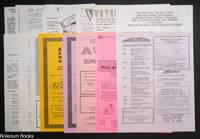
1990Best.-Nr. 335935Veterans C.A.R.E. 1990. Sixteen very good 8.5x11 inch sheets most printed both sides handbills excerpts from newsletters calendar of events etc. Potpourri of materials. Several sheets are apparently excerpts from newsletters containing ads reports events and one contains reprinted stories and letters from the LA Times & Washington Post. One is a column by David Hackworth "Gay Soldiers Demoralize Military. Veterans C.A.R.E. unknown books
1975Best.-Nr. 118092East Bay San Francisco etc.: Northern California VVAW-WSO 1975. 7p. 7x8.5 inch pamphlet cover illustration of a VVAW demonstration. Front cover unevenly toned horizontal fold crease. On a split in the VVAW involving tensions with the Revolutionary Union. The group issuing this pamphlet which opposed RU had been expelled from VVAW. Northern California VVAW-WSO unknown books
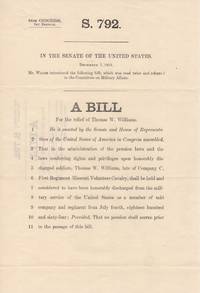
1922Best.-Nr. List2720Butte Montana 1922. Approximately 113 pieces: fifty-one letters to Thomas Williams; thirteen to various politicians mainly members of Congress; and twenty to Williams’ advocates mostly from Congresspeople; fifteen miscellaneous items including Grand Army of the Republic materials and Williams’ citizenship document; and fourteen empty envelopes. Materials date from between 1911 and 1922. Near fine with normal wear. Thomas W. Williams 1845–1931 was born outside of Swansea Wales and died in a Soldier’s Home in Los Angeles California. According to his obituary he came to the United States in about 1857 as a very young boy briefly left to learn blacksmithing in Toronto Canada and then returned stateside. He enlisted with the Union army at the outbreak of the Civil War shortly before he turned 16 and served in the 1st Missouri Cavalry of Volunteers Company C. After the war he was a resident of Butte Montana to or from which many of these letters are written. Offered here is a large lot of materials relating to Williams’ efforts late in life to secure a veteran’s pension for his service – or at least to have his 1864 dishonorable discharge expunged from his record. Williams enlists a number of people to help him with this task including fellow 1st Cavalry veteran Abraham Brokaw several local attorneys and the mayor of Butte. Their letters on Williams’ behalf are mainly addressed to congressmen mostly from Montana whose replies start out with polite deferrals—they would of course love to do anything in their power to help but these matters are difficult and now is simply not the right time—but devolve into accusations and firm denials. According to Williams he had served with Company C until his honorable discharge in May of 1864 at which point he immediately reenlisted. He received a thirty-day furlough on reenlistment and decided to visit his uncle in Hamilton Ontario as he had no other family on the continent. On attempting to return to his post: “As I was not of age my uncle held me and prevented me from returning to my command. I tried to get away so as to get back ran away twice but was recaptured twice my uncle having a letter from my mother instructing him to hold me as I would only be 19 on Sept 15 1864. I was branded as a deserter when I applied for a copy of my discharge.” December 11 1919 His record prior to this he claims had been stellar as he lays out in an eleven-page notarized statement as part of his appeal May 3 1922. He describes being sent as a member of General Frémont’s bodyguard into the First Battle of Springfield: “we were sent to lexington to drive Price and the Rebels out of Mo. we camp about 20 miles away in a viliage before we reached Springfield and General Freemont called the Body guard out at 2 oclock in the morning for volenteers we came out . we did not know where we were going. after we had gone a few miles we had a fight with the Rebels pickets and whiped and drove them away and we went two or three miles towards Springfield . we made the charge and drove the rebels out there were 2200 of them. we laid out in the prairies all night without Hat Coat or Blanket to keep us warm and Held our Horses by the Bridel all night”. The men “formed a camp near Springfield and you can see cut in a large rock the name of Camp Bliss which I cut and the dait of the year.” When Frémont was ordered back to Washington he ordered a dispatch sent from Springfield to Sedalia which Williams carried “132 miles from 8 oclock in the morning on our same Horses. and only one drink of water for our selves our Horses from the time we left camp that night untill 11 oclock when we arrived in Seidailia we then returned to Springfield with General Hunters comand escorted General fremont to Rolla”. The men go on “to Levenworth Kansas and the Bushwackers fought us all the way”. They winter in Leavenworth and are then sent to “Independence Mo to drive Quantrell and his gang out of North Mo” – that is William Quantrill and his Raiders an infamous pro-Confederate guerilla group. Williams writes: “We left the Sargent of Co E. in Kansas City to get our mail and a citizen and his son was with him Quantrell gang captured them and striped the both and placed them in a fence corner and killed them Both and placed fence rail over them and Burned them up and left the Boy see them do this he came to our Captain Miles Kehoe who sent us out in squads on all the roads and we captured 9 of the Rebles Captain line them up and told the Boy to pick out the man that killed his father . they coart Marcheled him and Hanged him the next morning at 8 oclock Capt Kehoe let the others go and told them if they were caught in any thing But a fair fight he would Hang them too”. Quantrill’s men heed Keogh’s warning and go much easier on six of the company’s men who are captured while searching for more feed for the horses: “Quantrals gang caught them after disarming took them to a farm house gave them supper and sent some of his men around and collected all the young ladies they could get and an old Mo fidler they danced all night and then Quantral gave them Brekfast and sent them to there camps this was the last trouble we had with him and his gang”. At this point Williams does admit to running into some trouble himself: another soldier “started to curse queen Victoria and I hit him . my Welch Blood could not stand to hear him”. Williams asks the soldier what he “would do to a man if he damned presedent Lincoln” and the soldier “went and swore I damned the president and I was Coart Marceled and sent to Alton then a Military Prison and at the Cort Marshal they did not alow me to say one word to protect myself when I arrived at Alton I explained the whole afair to the officer who had charge of this prison he advised me to write to president Lincoln”. Williams is shortly released from prison and sent back to his post at Little Rock; in later tellings of the story by Williams’ advocates including in a resolution of the Grand Army of the Republic Lincoln personally ordered Williams released. Willliams’ company fights in the Battle of Prairie D'Ane and then camps with “a comand of Jenensons coulered troops”—probably Colonel Charles Jennison—who were “attacked by the rebles” and “shot at them and then went at them with Bainets and drove them for miles it was a Sight to see the dead rebles how they were Killed”. Shortly before his initial discharge Williams’ company goes on to Camden where: “some of our troops were on picket and those not on guard were asleep around a fire and the rebles made a charge and shot the Boys around the fire after that the Boys took logs and put Hats and overcoats on the logs and the Rebles tryed the same game But was caught in a trap”. Finally Williams is discharged reenlists and is furloughed and heads to Canada where his troubles begin. He first appeals to fellow 1st Missourian Abraham Brokaw since Brokaw could act as a witness to his claims. In their correspondence Brokaw sometimes recalls interesting anecdotes from the war including the “dirty irishman thief and libertine” Kelley “who the boys you will call to mind was going to hang at Little Rock for steeling our postals” April 18 1912 and a “band of gurillas from Ark. that had captured and was holding the little town” of Ozark Missouri who “had got word of our coming and left for parts unknown a few hours before our coming” January 26 1915. The letters to Williams and his advocates are frustrating – what he’s told is inconsistent and he makes little progress. First he has to get confirmation of his first honorable discharge which he seems to receive around September of 1916. Then he applies for a pension; however the office of the Bureau of Pensions writes to him the following year that his pension “claim was rejected November 13 1916 on the ground that you were never honorably discharged from the only contract of service you entered into during the Civil War” August 31 1917. A month later the Missouri Adjutant General writes a certificate of his service which “clears your record both here and in Washington” and congratulates him “on receiving at last your just due as a Veteran so richly merited” September 20 1917. By the end of the year though he is still trying to clear the desertion charge and has now resorted to trying to pass a bill in congress to do so. Montana Senator Thomas Walsh writes that “I have tried very hard to secure a favorable report . but have been unable to induce the Military Committee to take action thereon” December 11 1917. The congressmen to whom he appeals—including Senators Walsh Tom Stout and Henry Myers and Representatives Frank W Mondell Carl W Riddick and Henry Z Osborne—are less than helpful. They often claim that there is insufficient time remaining in the current congressional session remind him that such bills are difficult to pass even in favorable circumstances and ask him to furnish them with the same information he has already provided. After years of this Senator Myers suddenly tells Charles Juttner one of Williams’ advocates a very different story about Williams’ service: “The report of the War Department shows that in March 1863 Mr. Williams was tried by court-martial on a long list of serious charges and that he was found guilty on all of them; that he was sentenced to imprisonment at hard labor for the duration of the war or at least until his term of enlistment should expire and that other penalties were assessed against him one of which was that at the expiration of his term of imprisonment he should be dishonorably discharged from the Army. It appears however that after having been imprisoned nearly a year the remainder of his sentence was remitted and that he was allowed to rejoin his company and that he did rejoin it in February 1864. The records of the War Department however show that July 4 1864 at St. Louis while on furlough Mr. Williams deserted and never rejoined the army.” July 18 1921 A letter from the War Department Adjutant General adds the details that he “was found guilty . of conduct prejudicial to good order and military discipline and of disobedience to orders” and that his sentence had included “a ball and chain weighing twelve pounds attached to his leg” and the forfeiture of all present and future pay and allowances January 16 1922. It is difficult to say which account is true. Myers however had given some telling further reason that Williams’ bill might have been rejected: “There is an intense prejudice in Congress against such bills. . The senators and representatives seem to think that such a bill is merely a prelude to an application for a pension and the expenses of the government are now so enormous and the expenses of providing for the veterans of the World War are so great . that there seems to be a general disposition in Congress not to increase the Civil War pension list any more by a single dollar.” Overall a record of one veteran’s experience dealing with the federal government. Of interest to scholars of the American Civil War and postbellum civilian life both for its firsthand accounts of engagements in the trans-Mississippi theater and for the look it offers at the treatment of veterans. unknown books
1975Best.-Nr. 99708Moscow: Progress Publishers 1975. Paperback. 413p. foldout map scattered illus. wraps wraps worn toned and creased else very good condition. Inscribed boldly in Russian and English to Abraham Lincoln Brigade vet Leonard Levenson presumably by one of the editors on the title page. Veterans of the International Brigades from 21 countries collect their memories of the war at a Soviet reunion along with contributions by Dolores Ibarruri and Luigi Longo. Progress Publishers paperback books
1965Best.-Nr. 33576n.p.: The Jewish War Veterans of the U.S.A. 1965. Near Fine. n.p: The Jewish War Veterans of the U.S.A 1965. Self-wrapped staple bound pamphlet 22cm; 12pp. Wrappers gently rubbed at margins but overall a Near Fine example with bright clean pages. Curiously paired with an opposition read: American Nazi party flyer for the 1965 Virginian gubernatorial election loosely laid in. The Jewish War Veterans of the U.S.A. were known for their advocacy for veterans women and children as well as their vocal resistance of alt-right groups. This pamphlet explains what the John Birch Society is and what they stand for as well as ways to oppose them and their politicians. The flyer laid in is for American Nazi Party candidate in 1965 George Lincoln Rockwell who claims to be the "Only Candidate for Governor who will work for the interest of the White People of Virginia." He lost horrifically thank goodness to the Democratic candidate Mills E. Godwin receiving 5700 votes to Godwin's 270000. Even the John Birch Society wanted nothing to do with him after he made anti-semitic statements. Only nine copies present in OCLC as of July 2025. The Jewish War Veterans of the U.S.A. unknown books
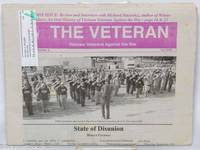
2008Best.-Nr. 308088Chicago: Vietnam Veterans Against the War VVAW 2008. Newspaper. 24p. tabloid newspaper horizontal fold; address label on front otherwise very good. Vietnam Veterans Against the War (VVAW) unknown books
1998Best.-Nr. 301624Washington DC: Readjustment Counseling Service U.S. Dept. of Veterans Affairs 1998. Spiral_bound. 81p. slender spiralbound paperback very good 8.5x11 inches. Readjustment Counseling Service, U.S. Dept. of Veterans Affairs unknown books
1996Best.-Nr. 254923San Francisco: the Post 1996. Pamphlet. 12p. 7x8.5 inches illustrations program very good in stapled pictorial yellow wraps. Ronnie Gilbert was the guest artist. the Post unknown books
1976Best.-Nr. 259346Chicago: VVAW 1976. Newspaper. 16p. tabloid newspaper horizontal fold evenly toned otherwise very good. From the period of Revolutionary Communist Party dominance over the group. VVAW unknown books
1978Best.-Nr. 247310Chicago: VVAW 1978. Newspaper. 16p. tabloid newspaper horizontal fold evenly toned otherwise very good. Cover story on a vet dying of complications from Agent Orange exposure; top headline is on Vietnam's invasion of Cambodia. VVAW supported the Khmer Rouge in this conflict accusing Vietnam of becoming an aggressor and tool of Soviet social imperialism; small photo of Cambodian troops is captioned "Cambodian freedom fighters must now fight again. VVAW unknown books
1976Best.-Nr. 248308Chicago: VVAW 1976. Newspaper. Four page brochure in tabloid newspaper format horizontal fold evenly toned. VVAW unknown books
1986Best.-Nr. 248504Chicago: VVAW 1986. Newspaper. Double issue of the newspaper 24p. tabloid newspaper horizontal fold evenly toned otherwise very good. Includes a 16p. supplement on the VVAW delegation to Nicaragua and US intervention in Central America. VVAW unknown books
1986Best.-Nr. 248505Chicago: VVAW 1986. Newspaper. 24p. tabloid newspaper horizontal fold evenly toned otherwise very good. Articles on the Iran-Contra scandal Central American immigrants Vietnam vets and prison and more. VVAW unknown books
1979Best.-Nr. 235787Washington DC: Veterans Administration 1979. 21p. 8.5x11 inches tables of job opportunities with the VA around the country some with hourly wage listed $8.80 for an air conditioning mechanic in Chicago very good booklet in stapled gray wraps. Veterans Administration unknown books
1978Best.-Nr. 237174Oakland: VVAW 1978. 8.5x14 inch handbill printed both sides horizontal crease. Announcement for a conference including an agenda. VVAW unknown books
1978Best.-Nr. 237302Chicago: VVAW 1978. 6p 8.5x11 inch mimeographed sheets stapled at corner; address label and stamp on rear cover otherwise very good. Includes coverage of Agent Orange activism. VVAW unknown books
1978Best.-Nr. 237166San Francisco: VVAW 1978. 8.5x11 inch handbill with photoreproduced text one side very good. "They can take their sympathy their vets unemployment their stinking VA care their American Legion and VFW leaders who trumpet their "patriotic" messages and their next profit-making war and cram them! VVAW unknown books
1977Best.-Nr. 237173Oakland: VVAW 1977. 8.5x11 inch handbill printed both sides very good. Updates on VVAW activism; notes that over 100 marched in the Fighting Vets Contingent in San Francisco. Much on anti-krugerand activism which was pursued by RCP activists within the group but criticized as tangential to the VVAW's mission by internal critics. VVAW unknown books
1976Best.-Nr. 237172San Jose: VVAW 1976. 8.5x14 inch handbill printed one side very good. "1976 - the Bicentennial year. All year long we've been hit with red white and blue garbage about how all of us have to unite with the Rich the same people who sent us off to Vietnam or some other place to protect their wealth the same people who break our backs in their factories and shops. VVAW unknown books
1977Best.-Nr. 237149San Francisco: VVAW 1977. 8.5x11 inch handbill printed both sides very good Calls for a demonstration on inauguration day as Carter is sworn in demanding universal unconditional amnesty. VVAW unknown books