Veterans, United ConfederateBiblio.com

490 résultats
réf. 1245873229.Gpaperback. Good. Access codes and supplements are not guaranteed with used items. May be an ex-library book. paperback
réf. 0656707682.Ghardcover. Good. Access codes and supplements are not guaranteed with used items. May be an ex-library book. hardcover
réf. 065670392X.Ghardcover. Good. Access codes and supplements are not guaranteed with used items. May be an ex-library book. hardcover
réf. 0331238853.Ghardcover. Good. Access codes and supplements are not guaranteed with used items. May be an ex-library book. hardcover
1961réf. 2708Washington DC 1961. Very good. 88pp. Quarto. Original textured padded cloth printed in gilt and black with calendar designs on front cover. Minor edge wear rubbing and abrading to covers. Ink gift inscription on front free endpaper toning to endpapers but otherwise internally clean. A rare yearbook from Veterans High School Center - an segregated academic and vocational training high school for American servicemen and other non-traditional male African-American students in the District of Columbia. Veterans High School was started in the old Armstrong Manual Training High School building in 1946 and operated until 1964 at which time it became an adult education center. During its run Veterans High School Center graduated around a hundred students a year trained in various academic and vocational specialties. The range of study is reflected in the senior class section here noting that each student is graduating on an "Academic" track or gaining a diploma in such vocational avenues as Printing Radio-TV Shoe Repair Auto Mechanics Brickmasonry Barber Science Electricity Drafting and Tailoring. Other sections of the yearbook feature students in typical settings such as the classroom in clubs playing sports and so forth. There is also a list of school patrons followed by an eight-page section of advertisements for local businesses. We could locate no other yearbooks from the segregated all-male Veterans High School in Washington D.C. unknown
réf. 1528168801.Gpaperback. Good. Access codes and supplements are not guaranteed with used items. May be an ex-library book. paperback
réf. 0967033187.Gpaperback. Good. Access codes and supplements are not guaranteed with used items. May be an ex-library book. paperback
réf. 0982058608.Gpaperback. Good. Access codes and supplements are not guaranteed with used items. May be an ex-library book. paperback
1890réf. 311597Confederate Veterans Committee Medical Society N. C. Good. 1890. Paperback. 8vo; 57 pp; Undated sewn pamphlet published with paper consistent with 1880-1890 period. Previous owner's name on front cover - Dr. W. W. Harris - who has updated his record on page 22 and added additional notes on blank page 24. No other marks in book moisture stains on paper wraps and page lower corners slightly affecting first 10 pages lower 1 inch of front cover/title page is missing sewn binding tight edge chips on foredge of front/back cover. Still a nice tight period document. . Confederate Veterans Committee, Medical Society, N. C. paperback
1972réf. 018946Washington D. C.: Veterans Administration 1972. Paper Back. Very Good/No Jacket. 4to - over 9¾" - 12" tall. 315pp.; SC salmon w/blk.; some rub w/tears on corners; spine sunned; cleantight pgs. Intro.; Bid solicitation format; Manufacture listing; Power&performance; and Data samples. IB 11-24 Veterans Administration unknown
2004réf. 052631Kingsbury Books. very nice copy . Fine. Hardcover. 1st Edition. 2004. Kingsbury Books hardcover
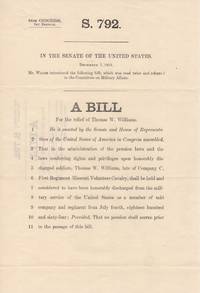
1922réf. List2720Butte Montana 1922. Approximately 113 pieces: fifty-one letters to Thomas Williams; thirteen to various politicians mainly members of Congress; and twenty to Williams’ advocates mostly from Congresspeople; fifteen miscellaneous items including Grand Army of the Republic materials and Williams’ citizenship document; and fourteen empty envelopes. Materials date from between 1911 and 1922. Near fine with normal wear. Thomas W. Williams 1845–1931 was born outside of Swansea Wales and died in a Soldier’s Home in Los Angeles California. According to his obituary he came to the United States in about 1857 as a very young boy briefly left to learn blacksmithing in Toronto Canada and then returned stateside. He enlisted with the Union army at the outbreak of the Civil War shortly before he turned 16 and served in the 1st Missouri Cavalry of Volunteers Company C. After the war he was a resident of Butte Montana to or from which many of these letters are written. Offered here is a large lot of materials relating to Williams’ efforts late in life to secure a veteran’s pension for his service – or at least to have his 1864 dishonorable discharge expunged from his record. Williams enlists a number of people to help him with this task including fellow 1st Cavalry veteran Abraham Brokaw several local attorneys and the mayor of Butte. Their letters on Williams’ behalf are mainly addressed to congressmen mostly from Montana whose replies start out with polite deferrals—they would of course love to do anything in their power to help but these matters are difficult and now is simply not the right time—but devolve into accusations and firm denials. According to Williams he had served with Company C until his honorable discharge in May of 1864 at which point he immediately reenlisted. He received a thirty-day furlough on reenlistment and decided to visit his uncle in Hamilton Ontario as he had no other family on the continent. On attempting to return to his post: “As I was not of age my uncle held me and prevented me from returning to my command. I tried to get away so as to get back ran away twice but was recaptured twice my uncle having a letter from my mother instructing him to hold me as I would only be 19 on Sept 15 1864. I was branded as a deserter when I applied for a copy of my discharge.” December 11 1919 His record prior to this he claims had been stellar as he lays out in an eleven-page notarized statement as part of his appeal May 3 1922. He describes being sent as a member of General Frémont’s bodyguard into the First Battle of Springfield: “we were sent to lexington to drive Price and the Rebels out of Mo. we camp about 20 miles away in a viliage before we reached Springfield and General Freemont called the Body guard out at 2 oclock in the morning for volenteers we came out . we did not know where we were going. after we had gone a few miles we had a fight with the Rebels pickets and whiped and drove them away and we went two or three miles towards Springfield . we made the charge and drove the rebels out there were 2200 of them. we laid out in the prairies all night without Hat Coat or Blanket to keep us warm and Held our Horses by the Bridel all night”. The men “formed a camp near Springfield and you can see cut in a large rock the name of Camp Bliss which I cut and the dait of the year.” When Frémont was ordered back to Washington he ordered a dispatch sent from Springfield to Sedalia which Williams carried “132 miles from 8 oclock in the morning on our same Horses. and only one drink of water for our selves our Horses from the time we left camp that night untill 11 oclock when we arrived in Seidailia we then returned to Springfield with General Hunters comand escorted General fremont to Rolla”. The men go on “to Levenworth Kansas and the Bushwackers fought us all the way”. They winter in Leavenworth and are then sent to “Independence Mo to drive Quantrell and his gang out of North Mo” – that is William Quantrill and his Raiders an infamous pro-Confederate guerilla group. Williams writes: “We left the Sargent of Co E. in Kansas City to get our mail and a citizen and his son was with him Quantrell gang captured them and striped the both and placed them in a fence corner and killed them Both and placed fence rail over them and Burned them up and left the Boy see them do this he came to our Captain Miles Kehoe who sent us out in squads on all the roads and we captured 9 of the Rebles Captain line them up and told the Boy to pick out the man that killed his father . they coart Marcheled him and Hanged him the next morning at 8 oclock Capt Kehoe let the others go and told them if they were caught in any thing But a fair fight he would Hang them too”. Quantrill’s men heed Keogh’s warning and go much easier on six of the company’s men who are captured while searching for more feed for the horses: “Quantrals gang caught them after disarming took them to a farm house gave them supper and sent some of his men around and collected all the young ladies they could get and an old Mo fidler they danced all night and then Quantral gave them Brekfast and sent them to there camps this was the last trouble we had with him and his gang”. At this point Williams does admit to running into some trouble himself: another soldier “started to curse queen Victoria and I hit him . my Welch Blood could not stand to hear him”. Williams asks the soldier what he “would do to a man if he damned presedent Lincoln” and the soldier “went and swore I damned the president and I was Coart Marceled and sent to Alton then a Military Prison and at the Cort Marshal they did not alow me to say one word to protect myself when I arrived at Alton I explained the whole afair to the officer who had charge of this prison he advised me to write to president Lincoln”. Williams is shortly released from prison and sent back to his post at Little Rock; in later tellings of the story by Williams’ advocates including in a resolution of the Grand Army of the Republic Lincoln personally ordered Williams released. Willliams’ company fights in the Battle of Prairie D'Ane and then camps with “a comand of Jenensons coulered troops”—probably Colonel Charles Jennison—who were “attacked by the rebles” and “shot at them and then went at them with Bainets and drove them for miles it was a Sight to see the dead rebles how they were Killed”. Shortly before his initial discharge Williams’ company goes on to Camden where: “some of our troops were on picket and those not on guard were asleep around a fire and the rebles made a charge and shot the Boys around the fire after that the Boys took logs and put Hats and overcoats on the logs and the Rebles tryed the same game But was caught in a trap”. Finally Williams is discharged reenlists and is furloughed and heads to Canada where his troubles begin. He first appeals to fellow 1st Missourian Abraham Brokaw since Brokaw could act as a witness to his claims. In their correspondence Brokaw sometimes recalls interesting anecdotes from the war including the “dirty irishman thief and libertine” Kelley “who the boys you will call to mind was going to hang at Little Rock for steeling our postals” April 18 1912 and a “band of gurillas from Ark. that had captured and was holding the little town” of Ozark Missouri who “had got word of our coming and left for parts unknown a few hours before our coming” January 26 1915. The letters to Williams and his advocates are frustrating – what he’s told is inconsistent and he makes little progress. First he has to get confirmation of his first honorable discharge which he seems to receive around September of 1916. Then he applies for a pension; however the office of the Bureau of Pensions writes to him the following year that his pension “claim was rejected November 13 1916 on the ground that you were never honorably discharged from the only contract of service you entered into during the Civil War” August 31 1917. A month later the Missouri Adjutant General writes a certificate of his service which “clears your record both here and in Washington” and congratulates him “on receiving at last your just due as a Veteran so richly merited” September 20 1917. By the end of the year though he is still trying to clear the desertion charge and has now resorted to trying to pass a bill in congress to do so. Montana Senator Thomas Walsh writes that “I have tried very hard to secure a favorable report . but have been unable to induce the Military Committee to take action thereon” December 11 1917. The congressmen to whom he appeals—including Senators Walsh Tom Stout and Henry Myers and Representatives Frank W Mondell Carl W Riddick and Henry Z Osborne—are less than helpful. They often claim that there is insufficient time remaining in the current congressional session remind him that such bills are difficult to pass even in favorable circumstances and ask him to furnish them with the same information he has already provided. After years of this Senator Myers suddenly tells Charles Juttner one of Williams’ advocates a very different story about Williams’ service: “The report of the War Department shows that in March 1863 Mr. Williams was tried by court-martial on a long list of serious charges and that he was found guilty on all of them; that he was sentenced to imprisonment at hard labor for the duration of the war or at least until his term of enlistment should expire and that other penalties were assessed against him one of which was that at the expiration of his term of imprisonment he should be dishonorably discharged from the Army. It appears however that after having been imprisoned nearly a year the remainder of his sentence was remitted and that he was allowed to rejoin his company and that he did rejoin it in February 1864. The records of the War Department however show that July 4 1864 at St. Louis while on furlough Mr. Williams deserted and never rejoined the army.” July 18 1921 A letter from the War Department Adjutant General adds the details that he “was found guilty . of conduct prejudicial to good order and military discipline and of disobedience to orders” and that his sentence had included “a ball and chain weighing twelve pounds attached to his leg” and the forfeiture of all present and future pay and allowances January 16 1922. It is difficult to say which account is true. Myers however had given some telling further reason that Williams’ bill might have been rejected: “There is an intense prejudice in Congress against such bills. . The senators and representatives seem to think that such a bill is merely a prelude to an application for a pension and the expenses of the government are now so enormous and the expenses of providing for the veterans of the World War are so great . that there seems to be a general disposition in Congress not to increase the Civil War pension list any more by a single dollar.” Overall a record of one veteran’s experience dealing with the federal government. Of interest to scholars of the American Civil War and postbellum civilian life both for its firsthand accounts of engagements in the trans-Mississippi theater and for the look it offers at the treatment of veterans. unknown
1979réf. 62361Washington DC: U. S. Government Printing Office 1979. Presumed first edition/first printing. Wraps. Good. No dust jacket as issued. Cover has some wear and soiling. iii 147 p. 96th Contress 1st Session Senate Report No. 96-100. Calendar No. 102. U. S. Government Printing Office paperback
2000réf. 62354Washington DC: U.S. Government Printing Office 2000. Presumed first edition/first printing. Wraps. Good. No dust jacket as issued. iv 248 p. Includes illustrations. Serial No. 106-40. This hearing examined the Department of Veterans Affairs disability claims processing. U.S. Government Printing Office paperback
1994réf. 63952Washington DC: U.S. Government Printing Office 1994. Presumed first edition/first printing. Wraps. Good. No dust jacket as issued. Distribution label on back page. Corner of several pages creased. iv 213 p. 23 cm. Illustrations. Occasional footnotes. Serial no. 103-19. The Committee was concerned that despite increased public awareness of women in the military and the fact that women were a fast growing segment of the veteran population it appeared that the Department of Veterans Affairs had not improved the availability of gender-specific health care services needed by women veterans. U.S. Government Printing Office paperback
1999réf. 62805Washington DC: U. S. Government Printing Office 1999. Presumed first edition/first printing. Wraps. Good. No dust jacket as issued. iii 122 p. Serial No. 105-47. The purpose of this hearing was to examine the preparations of the Department of Veterans Affairs and the Food and Drug Administration for the Year 2000 Y2K compliance of medication devices used for the health care of veterans. U. S. Government Printing Office paperback
2002réf. 62769Washington DC: U.S. Government Printing Office 2002. Presumed first edition/first printing. Wraps. Very good. No dust jacket as issued. iii 76 p. S. Hrg. 107-631. This hearing examined to some extent the practice of cost-shifting of medical expenditures and the cost of prescription drugs within the Veterans Affairs system. The committee was interested in ensuring that the Department of Veterans Affairs was properly resourced to provide the care needed by veterans. U.S. Government Printing Office paperback
1999réf. 36499Washington DC: National Academy Press 1999. very good. 24 cm 611 tables references appendices index front board slightly soiled. National Academy Press unknown
1999réf. 49089Washington DC: GPO 1999. First Edition. First Printing. good. 200 wraps illus. Serial No. 106-26. GPO paperback
2002réf. 50903Washington DC: GPO 2002. good. 59 wraps. Serial No. 107-114. The modern battleground can be a toxic and biological minefield. In far-flung deployments indigenous diseases parasites and environmental exposures pose unique health threats. Fighting and surviving in battle space contaminated by chemical and biological weapons demand medical countermeasures and treatment capabilities beyond those needed to deal with bullets and bombs. The military services apear to have different approaches to health surveillance training of medical personnel and treatment protocols. GPO paperback
1955réf. 36775Washington DC: Veterans Administration 1955. good. Quarto approx. 200 illus. figures footnotes bibliography boards somewhat worn and soiled. 10 bulletins bound together. Bound documents such as this are increasingly scarce. Important look at the post-World War II and Korean War periods. Veterans Administration hardcover
2003réf. 50908Washington DC: GPO 2003. First Edition. First Printing. very good. 114 wraps. Serial No. 107-187. This hearing addressed the effectiveness scope and implications of the U.S. counterterrorism policies in a world realigned by war without boundaries. Among the panelists were major "neo-con" representatives who were considered to be among the architects of the war against Saddam Hussein. GPO paperback
2000réf. 50898Washington DC: GPO 2000. First Edition. First Printing. very good. 100 wraps tables. Serial No. 106-36. This hearing gave the Committee an opportunity to explore issues relating to the Department of Veterans Affairs personnel needs. GPO paperback
1925réf. 2228Chicago: Veteran Foreign Wars of The United States 1925. Prepared Expressly For Patrons of Record. America; Great Crises In Our History Told by Its Makers. A Library of Original Sources Americanization Department VFW Veteran Foreign Wars Edition prepared expressly for Patrons of Record with multicolor dedication pages each volume "registered in the name of its owner at headquarters and certified to in Volume I". Signed by both the Commander-in-Chief of the VFW and the Adjutant-General with the blind-stamp of the National Encampment. Bound in full faux leather bindings. Gilded spines. Gilded eagle and VFW motifs on covers. The top edges are gilded. Printed on thick quality paper. With wide margins. Frontisplates. Gilded dedication page Dedicated to 'Our Boys Who Made The Supreme Sacrifice'. 8.5 inches tall. 16 inches of shelf space. Index in volume 12. VERY GOOD condition. The hinges are 100% fully attached. Some general shelf wear / abrasion. Printed on quality paper that is fresh bright and clean. This set displays beautifully. This set would make an excellent gift and/or addition to any fine library. In addition to their shelf presence antiquarian books make an excellent investment. We always pack very securely to help ensure safe handling during transit. All books are individually wrapped and are always professionally padded. We offer a full refund guarantee per our terms described on our site with notification of such intent requested. Please contact us with any inquiries. Veteran Foreign Wars of The United States unknown
1965réf. 33576n.p.: The Jewish War Veterans of the U.S.A. 1965. Near Fine. n.p: The Jewish War Veterans of the U.S.A 1965. Self-wrapped staple bound pamphlet 22cm; 12pp. Wrappers gently rubbed at margins but overall a Near Fine example with bright clean pages. Curiously paired with an opposition read: American Nazi party flyer for the 1965 Virginian gubernatorial election loosely laid in. The Jewish War Veterans of the U.S.A. were known for their advocacy for veterans women and children as well as their vocal resistance of alt-right groups. This pamphlet explains what the John Birch Society is and what they stand for as well as ways to oppose them and their politicians. The flyer laid in is for American Nazi Party candidate in 1965 George Lincoln Rockwell who claims to be the "Only Candidate for Governor who will work for the interest of the White People of Virginia." He lost horrifically thank goodness to the Democratic candidate Mills E. Godwin receiving 5700 votes to Godwin's 270000. Even the John Birch Society wanted nothing to do with him after he made anti-semitic statements. Only nine copies present in OCLC as of July 2025. The Jewish War Veterans of the U.S.A. unknown