ALMANACBiblio.com
8445 risultati
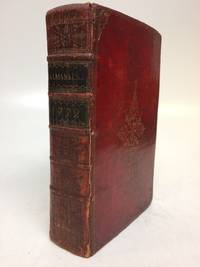
1772rif. 260710London: Various 1772. First. hardcover. very good. Rubricated text throughout. Illustrated with many charts and some woodcut diagrams. Thick 12mo contemporary red calf gilt leather label a.e.g. London: various publishers for The Company of Stationers 1772. First editions. An interesting collection in a very good attractive period binding Titles include: Remarkable News from the Stars; The Gentleman's Diary & Mathematical Repository; The Ladies' Diary; Vox Stellarum; Merlinus Liberatus; Parker's Ephemeris; The Coelestial Diary; Poor Robin; The English Apollo; Speculum Anni; Olympia Domata; The Coelestial Atlas. Various printers. Various unknown
1803rif. 373912New York: D. Longworth at the Shakespeare Gallery 1803. 24 engraved vignette illustrations by Peter Maverick. 5-80 2pp with the calendar and memorandum pages i.e. pp. 41-64 engraved. 12mo. Original wrappers each comprised of two plates backed onto each other i.e. 4 plates in total engraved by Anderson. Publisher's red morocco gilt slipcase. 24 engraved vignette illustrations by Peter Maverick. 5-80 2pp with the calendar and memorandum pages i.e. pp. 41-64 engraved. 12mo. As least three issues of Longworth's Belles Lettres Repository were published for 1801-1803 with slightly varying titles: The American ladies & gentlemen's pocket almanac and elegant belles lettres repository. for 1801 Evans 36816; The American ladies' & gentlemen's pocket almanac and belles lettres repository for 1802 Shaw & Shoemaker 50194; and the present titled at the bottom of the front wrapper and as a caption title at the head of p. 5. An advertisement on the recto of the final leaf states: "This is the third Belles-Lettres-Repository. The two former have been done at the expense of the Publisher. this he hopes will be at the expense of lovers of neat things." At the bottom of the same page are descriptions of the plates and illustrations including the "frontispiece title-page i.e. front wrapper L'Allegro and finishing piece Il Penseroso form the cover" and the plate on the inside front wrapper being "Orpheus Eurydice and Cerberus." The vignettes by Maverick illustrate "select passages in Hayley's 'Triumphs of temper' with extracts underneath each. At the foot of each of these pages are the kalendar sic pages for 1803 and the intermediate spaces are ruled for belles-lettres selections &c. . these alternate with twelve other vignettes architectural and picturesque with ruled memorandum pages under each the whole engraved." Shaw and Shoemaker locate only the example at the Huntington which collates precisely as the present; i.e. wrappers comprised of two engraved plates mounted to each other i.e. the front wrapper being pages 1-4 and the text beginning on page 5 with a caption title at the head. An additional example with the same collation at the Hay Library Brown University confirms the work is complete as issued A scarce example in the original slipcase; American publisher's slipcases or sheaths from the 18th century are very rare. The earliest noted by Tanselle is on an 1801 edition of the American Ladies & Gentlemans Pocket Almanac Tanselle 01.01 and plate 9. Shaw 2551 dating the imprint as 1802 locating only the example at the Huntington Library ; Pomeroy J.R. Alexander Anderson 1775-1870 105. See Tanselle 01.01 D. Longworth at the Shakespeare Gallery unknown
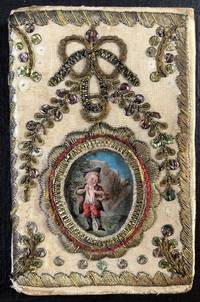
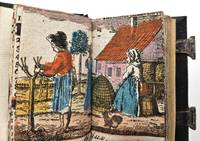
1795rif. 4083Amsterdam: M. Schalekamp 1795. 36mo binding size 97 x 62 mm. 71 1 pp. Title and text within type-ornament borders. Four double-page engraved plates two signed by W. J. Strunck. Contemporary embroidered binding of beige silk over binder's board both covers with an outer wavy border of gold satin stitch enclosing a gouache and watercolor medallion under glass each cover with a different scene within an oval relief frame of goldwork red thread and satin stitch the medallion suspended from a ring hanging from a ribbon and flanked with sprigs the design composed of couched and separate colored and gold pailletes silver-gilt thread purl and goldwork spine plain with two silver-gilt rectangles pale orange silk liners preserving original wrappers of orange block-printed patterned paper with sprigs and dots gilt edges. Loss of 5 sequins on upper cover and 3 on lower cover. Provenance: Robert de Beauvillain bookplate.A literary almanac in a possibly Netherlandish embroidered binding with watercolor miniatures. The painting on the front cover shows a young man wearing a tricorne standing jauntily in a mountainous landscape and that on the rear cover two shepherds at dusk. This "Poetic Almanac or choice of Heroic epistles Tales Theatrical and other Poetic Pieces" was published in Amsterdam and sometimes also sold in Utrecht from 1771 to the late 1790s. The almanac includes a 12-page tabular calendar with Saints'days moon phases and eclipses a schedule of the ringing of the Amsterdam city bells and tales and poems some adapted from classical mythology. The romantic double-page engravings by Strunck show Mirtil and Chloe Daphne's children Hero and Leander in a dramatic scene of roiling seas and lightning a pastoral love scene and a woman in a dungeon with snakes illustrating the final poem "Elane Romance." OCLC locates a single copy of a different year in the US at the Grolier Club; that copy of the 1781 issue is also in an embroidered binding with a floral design and no miniatures. On Strunck cf. Thieme-Becker 32:217. M. Schalekamp unknown books
1804rif. ABC_48705Paris 1804. Large 8vo ca. 19.5 x 12 cm. L.É. Testu Contemporary gold-tooled tree marbled calf with an ornamental border on both boards a richly gold-tooled spine with red calf title-label lettered in gold gilt board edges gilt edges marbled endpapers. With the engraved coat-of-arms of the First French Empire on the title page and numerous letterpress tables. 16 832 pp. Attractively bound copy of this interesting French almanac for the year 1804-1805 An XIII i.e. year 13 counted from 1792 the period running from 23 September 1804 to 22 September 1805 according to the French Republican calendar which was used from 1793 to 1805. It is the last almanac using the terminology of the French Revolution before Napoleon Bonaparte 1769-1821 was crowned Emperor of the French on 2 December 1804.This almanac contains a wealth of information concerning the organization of the administration of the French state in the first year of the First French Empire. It comprises the names of the main dignitaries in France and abroad mentioning i.a. Thomas Jefferson as President of the United States of America the public officials in Paris and in the provinces the magistracy the clergy the army officers etc. as well as the usual subjects present in most almanacs such as annual fairs stagecoaches and timetables. It is concluded with an extensive index pp. 817-824 and a supplement pp. 825-832 which is not always present in most copies we could trace.The French publisher Laurent Étienne Testu 1765-1839 worked from 1788 for the French printer François Jean Noël Debure 1743-1802 who was the son-in-law of the French printer Laurent Charles dHoury 1723-1786. The family of DHoury had started with the annual publication of the famous Almanach royal which appeared under this title from 1700 to 1792.In 1791 Testu took over Debures printing house and in 1792 the title of the almanac was turned into Almanach national de France due to the new political situation caused by the French Revolution. After Napoleons coronation to emperor in 1804 its title was subsequently changed into Almanach imperial. Testu was appointed imperial publisher to Napoleon until his abdication in 1814.With the 19th-century oval bookplate of the French military Albert Le Lorier "Sous-Intendant Militaire" mounted on the front pastedown. The head of spine is slightly chipped/damaged the corners of the boards are slightly worn. The title page is slightly stained in the outer blank margin two text leaves Oo2 and Zz5 are re-attached probably replaced and their outer blank margins are slightly shortened otherwise a beautiful binding in very good condition.l Grand-Carteret Les almanachs français no. 1433. BOOK HISTORY & PRINTING EUROPE HISTORY Almanacs France hardcover
1850rif. L6D9JJJQJ3D4Saint Helena 1850. 8vo. George Gibb Government office Later black half morocco gold-tooled spine. With the title page printed in orange with the woodcut royal arms of the United Kingdom. 126 37 3 pp.; plus 3 1 blank pp. advertisements Only copy located of the 1850 almanac for the island of Saint Helena. Famous for being the prison of Napoleon Bonaparte in his final years the British island was used as a frequent stop by ships calling in for supplies. The almanac contains 37 pages listing the 930 ships that visited the island between 1 December 1848 and 30 November 1849. The development of steamships as well as the opening of the Suez Canal in 1869 would almost completely deprive Saint Helena of its great importance as a supply station. In 1840 a naval station was established for the Royal Navy's campaign to suppress the slave trade. By 1 December 1849 15067 slaves had been brought to the island. Roughly a fourth died on the island with the rest emigrating to Jamaica British Guiana and Trinidad.Starting with the natural history of the island the almanac describes the geology of the island and lists the birds and fish that can be found. The rest of the almanac describes the feasts and festivals for the year 1850; lunar cycles; climate of the island; tides; the family of Queen Victoria; the British cabinet; the political military and ecclesiastical government of the island as well as the British naval command in West Africa; customs and judicial fees and penalties; ordinances; local institutions and societies; and a list of local miscellaneous information. The printer appears to have aimed for a full page; for instance placing a table of the height of several hills and peaks below the regional naval hierarchy instead of near the geographical description whereas a table of geographical distances is placed under the header "local miscellaneous information".With the bookplates of the barrister Alexander Meyrick Broadley 1847-1916 famous for being the defence lawyer for the Egyptian nationalist Ahmed 'Urabi 1841-1911 and of the legendary superspy Sidney George Reilly 1873-1925. Binding lightly worn at the hinges; a very good copy. AFRICA BOOK HISTORY & PRINTING ECONOMY TRADE & NUMISMATICS EUROPE LAW PHILOSOPHY & POLITICS Almanacs Geology Greek & Non-Western Types UK - United Kingdom ZZ Great Britain & Ireland unknown
1924rif. 65430Wien, Kunsthandlung Würthle & Sohn Nfg., 1924. Gr.-8°. Mit zahlr. Abbildungen u. Werbungen (dav. eine zwischengeb. Farbtafel). 80 S., 16 Bll., In Rot u. Schwarz typographisch illustr. OKart.-Umschlag.
rif. 110370Rare almanac with beautiful drawings on the special prepared erasable paper. With many woodcut portraits of Dutch hero's. Printed by the famed Golden Age printer Saeghman in 1665. Full leather embossed binding with dutch lion and the text Hollandia. On the back a coat of arms. With metal clasp in good condition other two clasps missing. Edges of the binding and the spine with some damages. In -16 95 x 75 cm. Coat of arms of Amsterdam on the titlepage. Titlepage in red and black ink. Only one copy in STCN Leiden. With stamps of Gemeente Archief van Amsterdam. With 16 white note pages prepared paper to write and delete writings or drawings of which 6 with beautiful drawings of birds and two with houses old church. Bound with ""kort en bondigh Chronicken van alle de gedeckwaerdighe geschiedenissen in Europa sedert den Jare 1500 tot dit tegenwoordighe jaer Amsterdam Gillis Joosten Saeghman"". With an illustrated title-page featuring Europa on the bull. On every page a portrait portraits of Willem van Oranje Piet Hein admiraal Jacob van Heemskerck Spinola etc. or other woodcut illustration. Last page severely damaged on the interior edge almost loose but still attached. The famed Golden Age printer Gilles Joosten Saeghman Saegman 1619-1704 published both works.NL Zeldzame almanak met kleine gebreken aan de geblindstempelde leren band. Prachtige tekeningen op het witte speciaal geprepareerde papier waarop je kan schrijven en gummen om opnieuw te beginnen. Veel van vogels zoals een eend en een pauw maar ook 2 met gebouwen. hardcover
1811rif. 12709Amsterdam by derfg. C Stigter 1811. Almanach op t jaar ons Heeren Esus sic Christus 1811. Voorzien met eene aanwijz. van de jaar-/paard-/beest- en leerm. in Holland en de maans op- en onder-gang: berekend door Jacob de Gelder mathematicus. Full shark leather binding with two silver clasps with silver marks among one with three crosses for Amsterdam and the letter B still intact and working. In -24 size 75 x 55 cm. / 276 x 197 inch. Binding with two very small holes in the leather and is further in good condition. Guilt edges. Rare almanac printed in Amsterdam with 12 folding coloured woodcut illustrations for each month Sinterklaas in December and 4 folding coloured woodcut illustrations for each season text in German under the seasons. With calendar printed in red and black ink Verduisteringen en hemelverschynselen voor den jare 1811 Reys-Wyzer wanneer de veerschepen en trekschuiten moet afvaren gedrukt voor de reizende Aantekeningen van don Antonio Magino Korte Kronyk beginnende van den jare 1805 8 blank leaves white note pages prepared to write and delete writings or drawings and 10 laid blank leaves for notes. Both blank note pages and the laid paper leaves are of a later date than the almanac. The illustration for December is a very nice illustration of the Dutch feast Sinterklaas with people with a rod of Sinterklaas. The only known copy of this 1811 almanac features added colored illustrations for each month and season. The illustrations are trimmed slightly shorter than the original almanac. Likely bound at a later date. On the first page of the thickened specially prepared pages the following is written in pencil: Stamped not perforated. Jacob de Gelder 17651848 was an influential mathematician and educational reformer who played a key role in reforming mathematics education in the Netherlands. One of his well-known mathematics books is Eerste gronden der meetkunst. In 1815 he became a professor of mathematics at the newly founded Military Academy in Delft but conflicts over his theoretical approach led to his suspension in 1819. He subsequently became a professor at Leiden University until his retirement in 1840. Amsterdam, by derfg. C Stigter hardcover
1785rif. (LCPCALM-0001)(L' exemplaire de Louise-Marie-Thérèse d'Artois, fille de la Duchesse de Berry dans sa reliure en maroquin rouge du temps à ses armes) "ALMANACH ROYAL, ANNEE M.DCC.LXXXV...". 1785, Paris, D'Houry. 1 vol. in-8° (204x130 mm) (dimensions pages 198x120 mm) 684 pp. Reliure de l'époque en maroquin vieux rouge ornée d'une magnifique plaque de Dubuisson. Armoiries en losange au centre des plats. Dos à cinq nerfs avec fleurs de lys et titre dorés. Coupes ornées et tranches dorées. Gardes de tabis bleu. Rares et infimes rousseurs. Très bel exemplaire. Spectaculaire reliure ornée d'une plaque de Dubuisson: elle est décrite sous le n° 184k du Catalogue Rahir (Livres dans de riches reliures, Paris, 1910) et sous le n° 10 du Classement de Christian Galantaris. Provenance: Exemplaire aux armes dorées de la Princesse Louise-Marie-Thérèse d'Artois (1819-1864), fille du Duc et de la Duchesse de Berry. Ex libris armorié Bibliothèque du Château de Rosamel. (LCPCALM-0001) (4.500,00 €) (Tous les livres provenant d'Italie possèdent la licence d'exportation (Attestato di Libera Circolazione) du Ministero dei Beni e Attività Culturali)
rif. 10623Paris, d'Houry, [1782] In-8 (215 x 133 mm), 683 pp. Maroquin rouge, triple filet doré encadrant les plats, armes au centre, fleurs de lis en écoinçons, dos à nerfs orné, fleurs de lys en caissons, roulette dorée sur les coupes et les chasses, tranches dorées, gardes de tabis bleu, des restaurations (reliure de l'époque).
1801rif. 55852Paris Chez Jeannet (1801) In-32 (100 x 65 mm), reliure de soie ivoire orne sur les plats de compositions brodes au fil d'argent, insrant de 44 petits cristaux disposs dans des cannetilles d'argent frises et des surfaces de mica rouge et bleu, le tout dans un semis de minuscules toiles trois branches ralises sur des pastilles de soie beige. Le premier plat est orn d'un grand bouquet de fleurs bord par un rideau rouge, le second, dans un encadrement de feuillages, d'une montgolfire avec deux personnages dans la nacelle; dos sans nerfs agrment de 8 de petits cristaux galement disposs dans des cannetilles argent frise, doublures de papier fantaisie rose petits triangles dors, non rogn (reliure de l'poque).Charmantes trennes pour l'anne 1801, comportant deux calendriers rpartis moiti en tte du volume, moiti la fin, donnant les phases de la Lune et le saint du jour. Ce dernier, dpliant, est orn pour chaque mois d'une vignette grave sur bois. L'ouvrage est illustr de 13 compositions graves galement sur bois, dont un titre et 12 hors-texte voquant les lments naturels, les saisons, les ges... Une des illustrations reprsente une montgolfire et a t plac en regard d'un pome relatant l'accident dont fut victime le scientifique Piltre de Rozier, le pionnier de l'ascension humaine en montgolfire, qui stait lanc le dfi de rejoindre, par les airs, Londres depuis les ctes de la Manche. Un funeste pari, car l'appareil s'embrasa, faisant du scientifique la premire victime d'une catastrophe arienne. Rare reliure brode, remarquable par la prsence d'un dcor arostatique sur le second plat, tmoignage de la fascination que provoqurent les premires ascensions en montgolfires. Les reliures dites "au ballon" sont trs recherches. La broderie comporte quelques manques et la soie est lgrement unses aux coins de la reliure.
rif. LCS-18197Précieux et superbe exemplaire relié en vélin doré fleurdelisé portant au centre des plats une réserve centrale à la date de 1697. A Paris, chez Laurent D’Houdry, 1697. In-8 de 80 pp., (2) ff.bl. intercalaires, (2) ff., 2 tableaux dépliants. Plein vélin doré, double encadrement de filets or autour des plats, fleurs-de-lys aux angles, réserve centrale dorée et finement décorée portant la date 1697 en or, dos fleurdelisé, tranches dorées. Reliure de l’époque. 185 x 115 mm.
1950rif. ZA-0945London 1820 - 1950. Angeboten wird hier eine nahezu komplette Reihe der britischen Ausgabe des "Nautical Almanac" von 1822/24 bis 1830 sowie von 1837 bis 1951 (lediglich Jg. 1846 fehlend, vol. 1846 missing). Blaue Halbleinenbände mit goldgeprägten Rückentiteln sowie (ab 1934) beige Halbleinenbände mit originaler Titelprägung auf Buchrücken und Vorderdeckel. Jeder Band mit ca. 500 Seiten (alte Jahrgänge im Umfang schmaler). Offizielles Astronomisches Jahrbuch der internationalen Astronomie (International Astronomical Union) und der Geowissenschaften (International Union of Geodesy and Geophysics). Wichtigster Inhalt des Almanachs sind präzise Vorausberechnungen aller größeren Körper des Sonnensystems. Zweck des Jahrbuchs war es ursprünglich, eine raschere Astronavigation auf See zu ermöglichen. Die Erstausgabe von "The Nautical Almanac and Astronomical Ephemeris" erfolgte für das Jahr 1767 in England, das amerikanische Pendant "The American Ephemeris and Nautical Almanac" wurde erstmals für das Jahr 1855 herausgegeben. Die britische Ausgabe erschien unverändert bis 1959 und wurde dann in "The Astronomical Ephemeris" umbenannt. Von 1981 an erscheinen britische und amerikanische Ausgabe gemeinsam unter dem Titel "The Astronomical Almanac".
rif. LCS-18199Exemplaire au chiffre supposé de Joseph Fouché, Ministre de la Police, duc d'Otrante. A Paris, chez Testu, Imprimeur de sa Majesté, 1812. In-8 de 976 pp. Maroquin vert, roulette aux feuilles de vignes et grappes de raisin autour des plats, chiffre F frappé or au centre des plats au sein d’un blason, dos lisse richement orné avec l’aigle impérial frappé dans deux caissons, coupes décorées, doublures et gardes de moire rose, tranches dorées. Reliure de l’époque. 217 x 120 mm.
1771rif. 29329Paris Le Breton 1771 In-8, maroquin rouge, plaque pousse or sur les plats avec un mdaillon central portant sous un mica des armes peintes en couleurs l'aquarelle, dos sans nerfs orn petits fers dors, roulette or sur les coupes; doublures et gardes de papier blanc orn d'un semis d'toiles dores, tranches dores (reliure de l'poque).Superbe almanach pour l'anne 1771, prsentant la France officielle, politique et administrative de l'anne. "Il a t fait dans la seconde moiti du dix-huitime sicle toute une srie de plaques ornementales destines orner richement des almanachs royaux. Certaines de ces plaques, totalement diffrentes des modles crs par les relieurs tels que Derome, Padeloup, etc., paraissent avoir t dessines par des artistes ornementalistes, ayant galement fourni des modles de dcorations pour les boiseries, sculptures, etc." (Ed. Rahir, Livres dans de riches reliures, Paris, 1910). Riche reliure orne de la plaque "G" attribue Dubuisson, et des armoiries aquarelles sous mica de Charles de Grente de Grcourt, seigneur et patron de Montfort, Thierville, Ponthautou, Fontainecourt et autres lieux, premier avocat du Roi au parlement de Normandie. Cette personnalit est cite dans le prsent almanach page 257 (armoiries reproduites dans Olivier planche 525). Ces almanachs royaux orns d'armoiries aquarelles sont de la plus grande raret.
rif. 46347aafZürich, Orell, Füssli, 1799-1822, in-12mo, mit 24 gest. Titeln, 9 (4 alt-kol.) Aquatinta-Taf., 43 Kupfertafeln, 69 altkol. gest. Trachtentafeln, 96 gefalt. gest. Ansichten, 3 (1 gefalt., 2 altkol.) gest. Profilen, 5 gefalt. Tabellen u. 1 gefalt. Musikbeilage, 24 altkol. gefalt. Kupferkarten (gest. v. J. Scheurman), Bibl.-sign. Lassberg. Illustr. Orig.-Pappbde, teilw. etwas berieben, Rücken v. Jg. 1799 ersetzt. Neu hergestelltes Papp-Ausstellkästchen.
1825rif. 23232Gotha e.a., Justus Perthes bzw. C.A. Starke, 1825-1989. Kl.-8vo bis gr.-8vo. Mit zahlr., teils farbigen Abb. von Wappen sowie vielen Portraits in Kupferstich o. Lichtdruck. OLwd., OHlwd. u. OPp., meist m. goldgeprägt. Rückentitel.
1768rif. 179Paris Deschamps, [puis:] Demoraine, [puis:] Vve Demoraine et Boucquin [et: Imp. de Poulet] 1768-1834 2 vol. in-4 demi-basane brune, dos lisses ornés de filets dorés et de fleurons à froid, pièces de titre et de tomaison beiges et vertes, tranches marbrées [Rel. du XIXe siècle], rest
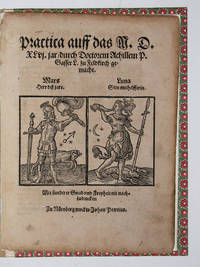
1545rif. 40844to. 20.5 x 15.4 cm 12 ff. With two title woodcuts of Mars and Luna. Patterned paper over boards with vellum spine; title-plaque on front cover; some expert reinforcement and minor repairs at gutter. Paper has even browning some faint waterstaining with marginal notations on one leaf. The sole known copy of a prediction pamphlet mein Almanac Gasser calls it f12 recto for the year 1546 with the first extended reference to Copernicus printed in a vernacular language German -- an "enthusiastic hymn of praise" for the great astronomer Burmeister addressed not specifically to an international community of scholars but to lay readers of a humble German language almanac whose daily activities "revolve" around the sun. Gasser further acknowledges here heliocentrism as a "hypothesis… demonstratively proven among mathematicians" i.e. a physical fact – a stance virtually unique among astronomers who were generally cautious with their approbations of Copernicus' calculations and methodology in the early years on the road towards its gradual positive reception. Achilles Gasser was intimately connected with the dissemination of heliocentrism through his patronage of Georg Rheticus Copernicus' student who initiated and oversaw the 1543 publication of De Revolutionibus. Gasser was one of very few recipients of the Narratio Prima intended to drum up support for Copernicus' work and wrote the preface to the 1541 edition of it. Gasser also owned a copy of De RevolutionibusGingerich I.99 printed by Johann Petreiuswho not coincidentally also published the present pamphlet. Alongside Rheticus' Narratio Prima of 1540 and Gasser's preface to the second edition of that work in 1541 the Practica offered here represents one of the very earliest published expressions of support for Copernican heliocentrism in any language. The extended reference to Copernicus appears in Gasser's dedicatory letter to Caspar Joachim Täntzl a Tyrolean nobleman and mine owner. Gasser takes pains to heap praise upon the most learned and wonderful man Dr. Nicolaus Copernicus who away off in Prussia has taken up the task with such seriousness diligence and steadfastness that for the establishment and restoration of astronomy he has had to lay an utterly and completely new foundation unheard of before or rather has been compelled to posit hypotheses not employed by other scholars…namely that the Sun is a light for all creation and stands unmoved in the midst of the whole universe; that this earthly realm… variously courses round between the planets Venus and Mars. and thus has not only demonstratively proven his theory among the mathematicians and with great pains restored the portrait of Astronomy but has also immediately been regarded as having perpetrated a heresy and indeed—by many others incapable of understanding this matter—is already being condemned see the complete Danielson translation of the epistle below. Numerous scholars penned prediction tracts or almanacs in this era including another Petreius author Johannes Schöner; Gasser wrote one for each year from 1544 and 1547. He makes general predictions for the luckiest days of 1546 B4v—as well as specifics relevant for mine owners like Täntzl— for example the relative value of precious metals B3. Part farmer's almanac and part horoscope Gasser's predictions depend on the movement of celestial bodies. His investment in propagating the importance of heliocentrism in this seemingly modest tract should therefore come as no surprise. According to Dennis Danielson in the article cited below Gasser also penned on the same day and year a Latin version of the present almanac with a different dedicatory epistle addressed in this case to Rheticus in which he urges the acolyte of the great astronomer to continue his efforts to prove the truth of the Copernican hypothesis. He tells the younger scholar in a manner of speaking that his job isn't finished yet and to get on with it. Several printed copies of this Latin version exist in German institutions but none in America. Offered here a well-preserved unique copy of the earliest example of vernacular Copernican ephemera. This present sole known copy now recorded in VD16 as ZV 28055 with 'Martayan Lan New York' as the source was only 'discovered' in the late 1990s by the respected historian of science Karl Heinrich Burmeister through the late Zurich bookdealer Jörg Schäfer. TEXT OF EPISTLE folios 1v-2r To the noble and worthy Caspar Joachim Tantzl of Tratzberg etc. his most gracious and beloved master Achilles Pirmin Gasser of Lindau doctor of natural and medicinal arts extends his willing service and best regards. Noble worthy and gracious master Your Worthiness doubtless still remembers the disputation that you often engaged in with me not without exceeding amazement concerning astronomy while I was in your service in Schwatz last year and above all the conversation in which – with the help of a small book I had with me eventually to be printed – I expressed my desire for a large lodestone whereby the course of the Sun and also the disposition of the firmament which in the schools we call the Primum Mobile though we know not where of what it is would here on Earth be rendered calculable and thoroughly perceptible in such a way that no more defects so frequent until now should appear. Moreover as I then indicated to Your Worthiness the greatest masters of this art have continuously for seventeen hundred years found the movement of the stars and planets rather incongruous and imperfect according to their instruments and calculations indeed even according to their daily experience. For this reason one after the other they always kept on hoping to adjust improve and remedy this situation by means of clever contrivances and ingenious speculations as is evident in Hipparchus Ptolemy Al-Zarqali Al-Bitrui Cusanus Regiomantanus and finally Werner with each on correcting the other now inventing new spheres then discarding the old ones and thinking up something else and on and on with no end of cycles epicycles and theoricae – until now so recently in our own day also the most learned and wonderful man Dr. Nicolaus Copernicus away off in Prussia has taken up the task with such seriousness diligence and steadfastness that for the establishment and restoration of astronomy he has had to lay an utter and completely new foundation unheard of before or rather has been compelled to posit hypotheses not employed by other scholars namely that the Sun is a light for all creation and stands unmoved in the midst of the whole universe; that his earthly realm together with the other three elements and the circuit of the Moon variously courses round between the planets Venus and Mars; and also that the heavens beyond Saturn in which are seen the fixed stars all together stand fast and unmoved with no other spheres encompassing them etc. and thus has not only demonstratively proven his theory among the mathematicians and with great pains restored the portrait of Astronomy but has also immediately been regarded as having perpetrated a heresy and indeed – by many others incapable of understanding his matter – is already being condemned. Since now Your Worthiness has for the benefit of this art and sundry other things promised to extract and provide me with a large lodestone from your mine I have a good will to see progress in this matter and am moved to put these my Practica for the coming year 1546 into writing for as Your Worthiness has no meagre capacity in astrological predictions to make discriminations and record nature's signs – which however must be derived solely from the courses of the planets and their position or placement relative to the other stars – You may easily weigh how very necessary it is that he who can help advise and give impetus to such an undertaking should do so in order that it can actually be brought to fruition. So I hoped to in particular that I might in part accomplish this by means of a large lodestone. I would like therefore to ask Your Worthiness to execute the specificied transaction and to be gracious to accept this my published dedication in your honour for I remain ever willing whenever I may to demonstrate to Your Worthiness my love and service. May God in heaven be with us and likewise ever protect your noble and virtuous wife and dear children. Feldkirch Monday 27 July 1545. Burmeister "'Mit subtilen fündlein und sinnreichen speculierungen.'". Die 'Practica auff das M.D.XLvj. jar' des Achilles Pirmin Gasser im Umfeld zeitgenössischer Astrolgen" Montfort 55 2003; Danielson "Achilles Gasser and the Birth of Copernicanism" Journal for the History of Astronomy 35/2004 457-74. J. Petreius hardcover books
RENNES, chez la Veuve de Nicolas-Paul Vatar, 1790 - In-16 - couverture imitation tissu - 132 pages, y compris Table - Ex-libris Le Blohic - Propre intérieurement - Rare