[CHRONIQUE LATINE DE BERNE]Livre Rare Book

38 résultats
réf. 20772Paris, Librairie Renouard, 1891-1897. 3 vol. in-8, 293 pp. + 398 pp. + 340 pp., demi-chagrin bordeaux pour les deux premiers volumes et demi-maroquin rouge pour le troisième, dos à nerfs, armes du comte d'Antioche dorées en queue du dos, tranches mouchetées (reliures légèrement différentes, petites taches et rousseurs).
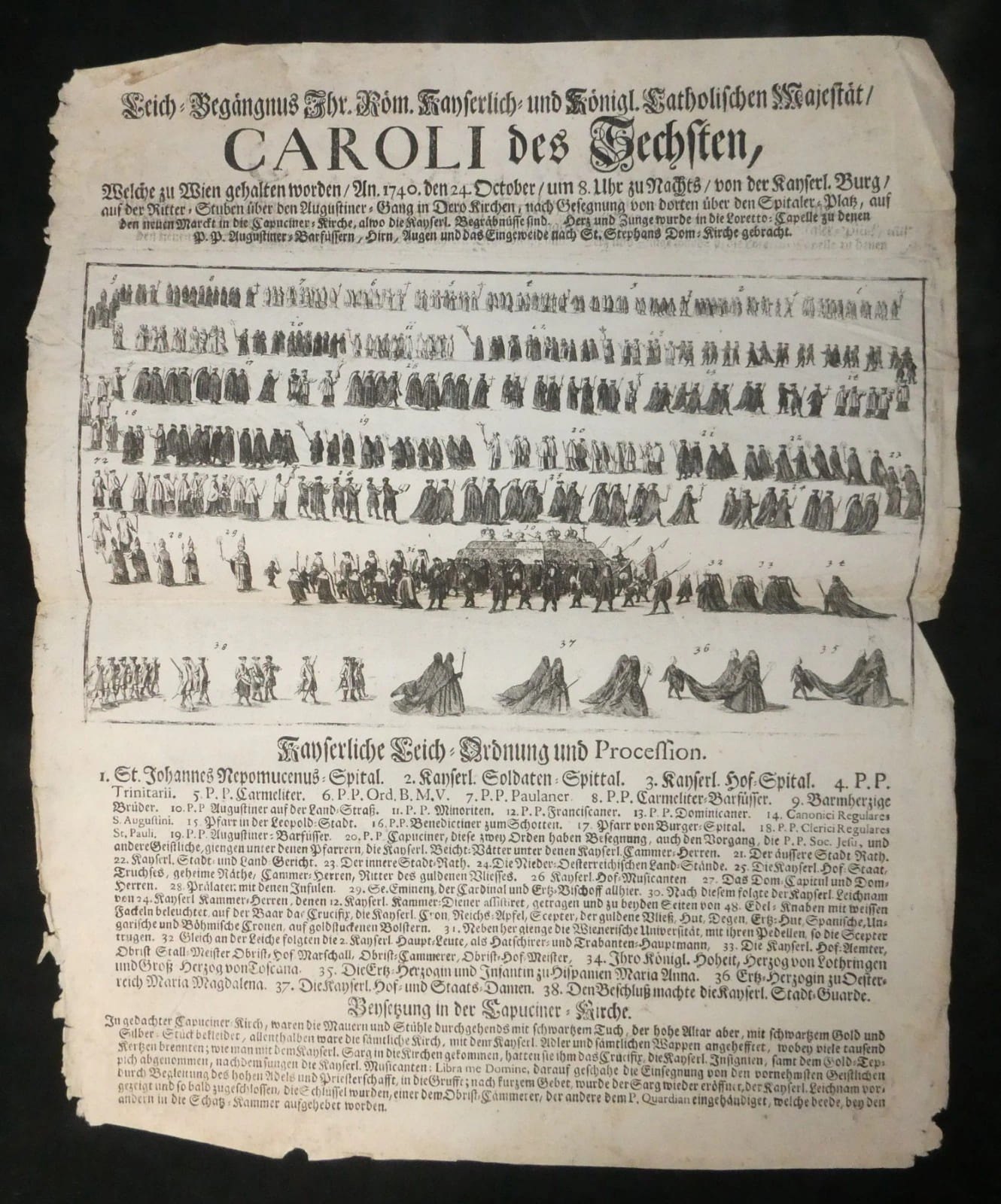
1740réf. boz_007057Placard imprimé - Funérailles de l'empereur Charles VI - Cortège funèbre - 1740 Grand placard imprimé en langue allemande relatant les funérailles de l'empereur Charles VI (1685-1740), Saint Empereur romain germanique, décédé à Vienne le 20 octobre 1740. Le placard est intitulé « Leich-Begängnus Ihr. Röm. Kayserlich- und Königl. Catholischen Majestät, Caroli des Sechsten » et décrit le cortège funèbre organisé le 24 octobre 1740 à 20 heures, de la Hofburg jusqu'à l'église des Capucins, où se trouve la crypte impériale, avec dépôt distinct du cœur à la chapelle de Lorette des Augustins-Déchaussés et des entrailles à la cathédrale Saint-Étienne. La feuille comporte une grande gravure représentant le cortège en plusieurs registres, où près de deux cents figures sont regroupées et numérotées de 1 à 38. Une légende imprimée sur deux colonnes identifie chaque numéro : établissements hospitaliers, ordres religieux, corps ecclésiastiques et municipaux, université de Vienne, grands officiers de la cour, membres de la famille impériale (dont la duchesse douairière et le grand-duc de Toscane, futur François Ier, ainsi que les archiduchesses Marie-Anne et Marie-Madeleine) et garde impériale fermant le cortège. Un dernier paragraphe décrit la cérémonie de mise au tombeau dans l'église des Capucins. Dimensions : 31,9 x 40 cm État : Bon état général. Petites déchirures avec manque, pli d'archivage, bords irréguliers, quelques brunissures. Voir photos pour plus de détails Nombre de pages : 1 page
1749réf. 25574A Amsterdam, par la Compagnie, 1749. 3 vol. au format in-12 (168 x 103 mm) de 2 ff. bl., 1 f. n.fol., xxxvi - 354 pp. et 2 ff. bl. ; 2 ff. bl., 1 f. n.fol., 424 pp. et 1 f. bl. ; 2 ff. bl., 254 pp. et 2 ff. bl. Reliures uniformes de l'époque de plein veau glacé et marbré havane, filet à froid encadrant les plats, dos à nerfs ornés de filets gras à froid, caissons d'encadrement dorés, filets en pointillés dorés, roulettes dorées, larges fleurons dorés, pièces de titre de maroquin vieux-rouge, pièces de tomaison de maroquin havane, titre doré, tomaison dorés, palette dorée en queue, roulette dorée sur les cupes, tranches rouges.
1741réf. 339750Vindobonae : Universitas 1741. 8 45pp. Folio. Later red cloth. 8 45pp. Folio. unknown
1741réf. 339750Vindobonae : Universitas 1741. 8 45pp. Folio. Later red cloth. 8 45pp. Folio. unknown books
réf. 5509Tot Brussel, by eugenius Henricus Fricx, 1723. 20,5 x 16 cm, 26 pp. Broché, cousu sous couverture de trois bandes de papier marbré conrecollées. Bel exemplaire. Rare.
réf. 5509Tot Brussel, by eugenius Henricus Fricx, 1723. 20,5 x 16 cm, 26 pp. Broché, cousu sous couverture de trois bandes de papier marbré conrecollées. Bel exemplaire. Rare.
1695Paris, chez Jean Baptiste Coignard, 1695. In-4 demi-basane blonde postérieure (début XIXe), dos lisse très orné de filets et entrelacs dorés, gardes de papier marbré. IV + 407 + 16 pages pour la table et le privilège. Beaux bandeaux et lettrines d'après MARIETTE. Petit manque de cuir à la coiffe, très bel état intérieur sans rousseurs ni taches. Exemplaire grand de marges. Edition originale.
1966réf. LFA-1267180154 volumes de 460, 534, 518 et 150 pages, format 165 x 250 mm, illustrés, brochés, publiés en 1966-1968, Editions Picard, bon état, peu courant
1617réf. D3698Berlin 16 April 1738. Hardcover. Very Good. Manuscript on vellum in German. 14 leaves 1 blank folio 350 x 243 mm. 17 lines written in a dark brown ink in an ornate gothic bookhand opening leaf with an elaborate penwork border the upper half with densely drawn scrollwork that interlocks with intermittent flower buds each additional leaf with a repeated penwork border of scrolling acanthus in free-form loops that create geometric patterns many in-text penwork flourishes. Fol. 13r signed "Carl" of Charles VI and signed by the scribe notary E. F. F. von Glandorff. In contemporary crimson velvet two holes in the hinges of the leaves where the cord and seal of Charles VI would have appeared slightly thumbsoiled some darkening to vellum; spine rubbed and velvet binding faded at edges. A fine example of German 18th-century penmanship by Von Glandorff. The three brothers von Bruhl were sons of Heinrich von Bruhl who had been ennobled the previous year and who became Minister of Saxony under King August. hardcover
1617réf. D3698Berlin 16 April 1738. Hardcover. Very Good. Manuscript on vellum in German. 14 leaves 1 blank folio 350 x 243 mm. 17 lines written in a dark brown ink in an ornate gothic bookhand opening leaf with an elaborate penwork border the upper half with densely drawn scrollwork that interlocks with intermittent flower buds each additional leaf with a repeated penwork border of scrolling acanthus in free-form loops that create geometric patterns many in-text penwork flourishes. Fol. 13r signed "Carl" of Charles VI and signed by the scribe notary E. F. F. von Glandorff. In contemporary crimson velvet two holes in the hinges of the leaves where the cord and seal of Charles VI would have appeared slightly thumbsoiled some darkening to vellum; spine rubbed and velvet binding faded at edges. A fine example of German 18th-century penmanship by Von Glandorff. The three brothers von Bruhl were sons of Heinrich von Bruhl who had been ennobled the previous year and who became Minister of Saxony under King August. hardcover books
1719réf. 4515Tall folio 44 x 27 cm Engraved frontispiece and 6 large folding plates by Helybrouck Berterham and Harrewyn after van Volxsom J. Colin and Eykens 32 pp. including title and first text leaf printed in red and black. Bound in 19th c vellum morocco title label on spine. Provenance: Victor Massena Prince of Essling 1836-1910; and the Paul and Marianne Gourary Collection "PMG" stamp on front pastedown. Minor toning but generally a tall and fresh copy with the plates in fine impression. First edition of a sumptuous festival book commemorating the inauguration of the Holy Roman Emperor Charles VI in 1717 as Count of Flanders featuring an allegorical frontispiece and six large folding plates including four engravings of the extravagant firework displays that followed the ceremony. The book provides a meticulous day-by-day account of the festivities including the cavalcade's departure from Brussels on the 16th of October and its arrival at Mont Blandin Abbey in Ghent the musical program of the Mass at St. Bavo's Cathedral and especially the opulent splendor of the inauguration on the afternoon of the 18th at the Marché du Vendredi Vrijdagmarkt Ghent's largest public square for which an enormous stage had been specially designed by the architect Jacob Colin. The inauguration engraving—nearly a full meter wide—is signed by Colin C. Eykens and the engraver J.B. Berterham who also executed the engraving of the interior of the Cathedral. A third plate depicts a rather grisly triumphal arch celebrating the expansion of the Austrian Empire with pikes bearing the severed heads of Turkish generals. The spacious Vrijdagmarkt with its central column and statue of HRE Charles V is also the backdrop for two of the three feu d'artifice plates. Curiously each of these engravings depicts the incendiary towers in two stages: not only during the detonation of their pyrotechnic fountains but also prior to their lighting when their thousands of canisters still hang intact and untouched. The most striking of these plates by Jacob Harrewijn depicts the towers at night looming over the Gothic façade of the Hôtel de Ville. Though Charles VI acceded as Count of Flanders in 1713 the protracted transfer of the province from the Spanish Habsburgs to the Austrian Habsburgs delayed festivities until 1717 at which point no expense was spared to celebrate the inauguration. Graet's fête book even proclaims Charles "Roy des Espanges" though that title had already been won in the War of the Spanish Succession by Philip V. Berlin 2959; Watanabe 2730; Landwehr Ceremonies 198; Lotz p. 104; Salatino Incendiary Art pp. 33-36. Augstin Graet hardcover
1719réf. 4515Tall folio 44 x 27 cm Engraved frontispiece and 6 large folding plates by Helybrouck Berterham and Harrewyn after van Volxsom J. Colin and Eykens 32 pp. including title and first text leaf printed in red and black. Bound in 19th c vellum morocco title label on spine. Provenance: Victor Massena Prince of Essling 1836-1910; and the Paul and Marianne Gourary Collection "PMG" stamp on front pastedown. Minor toning but generally a tall and fresh copy with the plates in fine impression. First edition of a sumptuous festival book commemorating the inauguration of the Holy Roman Emperor Charles VI in 1717 as Count of Flanders featuring an allegorical frontispiece and six large folding plates including four engravings of the extravagant firework displays that followed the ceremony. The book provides a meticulous day-by-day account of the festivities including the cavalcade's departure from Brussels on the 16th of October and its arrival at Mont Blandin Abbey in Ghent the musical program of the Mass at St. Bavo's Cathedral and especially the opulent splendor of the inauguration on the afternoon of the 18th at the Marché du Vendredi Vrijdagmarkt Ghent's largest public square for which an enormous stage had been specially designed by the architect Jacob Colin. The inauguration engraving—nearly a full meter wide—is signed by Colin C. Eykens and the engraver J.B. Berterham who also executed the engraving of the interior of the Cathedral. A third plate depicts a rather grisly triumphal arch celebrating the expansion of the Austrian Empire with pikes bearing the severed heads of Turkish generals. The spacious Vrijdagmarkt with its central column and statue of HRE Charles V is also the backdrop for two of the three feu d'artifice plates. Curiously each of these engravings depicts the incendiary towers in two stages: not only during the detonation of their pyrotechnic fountains but also prior to their lighting when their thousands of canisters still hang intact and untouched. The most striking of these plates by Jacob Harrewijn depicts the towers at night looming over the Gothic façade of the Hôtel de Ville. Though Charles VI acceded as Count of Flanders in 1713 the protracted transfer of the province from the Spanish Habsburgs to the Austrian Habsburgs delayed festivities until 1717 at which point no expense was spared to celebrate the inauguration. Graet's fête book even proclaims Charles "Roy des Espanges" though that title had already been won in the War of the Spanish Succession by Philip V. Berlin 2959; Watanabe 2730; Landwehr Ceremonies 198; Lotz p. 104; Salatino Incendiary Art pp. 33-36. Augstin Graet hardcover books