726 résultats
réf. 27777Paris de l'imprimerie de Vincent, Imprimeur-Libraire des Etats de Languedoc 1767 in 4 (26x19,5) 1 volume reliure plein veau fauve marbré de l'époque, dos à nerfs orné de caissons dorés (toute petite usure sur un caisson inférieur ), pièce de titre de maroquin rouge, tranches teintées rouge, 248 pages, et 1 faux-feuillet de privilège in fine, avec 120 blasons gravés par Nicolas Chalmandrier. Notre exemplaire est enrichi d'un feuillet inséré en regard de la page 136: Lettre manuscrite signée du Duc de Crussol, datée d'Argentan 1778. Bel exemplaire ( Photographies sur demande / We can send pictures of this book on simple request )
réf. 606740À Paris, de l'imprimerie Vincent, 1767. In-4, rel. de l'époque plein veau moucheté, dos lisse fleuri aux fers dorés, pièce de titre de maroquin rouge, double filet doré sur les coupes, tranches rouges ; 248 pp. [titre et avant-propos compris], [1]f. [privilège du roy]. Ex-libris ms ancien au titre. Edition originale. Bel ouvrage imprimé sur papier fort ; il est illustré de 130 gravures au burin, représentant de grands blasons, dont quelques-unes à plusieurs sujets.
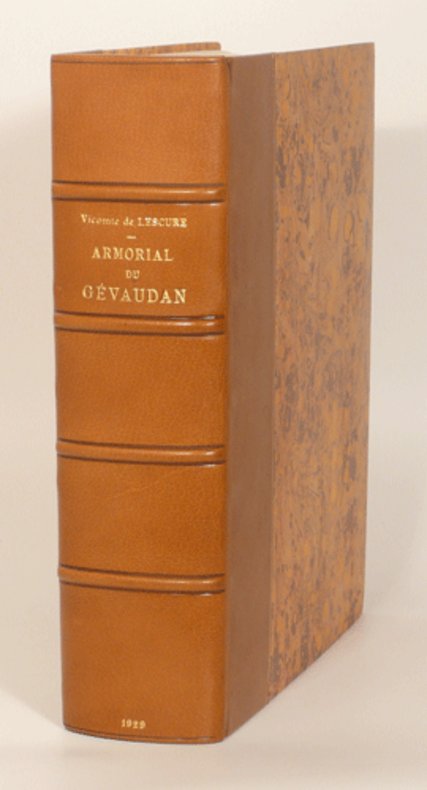
1929réf. 0020141929 Lyon, Badiou-Amant, 1929. Fort in-quarto (230 X 284 mm) demi-chagrin poli havane, dos cinq nerfs sertis de filets à froid, auteur et titre dorés, date en queue, plats et dos de la couverture conservés (reliure moderne) ; XXI, 953 pages, 20 planches in fine.
ROTTERDAM - 1775 - In-8 - 1/2 reliure, dos à 4 nerfs avec pièce de titre noire et titre doré - Plats et gardes marbrés - Armoiries de chaque famille - Table - 411 pages - Légères traces d'humidité en premières pages sinon propre
1865réf. 607420Paris, Firmin Didot, [1865-1883]. 1865 13 forts vol. in-4, reliure moderne pleine-toile bleu-gris, pièce de titre de cuir rouge, titre et tomaison dorés, couv. conservées (certaines restaurées). Fac-similé de l'édition originale de 1738-1768, complet du septième registre (1ere et 2e parties) publié par les Didot à cette occasion. Nous joignons, pour compléter cet exemplaire : le vol. de Table des 6 premiers registres par Fimin-Didot (1884), en rel. dimi-cuir fauve et le vol. de la Nouvelle Table Générale publiée par G. de Eynde, (Palais Royal, 1970) en cartonnage de l'éd. marron. Soit 15 volumes au total.
1902P., Champion, & Cahors, GIrma, 1902-1907. In-4 relié demi basane rouge (reliure des années 1920 environ), dos à nerfs orné de fleurons dorés, 2 ff;-281 pp-1 ff blanc- p. de t. [Planches]-XXXV planches-1 ff. blanc-pp. de t. [Supplément]-97 pp.-VI planches. Imprimé sur papier vergé épais pour le texte, et sur papier couché pour les planches de blasons. Tirage à à 175 exemplaires. exemplaire numéro 166 signé par l'auteur. Il s'agit de l'édition originale très rare et bien complète des planches de blasons réalisés d'après les dessins de l'auteur
réf. 233835Görlitz, C. A. Starke, 1875 2 tomes en 3 vol. in-folio, CLXVII pp. ; [2] ff. n. ch., 178 planches héraldiques en chromolithographie ; 158 planches héraldiques, demi-chagrin noir à coins, dos à larges faux-nerfs ornés de filets et guirlandes dorés, double filet doré sur les plats, têtes dorées (reliure de l'époque). Dos du vol. I se détachant, rousseurs, mouillures claires infra-paginales au vol. II.
réf. 50970Lefèvre.1922.In-4 de demi-chagrin maroquiné rouge à coins.2 parties.1/44 pages de texte avec table alphabétique.286 planches armoriées en couleurs.2/16 pages de texte.116 planches armoriées,numérotaion continue,avec les dernières sans numérotation.Ex-libris de Jacques de Blesson,ministre,ambassadeur.Couvertures conservées.Double gardes.Reliure XXème.Dos avec caractères et filets dorés.Peu de rousseurs.Beauté des armes.
réf. 50974London.1988.1991.2 vols.in-8 reliure bleue.Ills et 3 vols in-4,reliure bleue.Planches en noir.Très bon état.5 volumes brochés de supplément (sauf supplément Tome VI toilé beige) et Table du Supplément datés de 1933 à 1954.Bel ensemble. Rares annotations sans gène au crayon dans la Table de 1951. Bel et rare ensemble.
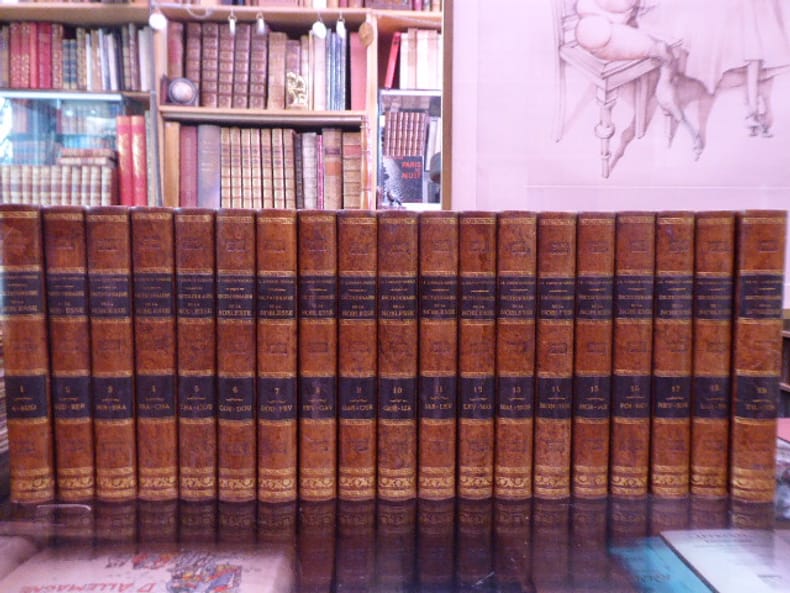
réf. 875994Schlesinger Paris 1863-76. 19 volumes in-4 ( 280 X 220 mn ) demi-basane fauve racinée, dos lisse orné de roulettes et palettes dorées et fleurons à froid avec pièces de titre et de tomaison de basane anthracite ( Reliure de lépoque ). Bel exemplaire bien relié de la meilleure édition de ce fameux ouvrage de référence, avec ex-libris héraldique WILMET-VALLIER dans chaque volume.
1779réf. 230747n.p. Bavaria 1779. 31 multi-colored coats-of-arm in red blue green black and gilt. 1 vols. 51 x 42.8 cm. Folded twice minor soiling otherwise fine and bright. 31 multi-colored coats-of-arm in red blue green black and gilt. 1 vols. 51 x 42.8 cm. The Morawitzky Family of Bavaria. Handsome and beautifully drawn genealogical tree of this noble Bavarian family whose members of have served for Bavarian Kings and Electors. Theodor Graf Topor von Morawitzky 1735 -1810 whose descent is given here had a disinguished career as a public servant and was the first President of the provincial government of Bavaria. unknown books
1779réf. 230747n.p. Bavaria 1779. 31 multi-colored coats-of-arm in red blue green black and gilt. 1 vols. 51 x 42.8 cm. Folded twice minor soiling otherwise fine and bright. 31 multi-colored coats-of-arm in red blue green black and gilt. 1 vols. 51 x 42.8 cm. Handsome and beautifully drawn genealogical tree of this noble Bavarian family whose members of have served for Bavarian Kings and Electors. Theodor Graf Topor von Morawitzky 1735 -1810 whose descent is given here had a disinguished career as a public servant and was the first President of the provincial government of Bavaria. unknown
réf. 607012Petit in-folio, reliure moderne demi-papier parcheminé à coins, dos lisse, pièce de titre de cuir rouge, blason doré en queue (de Jonghe d'Ardoye) ; 220 pp. réglées d'un filet rouge. Très belle copie, réalisée en 1958 par le vicomte Fernand de Jonghe d'Ardoye, célèbre héraldiste belge. L'écriture est fine et bien lisible, le texte est agrémenté de 86 blasons finement dessinés et peints à la main, armorial et table in-fine.
réf. 607014D'après le ms n°14935 de la Bibliothèque royale de Belgique et le n°100 du fonds Goethals. 1493 Petit in-folio, reliure XXe demi-papier parcheminé à coins, dos lisse, pièce de titre de cuir noir, blason doré couronné en queue et ex-libris armorié au contreplat (vicomte de Jonghe d'Ardoye) ; titre ms, [1]-60 feuillets, table des noms. Superbe copie manuscrite réalisée au début du XXe siècle ; elle reproduit finement les armoiries des 204 rois de la fête de l'Epinette (crée en 1283), qui furent élus successivement au sein des familles bourgeoises fortunées de la ville de Lille jusqu'en 1486. Chaque blason a été peint en couleurs.
réf. 112247aafRennes, Deniel, 1845-1848, in-folio, 535 p. (pagination continue) + 2101 blasons en 132 planches chromolithographiées, une feuille (page 16 bis/ter avec bords brunis) non reliée, mais présent, reliure en cuir originale. Titre or au dos, tranches dorées (rel. de l'époque). Quelques traces de frottements sur les plats, un coin légèrement dénudé, sinon très bel exemplaire imposant de cet ouvrage rare.
réf. 607016Petit in-folio, reliure du XXe demi-papier parcheminé à coins, dos lisse, pièce de titre de cuir noir, blason doré couronné en queue (vicomte de Jonghe d'Ardoye) ; 57 ff. (papier fort) réglés d'un filet rouge regroupant 388 blasons dessinés et peints à la main.
1957réf. 607017Copié et dessiné en 1957 par le vicomte Fernand de Jonghe d'Ardoye, d'après un manuscrit in-folio appartenant au Baron de Callataÿ. 1957 Petit in-folio, reliure moderne demi-papier parcheminé à coins, dos lisse, pièce de titre de cuir noir, blason doré couronné en queue (vicomte de Jonghe d'Ardoye) ; 284 pp. (les 60 premières réglées), illustré de 7 grandes armoiries à pleine page et 381 blasons dessinés et peints à la main.
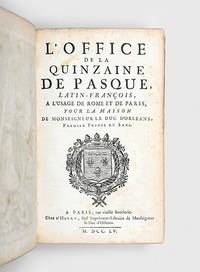
1755réf. 178721Paris: d'Houry seul imprimeur-libraire de monseigneur le Duc d'Orleans 1755. Royal Easter in Paris A beautiful copy of the Easter liturgy for the year 1755 printed and finely bound in Paris for the House of Orléans. The covers bear the arms of Louis-Philippe I 1725-1785 Duke of Orléans Valois and Montpensie premier prince du sang and grandfather of Louis-Philippe I the last king of France. Editions of the Easter liturgy were produced every year and printed by d'Houry the official printer to the duke of Orléans. Copies in fine bindings such as this bearing the arms of the current duke were destined for members of the family and court and to faithful subjects. The binding was very likely made by Jean-Charles-Henri LeMonnier le jeune who is documented as bookbinder to the duke of Orléans from 1759. The LeMonniers were one of the most famous families of bookbinders of the period. Henry le jeune son of Jean-Charles senior "lived with his father in the Rue Saint-Jean-de-Beauvais probably sharing his atelier and his tools and it is difficult to distinguish their work. The bindings for the duke of Orléans and his family are most probably the work of le jeune" Foot p. 199. Octavo 193 x 122 mm. Copper-engraved frontispiece. Contemporary red morocco spine with raised bands lettering in second compartment other compartments framed in gilt with floral corner pieces and armorial centrepieces covers bordered with gilt fillets and two fleur-de-lis rolls gilt armorial centrepieces of Louis Philippe I Duke of Orléans board edges and turn-ins tooled in gilt marbled endpapers edges gilt. Small printed illustration of a fly hand-coloured loosely inserted. Binding sometime skilfully polished a little wear to corners front inner hinge split but firm faint small damp stain to lower margin of a couple of gatherings. A handsomely bound copy. Mirjam M. Foot The Henry Davis Gift I 1978. Stamp: close to OHR 2572 no. 1; Guigard attributes it to Philippe-Égalité see p. 39. hardcover
1760réf. 115168Dijon, Jean-François Durand, graveur 1760 2 parties en 1 volume. In-folio 50 x 30,5 cm. Reliure de l’époque veau havane marbré, dos à nerfs encadrés de fers dorés, pièce de titre maroquin grenat, 1 faux-titre gravé, [1] f. de titre, 79-77 pp., 36 planches hors texte. Ouvrage d’une relative rareté. Coiffes arrachées, manque en pied de dos, coins sensiblement émoussés et frottés, frontispice effrangé en pied, mouillure angulaire en continu, intérieur frais.
réf. 46402309, in-4 (17 X 22 cm), reliés dans un cartonnage gris muet du XIXe siècle. Somptueux armorial original, portant 121 blasons finement DESSINÉS À LA PLUME ET COLORIÉS À L’AQUARELLE, illustrant la noblesse germanique, austro-hongroise, russe, suisse, italienne et française. Tous les blasons sont légendés avec une calligraphie particulièrement soignée.La grande quantité de blasons avec des figures d’animaux réels ou fantastiques font de cette suite un intéressant bestiaire d’aigles, griffons, lions, chevaux, cerfs, animaux monstrueux, cygnes, gorgones, oiseaux divers, singes, sangliers, licornes, ours, poissons, sirènes, phénix, bouc, agneaux, chiens. L’auteur de ce chef-d’oeuvre n’a pas signé. Cet armorial est sans doute inédit.
1992réf. LFA-1267105386 volumes de 456, 462, 499, 498, 731 et 175 pages, format 240 x 340 mm, reliés bleu avec blason de Savoie, réimpression (1992) des éditions de Grenoble (1863-1966), tirage limité à 350 exemplaires numérotés, bon état
1760réf. 260692Brünn: Johann Paul Krauss 1760. Engraved title in each volume vols. II-IV reading "Unser Lieben Frauen .". 189; 2 193-390; 2 393-590; 190 pp. 8vo. Contemporary Italian binding of full brown morocco covers gilt with two outer border rolls corner-pieces and arms of Prince-Bishopric of Trent spine gilt in six compartments a.e.g. Dutch gilt endpapers. Light wear to corners else fine. In original morocco pull-off case tooled in gilt to match lined with Dutch gilt paper. Some wear and splitting to edges of box. Engraved title in each volume vols. II-IV reading "Unser Lieben Frauen .". 189; 2 193-390; 2 393-590; 190 pp. 8vo. Italian Armorial Binding in Original Box. A beautiful Italian armorial binding of the mid 18th-century similar in style to those promoted by the Salvioni firm in the original pull-off case. OCLC locates only one copy of this scarce German breviary in the Bayerische Staatsbibliothek. Johann Paul Krauss unknown books
1760réf. 260692Brünn: Johann Paul Krauss 1760. Engraved title in each volume vols. II-IV reading "Unser Lieben Frauen .". 189; 2 193-390; 2 393-590; 190 pp. 8vo. Contemporary Italian binding of full brown morocco covers gilt with two outer border rolls corner-pieces and arms of Prince-Bishopric of Trent spine gilt in six compartments a.e.g. Dutch gilt endpapers. Light wear to corners else fine. In original morocco pull-off case tooled in gilt to match lined with Dutch gilt paper. Some wear and splitting to edges of box. Engraved title in each volume vols. II-IV reading "Unser Lieben Frauen .". 189; 2 193-390; 2 393-590; 190 pp. 8vo. A beautiful Italian armorial binding of the mid 18th-century similar in style to those promoted by the Salvioni firm in the original pull-off case. OCLC locates only one copy of this scarce German breviary in the Bayerische Staatsbibliothek. Johann Paul Krauss unknown
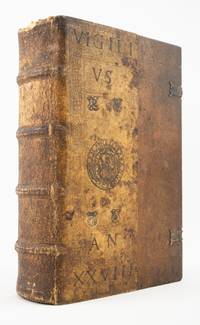
1527réf. ST20749Tübingen Cologne or Basel 1527-28. 315 x 205 mm. 12 1/2 x 8 1/4". 6 p.l. XXII leaves; CCXLII leaves; 12 p.l. 211 pp.; 14 110 1 leaves; 10 p.l. 3-77 leaves 1 leaf. EXCELLENT CONTEMPORARY HALF PIGSKIN over wooden boards UPPER COVER WITH "VIGILIUS" at top and the year "ANNO MDXXVIII" at the bottom AND WITH JOHAN HESS' SUPRALIBROS composed of his family coat of arms surrounded by the text "ARMA HESSICA ANNO 1525" this flanked by four smaller heraldic stamps rear covers with two Agnus Dei and one oval arabesque ink stamps raised bands spine panel diapered in blind each lozenge-shaped compartment with a small flower stamped at center Medieval manuscript scraps used as sewing guards visible at front and back two brass catchplates one pigskin strap and brass catch remnants of other strap. Each with woodcut printer's device; the first third fourth and fifth with attractive woodcut initials. Front pastedown with contemporary ink inscription listing the works included title page of first work WITH THE INK OWNERSHIP INSCRIPTION OF JOHAN HESS and later 18th century ink inscription; evidence of book label removal at foot of title page. The final two works with occasional contemporary ink underlining and marginalia. VD16 V 1185; VD16 B 3835 and Adams R-935; VD16 P 2459 and Adams P-1024; VD16 S 5250 and Adams S-855; VD16 B 5208. For the binding: EBDB m001169. Pigskin rather soiled lower cover with a handful of irregular holes in the pigskin but with blind-tooled decoration clearly visible in these openings front flyleaves and first half dozen quires of first work with a sprinkling of small round wormholes title page lightly soiled leaves faintly browned at edges first work with occasional minor browning due to paper quality text with isolated spots of foxing or trivial marginal stains but still quite an excellent contemporary copy the text clean and fresh the binding sturdy with considerable antique appeal. In its imposing original binding this is a famous Reformer's copy of five now-scarce theological works and a volume that ironically later belonged to a counter-Reformation mission. The most important Reformation figure after Martin Luther and Philip Melanchthon Johan also Johann Hess 1490-1547 was educated in Leipzig and Wittenberg where he was initially exposed to Luther's preaching. After several years serving as secretary to the bishop of Breslau now Wroc aw he traveled to Italy to complete his studies in theology and was ordained a priest upon his return to Breslau in 1520. His misgivings about the Church had increased in the years leading up to his ordination and he publicly voiced his support for the Reformation in a 1523 sermon in Nuremburg. He became the first Protestant pastor elected in Breslau and played a major role in the spread of the Reformation within the region. He participated in the major theological debates of the day taking part in the Diet of Regensburg the final attempt at reconciliation between the Reformers and the Catholic Church within the Holy Roman Empire. The present volume's selection demonstrates the range of his theological interests: its five works while all published in a one-year period span 1000 years of biblical scholarship and a variety of topics. The first is the original printing of the 5th century theologian Vigilius of Thapsus' condemnation of Eutyches whose beliefs about Christ's blended divine and human nature had been deemed heretical. This is followed by the 12th century Benedictine abbot Rupert of Deutz's discussion of the minor prophets a rare imprint USTC finds only one copy in a U. S. institution. The third work is a commentary on the Book of Job by Phillipus Presbyter an otherwise little-known disciple of St. Jerome. This was the only printing of this work under the author's own name the only other 16th century edition being credited to the Venerable Bede. This edition provides the text as taken from a now-lost manuscript at Fulda Abbey. The fourth included work is 9th century Irish monk Sedulius Scotus' scriptural commentary on Paul's letters. This and the previous work were printed by the Officina Petri the oldest extant Basel publishing house. The fifth and final text is by a contemporary of Hess the French humanist Jacques Lefèvre d’Étaples ca.1455 - ca. 1536. While Lefèvre remained committed to reform within rather than separation from the Roman Church his ideas and writings greatly influenced the Reformers. The present work is the first edition of his commentaries on the New Testament epistles published by major Basel printer Andreas Cratander. Ironically nearly two centuries after Hess' death this volume was owned by a group working precisely counter to his own goals and ideals. The 1739 inscription indicates that the copy was the property of the Franciscan mission in Dessau which was founded in 1719 to convert the now largely Protestant population back to Catholicism. Since Hess was the leading Protestant pastor in Breslau in Silesia from the time our five works were issued until he died two decades later the present binding was very probably done in a nearby Silesian workshop. Other Hess volumes appearing on the market over the years have mostly been unremarkable octavos so the present thick folio with its distinctive forceful decoration and titling stands out as unusually impressive. unknown