732 resultados
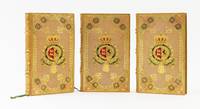
1825ref. ST17589Paris: L. Daubry 1825. First French Edition text in English. 170 x 103 mm. 6 3/4 x 4". Three volumes. REGAL CONTEMPORARY BEIGE MOROCCO GILT AND INLAID covers with gilt frame and inlaid cornerpieces of pink and burgundy morocco in floral designs ARMS OF WILLIAM DUKE OF BRUNSWICK at center inlaid in red and green morocco and lavishly gilt raised bands spine panels with graceful design of flowers and acanthus leaves gilt lettering gilt-ruled turn-ins all edges gilt. Front pastedowns with bookplate of Wilhelm Herzog zu Braunschweig printed in colors and embossed with gilt; title pages with ink stamp "Prinz von Braunschweig." ◆Spines darkened to tan head panels with traces of brown residue possibly from library labels boards faintly soiled at edges but A FINE SET with no signs of use inside or out. This is an exceptionally fine copy with distinguished provenance of the first Paris printing of a nautical adventure by a great American writer who enjoyed unusual popularity in France. Set during the American Revolution and first printed in 1823 "The Pilot" has for its protagonist a real-life American naval hero John Paul Jones. Cooper 1789-1851 had himself worked as a commercial seaman and served in the U.S. Navy and his firsthand knowledge of both the technical aspects of seamanship and the day-to-day realities of life at sea lend a ring of authenticity to his sea novels of which this was the first. According to Encyclopedia Americana "Cooper may be said in 'The Pilot' to have created a new literary type the tale of adventure on the sea . . . . Smollett had already discovered the racy humors of seamen but he had seen little else in their calling; it remained for Cooper to capture for fiction the mystery and beauty the shock and thrill of the sea which in his pages has much of the proud pomp of Byron's ocean." Cooper spent the years 1826-28 in Paris where his literary reputation gained him access to the best salons and where he became a close friend of the marquis de Lafayette. Given the ornate decoration and the quality of materials and execution this binding was very likely done by a Parisian workshop as a commission for Duke William of Brunswick-Lüneburg 1806-84 the last member of his family to rule the duchy of Brunswick. Although he was the ruler of the Duchy of Brunswick for more than 50 years he preferred to spend his time enjoying the life of an aristocrat and left most of the official business to his ministers. He also failed to produce a legitimate heir though he had a number of illegitimate children and ended the House of Brunswick's rule over the duchy. L. Daubry unknown
1825ref. ST17589Paris: L. Daubry 1825. First French Edition text in English. 170 x 103 mm. 6 3/4 x 4". Three volumes. REGAL CONTEMPORARY BEIGE MOROCCO GILT AND INLAID covers with gilt frame and inlaid cornerpieces of pink and burgundy morocco in floral designs ARMS OF WILLIAM DUKE OF BRUNSWICK at center inlaid in red and green morocco and lavishly gilt raised bands spine panels with graceful design of flowers and acanthus leaves gilt lettering gilt-ruled turn-ins all edges gilt. Front pastedowns with bookplate of Wilhelm Herzog zu Braunschweig printed in colors and embossed with gilt; title pages with ink stamp "Prinz von Braunschweig." ◆Spines darkened to tan head panels with traces of brown residue possibly from library labels boards faintly soiled at edges but A FINE SET with no signs of use inside or out. This is an exceptionally fine copy with distinguished provenance of the first Paris printing of a nautical adventure by a great American writer who enjoyed unusual popularity in France. Set during the American Revolution and first printed in 1823 "The Pilot" has for its protagonist a real-life American naval hero John Paul Jones. Cooper 1789-1851 had himself worked as a commercial seaman and served in the U.S. Navy and his firsthand knowledge of both the technical aspects of seamanship and the day-to-day realities of life at sea lend a ring of authenticity to his sea novels of which this was the first. According to Encyclopedia Americana "Cooper may be said in 'The Pilot' to have created a new literary type the tale of adventure on the sea . . . . Smollett had already discovered the racy humors of seamen but he had seen little else in their calling; it remained for Cooper to capture for fiction the mystery and beauty the shock and thrill of the sea which in his pages has much of the proud pomp of Byron's ocean." Cooper spent the years 1826-28 in Paris where his literary reputation gained him access to the best salons and where he became a close friend of the marquis de Lafayette. Given the ornate decoration and the quality of materials and execution this binding was very likely done by a Parisian workshop as a commission for Duke William of Brunswick-Lüneburg 1806-84 the last member of his family to rule the duchy of Brunswick. Although he was the ruler of the Duchy of Brunswick for more than 50 years he preferred to spend his time enjoying the life of an aristocrat and left most of the official business to his ministers. He also failed to produce a legitimate heir though he had a number of illegitimate children and ended the House of Brunswick's rule over the duchy. L. Daubry unknown books
1760ref. 260692Brünn: Johann Paul Krauss 1760. Engraved title in each volume vols. II-IV reading "Unser Lieben Frauen .". 189; 2 193-390; 2 393-590; 190 pp. 8vo. Contemporary Italian binding of full brown morocco covers gilt with two outer border rolls corner-pieces and arms of Prince-Bishopric of Trent spine gilt in six compartments a.e.g. Dutch gilt endpapers. Light wear to corners else fine. In original morocco pull-off case tooled in gilt to match lined with Dutch gilt paper. Some wear and splitting to edges of box. Engraved title in each volume vols. II-IV reading "Unser Lieben Frauen .". 189; 2 193-390; 2 393-590; 190 pp. 8vo. A beautiful Italian armorial binding of the mid 18th-century similar in style to those promoted by the Salvioni firm in the original pull-off case. OCLC locates only one copy of this scarce German breviary in the Bayerische Staatsbibliothek. Johann Paul Krauss unknown
1760ref. 260692Brünn: Johann Paul Krauss 1760. Engraved title in each volume vols. II-IV reading "Unser Lieben Frauen .". 189; 2 193-390; 2 393-590; 190 pp. 8vo. Contemporary Italian binding of full brown morocco covers gilt with two outer border rolls corner-pieces and arms of Prince-Bishopric of Trent spine gilt in six compartments a.e.g. Dutch gilt endpapers. Light wear to corners else fine. In original morocco pull-off case tooled in gilt to match lined with Dutch gilt paper. Some wear and splitting to edges of box. Engraved title in each volume vols. II-IV reading "Unser Lieben Frauen .". 189; 2 193-390; 2 393-590; 190 pp. 8vo. A beautiful Italian armorial binding of the mid 18th-century similar in style to those promoted by the Salvioni firm in the original pull-off case. OCLC locates only one copy of this scarce German breviary in the Bayerische Staatsbibliothek. Johann Paul Krauss unknown books
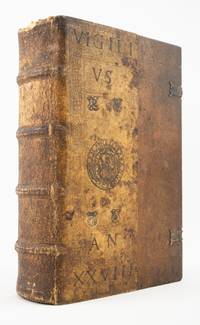
1527ref. ST20749Tübingen Cologne or Basel 1527-28. 315 x 205 mm. 12 1/2 x 8 1/4". 6 p.l. XXII leaves; CCXLII leaves; 12 p.l. 211 pp.; 14 110 1 leaves; 10 p.l. 3-77 leaves 1 leaf. EXCELLENT CONTEMPORARY HALF PIGSKIN over wooden boards UPPER COVER WITH "VIGILIUS" at top and the year "ANNO MDXXVIII" at the bottom AND WITH JOHAN HESS' SUPRALIBROS composed of his family coat of arms surrounded by the text "ARMA HESSICA ANNO 1525" this flanked by four smaller heraldic stamps rear covers with two Agnus Dei and one oval arabesque ink stamps raised bands spine panel diapered in blind each lozenge-shaped compartment with a small flower stamped at center Medieval manuscript scraps used as sewing guards visible at front and back two brass catchplates one pigskin strap and brass catch remnants of other strap. Each with woodcut printer's device; the first third fourth and fifth with attractive woodcut initials. Front pastedown with contemporary ink inscription listing the works included title page of first work WITH THE INK OWNERSHIP INSCRIPTION OF JOHAN HESS and later 18th century ink inscription; evidence of book label removal at foot of title page. The final two works with occasional contemporary ink underlining and marginalia. VD16 V 1185; VD16 B 3835 and Adams R-935; VD16 P 2459 and Adams P-1024; VD16 S 5250 and Adams S-855; VD16 B 5208. For the binding: EBDB m001169. Pigskin rather soiled lower cover with a handful of irregular holes in the pigskin but with blind-tooled decoration clearly visible in these openings front flyleaves and first half dozen quires of first work with a sprinkling of small round wormholes title page lightly soiled leaves faintly browned at edges first work with occasional minor browning due to paper quality text with isolated spots of foxing or trivial marginal stains but still quite an excellent contemporary copy the text clean and fresh the binding sturdy with considerable antique appeal. In its imposing original binding this is a famous Reformer's copy of five now-scarce theological works and a volume that ironically later belonged to a counter-Reformation mission. The most important Reformation figure after Martin Luther and Philip Melanchthon Johan also Johann Hess 1490-1547 was educated in Leipzig and Wittenberg where he was initially exposed to Luther's preaching. After several years serving as secretary to the bishop of Breslau now Wroc aw he traveled to Italy to complete his studies in theology and was ordained a priest upon his return to Breslau in 1520. His misgivings about the Church had increased in the years leading up to his ordination and he publicly voiced his support for the Reformation in a 1523 sermon in Nuremburg. He became the first Protestant pastor elected in Breslau and played a major role in the spread of the Reformation within the region. He participated in the major theological debates of the day taking part in the Diet of Regensburg the final attempt at reconciliation between the Reformers and the Catholic Church within the Holy Roman Empire. The present volume's selection demonstrates the range of his theological interests: its five works while all published in a one-year period span 1000 years of biblical scholarship and a variety of topics. The first is the original printing of the 5th century theologian Vigilius of Thapsus' condemnation of Eutyches whose beliefs about Christ's blended divine and human nature had been deemed heretical. This is followed by the 12th century Benedictine abbot Rupert of Deutz's discussion of the minor prophets a rare imprint USTC finds only one copy in a U. S. institution. The third work is a commentary on the Book of Job by Phillipus Presbyter an otherwise little-known disciple of St. Jerome. This was the only printing of this work under the author's own name the only other 16th century edition being credited to the Venerable Bede. This edition provides the text as taken from a now-lost manuscript at Fulda Abbey. The fourth included work is 9th century Irish monk Sedulius Scotus' scriptural commentary on Paul's letters. This and the previous work were printed by the Officina Petri the oldest extant Basel publishing house. The fifth and final text is by a contemporary of Hess the French humanist Jacques Lefèvre d’Étaples ca.1455 - ca. 1536. While Lefèvre remained committed to reform within rather than separation from the Roman Church his ideas and writings greatly influenced the Reformers. The present work is the first edition of his commentaries on the New Testament epistles published by major Basel printer Andreas Cratander. Ironically nearly two centuries after Hess' death this volume was owned by a group working precisely counter to his own goals and ideals. The 1739 inscription indicates that the copy was the property of the Franciscan mission in Dessau which was founded in 1719 to convert the now largely Protestant population back to Catholicism. Since Hess was the leading Protestant pastor in Breslau in Silesia from the time our five works were issued until he died two decades later the present binding was very probably done in a nearby Silesian workshop. Other Hess volumes appearing on the market over the years have mostly been unremarkable octavos so the present thick folio with its distinctive forceful decoration and titling stands out as unusually impressive. unknown
1527ref. ST20749Tübingen Cologne or Basel 1527-28. 315 x 205 mm. 12 1/2 x 8 1/4". 6 p.l. XXII leaves; CCXLII leaves; 12 p.l. 211 pp.; 14 110 1 leaves; 10 p.l. 3-77 leaves 1 leaf. EXCELLENT CONTEMPORARY HALF PIGSKIN over wooden boards UPPER COVER WITH "VIGILIUS" at top and the year "ANNO MDXXVIII" at the bottom AND WITH JOHAN HESS' SUPRALIBROS composed of his family coat of arms surrounded by the text "ARMA HESSICA ANNO 1525" this flanked by four smaller heraldic stamps rear covers with two Agnus Dei and one oval arabesque ink stamps raised bands spine panel diapered in blind each lozenge-shaped compartment with a small flower stamped at center Medieval manuscript scraps used as sewing guards visible at front and back two brass catchplates one pigskin strap and brass catch remnants of other strap. Each with woodcut printer's device; the first third fourth and fifth with attractive woodcut initials. Front pastedown with contemporary ink inscription listing the works included title page of first work WITH THE INK OWNERSHIP INSCRIPTION OF JOHAN HESS and later 18th century ink inscription; evidence of book label removal at foot of title page. The final two works with occasional contemporary ink underlining and marginalia. VD16 V 1185; VD16 B 3835 and Adams R-935; VD16 P 2459 and Adams P-1024; VD16 S 5250 and Adams S-855; VD16 B 5208. For the binding: EBDB m001169. Pigskin rather soiled lower cover with a handful of irregular holes in the pigskin but with blind-tooled decoration clearly visible in these openings front flyleaves and first half dozen quires of first work with a sprinkling of small round wormholes title page lightly soiled leaves faintly browned at edges first work with occasional minor browning due to paper quality text with isolated spots of foxing or trivial marginal stains but still quite an excellent contemporary copy the text clean and fresh the binding sturdy with considerable antique appeal. In its imposing original binding this is a famous Reformer's copy of five now-scarce theological works and a volume that ironically later belonged to a counter-Reformation mission. The most important Reformation figure after Martin Luther and Philip Melanchthon Johan also Johann Hess 1490-1547 was educated in Leipzig and Wittenberg where he was initially exposed to Luther's preaching. After several years serving as secretary to the bishop of Breslau now Wroc aw he traveled to Italy to complete his studies in theology and was ordained a priest upon his return to Breslau in 1520. His misgivings about the Church had increased in the years leading up to his ordination and he publicly voiced his support for the Reformation in a 1523 sermon in Nuremburg. He became the first Protestant pastor elected in Breslau and played a major role in the spread of the Reformation within the region. He participated in the major theological debates of the day taking part in the Diet of Regensburg the final attempt at reconciliation between the Reformers and the Catholic Church within the Holy Roman Empire. The present volume's selection demonstrates the range of his theological interests: its five works while all published in a one-year period span 1000 years of biblical scholarship and a variety of topics. The first is the original printing of the 5th century theologian Vigilius of Thapsus' condemnation of Eutyches whose beliefs about Christ's blended divine and human nature had been deemed heretical. This is followed by the 12th century Benedictine abbot Rupert of Deutz's discussion of the minor prophets a rare imprint USTC finds only one copy in a U. S. institution. The third work is a commentary on the Book of Job by Phillipus Presbyter an otherwise little-known disciple of St. Jerome. This was the only printing of this work under the author's own name the only other 16th century edition being credited to the Venerable Bede. This edition provides the text as taken from a now-lost manuscript at Fulda Abbey. The fourth included work is 9th century Irish monk Sedulius Scotus' scriptural commentary on Paul's letters. This and the previous work were printed by the Officina Petri the oldest extant Basel publishing house. The fifth and final text is by a contemporary of Hess the French humanist Jacques Lefèvre d’Étaples ca.1455 - ca. 1536. While Lefèvre remained committed to reform within rather than separation from the Roman Church his ideas and writings greatly influenced the Reformers. The present work is the first edition of his commentaries on the New Testament epistles published by major Basel printer Andreas Cratander. Ironically nearly two centuries after Hess' death this volume was owned by a group working precisely counter to his own goals and ideals. The 1739 inscription indicates that the copy was the property of the Franciscan mission in Dessau which was founded in 1719 to convert the now largely Protestant population back to Catholicism. Since Hess was the leading Protestant pastor in Breslau in Silesia from the time our five works were issued until he died two decades later the present binding was very probably done in a nearby Silesian workshop. Other Hess volumes appearing on the market over the years have mostly been unremarkable octavos so the present thick folio with its distinctive forceful decoration and titling stands out as unusually impressive. unknown books
ref. 17540(vers 1500).