669 risultati
1975rif. 2412050448xbvkHoniara, British Solomon Islands Protectorate, printed by the Government Printer, 1971-1975. Detailed collation: I. Annual titlepage, v pages 'Index', 224 pages (Issue #1-#4 individually paginated [16 p. in total], Issue 5 starts with p. 17, then onwards to p. 224). / II. Annual titlepage, xiii pages 'Index', 245 pages. / III. Annual titlepage, xi pages 'Index', 200 pages. / IV. Annual titlepage, x pages 'Index', 245 pages. / V. Annual titlepage, xi pages 'Index', 196 pages. - 'Publisher's' titled greyblue halfcloth bindings with yellow thick cardboard-panels; 8vo.(ca. 20,5 x 14 x 9 cm; ca. 2,5 kg.).
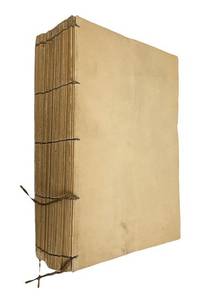
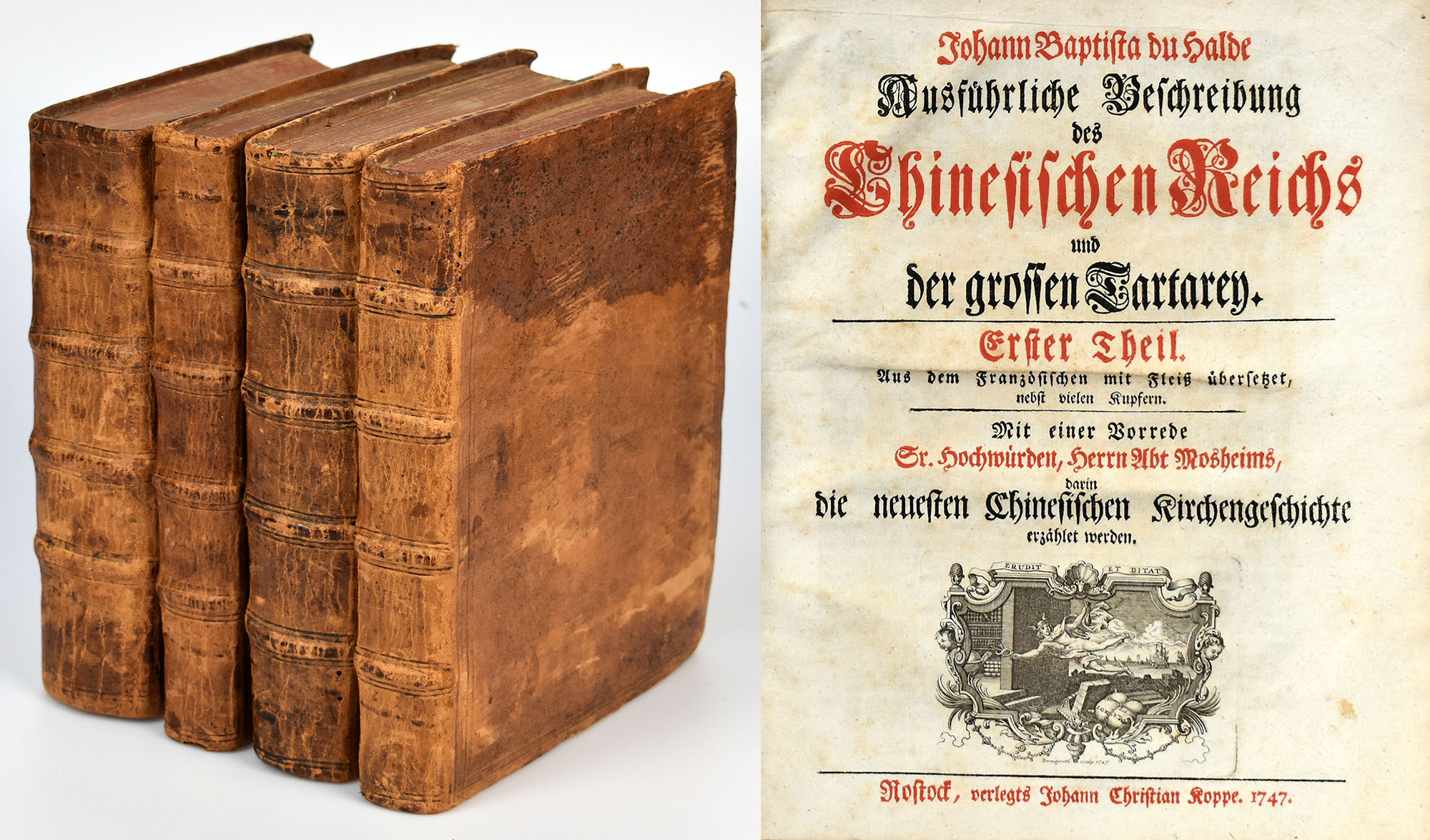
1747rif. 3878FBRostock, Verlag Christian Koppe, 1747-1749. 4°. 26,5 x 21,5 cm. [1] Blatt, 58, 472 Seiten; [1] Blatt, 56, 748; 28 Seiten, [2] Blatt, 548; 56, 264, 552 Seiten, [16] Blatt. Ganzlederbände der Zeit auf 4 Zierbünden mit Streicheisenlinien auf den Deckeln und rotem Sprengschnitt. [12 Warenabbildungen]
1920rif. 88696Berlin, Missionsverein, 1913-1920. 20 cm. OHLn.
rif. 93592o.J. VII,161 TyposkriptS. (= Adventistica; Band 4). 21 cm. OBroschur.
1874rif. 66003CBLondon und Newcastle-on-Tyne, Adam & Co., [1874]. 4°. 32 x 26 cm. VIII, 632 Seiten. Original-Ganzlederband mit reich goldgeprägtem Deckel- und Rückentitel, Deckelillustrationen, Rundum-Goldschnitt, ornamental dekorierter Messingumrandung und 2 intakten Messingschließen. [8 Warenabbildungen]
1925rif. 75400Gütersloh, C. Bertelsmann, [1925]. 53 S. Mit 1 farb. Frontispiz u. 2 s/w. Fototaf. (21,5 x 16,5 cm). OLn.
1862rif. 23589Basel, Verlag des Missions-Comptoirs, 1862. IV, 552 S. Mit 11 Holzstich-Taf. , 1 farb. lith. Taf. u. 2 Ktn.-Skizzen im Text. 22 cm. Bibl.-Pp. mit Kleisterpapierbezug u. hs. Rückenschild.
1845rif. 79470Berlin, Friedrich Schantze, 1845. VIII, 227 S. Mit 1 gestochenen, gefalt. Kte. (20 x 12 cm). HLn. d. Zt.
1988rif. 8376EBChicago, Loyola University Press, 1988. Groß-8°. 23,5 x 16 cm. xxxiii, 332 Seiten. Original-Pappband mit Original-Schutzumschlag.
1988rif. 8377EBChicago, Loyola University Press, 1988. Groß-8°. 23,5 x 16 cm. xxxiii, 332 Seiten. Original-Pappband mit Original-Schutzumschlag.
1905rif. 8180EBGroßlichterfelde-West, Deutsche Orient Mission E.V., 1905. 8°. 22,5 x 15,5 cm. 136 Seiten, [6] zwischengebundene Blätter. Original-Leinenband mit goldgeprägtem Deckeltitel und Farbschnitt.
1949rif. 90908Hermannsburg, Selbstverlag des Herausgebers, 1949. 32 S. Mit 4 Abb. OKart. 21 cm.
1953rif. 90907Hermannsburg, Verlag der Missionshandlung, 1953. 39 S. Mit 2 Illustr.-Taf. 19 cm. OBrosch.
1871rif. 5815Nellore: March 17 1871. Very good. Broadside 8.25 x 5 inches. Old horizontal folds minor toning. An unrecorded broadside calling a meeting of the General Committee of the Jaffna Auxiliary Bible Society JABS at the Wesleyan Mission House in Jaffna in March 1871. The Jaffna Auxiliary Bible Society is an arm of the British & Foreign Bible Society focused on distributing Bibles and engaging in scriptural education within the Jaffna district of Sri Lanka. In the present broadside the secretary of the JABS Thomas Good writes from Nellore and lays out the business of the meeting in six line items. The meeting is meant to include Devotional Exercises a reading of the minutes from the last meeting "Brief Verbal Reports of Bible Work" sub-committee reports a reading of a paper by Rev. L. Spaulding on the "best method of doing Bible Work" and a discussion of said paper. Original materials held by institutions relating to the Jaffna Auxiliary Bible Society are almost exclusively either their printings of various Books of the Bible into Tamil or later annual reports. Ephemera from the society's work in Sri Lanka is almost nonexistent. March 17 unknown books
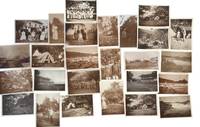
1912rif. 236551912. American Protestant mission photo archive depicting schools Western and African Christian workers in Portuguese Angola 1912 to 1914 recording the local life missionary presenceand infrastructure extending Western religious and educational authority. Dated inscriptions identify "missionaries and native workers" in 1912 and a "boys school" in 1914 while another photograph is captioned "At the Quanza" the historical English spelling of Angola's Kwanza River. Protestant missions had operated in Angola since the late nineteenth century establishing schools training African evangelists and teachers and creating networks that could compete with Portuguese colonial institutions for influence over language education and community allegiance. We believe the se are American Protestant missionaries because the language of the captions itself sounds North American. One phrase especially stands out: "Our force" That wording was commonly used by North American Protestant missionaries to describe their combined European and African staff. British missionaries more often wrote "our staff" "our workers" or "the mission staff." Likewise the informal captions "Hopefuls" "Sit down rest a while" resemble private North American missionary albums more than official British mission records. Photo archive of 27 photographs seven silver gelatin and and twenty laser-printed photographs all large format ranging from 7 x 5 to 7 x 4 inches Portuguese Angola circa 1912 to 1914. Formal portraits show European missionaries with Angolan personnel before stuccoed mission buildings including a large group captioned "Missionaries and native workers 1912" and a smaller portrait captioned "Our force 1912." School photographs depict boys girls and younger children arranged in rows with European instructors; one verso reads "Boys school 1914" while an individual portrait of two neatly dressed boys is titled "Hopefuls." Mission compounds include long veranda buildings fenced grounds thatched dwellings tents cooking equipment folding furniture and temporary encampments occupied by missionaries and local residents. Several photographs record travel and subsistence away from the station: missionaries pose beside rapids captioned "At the Quanza" rest in wooded country prepare meals outside canvas tents exchange food or supplies with African residents and occupy a mixed camp of tents and thatched structures. Other images show a fruiting orange grove men and women gathering fruit a landscape identified as "The lumbermen's camp" mission residents seated among dense vegetation river scenery village buildings and African children and adults photographed at schools settlements and work sites. Verso captions also include "Down for the night" and "Sit down rest a while" language that frames travel camp life and mission expansion through the photographer's informal record of daily activity. Portuguese rule in Angola remained uneven in the early twentieth century particularly beyond coastal administrative centers and mission stations often supplied education printing agricultural instruction medical care and religious training where the colonial state maintained little permanent infrastructure. Schools were central to this expansion. Literacy and teacher training enabled missionaries to circulate Christian texts while African instructors and evangelists carried teaching and worship into communities that European personnel could not reach directly. The photographs expose the racial hierarchy of this arrangement through clothing spatial placement and captioning: European missionaries are named collectively as the directing body while Angolan colleagues are reduced to categories such as "native workers" even when formal group portraits present them as teachers clergy assistants or institutional staff. Agricultural scenes the lumber camp mission residences school groups and mobile tent sites further demonstrate how evangelization depended upon land food production transport construction and locally recruited labor rather than preaching alone. Protestant educational networks later produced generations of Angolan teachers clergy writers and political organizers while Portuguese authorities repeatedly regarded independent mission schooling and African language literacy as potential challenges to colonial control. Light surface wear occasional creasing and fading scattered stains and adhesive or paper residue on several versos; captions remain legible. Overall in good condition. unknown books
1911rif. 95663n.p.: West African African Mission A. B. F. F. M. 1911. Good. 400 248p. Lacks cover we don't know whether this uncommon linguistic item was originally hard or soft cover. Outer leaves soiled. This 1911 edition appears to be much explanded from the first edition of 1885. The first part Umbundu-English is longer and more detailed than the second part English-Umbundu. This feature is explained or excused in the Preface: "Having as a basis the Engliush-Umbundu vocabulary which fairly enough gathers up the Umbundu-English each one can prepare for his own use a serviceable English-Umbundu vocabulary. The work of printing has been so exacting on all concerned that adding to correcting or classifying the Umbundu words in the second part could not be attempted." The Preface also warns that "The necessity of substituting ordinary c for c with cedilla in Portuguese words containing that letter is one among several infelicities occasioned by an inadequate supply of type which are much regretted." Umbundu is spoken by about a third of the inhabitants of Angola making it that country's most widely spoken indigenous language. West African African Mission, A. B. F. F. M. unknown books
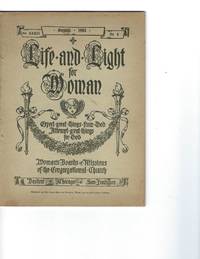
1903rif. 164381903. Woman's Board of Missions. Life and Light for Women 1903 an issue of the Congregational women's missionary periodical reporting on female-led educational medical and religious work in Africa and Asia. Published during the expansion of American Protestant women's missionary organizations the August issue includes accounts of medical work undertaken by Dr. Ruth Hume in India and developments at missionary schools in Africa and Asia. A frontispiece photograph depicting pupils at a missionary school in present-day Zimbabwe provides a contemporary visual record of African children receiving education through Congregational missionary institutions. Life and Light for Women. Vol. XXXIII No. 8. Boston: Woman's Board of Missions August 1903. First edition. Original printed paper wrappers staplebound. The frontispiece shows pupils at a missionary school in Zimbabwe then part of Southern Rhodesia accompanied by reports concerning the Board's international missionary activities. Among the subjects addressed are Dr. Ruth Hume's medical work in India and educational initiatives in Africa and Asia. The publication records the activities of American women missionaries working as teachers physicians and nurses including their efforts to establish schools and provide medical treatment in regions where prevailing social customs often restricted women's access to male religious instructors and medical practitioners. Founded in the nineteenth century the Woman's Board of Missions worked in association with the American Board of Commissioners for Foreign Missions supporting Protestant missionary activities abroad and organizing American women to finance and administer educational and medical programs. Life and Light for Women circulated accounts of these undertakings among Congregational supporters in the United States reporting on missionary personnel schools medical services and religious instruction. The August 1903 issue preserves contemporary reporting on women's participation in overseas missionary institutions with particular attention to African education and women's medical work in India. In very good condition. unknown books
1847rif. 90883New York: Snowden & Prall Printers 1847. 1st ed. Hardcover. Fair. 93p. Original marbled boards. 23cm. Lacks backstrip. Covers detached. Substantial foxing in large portions of book. DEFECTIVE -- one signature pages 57-64 present in duplicate while the next signature pages 65-72 is missing. Ex lib. Society for the Propagation of the Gospel in Foreign Parts Library. Snowden & Prall, Printers hardcover books
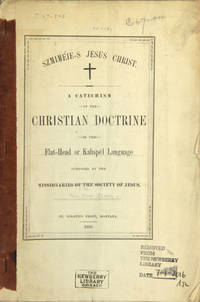
1880rif. 49586St. Ignatius Montana: St. Ignatius Print 1880. 8vo pp. 4 45 1; original paper wrapper perished reinforced in stiff brown library card; pages toned and worn at edges good. An Ayer Linguistics duplicate with release stamp on title page. "These works were put in type and printed by the Indian school boys at St. Ignatius. About 225 copies of each were printed." Pilling identifies the author as Giorda per his correspondence with a superintendent of the school Father Leopold Van Gorp. Pilling Salishan p. 28; Pilling Proof-sheets 1558; Schoenberg 7. St. Ignatius Print unknown books
1844rif. 84090Boston: Crocker and Brewster 1844. 1st ed. Paperback. Very Good. 7 5-44p. Disbound removed from a bound volume. No separate wrapper present. 23cm. Signed in type on page 30 by Goodell and six other missionaries. Crocker and Brewster paperback books
1892rif. List3029Indian Territory: N.p. 1892. Folio of eleven unbound sheets forty-four pages measuring approximately 6 x 8 inches. Marginal damage and fading to text; excellent. Amory Nelson Chamberlin 1821–1894 was born on Brainerd Mission in what is now Chattanooga Tennessee the son and grandson of missionaries. Fluent in both English and Cherokee Chamberlin worked as an interpreter and served under General Stand Watie in the Confederate States Army.1 After the war Chamberlin established the Pheasant Hill Mission near Vinita Indian Territory with Reverend Hamilton Balentine preaching in Cherokee and English.2 Offered here is a Cherokee-language version of the Shorter Catechism translated by Chamberlin. The Cherokee written language is a syllabary—a writing system in which symbols represent whole syllables—developed in the early 19th century by Sequoyah a Cherokee leader and inventor. It was one of the first writing systems for an Indigenous American language and significantly increased Cherokee literacy within a short time of its adoption in the 1820s.3 We find fifteen copies of Chamberlin’s catechism in OCLC. Of interest to historians of the Cherokee nation its language and its Christian missionaries. 1 Lon H. Eakes “Rev. Amory Nelson Chamberlin 1821–1894” Chronicles of Oklahoma 12 no. 1 1934: 97–102. 2 O.B. Campbell Vinita I.T.: The Story of a Frontier Town of the Cherokee Nation 1871–1907 The Oklahoma Publishing Co. 1909. 3 Willard Walker and James Sarbaugh “The Early History of the Cherokee Syllabary” Ethnohistory 40 no. 1 Winter 1993: 70–94. N.p. unknown books
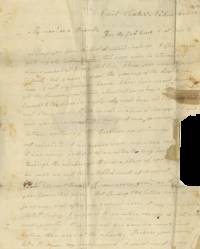
1820rif. List3735Elliott Mission Choctaw Nation 1820. Four pages bifolium 10 x 8 inches. Stampless cover bearing the scarce "Choctaw Agency May 25" manuscript marking and "Via Philadelphia" routing notation described in the original philatelic history sale as possibly "one of the earliest if not the earliest cover known from Choctaw Agency while still in Mississippi. Some losses at folds and areas of old reinforcement though the remaining text is extensive throughout. An early missionary letter from the Choctaw Nation written by Minerva Washburn 1788-1852 one of the first women attached to the American Board of Commissioners for Foreign Missions' Choctaw mission efforts shortly after her arrival at Elliott Mission in what was then the Mississippi frontier. Carried under what appears to be one of the earliest recorded "Choctaw Agency" manuscript postal markings known the letter was sent to her parents Jonah and Sarah Washburn of Randolph Vermont in the spring of 1820. Minerva Washburn entered the service of the American Board in 1819 and arrived at Elliott Mission in January 1820. She was the sister of the missionary Cephas Washburn and would later marry missionary James Orr becoming associated with the establishment of Dwight Mission in the Cherokee Nation. The identification of Washburn as the author is confirmed both by surviving missionary records and by the partially obscured signature beneath old reinforcement at the conclusion of the present letter. Datelined simply "Elliot Choctaw Nation April 29" the letter describes realities of life at one of the earliest Protestant mission stations among the Choctaw. Written only months after her arrival the letter preserves a firsthand account of missionary settlement in Choctaw territory during the earliest phase of organized evangelical expansion into the Southeast. She writes: "For the first time I sit down to address you from this land of moral darkness. I often interrogate myself isn't it a pity that 2000 miles lie between us I am compelled to say that it is. I know your anxiety for me is great. But I have to record the goodness of the Lord to me since I left my father's house. I have been carried through all the dangers and trials attendant on so long a journey & was brought to this place in safety. My wants have all been supplied and I have been blessed with friends in a land of strangers. I suppose you have learnt the process of our journey from letters written by the brethren and sisters and text missing due to paper loss not repeat it. I can assure you my dear parents paper loss it was very grateful to us after so long journey through the wilderness to find a place of rest for such we call this establishment at present. paper loss from Vermont . was very good as I paper loss you from that place. But during the latter part of my journey and after my arrival here it was in a declining state owing I suppose to an entire change of diet and employment. It is now and has been for some time better than when at the South. Perhaps you would like to know my employment. I spend most of my time in sewing. We generally have enough to employ two hands. I usually ride or walk out morning and exercising for the preservation of health accompanied with some of the other sisters. Our walks are very pleasant. The woods are beautiful. Instead of . brush as at the north they are covered with grass & flowers. I wish you could have a view of Elliot. Its local situation far exceeded my expectation. And I found more of the necessaries and even the comforts of life than I expected. We have a plenty of cornbread milk and meat and some butter coffee and tea and sugar and some flour and a boat is expected in a few days that will supply us with a quantity of flour cheese and dried apples. My dear parents you often mentioned to me the dangers and fears that would attend me when crossing rivers forests and swamps. But I can tell you my fears were dissipated and I felt calm and composed. I must write a few words about the brethren and sisters. Br. Kingsbury our pastor has the superintendence of the mission. Br. Williams the care of the school which consists of 63 scholars. Br. Jesel the care of the farm. Br. Fisk is the blacksmith. paper loss the sisters they are paper loss Kingbury's absence paper loss Kingsbury he is a paper loss both a friend and a sister to me and wishes to be remembered particularly to you.Her little son is a paper loss promising child. O how I long to hear from you. paper loss you not write me soon That I may know how paper loss prosper in your temporal and spiritual . I think of you daily and hourly. And were it in my power how happy should I be to alleviate your paper loss and cares. But I hope you cast your cares on paper loss who will be better to you than children or friends. I have a few hours notice of an opportunity of sending letters and can write but little at this time. I shall paper loss my dear brothers and sisters in one or two paper loss. Give my love to all my dear relatives. I paper loss love to write to them all. O my dear parents paper loss you supplicate the throne of grace do not forget your affectionate daughter Minpaper loss". The Washburn family was closely connected to the early evangelical and missionary culture of New England during the early decades of the nineteenth century. Minerva Washburn's brother Cephas Washburn became one of the better-known missionaries associated with the American Board's work among Indigenous nations in the Southeast while Minerva herself entered missionary service in 1819 before later assisting alongside her husband James Orr in the development of Dwight Mission in the Cherokee Nation. The present letter belongs to this first generation of Protestant missionary efforts carried into the Choctaw and Cherokee Nations. Overall an early and highly personal missionary letter documenting evangelical expansion women's labor family separation and daily life in the Choctaw Nation during the opening years of organized American mission activity. unknown books
rif. 4337CHRISTIAN MISSIONARIES IN INDIA. An archive of three letters from Christian missionies in India to E.E. Pelz of Seattle Washington:TLS. 1pg. 8 x 11. March 5 1902. Allahabad India. A typed letter signed Rockwell Clancy to E.E. Pelz: I have been transferred from the Allahabad District to the Muttra District. There are more than 12000 Christians in my new district and it will be impossible for me to attend to that work to retain the secretary ship of the Bishop Thoburn Special Fund for India. Mr. Rockey is a missionary of many years experience and is not new to the work of the special fund as he was secretary before I took over the work from him at the beginning of 1895 when he went to America on furlough. His name will be familiar to the patrons of 1894 in previous years. I feel sure that anyone who has ever had a letter from him about the work in India will be very glad to know that he is taken up this duty again. Among all are missionaries there are very few men who can write more interestingly of India than Mr. Rockey. Let me ask you to continue to do all you can to interest others in India. The opportunities for work among the heathen are boundless. Many doors are open to us; thousands would become Christians if we could give them pastors and teachers. I came to India 18 years ago. At that time there were not more than 10000 Christians in our mission; today there are 128000. Let us continue to pray and work till India becomes a Christian land. The letter has chipping along the right edge and is in good condition.TLS. 1pg. 8 x 11. April 24 1902. A typed letter signed N.L. Rockey on The Bishop Thoburn Special Fund For India letterhead. He wrote to E.E. Pelz: The latest draft from mission rooms brought to meet your your donation of $15 given in February for the continued support of a pastor teacher in India. I find from the books that Bro. Clancy turned over to me that you have given on several occasions but he has made no assignment. I know that it is pleasant for people who give for this fun to have some special man in view and therefore ascending the sum to the presiding elder of Kasgunj district I asked him to send me the names of men who would be supported by the special fund. One of them I am assigning to you. When you pray and when you give keep Chadmai Lall's maybe for you. He is a pastor teacher in Kasgunj district. He is 28 years of age. A number of villages must be visited by him. In some of these villages a few Christians live apart from other people despised by their neighbors. This year he has 10 men whom he is seeking to win for Christ. He also teaches a small school which 15 boys are reading.N.L. Rockey. The letter has a rough right edge.ALS. 5pg. 5 x 8. April 24 1902. Sitaper India. A lengthy autograph letter signed N.L. Rockey to E.E. Pelz: Several years ago we had the pleasure of receiving from you a donation of $15 for our special fund but now for some time we've not heard from you. It is possible to the fault is ours and that you do not get a proper acknowledgment of your donation. Our Bro Clancy tried to keep all straight but he has had several men working upon them and the great strain of the famine came let some of the records get into confusion and the writing had to be left to such helpers as he could secure. You will see by the enclosed that I am now called to this duty and I desire to have brethren in America correspond with me concerning any difficulty in past donations. As far as I can I will trace the matter a reply to your questions. We have been roughly honest with the money you entrusted to us. Over one half of the work in the N.W. India conference has been carried on only through the aid of the special fund that started as promised$100 would support a full preacherWe would be so glad to enlist your prayers and help to enable us to continue our work. Our missionary society has scattered its obligations on all continents and is not been able to contain its support to India. You can designate your gift for the support of Scholarships for our native schools or for the support of an orphan or for the endowment of our English schools where our missionaries children are educated. We need a fund that will supply good teachers in these.N.L. Rockey. The lengthy letter is in fine condition. unknown books
rif. 1505ALS. 1pg. 6" x 7 ". July 20 1818. Kensington probably Connecticut. An autograph letter signed "John Blake" as president of the Society for Propagating Christian Knowledge to Reverend Eliphalet Pearson 1752-1826 a Harvard professor who began the theological seminary at Andover Academy: "The committee in Kensington for travailing Ministerial affairs again hereby testify their grateful acknowledgements to you and to the Society over which you preside for favours recently received and still solicit your further aid in supporting Mr. Minister Samuel Whiting as a preacher of the Gospel among us the one hundred dollars already voted to the Society for Propagating Christian Knowledge was with the sole view that Mr. Whiting might be continued among us whose labors are very acceptable and be assured that we on our part will endeavor to do as much as we can for his support." The Society for Propagating Christian Knowledge was a Scottish organization whose mission was to Christianize Native Americans. The letter is clearly legible with a few spots of toning unknown books
1893rif. List1712Nagasaki: Ikuta 1893. Albumen photograph measuring 5 x 3 ½ inches on a larger mount with the imprint of Ikuta Uwajima on mount recto. Slight fading near fine condition. With identifying marks to verso. Near Fine. A photograph of the wedding party of the American missionary and author William Jackson Callahan and Martha Taylor Callahan taken at the Kwassui Girls' School later Kwassui Women's University in Nagasaki. At the time Taylor was representing the Women's Board of the Methodist Episcopal Church and serving perhaps as principal of the school which had been started in 1879. Callahan began his work as a teacher in Japan shortly after graduating from Emory in 1890. The two would spend over forty-five years in Japan as missionaries. Ikuta unknown books