5 Ergebnisse
1851Best.-Nr. 69670Dover N.H.: William Burr Printer 1851. First edition. Hardcover. Good. 190pp. Sextodecimo 17 cm Blue decoratively embossed cloth over boards. Frontispiece portrait. Ex-library Dover Public with a library label on the spine a bookplate on the front pastedown and a discreet blind stamp on the title page. Backstrip sunned. Bookplate of prominent Dover banker Elisha Rhodes Brown 1847-1922 on the front pastedown. Brown was President of the Concord and Portsmouth Railroad and of the Stratford National Bank. The biography of American Free-will Baptist preacher 1780- 1855 Clement Phinney born in Gorham Maine. He worked as a teacher was associated with the abolitionist movement and was entrenched in the economic development of the time. William Burr, Printer hardcover books
1851Best.-Nr. 70562Dover NH: William Burr Printer 1851. First edition. Hardcover. Good. 190pp. Sextodecimo 17 cm. Full green cloth; decorative blind stamping. Title stamped in gilt on spine. Frontispiece portrait. Spine sunned. Spine ends and corners bumped and mildly scuffed. Binding a bit shaky. Light foxing scattered throughout. In a custom slipcase bound in blue cloth with raised bands and gilt lettering and ornamentation on spine. The biography of American Free-will Baptist preacher 1780- 1855 Clement Phinney born in Gorham Maine. He worked as a teacher was associated with the abolitionist movement and was entrenched in the economic development of the time. William Burr, Printer hardcover books
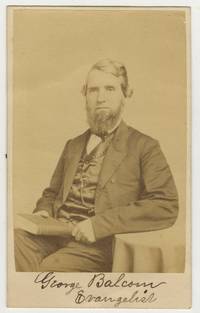
1866Best.-Nr. BK0132Philadelphia: F. Gutekunst 1866. Carte-de-visite photograph 3 ½ x 2 ¼ inches on larger mount with Gutekunst's 704 & 706 Arch Street imprint and two-cent U.S. revenue stamp for playing cards on verso. Contemporary identification beneath image "George Balcom / Evangelist. Fine condition. A portrait of George Farnham Balcom 1823-1879 the New York Baptist evangelist whose itinerant ministry eventually took him west to Kansas and Nevada. Balcom grew up in Oxford New York entered the Baptist ministry at about thirty and became known particularly for evangelistic work in both speaking and singing. He conducted meetings and helped organize churches in New York Pennsylvania Ohio and the western states. Balcom moved west in 1870 settling near Cawker City Kansas. Local accounts credit him with preaching among the earliest sermons in Osborne County and describe his continued work establishing churches on the frontier. His western career also included a brief period in federal service as special Indian agent at Nevada's Pyramid Lake Reservation in late 1871 making him the first Baptist preacher in the state.1 The revenue stamp dates the portrait closely to the Civil War-era federal tax on photographs while Balcom's handwritten identification as an "Evangelist" places the image squarely within the itinerant phase of his career. An well-documented portrait of a nineteenth-century Baptist revivalist whose ministry extended from rural New York to the developing communities of the American West. . F. Gutekunst unknown books
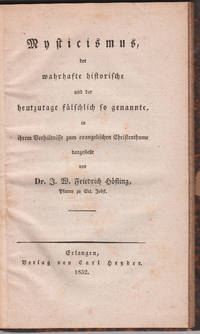
1832Best.-Nr. 5302Erlangen: C Heyder 1832. First Edition. Late 19th century cloth backed boards. . Very good. 8vo xii 13 - 70 2 - errata & advertisement pp. A most interesting inquiry into the nature of mysticism in its relation to evangelical christianity contrasted with what the author designates as false modern mysticism. C Heyder hardcover books
1910Best.-Nr. 182851910. Large missionary lantern slide archive documenting Protestant evangelical activity and African village life in West Africa during the early twentieth century most plausibly within the Upper Guinea Coast region encompassing present day Sierra Leone or Liberia. The photographs record interactions between European or American missionaries and local communities during a period when Protestant mission societies expanded schools churches and literacy programs throughout the forest belt of West Africa. Lantern slide sets such as this were commonly produced as visual material for missionary lecture circuits in Europe and North America where churches presented illustrated narratives describing evangelization education programs and village life in mission territories in order to secure financial and institutional support. Several images depict African men and women dressed in Christian or mission-associated attire and gathered in what appear to be congregational or instructional settings suggesting scenes staged or selected to illustrate the success of missionary work conversion and Christian instruction. The images collectively reflect the visual language commonly employed in missionary propaganda of the period presenting both everyday village life and scenes of religious participation as evidence of missionary influence. Archive of 49 glass lantern slides circa 1910-1920 depicting village communities missionary encounters and daily life scenes in what visual evidence suggests is the Upper Guinea forest region of West Africa. Slides measure approximately 3.25 x 3.25 inches.Slides show thatched village compounds constructed with wattle walls and palm or grass roofing agricultural work food preparation and communal gatherings. Several images portray individuals wearing raffia or fiber skirts and other forms of dress historically documented among forest societies of Sierra Leone and Liberia including Mende Vai and related communities. Other photographs show agricultural carrying baskets worn on the back with shoulder straps a method of transport widely used in the forest regions of Liberia and Sierra Leone for carrying crops and forest products. Additional slides depict domestic labor including a woman grinding plant material in a bowl on the ground within a village compound scenes consistent with food preparation and herbal processing practices recorded in ethnographic studies of Upper Guinea Coast societies. One photograph shows a man standing beside a river or coastal fish trap constructed from wooden stakes a fishing technology historically documented along the riverine and coastal systems of Sierra Leone and Liberia where fishing formed a major component of subsistence economies. The slides are mounted within glass frames typical of magic lantern projection the visual format widely used by missionary organizations for illustrated lectures and fundraising presentations. Architectural environmental and material culture details visible in the photographs strongly support identification within the Upper Guinea Coast rather than East Africa. The combination of rectangular wattle-and-thatch houses raffia fiber clothing agricultural basket transport mortar-based grinding of foods and herbs and coastal or riverine fishing structures corresponds closely with practices documented among forest and coastal societies of Sierra Leone and Liberia in the late nineteenth and early twentieth centuries. The surrounding vegetation including palm ecology and dense tropical growth aligns with the Guinea forest zone extending from Guinea through Sierra Leone and Liberia into Côte d'Ivoire. Missionary activity intensified in this region during the late nineteenth and early twentieth centuries through American and European Protestant societies including Methodist Episcopal Presbyterian and Anglican missions which established schools churches and mission stations while producing photographic material for lecture circuits abroad. Light surface wear minor abrasions to several mounts and scattered handling marks consistent with projection use; 2-3 images have cracks to glass but no loss to image overall condition good. A substantial visual archive illustrating missionary propaganda village life and early twentieth century cross-cultural encounters in the mission fields of the Upper Guinea Coast. unknown books