214 Ergebnisse
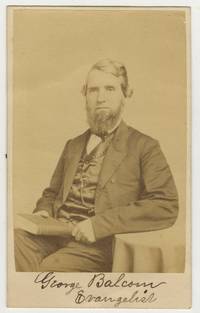
1866Best.-Nr. BK0132Philadelphia: F. Gutekunst 1866. Carte-de-visite photograph 3 ½ x 2 ¼ inches on larger mount with Gutekunst's 704 & 706 Arch Street imprint and two-cent U.S. revenue stamp for playing cards on verso. Contemporary identification beneath image "George Balcom / Evangelist. Fine condition. A portrait of George Farnham Balcom 1823-1879 the New York Baptist evangelist whose itinerant ministry eventually took him west to Kansas and Nevada. Balcom grew up in Oxford New York entered the Baptist ministry at about thirty and became known particularly for evangelistic work in both speaking and singing. He conducted meetings and helped organize churches in New York Pennsylvania Ohio and the western states. Balcom moved west in 1870 settling near Cawker City Kansas. Local accounts credit him with preaching among the earliest sermons in Osborne County and describe his continued work establishing churches on the frontier. His western career also included a brief period in federal service as special Indian agent at Nevada's Pyramid Lake Reservation in late 1871 making him the first Baptist preacher in the state.1 The revenue stamp dates the portrait closely to the Civil War-era federal tax on photographs while Balcom's handwritten identification as an "Evangelist" places the image squarely within the itinerant phase of his career. An well-documented portrait of a nineteenth-century Baptist revivalist whose ministry extended from rural New York to the developing communities of the American West. . F. Gutekunst unknown books
1910Best.-Nr. 182851910. Large missionary lantern slide archive documenting Protestant evangelical activity and African village life in West Africa during the early twentieth century most plausibly within the Upper Guinea Coast region encompassing present day Sierra Leone or Liberia. The photographs record interactions between European or American missionaries and local communities during a period when Protestant mission societies expanded schools churches and literacy programs throughout the forest belt of West Africa. Lantern slide sets such as this were commonly produced as visual material for missionary lecture circuits in Europe and North America where churches presented illustrated narratives describing evangelization education programs and village life in mission territories in order to secure financial and institutional support. Several images depict African men and women dressed in Christian or mission-associated attire and gathered in what appear to be congregational or instructional settings suggesting scenes staged or selected to illustrate the success of missionary work conversion and Christian instruction. The images collectively reflect the visual language commonly employed in missionary propaganda of the period presenting both everyday village life and scenes of religious participation as evidence of missionary influence. Archive of 49 glass lantern slides circa 1910-1920 depicting village communities missionary encounters and daily life scenes in what visual evidence suggests is the Upper Guinea forest region of West Africa. Slides measure approximately 3.25 x 3.25 inches.Slides show thatched village compounds constructed with wattle walls and palm or grass roofing agricultural work food preparation and communal gatherings. Several images portray individuals wearing raffia or fiber skirts and other forms of dress historically documented among forest societies of Sierra Leone and Liberia including Mende Vai and related communities. Other photographs show agricultural carrying baskets worn on the back with shoulder straps a method of transport widely used in the forest regions of Liberia and Sierra Leone for carrying crops and forest products. Additional slides depict domestic labor including a woman grinding plant material in a bowl on the ground within a village compound scenes consistent with food preparation and herbal processing practices recorded in ethnographic studies of Upper Guinea Coast societies. One photograph shows a man standing beside a river or coastal fish trap constructed from wooden stakes a fishing technology historically documented along the riverine and coastal systems of Sierra Leone and Liberia where fishing formed a major component of subsistence economies. The slides are mounted within glass frames typical of magic lantern projection the visual format widely used by missionary organizations for illustrated lectures and fundraising presentations. Architectural environmental and material culture details visible in the photographs strongly support identification within the Upper Guinea Coast rather than East Africa. The combination of rectangular wattle-and-thatch houses raffia fiber clothing agricultural basket transport mortar-based grinding of foods and herbs and coastal or riverine fishing structures corresponds closely with practices documented among forest and coastal societies of Sierra Leone and Liberia in the late nineteenth and early twentieth centuries. The surrounding vegetation including palm ecology and dense tropical growth aligns with the Guinea forest zone extending from Guinea through Sierra Leone and Liberia into Côte d'Ivoire. Missionary activity intensified in this region during the late nineteenth and early twentieth centuries through American and European Protestant societies including Methodist Episcopal Presbyterian and Anglican missions which established schools churches and mission stations while producing photographic material for lecture circuits abroad. Light surface wear minor abrasions to several mounts and scattered handling marks consistent with projection use; 2-3 images have cracks to glass but no loss to image overall condition good. A substantial visual archive illustrating missionary propaganda village life and early twentieth century cross-cultural encounters in the mission fields of the Upper Guinea Coast. unknown books
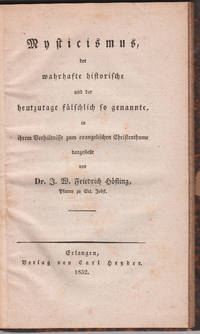
1832Best.-Nr. 5302Erlangen: C Heyder 1832. First Edition. Late 19th century cloth backed boards. . Very good. 8vo xii 13 - 70 2 - errata & advertisement pp. A most interesting inquiry into the nature of mysticism in its relation to evangelical christianity contrasted with what the author designates as false modern mysticism. C Heyder hardcover books
1851Best.-Nr. 70562Dover NH: William Burr Printer 1851. First edition. Hardcover. Good. 190pp. Sextodecimo 17 cm. Full green cloth; decorative blind stamping. Title stamped in gilt on spine. Frontispiece portrait. Spine sunned. Spine ends and corners bumped and mildly scuffed. Binding a bit shaky. Light foxing scattered throughout. In a custom slipcase bound in blue cloth with raised bands and gilt lettering and ornamentation on spine. The biography of American Free-will Baptist preacher 1780- 1855 Clement Phinney born in Gorham Maine. He worked as a teacher was associated with the abolitionist movement and was entrenched in the economic development of the time. William Burr, Printer hardcover books
1851Best.-Nr. 69670Dover N.H.: William Burr Printer 1851. First edition. Hardcover. Good. 190pp. Sextodecimo 17 cm Blue decoratively embossed cloth over boards. Frontispiece portrait. Ex-library Dover Public with a library label on the spine a bookplate on the front pastedown and a discreet blind stamp on the title page. Backstrip sunned. Bookplate of prominent Dover banker Elisha Rhodes Brown 1847-1922 on the front pastedown. Brown was President of the Concord and Portsmouth Railroad and of the Stratford National Bank. The biography of American Free-will Baptist preacher 1780- 1855 Clement Phinney born in Gorham Maine. He worked as a teacher was associated with the abolitionist movement and was entrenched in the economic development of the time. William Burr, Printer hardcover books
1866Best.-Nr. BK0132Philadelphia: F. Gutekunst 1866. Carte-de-visite photograph 3 ½ x 2 ¼ inches on larger mount with Gutekunst's 704 & 706 Arch Street imprint and two-cent U.S. revenue stamp for playing cards on verso. Contemporary identification beneath image "George Balcom / Evangelist. Fine condition. A portrait of George Farnham Balcom 1823-1879 the New York Baptist evangelist whose itinerant ministry eventually took him west to Kansas and Nevada. Balcom grew up in Oxford New York entered the Baptist ministry at about thirty and became known particularly for evangelistic work in both speaking and singing. He conducted meetings and helped organize churches in New York Pennsylvania Ohio and the western states. Balcom moved west in 1870 settling near Cawker City Kansas. Local accounts credit him with preaching among the earliest sermons in Osborne County and describe his continued work establishing churches on the frontier. His western career also included a brief period in federal service as special Indian agent at Nevada's Pyramid Lake Reservation in late 1871 making him the first Baptist preacher in the state.1 The revenue stamp dates the portrait closely to the Civil War-era federal tax on photographs while Balcom's handwritten identification as an "Evangelist" places the image squarely within the itinerant phase of his career. An well-documented portrait of a nineteenth-century Baptist revivalist whose ministry extended from rural New York to the developing communities of the American West. . F. Gutekunst unknown
Best.-Nr. BARB-CAN005256Very Good. Very Good used condition. Minor shelf wear and signs of use with highlighting/underlining in introduction chapter. unknown
1910Best.-Nr. 182851910. Large missionary lantern slide archive documenting Protestant evangelical activity and African village life in West Africa during the early twentieth century most plausibly within the Upper Guinea Coast region encompassing present day Sierra Leone or Liberia. The photographs record interactions between European or American missionaries and local communities during a period when Protestant mission societies expanded schools churches and literacy programs throughout the forest belt of West Africa. Lantern slide sets such as this were commonly produced as visual material for missionary lecture circuits in Europe and North America where churches presented illustrated narratives describing evangelization education programs and village life in mission territories in order to secure financial and institutional support. Several images depict African men and women dressed in Christian or mission-associated attire and gathered in what appear to be congregational or instructional settings suggesting scenes staged or selected to illustrate the success of missionary work conversion and Christian instruction. The images collectively reflect the visual language commonly employed in missionary propaganda of the period presenting both everyday village life and scenes of religious participation as evidence of missionary influence. Archive of 49 glass lantern slides circa 1910-1920 depicting village communities missionary encounters and daily life scenes in what visual evidence suggests is the Upper Guinea forest region of West Africa. Slides measure approximately 3.25 x 3.25 inches.Slides show thatched village compounds constructed with wattle walls and palm or grass roofing agricultural work food preparation and communal gatherings. Several images portray individuals wearing raffia or fiber skirts and other forms of dress historically documented among forest societies of Sierra Leone and Liberia including Mende Vai and related communities. Other photographs show agricultural carrying baskets worn on the back with shoulder straps a method of transport widely used in the forest regions of Liberia and Sierra Leone for carrying crops and forest products. Additional slides depict domestic labor including a woman grinding plant material in a bowl on the ground within a village compound scenes consistent with food preparation and herbal processing practices recorded in ethnographic studies of Upper Guinea Coast societies. One photograph shows a man standing beside a river or coastal fish trap constructed from wooden stakes a fishing technology historically documented along the riverine and coastal systems of Sierra Leone and Liberia where fishing formed a major component of subsistence economies. The slides are mounted within glass frames typical of magic lantern projection the visual format widely used by missionary organizations for illustrated lectures and fundraising presentations. Architectural environmental and material culture details visible in the photographs strongly support identification within the Upper Guinea Coast rather than East Africa. The combination of rectangular wattle-and-thatch houses raffia fiber clothing agricultural basket transport mortar-based grinding of foods and herbs and coastal or riverine fishing structures corresponds closely with practices documented among forest and coastal societies of Sierra Leone and Liberia in the late nineteenth and early twentieth centuries. The surrounding vegetation including palm ecology and dense tropical growth aligns with the Guinea forest zone extending from Guinea through Sierra Leone and Liberia into Côte d'Ivoire. Missionary activity intensified in this region during the late nineteenth and early twentieth centuries through American and European Protestant societies including Methodist Episcopal Presbyterian and Anglican missions which established schools churches and mission stations while producing photographic material for lecture circuits abroad. Light surface wear minor abrasions to several mounts and scattered handling marks consistent with projection use; 2-3 images have cracks to glass but no loss to image overall condition good. A substantial visual archive illustrating missionary propaganda village life and early twentieth century cross-cultural encounters in the mission fields of the Upper Guinea Coast. unknown
Best.-Nr. BN71099FECOM. 2000 Jahre Chistentum: Historiogramm des Weges der Kirche FECOM unknown
1914Best.-Nr. 0100145Swan River: The Swan River Survey Committee 1914. Paperback. pp. 73. 8vo. Black and white photographs fold-out map. Light shelfwear tears to spine pencil name to inside front cover; very good-. The Swan River Survey Committee paperback
Best.-Nr. 016220Ikoma Naraken Japan: Japan and Pentecost Publishing Co. First Edition. Hardcover. Very Good-. 334pp; Red cloth boards with faded titling to front gilt titling to spine boards moderately soiled front endpaper age-toned pages slightly age-toned frontispiece tissue guard intact text unmarked binding is sound VG- condition. Signed by Author. Quaint vintage collection of sermons by Irish evangelist who had led a Pentecostal mission in Sydney Australia and then moved to Pasadena California. Partial Contents: Holy Ghost Millionaires; Baptised for the Dead: What Does It Mean; Deathless Life; In Him Was Life; Through The Waters; A Prophetic Warning; Hail Hail He Comes; The Outcome of the Former & Latter Rain; Have You Received the Holy Ghost; The Capture of Jerusalem by the British in 1918; much more. Published circa 1920s-1930s. Japan and Pentecost Publishing Co. hardcover
1990Best.-Nr. Q-0898692237The Church Hymnal Corporation 1990-12-01. Paperback. New. In shrink wrap. Looks like an interesting title! The Church Hymnal Corporation paperback
2003Best.-Nr. Q-0842372067Tyndale House Publishers Inc 2003-02-01. Paperback. New. In shrink wrap. Looks like an interesting title! Tyndale House Publishers, Inc paperback
Best.-Nr. 1334761701.Gpaperback. Good. Access codes and supplements are not guaranteed with used items. May be an ex-library book. paperback
Best.-Nr. 0243521308.Gpaperback. Good. Access codes and supplements are not guaranteed with used items. May be an ex-library book. paperback
1851Best.-Nr. 70562Dover NH: William Burr Printer 1851. First edition. Hardcover. Good. 190pp. Sextodecimo 17 cm. Full green cloth; decorative blind stamping. Title stamped in gilt on spine. Frontispiece portrait. Spine sunned. Spine ends and corners bumped and mildly scuffed. Binding a bit shaky. Light foxing scattered throughout. In a custom slipcase bound in blue cloth with raised bands and gilt lettering and ornamentation on spine. The biography of American Free-will Baptist preacher 1780- 1855 Clement Phinney born in Gorham Maine. He worked as a teacher was associated with the abolitionist movement and was entrenched in the economic development of the time. William Burr, Printer hardcover
1892Best.-Nr. 8871Cincinnati: Cranston & Curtis 1892. First edition. 8vo 388 4pp. Frontis portrait vignette illustrations in the text. Publisher's gilt stamped orange cloth. Boards with some staining front hinge starting scuffing to ffep from bookplate removal. Former owner's inscription to final page of text. Very good. Cranston & Curtis unknown
1851Best.-Nr. 69670Dover N.H.: William Burr Printer 1851. First edition. Hardcover. Good. 190pp. Sextodecimo 17 cm Blue decoratively embossed cloth over boards. Frontispiece portrait. Ex-library Dover Public with a library label on the spine a bookplate on the front pastedown and a discreet blind stamp on the title page. Backstrip sunned. Bookplate of prominent Dover banker Elisha Rhodes Brown 1847-1922 on the front pastedown. Brown was President of the Concord and Portsmouth Railroad and of the Stratford National Bank. The biography of American Free-will Baptist preacher 1780- 1855 Clement Phinney born in Gorham Maine. He worked as a teacher was associated with the abolitionist movement and was entrenched in the economic development of the time. William Burr, Printer hardcover
1896Best.-Nr. 048973St. Thomas Ont. Canada: The Author 1896. Leather Bound. Very Good/No Jacket. 4to - over 9¾ - 12" tall. Carlotta B. Beattie. Quarto. 188 194 1 pages. Hardcover bound in full leather. Light to moderate wear to the binding. Now housed in a full mylar or acetate wrapper removable. The front cover is embossed in blind with four portraits and the title embossed in gilt. There is a little splitting to the front hinge near the foot of the spine. All edges gilt. The text is sound and clean. Illustrated with small photographic portraits for a number of the Temperance workers. The spine states "Vol. I" but this may be all that was published. The work is divided into two sections separately paginated. The first 188 pages offers biographies of Temperance workers most with a photographic portrait four per page. The second section is "Speeches and Lectures of the Leaders of the Temperance Reform with Articles Bearing upon the Temperance Movement." A nice attractive copy. The Author hardcover
1940Best.-Nr. 043967Grand Rapids Michigan: Wm. B. Eerdmans Publishing Company 1940. Hardcover. Very Good/Good. 8vo - over 7¾ - 9¾" tall. Octavos. 467; 549; 561 pages. Hardcovers with yellow dust jackets. The jackets show some edge wear and are a bit dust-stained. Jackets show some brief edge tears and the spines are toned. The books are sound with secure inner hinges and unmarked text. Complete three volume set. "Christ in His Suffering" is a fifth printing dated 1938. "Christ on Trial" is a fifth printing dated 1939. "Christ Crucified" is a fifth printing dated 1940. Wm. B. Eerdmans Publishing Company hardcover
1840Best.-Nr. 043281New York: Robert Carter 1840. First Edition First Printing . Hardcover. Fair. 8vo. vii 384 7 pages. Hardcover bound in 3/4 leather with marbled paper-covered boards. The binding is worn and the spine is completely gone. Boards are holding by the cords. The text block has been damped along the fore edge throughout. Indexed at the front. Contains a couple of illustrations. The last 7 pages are an "Abstract of the Third Annual Report of the Presbyterian Board of Foreign Missions Presented to the General Assembly in May 1840." A couple of issues towards the rear seem to focus on India and Hinduism. Robert Carter hardcover
1844Best.-Nr. 039923Philadelphia: James M Campbell & Co. 1844. First Edition First Printing . Hardcover. Poor. Octavo. 318 pages indexed. Hardcover in brown cloth binding. Edges of boards and spine have been reinforced with black cloth tape. The part of the spine with the title has detached on the right side for 2.25 inches causing a flap. The original board cloth is scuffed has damp stains. Prior owner's name stamped on front flyleaf. Reverse of dedication page reverse of last page and the second rear flyleaf have another owner's name written in fountain pen ink. Text has foxing. There are occasional pencil marks in margins of text. James M Campbell & Co. hardcover
1809Best.-Nr. 4674New York: Williams & Whiting 1809. Hardcover. Good/No Jacket. 12mo. 374 pages indexed. Bound in full leather. The binding is bumped and worn with the corners exposed. The foot of the spine is chipped and the binding is rubbed. Early owner's name at the front flyleaf. The text is browned and occasionally damped. Damping to the edges of the title page. Williams & Whiting hardcover
1850Best.-Nr. 020801Cincinnati: Longley & Brother 1850. First Edition First Printing . Hardcover. Good. 8vo. 385 pages. Hardcover bound in brown publisher's cloth. The binding is moderately rubbed and worn with the foot of the spine chipped and perhaps with some shoe polish applied for coloring. A sound copy. Text shows some foxing and toning. Longley & Brother hardcover
1804Best.-Nr. 029372Budissin: George Gotthold Monse 1804. Second Edition. . Hardcover. Very Good. 8vo. 676 8 pages. Hardcover bound in original full leather. Moderate rubbing and wear to the binding. The corners are bumped and the hinge to the front cover has been discretely reinforced. Headcap rebuilt with japanese tissue stained to match the binding. All edges red. A sound copy with generally clean text. Loskiel name is not on the title page was a Moravian minister who moved to Pennsylvania in 1801 to become the Moravian bishop in North America. Text is in German. George Gotthold Monse hardcover